One of Haydn’s most popular melodies wasn’t by Haydn at all.
Join me this afternoon on The Classical Network, as we listen to the “Haydn Serenade,” in reality composed by one Roman Hoffstetter. Hoffstetter was a Benedictine monk who evidently admired Hadyn to the point of successfully emulating his style.
It wasn’t until 1965 that musicologist Alan Tyson asserted that the six string quartets published under Haydn’s Op. 3 – including the fifth, which contains the celebrated andante cantabile widely known as the “Serenade” – were indeed the work of Hoffstetter. We’ll enjoy it this afternoon, on this, the anniversary of Hoffstetter’s birth.
We’ll also hear music for guitar and orchestra performed by John Williams (the guitarist, not the film composer), on his birthday, and a substantial fantasy on Ralph Vaughan Williams’ neglected opera, “The Poisoned Kiss.”
Name your poison, from 4 to 7:00 EDT, on WWFM – The Classical Network and wwfm.org.
We don’t know for sure when he was born (he was baptized on April 26, 1564), but April 23 is the day the world has chosen to celebrate Shakespeare.
Rather than pummel you with more music inspired by the Bard, I thought I would take a circuitous approach, this Sunday night on “The Lost Chord,” and present Constant Lambert’s 1924-25 ballet, “Romeo and Juliet.” Do not go into it expecting the star-cross’d lovers of Shakespeare’s immortal tragedy. Lambert’s version takes a look at a ballet company. In the process of preparing an adaptation of the play, the two leads fall in love. They flee a rehearsal, and are glimpsed eloping in an aeroplane!
Lambert was only 20 years-old when he wrote the music, which is cheeky and burlesque, evocative of commedia dell’arte and perhaps influenced by contemporaneous displays of joie de vivre by composers of the Parisian collective, Les Six.
“Romeo and Juliet” was one of only two ballets commissioned from English composers by Serge Diaghilev for his Ballets Russes. The other was “The Triumph of Neptune,” written in 1926 by Gerald Hugh Tirwhitt-Wilson, 14th Baron Berners.
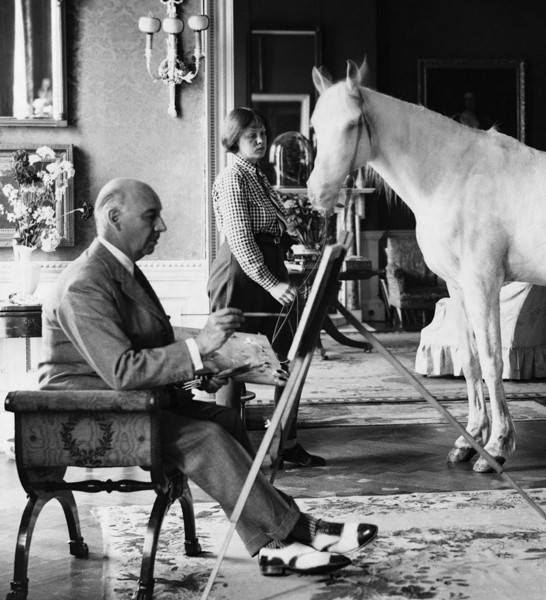
Berners was an exemplar of a certain tradition of English eccentricity, in which a lord might invite a giraffe to an outdoor tea party or a horse would be given license to roam the indoors to mingle with his guests. His garden was full of paper flowers, his dogs wore pearl necklaces, and he built a hundred foot folly tower, allegedly just to annoy the neighbors.
Berners was gifted in so many areas – as a composer, of course, but also as a writer (his stories and autobiographical musings have been brought back into print) and a painter (he loved to include mustaches in his portraits, whether the sitter had one or not). He liked ballet best of all, since it allowed him to write the scenarios and design the backdrops, in addition to composing the music.
“The Triumph of Neptune” is Berners’ best-known piece. In this instance, it was Sacheverell Sitwell who devised the scenario, which sprang from their mutual enchantment with 19th century theatrical prints. An English sailor is shipwrecked en route to Fairyland. He is saved by Britannia, who dances a hornpipe. He returns home in spirit form, to find his wife carrying on with a well-dressed villain. But all ends happily, as he is turned into a prince and marries Neptune’s daughter.
The choreography was by George Balanchine, and the work became a great favorite of Sir Thomas Beecham.
I hope you’ll join me for “England à la Russe” – music written by English composers for the Ballets Russes – this Sunday night at 10:00 EDT, on WWFM – The Classical Network and at wwfm.org.
PHOTOS: Berners paints a horse; Lambert pushes a car
Well before there was Earth Day, there was Edward Joseph Collins (1886-1951).
Collins was born in Joliet, Illinois, the youngest of nine children, to Irish-American parents. All nine were musical, and Collins’ early aptitude was encouraged by his siblings. At 14, he began piano studies with Rudolf Ganz in Chicago, and then, from 1906, composition with Max Bruch, Engelbert Humperdinck, and others in Berlin.
He distinguished himself as a pianist and conductor, both in Europe and in the United States. He was engaged as assistant conductor at the Bayreuth Festival in 1914, but then with the outbreak of war, Collins left Europe to make a name for himself in Chicago, until he was called up for active duty. Throughout the conflict, he served as an interpreter and entertained troops.
Following the war, he married a voice student, who happened to be the daughter of meat-packing magnate Oscar Mayer. Needless to say, thereafter he had a comfortable support system.
Collins is a very interesting composer. Born nearly a generation before Copland and Gershwin, he nonetheless embraced African-American spirituals, cowboy songs, and American jazz.
In 1929, he composed the secular cantata “Hymn to Earth.” The work, scored for vocal soloists, chorus, and orchestra, falls into six movements and spans approximately 40 minutes.
It was commissioned by the New York Society of the Friends of Music, but, for whatever reason, the group may not have performed it. In fact, it is thought to have lain dormant for 60 years, only to be revived in 1989 by choral director William Ferris.
Like Gustav Mahler, Collins’ career kept him in the city during the season, where he found it difficult to compose. But during the summer months, he would retreat to the countryside, to be inspired by the beauty of the natural world. His journals are full of ecstatic musings on nature and observations about the Wisconsin countryside, where his wife’s family kept a cottage on Cedar Lake, and the Door County peninsula. He set “Hymn to the Earth” entirely to his own texts.
Marin Alsop made a complete recording of the piece in 2004, as part of her comprehensive series of Collins’ major works with orchestra for the Albany Records label.
Here’s the opening movement, “Hail! Mother of us all, and beautiful!”
and the fourth, “Hour of youth, Springtime of life”:
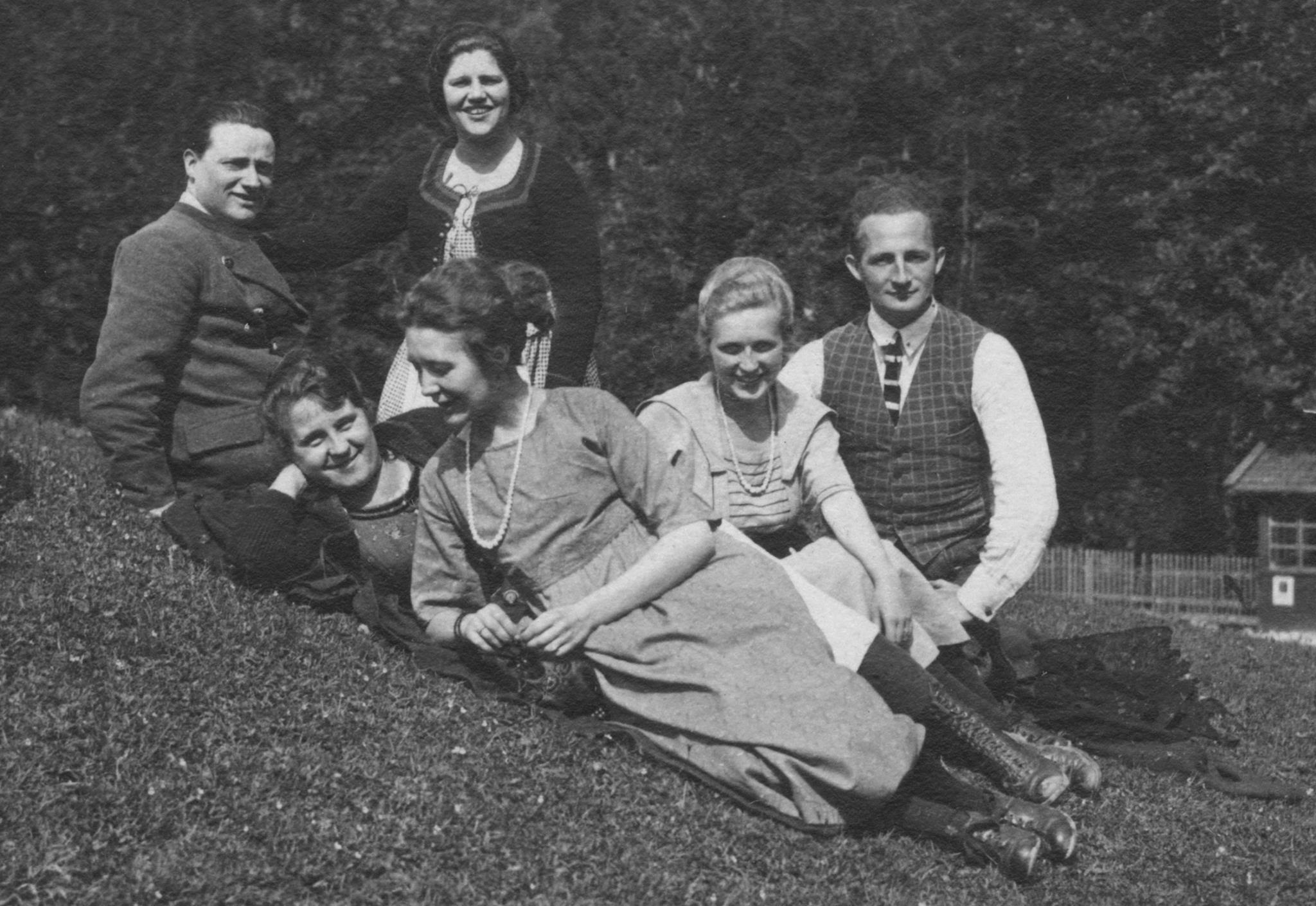
PHOTO: Edward Joseph Collins (left) enjoying the outdoors with wife Frieda (kneeling) and friends
We don’t know when, exactly, Shakespeare was born, but his baptismal date is April 26, 1564. Since it’s human nature to try to keep things neat, his natal day is generally held to be April 23, the very date of his death in 1616.
This week on “Picture Perfect,” we’ll honor the Bard, just a few days early, with an hour of music from movies based upon his comedies. We’ll hear selections from “As You Like It” (William Walton), “A Midsummer Night’s Dream” (Korngold), “The Taming of the Shrew” (Nino Rota), and “Much Ado About Nothing” (Patrick Doyle).
What fools these mortals be! Join me this Friday evening at 6:00 EDT for music for Shakespearean comedies, on WWFM – The Classical Network and wwfm.org.
First comes Groundhog Day, then comes Easter, then comes Shakespeare’s birthday. All that remains is for us to lock up a sacrifice in the Wicker Man on April 30 and Sulis will have been appeased.
We don’t know when, exactly, the Bard was born, but his baptismal date is April 26, 1564. Since it’s human nature to try to keep things neat, his natal day is generally held to be April 23, the very date of his death in 1616.
I hope you’ll join me this morning, as we celebrate the Bard, with a full morning of music inspired by his plays. We’ll hear selections from composers who were Shakespeare’s contemporaries, right on down to Paul Moravec’s “Tempest Fantasy,” which was awarded the Pulitzer Prize for Music in 2004.
Other treats will include a recording of Ralph Vaughan Williams conducting his own “Serenade to Music,” after a text from “The Merchant of Venice,” a reconstructed duet from a projected opera on the subject of “Romeo and Juliet” by Peter Ilych Tchaikovsky, and incidental music for a production of “Antony and Cleopatra” by French composer Florent Schmitt, in an opulent recording conducted by JoAnn Falletta.
Just some of the ingredients that will go into a secret recipe made public from 6 to 11 a.m. EDT, on WPRB 103.3 FM and wprb.com. We engage in a little Shake and bake, on Classic Ross Amico.