Category: Daily Dispatch

  • Easter Joy Vaughan Williams & Metaphysical Poets

    Easter Joy Vaughan Williams & Metaphysical Poets

    For me, it just isn’t Easter until I’ve heard Ralph Vaughan Williams’ “Five Mystical Songs.” I defy anyone not to be uplifted by the opening song of the cycle, titled, appropriately enough, “Easter.” The songs are settings of poems by George Herbert (1593-1633). This Sunday night on “The Lost Chord,” we’ll hear a classic recording, with bass-baritone John Shirley-Quirk, as part of a program devoted to the 17th century metaphysical poets.

    We’ll also hear William Alwyn’s “Lyra Angelica” of 1954, a harp concerto inspired by Giles Fletcher’s epic poem of 1610, “Christ’s Victorie and Triumph.” The composer regarded it as his most beautiful piece, and I am inclined to agree. The work likely received its widest exposure when Michelle Kwan elected to skate to it during the 1988 Olympics.

    Finally, we’ll have a lute song setting by John Hilton of a poem by John Donne, “Wilt thou forgive that sinne,” from an album on the Harmonia Mundi label, titled “The Rags of Time.”

    I hope you’ll join me for “Donne Deal” – an hour of metaphysical therapy – this Easter Sunday at 10 p.m. EDT, on WWFM – The Classical Network and wwfm.org.

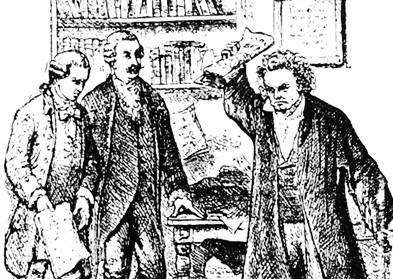
  • Kissin’s Rage Over a Lost Penny Beethoven

    Kissin’s Rage Over a Lost Penny Beethoven

    AUDIO: Evgeny Kissin plays “Rage over a Lost Penny”

    IMAGE: Beethoven in a rage over his income tax.

  • Good Friday Music on The Classical Network

    Good Friday Music on The Classical Network

    Good Friday will be full of great music on The Classical Network.

    At 12:00 EDT, we’ll hear a performance of Johann Sebastian Bach’s “St. John Passion,” live from Trinity Wall Street in New York City. The Choir of Trinity Wall Street will be joined by New York Baroque Incorporated, Wen Yang artistic director. David Osenberg will be your host for this special three-hour broadcast.

    I’ll be along at 4:00 to share a glorious recording of Leopold Stokowski conducting the “Good Friday Spell” from Wagner’s “Parsifal.” We’ll also hear symphonies for Passion Week by Haydn and Paul Creston. Adolphus Hailstork’s “Sonata da Chiesa,” inspired by his fascination with cathedrals, will span a variety of moods, from mystery to exultation.

    At 6:00, “Picture Perfect” will focus on “Lives of the Saints,” with selections from “The Song of Bernadette” (by Alfred Newman), “Saint Joan” (Mischa Spoliansky), “A Man for All Seasons” (Georges Delerue), and “Quo Vadis?” (Miklos Rozsa).

    We’ll get a start on the Easter weekend with intimations of hope and renewal on WWFM – The Classical Network and wwfm.org.

  • Saints on Film: Bernadette, Joan, More & Nero

    Saints on Film: Bernadette, Joan, More & Nero

    This week on “Picture Perfect,” the saints go marching in.

    We’ll hear a suite from “The Song of Bernadette” (1943), one of Jennifer Jones’ finest hours. Jones was honored with an Academy Award for her performance (the film was nominated in 12 categories). Franz Werfel’s novel tells the story of Bernadette Soubirous, a Lourdes peasant prone to visions of the Blessed Virgin Mary.

    Igor Stravinsky made several attempts to break into Hollywood, but he could never keep up with the grinding schedule. He took a crack at scoring the “Apparition of the Virgin” scene, but then thought better of it. The project went to Alfred Newman, who won his third (of nine) Oscars. Stravinsky’s music was recycled in the second movement of his “Symphony in Three Movements.”

    The story of Joan of Arc has been translated to film many times. In the case of “Saint Joan” (1957), Otto Preminger adapted the play by George Bernard Shaw. Newcomer Jean Seberg was cast in the title role. Her inexperience brought her in for a sound critical drubbing. Even an old hand like screenwriter Graham Greene was not immune to critical barbs for the liberties he took in reworking Shaw’s play. Despite all that, the score, by Russian-born English composer Mischa Spoliansky, is lovely.

    By contrast, the film of “A Man for All Seasons” (1966), after the play of Robert Bolt, was lavishly praised, especially Paul Scofield’s performance as Sir Thomas More (for which he received an Academy Award for Best Actor). The film won six Academy Awards in all, including that for Best Picture. The period-inflected score is by Georges Delerue.

    I guess it’s impossible to get through Easter without some Biblical bombast, so why not go all out with “Quo Vadis” (1951)? Henryk Sienkiewicz’s international bestseller incorporates into its narrative Saints Peter and Paul, but the really interesting characters are the cynical Petronius, who knows how to throw a party, and the quite mad Nero, who plays the lyre even as Rome burns.

    Miklós Rózsa’s score has been much-lauded for its attempt at historical authenticity (the incorporation of contemporaneous Greek, Hebrew and Sicilian melodies), though its popularity has been eclipsed, somewhat, by that of his work on “Ben-Hur” and “King of Kings.” “Quo Vadis” is really the film in which Rózsa lays out the blueprint for a decade or more of big screen piety. Bernard Herrmann called it “the score of a lifetime.”

    I hope you’ll join me for “Lives of the Saints” this week, on “Picture Perfect,” this Friday evening at 6 EDT, on WWFM – The Classical Network and wwfm.org.


    PHOTO: Jennifer Jones and the Lourdes’ prayer

  • Easter Music on WPRB Holy Week Special

    Easter Music on WPRB Holy Week Special

    It’s wholly works for Holy Week this morning, or just about.

    I hope you’ll join me on WPRB for 500 years of Easter music, ranging from Richard Davy’s “Stabat Mater” (1490) through Osvaldo Golijov’s “La Pasión según San Marcos” (2000). In between, we’ll also enjoy reflective (and occasionally bombastic) works by Gregorio Allegri, William Alwyn, George Frideric Handel, Franz Liszt, Victor de Sabata, Ottorino Respighi, Edmund Rubbra, John Tavener, and Ralph Vaughan Williams.

    At 9:00, we’ll take a break for a special visit from Douglas Martin, artistic director of American Repertory Ballet, and Marc Uys, executive director of the Princeton Symphony Orchestra. They’ll drop by to talk about Martin’s new ballet, “Pride and Prejudice,” which sets the classic novel by Jane Austen to music by Ignaz Pleyel. The PSO will provide live musical accompaniment for the dancers, at McCarter Theatre Center on April 21 & 22.

    Otherwise, we’ll make a habit of the rabbit, from 6 to 11 EDT, on WPRB 103.3 FM and at wprb.com. I’ll be putting all my eggs in one basket, on Classic Ross Amico.

Tag Cloud

Aaron Copland (93) Beethoven (95) Composer (114) Film Music (139) Film Score (143) Film Scores (255) Halloween (94) John Williams (195) KWAX (229) Leonard Bernstein (103) Marlboro Music Festival (125) Movie Music (154) Mozart (88) Opera (210) Philadelphia Orchestra (89) Picture Perfect (174) Princeton Symphony Orchestra (108) Radio (88) Ross Amico (244) Roy's Tie-Dye Sci-Fi Corner (290) The Classical Network (101) The Lost Chord (268) Vaughan Williams (103) WPRB (396) WWFM (881)

DON’T MISS A BEAT

Receive a weekly digest every Sunday at noon by signing up here


RECENT POSTS