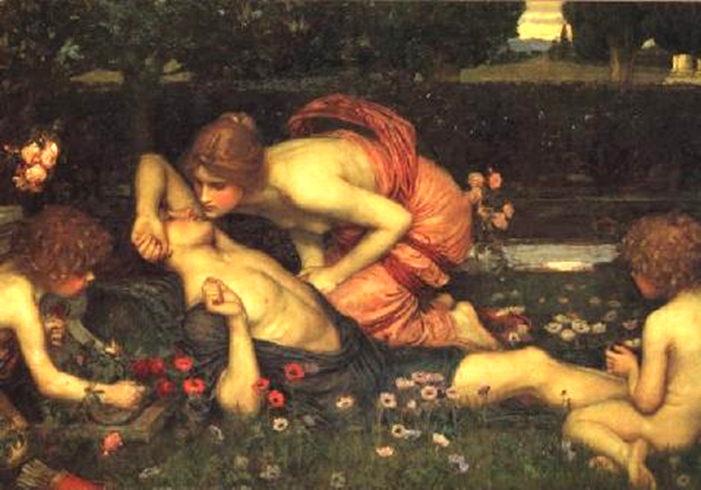
A lovely autumn afternoon in the Trenton-Princeton area. In fact, a tempting day to wander off into the woods to die in the arms of an alluring nymph. That’s the subject of Vitězslav Novák’s tone poem, “Toman and the Wood Nymph.” Enjoy it this afternoon, as we celebrate the anniversary of the composer’s birth, along with that of Francesco Geminiani, the 70th birthday of José Carreras, and the 60th birthday of Krystian Zimerman, between 4 and 7 EST, on WWFM – The Classical Network and at wwfm.org.
Category: Daily Dispatch
-

Jean Cras’ “Polyphème” Opera on WPRB
I’ve got my eye on you!
Join me this morning for Jean Cras’ Cyclops opera, ““Polyphème.” It’s the featured work on Sunday Morning Opera with Sandy. I’ll be guest hosting from 7 to 10 EST, on WPRB 103.3 FM and at wprb.com.
Cras, a career navy man, composed much of his music at sea. Tune in early (around 6:35) to enjoy his orchestral suite “Journal de bord” (“Ship’s Log”).
“More wine for Polyphemus!”
-

Estonian Composers Eller Kapp Sumera
This Sunday night on “The Lost Chord,” we’ll immerse ourselves in tones from Estonia.
We’ll have music by the so-called father of Estonian music, Heino Eller. Eller, born in Tartu in 1887, studied violin at the St. Petersburg Conservatory. He also studied law. For 20 years, he was professor of music theory and composition at the Tartu Higher School for Music. In 1940, he became a professor of composition at the Tallinn Conservatory, where he taught until his death, in 1970.
Eller composed many beautiful tone pictures. We’ll be listening to his violin concerto, in a performance taken from a concert given in celebration of the composer’s 80th birthday.
Among Eller’s pupils were Eduard Tubin, Arvo Pärt, and Lepo Sumera. Sumera was born in Tallinn in 1950. In his teens, he studied with Veljo Tormis; then, beginning in 1968, with Eller, at what was then the Tallinn State Conservatory. He went on to compose six symphonies, as well as many chamber and choral works.
In the 1980s, he became interested in electro-acoustic music. He founded the Electronic Music Studio at the Estonian Academy of Music in 1995. He served as its director until 1999. Sumera died of heart failure in the year 2000, at the age of 50.
We’ll hear his Symphony No. 4, subtitled “Serena borealis,” composed in 1992. Western ears may detect the influence of minimalist techniques, but it’s worthwhile to note that the folk tradition of Estonian runo songs, handed down orally, relies equally on repetition. And the Estonian nationalists were nothing if not in tune with their musical past.
Finally, we’ll hear from Artur Kapp, who lived from 1878 to 1952. Like Eller, Kapp studied at the St. Petersburg Conservatory, where Rimsky-Korsakov was among his teachers. He himself became a professor at the Tallinn Conservatory, where he taught many notable Estonian composers, his sons, Eugen and Villem, among them. Kapp is considered the head of the Tallinn school of composition, a counterbalance to Eller, who is considered the head of the Tartu school.
We’ll be listening to the finale from one of Kapp’s most enduring works, the oratorio “Job,” in a recording sent to me by the very generous Neeme Järvi (also born in Tallinn), in response to an enthusiastic letter I had sent him while he was still music director of the New Jersey Symphony Orchestra.
I’ll share the wealth, on this hour of musical discoveries from Estonia – “Tallinn’s Got Talent” – this Sunday night at 10:00 EST, on WWFM – The Classical Network and at wwfm.org.
-
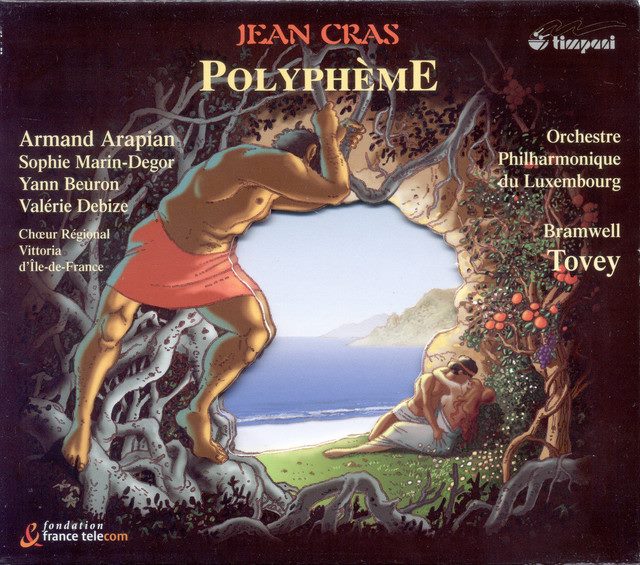
Jean Cras’ Polyphème Opera Rediscovered
For some, the holidays can be a lonely, melancholy time. If that’s the case for you, I’m sorry, but at least you’re not Polyphemus the Cyclops.
The one-eyed giant Polyphemus, the son of Poseidon, is loved by the beautiful Galatea. But when the fickle teenager falls for the handsome, well-sculpted Acis, he is plunged into isolation and jealous rage.
Join me tomorrow morning on WPRB, for another edition of Sunday Morning Opera with Sandy, as I fill in for Sandy Steiglitz to present the rarely-heard, though quite gorgeous “Polyphème” by Jean Cras.
Cras, a career navy man, literally completed the work while at sea. The libretto, replete with nymphs and satyrs and an appearance by the Great God Pan (in a non-singing role), is in the style of Maurice Maeterlinck. The composer adapted the text from a dramatic poem by Albert Samain.
In some tellings of the story (e.g., Handel’s “Acis and Galatea”), Polyphemus at least has the satisfaction of crushing his rival with a boulder. In Cras’ version (SPOILER ALERT!), Polyphemus blinds himself and wanders morosely into the sea.
The opera, completed in 1914, was given its premiere in Paris in 1922. Like Polyphemus himself, it then disappeared without a trace until this very fine recording from 2003, on the Timpani label, conducted by Bramwell Tovey.
The whole thing is a languorous exercise in hypnotic pantheism. Not surprisingly, given its source, the atmosphere is infused with the sea. If you find yourself lost in enchantment when listening to the music of Debussy or Ravel, you will absolutely love this opera.
Keep an “eye out” for Jean Cras’ “Polyphème,” on “Sunday Morning Opera,” tomorrow morning from 7 to 10 EST, on WPRB 103.3 FM and at wprb.com.
Of perhaps related interest: The dryly irreverent Bramwell Tovey will next conduct The Philadelphia Orchestra in a New Year’s Eve program at the Kimmel Center for the Performing Arts (on Dec. 31, obviously), which will feature works by Bernstein, Gershwin and Johann Strauss II. He will return in April to conduct the world premiere of Pat Metheny’s “Duo Concerto for Vibraphone and Marimba.” More information may be found by searching the concert calendar at philorch.org.
-
Britten’s Carols Analyzed with Kapilow & Choir
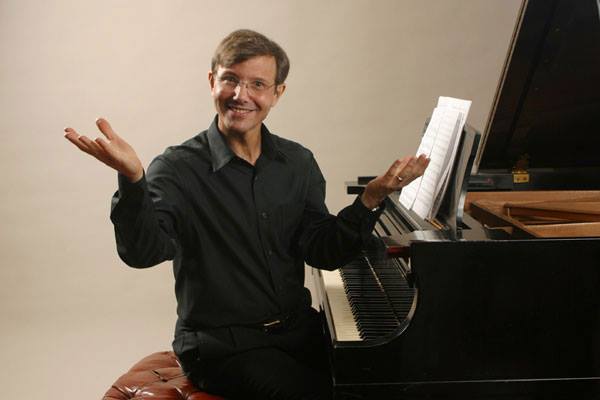
What makes it great? Benjamin Britten, The American Boychoir, and Rob Kapilow musician. All three will join for a one-of-a kind event this Monday evening at 7 p.m. at Nassau Presbyterian Church, as performers and presenter parse out Britten’s beloved “A Ceremony of Carols,” followed by a complete performance of the work directed by Fernando Malvar-Luiz.
What Kapilow, host of the long-running program “What Makes It Great?,” does can hardly be described as lecturing.
“It’s an unusual kind of evening designed to get people to hear music in a different way, to get them involved in music in a different way,” he says. “The whole idea of ‘What Makes It Great?’ is to invite people into an evening designed to really get them inside a piece of music, from the composer’s point-of-view, to see what makes it tick. There’s an hour of discussions and demonstrations with the choir, with the audience singing as well, you know, so that when they do hear the complete performance after intermission, they’ll hear it with new ears. That’s really the goal. And then, of course, they get to ask anyone a question – me, the conductor, the choir, the kids, whatever they want.”
“What Makes It Great?” has undergone a gradual evolution over the past two decades, from its beginnings as a brief segment on NPR’s “Performance Today” to its current format of a two-hour commentary-with-concert event. Monday’s appearance is sponsored by WWFM – The Classical Network, the current producer of the radio broadcasts. WWFM can be heard locally at 89.1 FM and globally at wwfm.org.
“A Ceremony of Carols” will be heard in a somewhat different guise on The American Boychoir’s popular “Home for the Holidays” concert. That program will be present at Princeton University’s Richardson Auditorium on Dec. 18 at 4 p.m.
Find out what distinguishes the two in my article in today’s Trenton Times:
http://www.nj.com/times-entertainment/index.ssf/2016/11/classical_music_rob_kapilow_am.html
Tag Cloud
Aaron Copland (93) Beethoven (95) Composer (114) Film Music (139) Film Score (143) Film Scores (255) Halloween (94) John Williams (195) KWAX (229) Leonard Bernstein (103) Marlboro Music Festival (125) Movie Music (154) Mozart (89) Opera (210) Philadelphia Orchestra (89) Picture Perfect (174) Princeton Symphony Orchestra (108) Radio (88) Ross Amico (244) Roy's Tie-Dye Sci-Fi Corner (290) The Classical Network (101) The Lost Chord (268) Vaughan Williams (103) WPRB (396) WWFM (881)