Category: Daily Dispatch

  • Shakespeare Month on Classic Ross Amico

    Shakespeare Month on Classic Ross Amico

    April marks the 400th anniversary of the death of William Shakespeare. We’ll mark the occasion on Classic Ross Amico with a full month of programs inspired by his writings. That’s 20 hours worth of Shakespeare-related works – minus the weekly musician interviews, of course – as we enjoy overtures, incidental music, symphonic poems, art songs and choral works, all with a distinctive Bardic slant.

    We’ll take a short break tomorrow in the 9:00 hour, as we are joined by representatives of Foundation Academies Charter School in Trenton. Students of the Academy will join cellist Michelle Djokic, artistic director of Concordia Chamber Players, for a fundraising concert at the Trenton City Museum at Ellarslie Mansion, this Saturday at 4 p.m.

    Then on Sunday at 3 p.m., the students will attend Concordia’s next concert at Trinity Episcopal Church, Solebury, PA, that will feature works by Mozart, Brahms and Michael Daugherty. Hopefully you will consider being there, as well. We’ll hear more about it, plus the Foundation Academy’s “Stand Partners” program, during the course of their visit.

    Then it’s back to the Bard! It’s all Shakespeare this month, every Thursday morning from 6 to 11 EDT, on WPRB 103.3 FM and at wprb.com. Where there’s a Will, there’s a way, on Classic Ross Amico.

    #Shakespeare400

  • Granados Tragedy Wilson’s Invitation

    Granados Tragedy Wilson’s Invitation

    One more source of controversy for Woodrow Wilson:

    100 years ago, Enrique Granados was in New York for the premiere of his opera, “Goyescas,” at the Metropolitan Opera. An unexpected invitation to perform a recital at the White House caused the composer to miss his ship back to Spain. As a result, he booked passage on an English vessel. On March 24, 1916, on the second leg of their journey, he and his wife boarded the passenger ferry, “S.S. Sussex,” with the intention of crossing the channel for Dieppe, France. En route, the ferry was torpedoed by a German U-boat, and Granados drowned in an attempt to save his wife.

    Just before his departure from New York, the composer made some live-recorded player piano rolls for the Aeolian Company’s “Duo-Art” system.

    Granados piano roll of “The Maiden and the Nightingale” from “Goyescas”:

    And of the Spanish Dance No. 5 “Andaluza”:

    Granados began to write a piano concerto in 1909, breaking off work on it to compose “Goyescas.” He died before the piece could be completed. Six years ago, the sketches were discovered, and a realization of the concerto was recorded for the Hyperion label. The work will finally be heard in concert in Barcelona at the Palau de la Música Catalana on April 21. I recommend taking a plane.

    An ironic footnote: one of the Granados’ sons, also named Enrique, was a champion swimmer.

  • Gregory Peck Centennial on TCM

    Gregory Peck Centennial on TCM

    Today is the 100th birthday of Gregory Peck, and Turner Classic Movies: TCM is showing a full day of his films, including “To Kill a Mockingbird” (at 10 p.m. EDT).

    Happy birthday, Atticus!


    Full schedule here:

    http://www.tcm.com/schedule/?ecid=subnavfulltcmschedule

  • Composer Painters Music Beyond One Art

    Composer Painters Music Beyond One Art

    For some people, being a master in one field, it seems, just isn’t enough. This Sunday night on “The Lost Chord,” we’ll have an hour of music by ambidextrous artists. We’ll hear works by the cantankerous American modernist, Carl Ruggles, and the Lithuanian romantic, Mikalojus Ciurlionis. We’ll also have time for a little piano work by the painter Lyonel Feininger.

    Ruggles, a friend of Charles Ives, lived from 1876 to 1971 – 95 years. As a creator of a handful of meticulously-crafted, uncompromising works, his complete, authorized output amounts to four times the length of an LP side. We know this, because Michael Tilson Thomas recorded everything as part of a two-LP set, issued on the Columbia Masterworks label back in 1980.

    Ruggles’ method was described by musicologist Charles Seeger as “dissonant counterpoint,” a system wherein all the traditional rules of counterpoint are reversed, so that dissonance, rather than consonance, is the norm. The very practice smacks of contrarianism!

    Not surprisingly, he was beloved by Ives. When someone had the audacity to boo a work by Ruggles at a concert given in 1931, Ives berated the critic as a sissy. “Why can’t you stand up before fine, strong music like this, and use your ears like a man?” he asked.

    In addition to his activities as a composer, it just so happens that Ruggles created hundreds of paintings over the course of his life, and he was successful enough at it that he was invited to hang shows and even sold many of his canvases.

    His musical composition “Sun-Treader” was inspired by Robert Browning’s poem, “Pauline” – in particular the line, “Sun-treader, light and life be thine forever!”

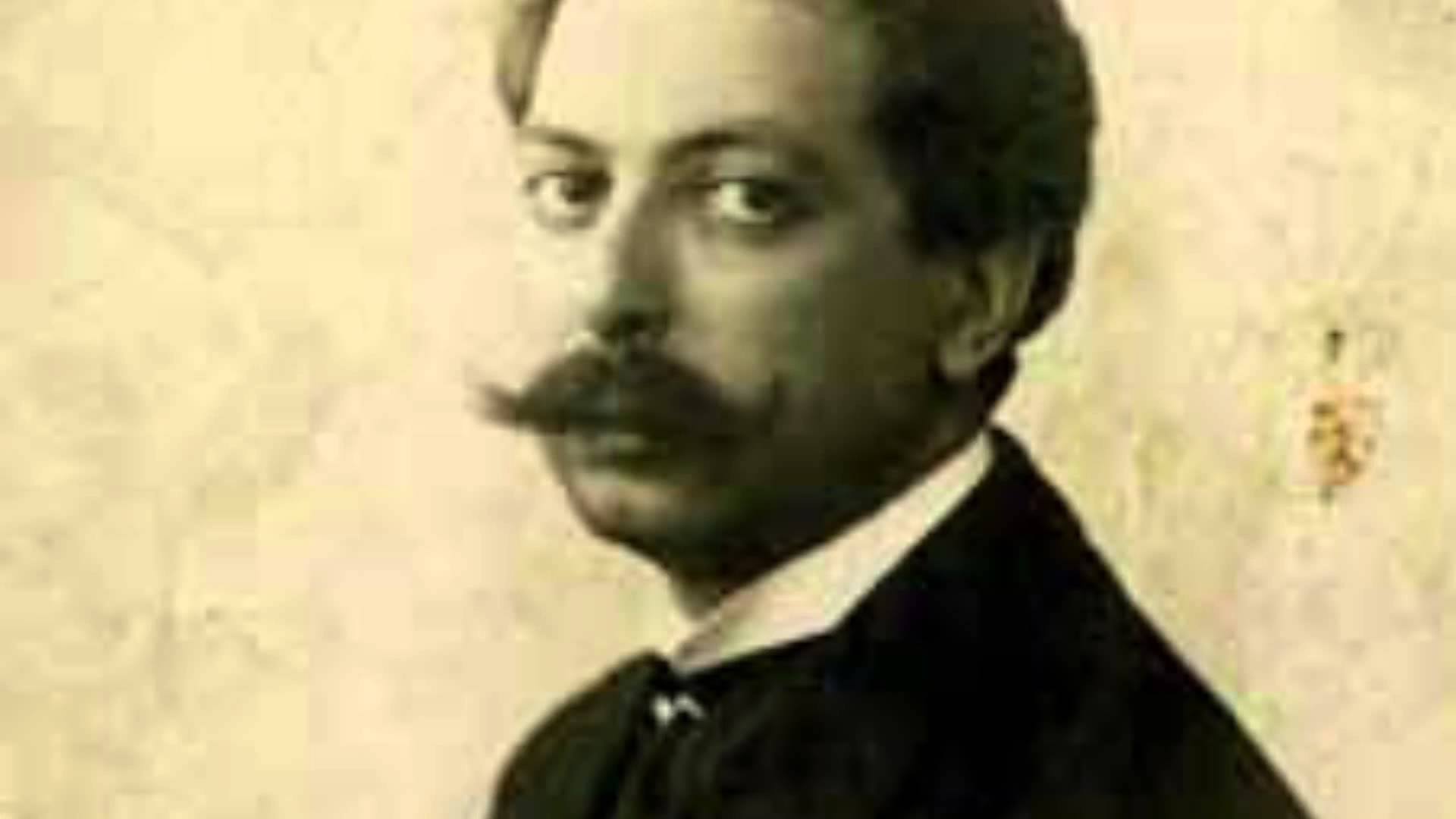
    In contrast to Ruggles, who was a gifted dilettante who tossed off paintings in an afternoon, Mikalojus Ciurlionis was every bit as important a painter as he was a composer.

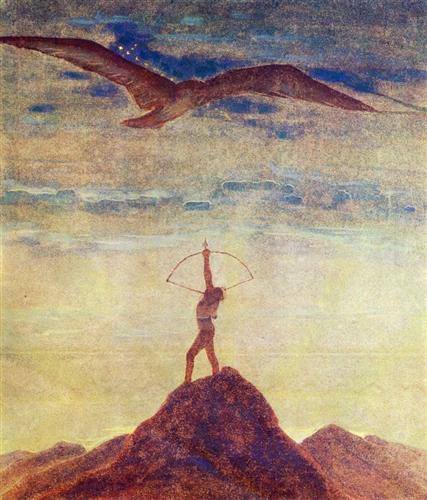
    In his 35 years – Ciurlionis lived from 1875 to 1911 – he managed to compose about 400 pieces of music and paint about 300 canvases. A pioneer of abstract art in Europe, he was an exemplar of the symbolist and art nouveau movements, a representative of the fin de siècle epoch, and a major figure in Lithuanian culture. Interestingly, Ciurlionis was a synesthete; that is to say, he perceived colors and music simultaneously. We’ll be listening to his vibrant symphonic poem, “The Sea.”

    Lyonel Feininger alone of our composers this week is known almost exclusively as a visual artist. Feininger lived from 1871 to 1956. Born and raised in New York, he moved to Germany at the age of 16. There, he became a leading practitioner of German Expressionism and the Bauhaus. With the rise of the Nazis in the 1930s and the party’s campaign against modern art, Feininger was driven out of Germany, and after 50 years returned to the United States, where he met with great success.

    Feininger had no formal music studies beyond a few years of violin lessons. Regardless, he composed thirteen fugues (with extant sketches for a fourteenth). These, he composed by ear, with the music of Johann Sebastian Bach being an undisguised influence. Feininger claimed that the influence of Bach was equally evident in his painting.

    I hope you’ll join me for “Fixtures at an Exhibition” – music by successful composer-painters – this Sunday night at 10 EDT, with a repeat Wednesday evening at 6; or that you’ll listen to it later as a webcast at wwfm.org.


    “Sagittarius,” by Mikalojus Ciurlionis

  • Tooth Phonograph Hear Vinyl After Apocalypse

    Tooth Phonograph Hear Vinyl After Apocalypse

    If, as I have, you’ve ever mulled over how exactly you’d be able to listen to music should you happen to survive the Apocalypse, this information should be of particular interest to you. Be sure to copy it out now, since there likely will be no internet post-Armageddon.

    I was referred to this article a few weeks ago by regular Classic Ross Amico visitor Roberta Batorsky, but I was saving it for a slow news day. Thanks Roberta. You know I’m definitely trying this out.

    http://www.popsci.com/listen-to-records-with-your-teeth

    More here:

    http://www.instructables.com/id/Tooth-Phonograph/

    Yet one more reason to hang on to your vinyl.

    You can visit Roberta’s blog, The Solipsist’s Soiree, here:

    http://solipsistssoiree.blogspot.com/


    These organizations love vinyl:

    Princeton Record Exchange, WPRB 103.3 FM

Tag Cloud

Aaron Copland (93) Beethoven (95) Composer (114) Film Music (139) Film Score (143) Film Scores (255) Halloween (94) John Williams (195) KWAX (229) Leonard Bernstein (103) Marlboro Music Festival (125) Movie Music (154) Mozart (89) Opera (210) Philadelphia Orchestra (89) Picture Perfect (174) Princeton Symphony Orchestra (108) Radio (88) Ross Amico (244) Roy's Tie-Dye Sci-Fi Corner (290) The Classical Network (101) The Lost Chord (268) Vaughan Williams (103) WPRB (396) WWFM (881)

DON’T MISS A BEAT

Receive a weekly digest every Sunday at noon by signing up here


RECENT POSTS