Category: Daily Dispatch

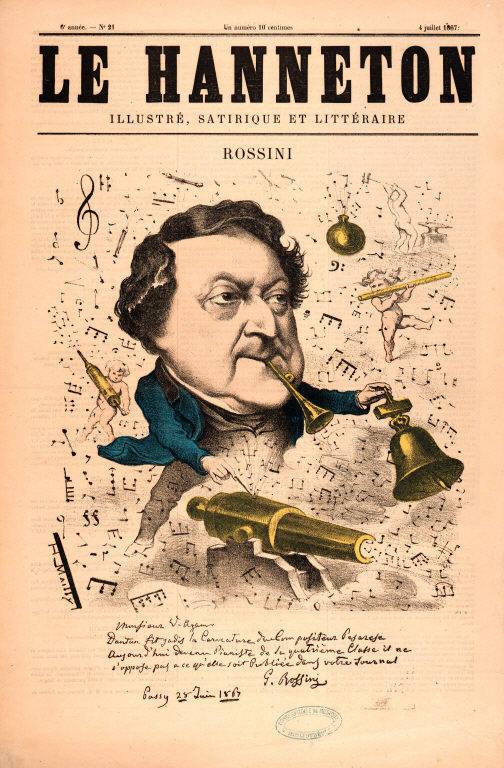
  • Leap Day Rossini Birthday Truth or Hoax

    Leap Day Rossini Birthday Truth or Hoax

    Happy Leap Day!

    Was Gioachino Rossini really born on February 29? It has been suggested to me by a knowledgeable source that he was not; yet I cannot find any evidence of this by way of a cursory internet search. So was Rossini a charlatan (i.e. a canny showman) – which I wouldn’t put past him – or is this classical music’s answer to the Birther movement?

    As I continue to ponder the imponderables, here’s “Rabbit of Seville.”

    http://www.dailymotion.com/video/x2mjbrz

  • Korngold Wolf-Ferrari Opera on WPRB

    Korngold Wolf-Ferrari Opera on WPRB

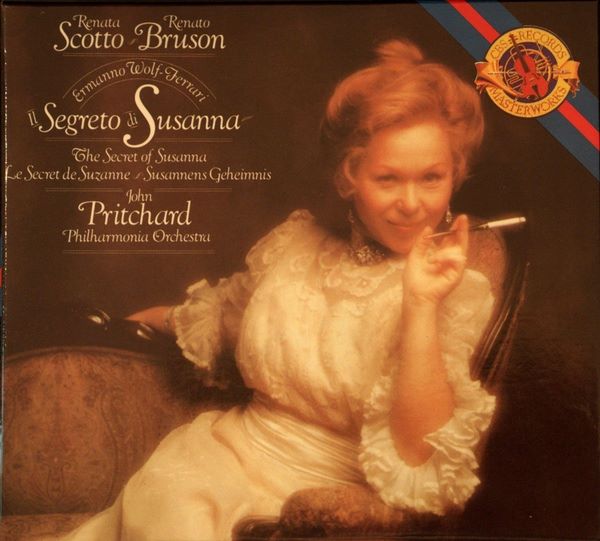
    Wake up to your conflicted emotions with Erich Wolfgang Korngold’s “Violanta,” and then sneak a cigarette with Ermanno Wolf-Ferrari’s “Il segreto di Susanna” (“Susanna’s Secet”). I’ll be filling in for Sandy Steiglitz today for “Sunday Morning Opera,” from 7 to 10 ET, on WPRB 103.3 FM and at wprb.com.

  • Kalevala Day Finland Celebrates Its Epic Hero

    Kalevala Day Finland Celebrates Its Epic Hero

    It’s Kalevala Day! Be stoic, everyone:

    http://www.finland.ro/public/default.aspx?contentid=299691&nodeid=38122&culture=en-US

    Ormandy conducts Sibelius’ “Four Legends”:

    Bernstein conducts “Pohjola’s Daughter”:

    PHOTO: Steadfast old Väinämöinen and the giant pike

  • Film Composers Beyond the Screen

    Film Composers Beyond the Screen

    If after about three hours you find yourself getting played out on the Academy Awards– once Ennio Morricone finally wins his first competitive Oscar, that is (fingers crossed) – you might consider tuning in to “The Lost Chord.” We’ll both complement and enjoy counterprogramming to the ceremony by listening to concert works by composers better known for their work in film.

    Franz Waxman was a two-time Academy Award winner, honored with back-to-back Oscars, in 1950 and 1951, for his work on “Sunset Boulevard” and “A Place in the Sun.” Some of his other classic scores include those for “The Bride of Frankenstein,” “Rebecca,” “Rear Window,” “Peyton Place” and “The Nun’s Story.”

    In 1955, he was traveling from California to Zurich to conduct a new piece commissioned by Rolf Liebermann. When Waxman reached New York he was met with a request from Lieberman’s office for program notes for the impending premiere. Waxman was forced to admit he hadn’t yet begun work on the piece, which he had planned to write during the ocean voyage. Fortunately, he was accustomed from his experience in Hollywood to write very quickly. The result was his “Sinfonietta for String Orchestra and Timpani.”

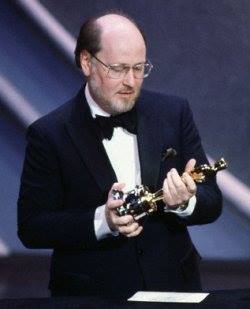
    Five-time Academy Award winner John Williams – whose 50th nominated score, for “Star Wars: The Force Awakens,” is in contention tonight – is of course very well-known for his collaborations with George Lucas and Steven Spielberg. Over the years, he’s also accrued an impressive quantity of concertos. One of the more immediately attractive of these is his Tuba Concerto of 1985, written for the 100th anniversary of the Boston Pops.

    Finally, we’ll turn to three-time Academy Award winner Miklós Rózsa, honored for his work on Alfred Hitchcock’s “Spellbound” in 1945, the Ronald Colman thriller “A Double Life” in 1947, and “Ben-Hur” in 1959. He also composed quite a bit of concert music, including concertos for Jascha Heifetz, Gregor Piatigorsky, Janos Starker, Leonard Pennario and Pinchas Zukerman.

    Rózsa, Hungarian by birth, turned to film after a period of struggle as a young artist in Paris, where he learned from Arthur Honegger that he was able to pay the rent by supplementing his concert music with cinematic efforts. Rózsa’s “Theme, Variations and Finale,” Op. 13, of 1933, preceded the start of his film career by a few years. He revised the piece in 1943, by which time he had already completed his classic fantasy scores for Alexander Korda’s “The Thief of Bagdad” and “Jungle Book,” and was on the verge of becoming a leading composer of film noir.

    “Theme, Variations and Finale” received performances by Charles Munch, Karl Böhm, Georg Solti, and Eugene Ormandy. It was also one of the works that featured on the legendary concert that launched Leonard Bernstein with the New York Philharmonic, on November 14, 1943, when the young assistant conductor substituted at the last minute for an ailing Bruno Walter.

    I hope you’ll join me for an hour of concert music by composers better known for their work in film – “Against Type” on “The Lost Chord” – this Sunday night at 10 ET, with a repeat Wednesday evening at 6; or that you’ll listen to it later as a webcast at wwfm.org.


    PHOTOS: Has anyone here seen Kelly? (Clockwise from left) John Williams wins the Oscar for “Star Wars;” Franz Waxman and Miklós Rózsa receive their awards from the hands of Gene Kelly
  • Opera on Vinyl Korngold and Wolf-Ferrari

    Opera on Vinyl Korngold and Wolf-Ferrari

    Tomorrow morning I will have the honor of keeping the chair warm for Sandy Steiglitz, who will be taking the week off from her long-running show, “Sunday Morning Opera,” at WPRB. That’s a large bill to fill, so I’ll be bringing along not one, but two operas.

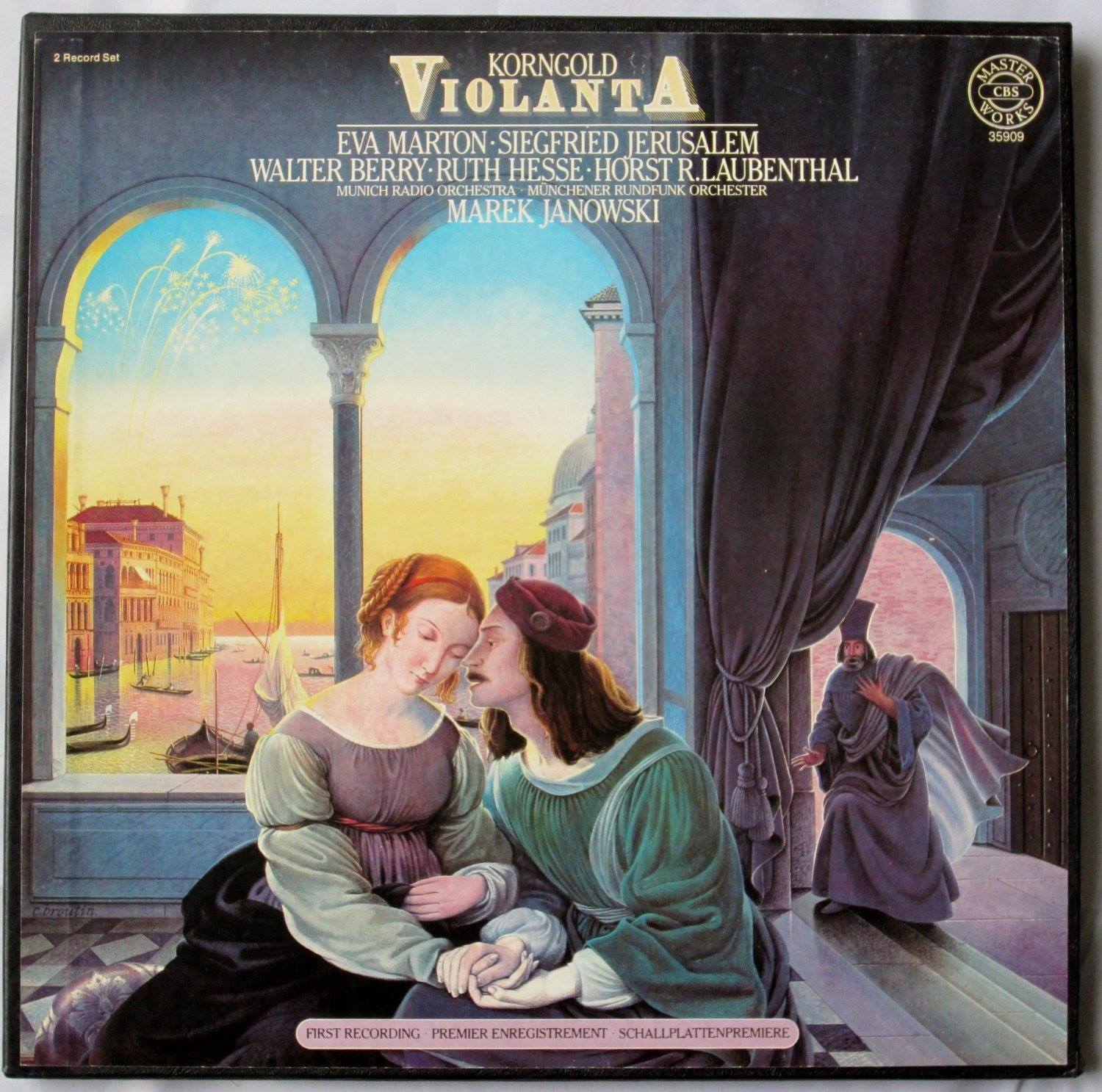
    Erich Wolfgang Korngold wrote “Violanta” at the age of 17. Already his second opera, composed in 1914, the work demonstrates the composer’s early mastery of large orchestral forces, rich, heroic vocal writing, and compelling stagecraft. It’s small wonder that 20 years later Korngold would revolutionize the Hollywood film score. He would be recognized for his efforts with two Academy Awards, for his work on “Anthony Adverse” (1936) and “The Adventures of Robin Hood” (1938). A good choice, then, for Academy Awards Sunday!

    The story of “Violanta,” set in 15th century Venice against the backdrop of Carnival, involves seduction, suicide, thirst for revenge, dawning compassion, and sacrifice. The music is intoxicating, and the recording, led by Marek Janowski – with Eva Marton in the title role, Siegfried Jerusalem as a sympathetic lothario, and Walter Berry as an insecure husband – is fabulous. Bruno Walter conducted the world premiere in Munich, so the choice of the Munich Radio Orchestra is an idiomatic one.

    We’ll follow up the opulent tragedy of “Violanta” with Ermanno Wolf-Ferrari’s fun and frothy comedy of marital misunderstanding, “Il segreto di Susanna” (“Susanna’s Secret”), composed in 1909. A man suspects his wife is having an affair when he smells cigarette smoke on her clothes. He attempts to get to the bottom of her “secret,” with amusing results. Renato Scotto is Susanna, Renata Bruson her husand, Count Gil, and John Pritchard conducts the Philharmonia Orchestra.

    In the process, we’ll inadvertently be observing the birthdays of Scotto (Feb. 24), Pritchard (Feb. 5) and Janowski (Feb. 18), along with those of Leontyne Price (Feb. 10), and Lotte Lehmann (Feb. 27).

    My choices are somewhat limited due to the requirements of WPRB’s All Vinyl Week. Still, I think I’ve managed to come up with some good material. I hope you’ll join me as I kick back with some caffeine and some good music, on “Sunday Morning Opera,” tomorrow from 7 to 10 ET, on WPRB 103.3 FM and at wprb.com.


    PHOTO: Massive spoiler alert!

Tag Cloud

Aaron Copland (93) Beethoven (95) Composer (114) Film Music (139) Film Score (143) Film Scores (255) Halloween (94) John Williams (195) KWAX (229) Leonard Bernstein (103) Marlboro Music Festival (125) Movie Music (154) Mozart (89) Opera (210) Philadelphia Orchestra (89) Picture Perfect (174) Princeton Symphony Orchestra (108) Radio (88) Ross Amico (244) Roy's Tie-Dye Sci-Fi Corner (290) The Classical Network (101) The Lost Chord (268) Vaughan Williams (103) WPRB (396) WWFM (881)

DON’T MISS A BEAT

Receive a weekly digest every Sunday at noon by signing up here


RECENT POSTS