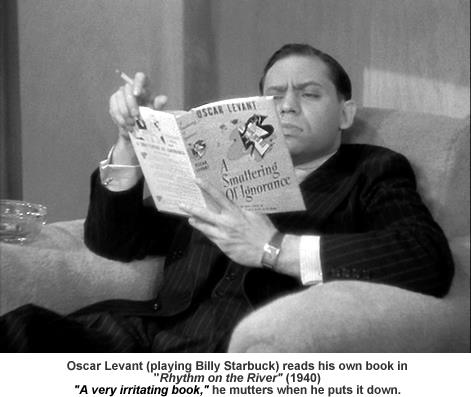
The Three Stooges made a cameo in my discursive post yesterday. This put me in mind of one of my favorite Stooges shorts, with Larry as a starving violinist who strikes gold when he discovers the secret to Curly’s strength.
Here’s an article by long-time rock critic Paul Morley who, jaded by the safe, slick commercialism of contemporary pop, shares his new-found zeal for the raw undercurrents in much of classical music.
Predictably, but no less depressingly, the backlash from too many of his readers in the comments section is informed by a knowledge of classical music apparently gleaned from Three Stooges shorts. You know, where they flip bananas and grapes into the mouths of histrionic opera singers to scandalize the snooty patrons.
As you probably know if you’re a regular reader, I love love love classic movies, but one thing that disturbs me as a viewer is a recurrent misunderstanding of, if not outright disdain for, classical music. Was it ever as stuffy, inaccessible and exclusive as it is portrayed in movies of the ‘30s and ‘40s (or even today, for that matter?).
Yes, it helps if you have enough money to be able to attend concerts, and the old films are full of anti-populist straw men, the idle rich, all knock-offs of diminutive Uncle Pennybags and dowagers with Thurber builds. But then what about the cab driver in Preston Sturges’ “Unfaithfully Yours,” who is delirious for Rex Harrison’s Delius? It could be argued that the humor in that is that someone holding such a position could be knowledgeable about, let alone capable of appreciating, classical music.
Whatever the reality, today things couldn’t be more accessible. You’ll still get sneers (frequently from me) if you text in the concert hall or wear open-toed sandals and cross your legs to display your untrimmed, fungal toenails, but for the most part I think classical music has become a very democratic pursuit for anyone with half an interest in it. Morley makes a very good point when he indicates that it is now easier than ever to educate oneself – or, if that sounds too pompous, to explore – by following one’s natural curiosity through the privacy and convenience of one’s own laptop.
What a world it would be if people could lose some of the attitude and just listen. Of course, that would apply to anything, not just music.
This Sunday night on “The Lost Chord,” we’ll have selections for the Jewish High Holy Days. We’ll hear a string quartet by Jacob Weinberg, dating from 1950. The work falls into three movements, which bear the respective subtitles “Rosh Hashanah” (the Jewish New Year), “Yom Kippur” (the Day of Atonement) and “Sukkot” (the harvest festival).
Weinberg’s “Yom Kippur” is based on the familiar declaration of “Kol Nidrei,” best known to gentiles, probably, through the setting for cello by Max Bruch. Bruch, though not Jewish, always had a good ear for characteristic melodies of different cultures (e.g. the “Scottish Fantasy,” the “Swedish Dances,” the “Suite on Russian Themes,” etc.).
Emil Nikolaus von Reznicek – he of “Donna Diana Overture” fame – was likewise moved by the Yom Kippur melody, on which he wrote a large-scale set of orchestral variations, which we’ll also hear. Interestingly, in contrast to the reverential setting by Bruch, Reznicek puts the theme through a befuddling array of permutations, pivoting back and forth from light to serious. It’s not synagogue music, but it is fascinating.
We’ll conclude the hour with a moving arrangement by Patrick Sinozich of ”Avinu Malkeynu” (“Our Father, Our King”) by Max Janowski, performed by Chicago a cappella.
Join me for “Tones of Atonement,” tonight at 10 ET, with a repeat Friday morning at 3. Or enjoy the show later as a webcast, at http://www.wwfm.org.
PHOTO: Yom Kippur, the holiest day of the Jewish calendar, begins at sundown on Friday. The solemn occasion will conclude at nightfall on Saturday with a long blast on the shofar.
A languid Saturday is a good day for Cyril Scott. Though I suppose under ideal circumstances it would be a rather balmy day full of cicadas and satyrs.
Scott was one of the so-called Frankfurt Group, a collective of up-and-coming musicians who studied at the Hoch Conservatory in Frankfurt am Main, Germany, in the 1890s. The group included conductor and composer Balfour Gardiner (the great uncle of John Eliot Gardiner), songwriter Roger Quilter, and the nearly forgotten Norman O’Neill. The youngest of the bunch was a quirky, 13 year-old piano prodigy by the name of Percy Grainger.
Scott’s fame, such that it is, rests primarily on a piano miniature called “Lotus Land,” which helped insulate the piano benches of musical grandmothers everywhere. But he also left behind a sizable body of dreamy, wayward orchestral works, including two symphonies, four operas, four oratorios, and concertos of all stripes, to say nothing of his chamber and instrumental music. Often referred to as “the English Debussy,” Scott could usually be counted on for a good wallow. Alban Berg described his music as mushy.
His works, more or less neglected for decades, beyond some notable recordings of the piano concertos by John Ogdon, have received a lot of love in the recording studio over the past ten years.
Scott was fascinated by the occult. His claim to have contacted Grainger’s mother from beyond the grave put an end to their friendship. He was also occupied with the subject of health foods. His writings on diet and alternative medicine prefigure a school of thought which has become practically mainstream in the present day.
Someone must have sold off the library of Eugene Ormandy at some point since, somewhere in my own collection, I’ve got a book inscribed to Ormandy by Cyril Scott.
Like Howard the Duck, I am trapped in a world I never made.
It’s frustrating to have people who don’t know classical music edit your classical music articles – hence, a sentence like “The repertoire on tomorrow’s program encompasses art music from the Renaissance to the present day, along with settings of an Aboriginal creation myth and an Iroquois peyote song” gets changed to “The repertoire on tomorrow’s program encompasses art music from the Renaissance to the present day, along with PIECES SET IN an aboriginal creation myth and an Iroquois peyote song” – but at least, as far as I can see, the entire article ran this week. I just hate being made to sound like an idiot.
You can read about the Princeton Singers, as they celebrate 30 years, here: