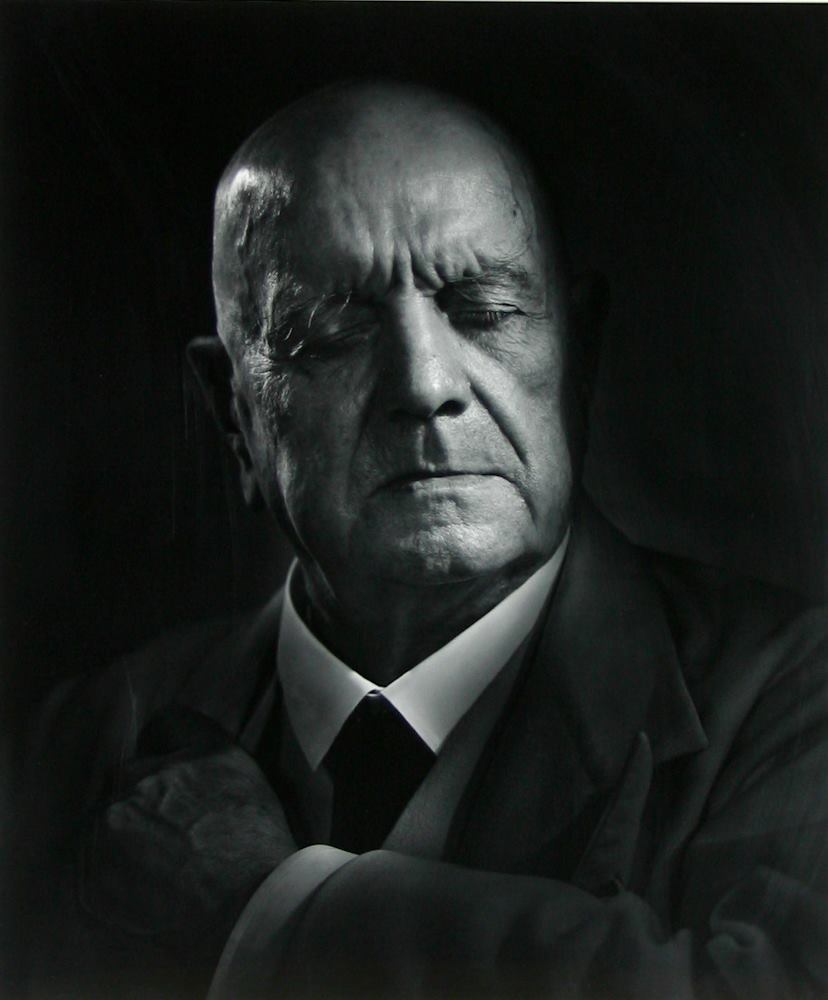
What’s the world coming to when I don’t even have time to write a proper birthday tribute to one of my favorite composers? That granitic head, like his symphonies, hewn from rock, full of austere pine trees and shrouded with snow. Bless you, Jean Sibelius. Thank you for your stoic, noble masterpieces. I worship at the altar of your Fifth Symphony.
Category: Daily Dispatch
-

Irving Fine: Celebrating the Composer’s Centenary
Irving Fine, you’re so fine. You’re so Fine, you blow my mind.
This Sunday night on “The Lost Chord,” we’ll mark the centenary of the birth (on December 3, 1914) of this most appropriately named composer, with an hour of his well-crafted music. We’ll hear works for piano, mixed chorus, woodwind quintet, and string orchestra.
For more on Fine, see my post of December 3.
I’ve mentioned several times, between the show and my postings, Fine’s late flirtation with serialism. Since I don’t actually include any of the twelve-tone works on my playlist (too many other short, beautiful pieces to cover), I’ll include a link to his Symphony here.
This is twelve-tone music for people who don’t like twelve-tone music.
Fine conducted the work’s premiere with the Boston Symphony Orchestra in 1962. Less than two weeks later, he was dead of a massive coronary at the age of 47.
I hope you’ll join me for “Everything’s Fine,” this Sunday night at 10 ET, with a repeat Wednesday evening at 6; or that you’ll listen to it later as a webcast at http://www.wwfm.org.
PHOTO: (Left to right) The inseparable Lukas Foss, Irving Fine and Harold Shapero, composers of the “Boston Six,” doin’ nothin’
-
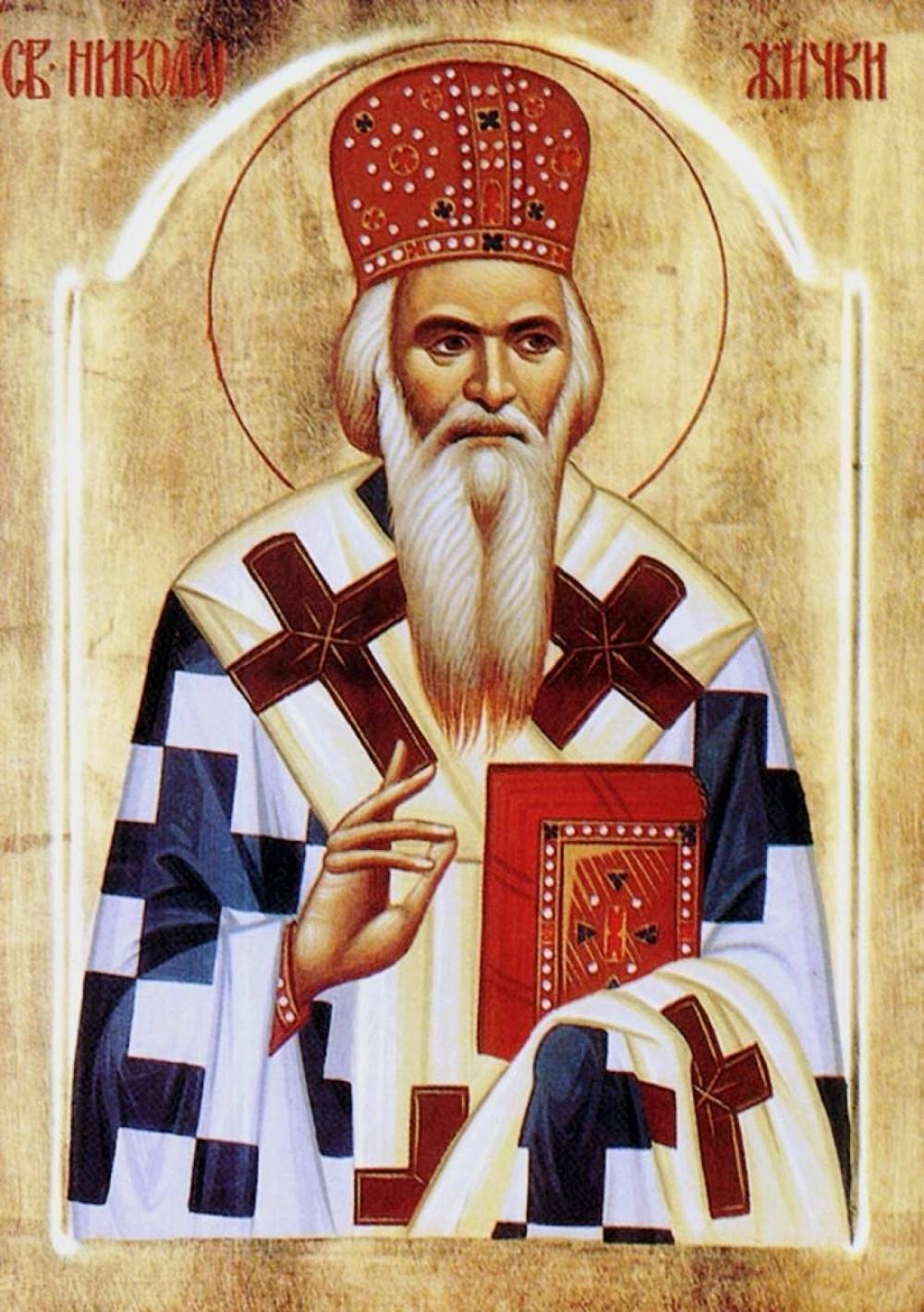
Grumpy Saint Nick Hidden History
ADVENT CALENDAR – DAY 7
December 6. Saint Nicholas Day. Yay! Jolly old Saint Nick, right? Wrong!
While it would be impossible to deny Saint Nicholas having done a lot of good in the world, with a reputation for miracles and outstanding generosity, his modesty was so extreme as to sometimes verge on the sociopathic. In fact, he suffered fools grudgingly and became cantankerous if thanked.
Nicholas is one of those rare all-purpose saints, who seems to watch over everyone – sailors, merchants, archers, prostitutes, women seeking husbands, repentant thieves, wrongly condemned prisoners, travelers, pawnbrokers, students, and of course children. Is it any wonder he’s grouchy?
The historic Nicholas served as Bishop of Myra (part of modern day Turkey) in the 4th century. When his parents died, he gave away his inheritance to the poor.
To avoid uncomfortable scenes, he developed a reputation for secret gift-giving. In one famous incident, he rescued three daughters of an unfortunate man who could not afford a proper dowry. In that time and place, it would have made them unmarriageable, and with no opportunity for honest employment, they would have had no alternative but to enter into a life of prostitution.
Nicholas learned of their plight and under the cloak of darkness passed their house three times, each time tossing a purse of gold through a window. Some traditions say he dropped the purses down the chimney; others claim he left coins in stockings left out to dry. When the elated father tried to thank him, Nicholas responded gruffly that it is God he should thank.
The next time you pass a pawnbroker’s shop, take a look at the symbol with the three spheres. Its significance is attributed to Nicholas’ gift of three bags of gold.
On another occasion, during a sea voyage, Nicholas’ ears were assailed by a cacophony of oaths and blasphemies lustily exchanged by the crew. When he tried to get them to mind their language, the sailors laughed and mocked him, and took to swearing with renewed vigor. Nicholas responded by praying for stormy seas, until the sailors dropped to their knees in repentance, effectively scared straight.
He was also wholly intolerant of pagans and heretics. He sent Arius, the father of Arianism, sprawling with a box on the ears, for his assertion that Jesus Christ is subordinate to the entity of God.
The creepiest Nicholas tale concerns the murder of three boys by a butcher during a time of famine. The butcher placed their remains in a barrel to cure, hoping to pass them off as ham(!). Not surprisingly, this didn’t go down well with Nicholas, who resurrected the three children. The episode is captured most eerily by Benjamin Britten in his cantata, “Saint Nicholas.”
While he’s not a “Bad Santa,” exactly, he’s also not the jolly old elf Clement Moore, Thomas Nast and Coca Cola would have us believe.
That said, more in that vein, here’s the “Santa Claus Symphony,” really an ambitious symphonic poem, by the Philadelphia composer William Henry Fry (1813-1864):
-

Krampusnacht is Coming! Meet the Christmas Demon
ADVENT CALENDAR – DAY 6
Okay, I warn you right up front, if you’re devout, this one is really going to push your limits. Where do I start with Krampus?
From deep within the recesses of the Alpine psyche emerges this egregiously-horned, whiplash-tongued Christmas demon, who travels from door to door as Saint Nicholas’ barely-restrained disciplinarian sidekick. In the ultimate good cop/bad cop ploy, Saint Nicholas makes nice with children if they’ve been good. If they haven’t, they are turned over to Krampus, who beats them with a switch, slaps them in chains, and then hauls them off in his basket to be drowned in a stream or thrown into hellfire.
Oh yeah, and there are always cowbells, lots of cowbells.
Don’t shoot the messenger, folks, I’m just telling it like it is. Google him, if you don’t believe me.
The heartwarming domestic tradition was captured in this YouTube video for all to share:
For me, the acquaintance of Krampus was essentially love at first sight, and I still feel a degree of ownership when it comes to Krampus lore. Perhaps there are still some who don’t know about this twisted Christmas tradition, but every year, Krampus seems to be gaining traction – which means it is only a matter of time before he is robbed of his teeth. There are now Krampuslaufen in the United States – there’s even one in Philadelphia, for crying out loud – but they are tame affairs alongside the hardcore observances thrown by the Austrians, which often begin as parades but devolve into alcohol fueled free-for-alls.
You could spend hours on YouTube watching footage, but be forewarned that much of it has been put to unlistenable heavy metal soundtracks. In some of them, you’ll witness costumed hooligans dragging bystanders out of the crowd for a good flogging. Hey, you’ve got to know what to expect when you show up for a Krampuslauf.
Here’s a Krampus parade in Graz, with Prokofiev and Carl Orff on the soundtrack:
After hours, Krampus is as Krampus does:
In a bizarre side development, perhaps due to Krampus’ inherently salacious vibe, he has also become part of the Valentine’s Day tradition in German-speaking countries. Hence, you will find vintage postcards of Krampus casting amorous glances, terrorizing lovers, and chasing women (or running away from them).
Tonight, December 5, the eve of St. Nicholas Day, is Krampusnacht. If you’ve been especially naughty this year, you only have a few hours to get down on your knees and do some fast repenting.
More about Krampus (with a nice gallery of postcards) at http://www.krampus.com.
http://www.krampus.com/who-is-krampus.php
http://www.krampus.com/krampus-gallery.php
Krampus celebrated in song (and a catchy one, at that):
-
Boar’s Head Carol: A Festive Christmas Tradition
ADVENT CALENDAR – DAY 5
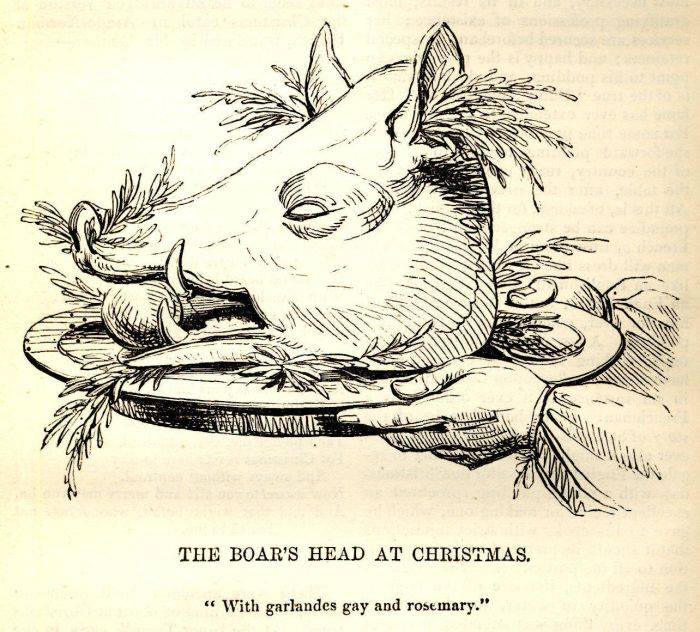
What’s my favorite Christmas carol? There are several, certainly, but near the top of the list must be “The Boar’s Head Carol.” Why? Because what’s more festive than a steaming head of boar? I also love the fact that half of the thing is in Latin, so I have no idea what I am singing about.
The carol dates from the 15th century and grew out of the ancient custom of sacrificing a boar for the Yuletide feast. Like so many of the arcane Christmas traditions, it can be traced to the Northern folk, who sacrificed a boar to Freyr, the god of virility and prosperity, to bless the New Year.
With the advent of Christianity, St. Stephen stepped up as the deliverer of boar to the Yuletide banquet, and Christmas ham has been with us ever since. The presentation of the boar’s head has become symbolic of the Christ Child’s triumph over sin.
The carol also has academic associations, not only because of the refrains (which are sung in Latin), but because of an enduring ceremony at Oxford, among other institutions of higher learning.
Tradition holds that an Oxford student was out strolling in the forest one day, immersed in Aristotle, when he was set upon by a wild boar. Thinking quickly, the student thrust the volume into the boar’s mouth and cried, “Græcum est!” (“With compliments of the Greeks!”), there at the boar was choked to death.
A celebratory feast held at Queen’s College involves three chefs bearing the boar’s head into the hall, with a solo singer accompanied by torch bearers and choir. During each of the verses the procession halts, then proceeds again with the chorus. At the high table, the Provost distributes the dish’s herbs to the choir and bestows an orange, which is held in the boar’s jaw, to the solo singer.
The carol goes something like this:
The boar’s head in hand bear I,
Bedeck’d with bays and rosemary.
And I pray you, my masters, be merry
Quot estis in convivio (Translation: As many as are in the feast)CHORUS
Caput apri defero (Translation: The boar’s head I offer)
Reddens laudes Domino (Translation: Giving praises to the Lord)The boar’s head, as I understand,
Is the rarest dish in all this land,
Which thus bedeck’d with a gay garland
Let us servire cantico. (Translation: Let us serve with a song)CHORUS
Our steward hath provided this
In honor of the King of Bliss;
Which on this day to be servèd is
In Reginesi atrio. (Translation: In the hall of Queen’s [College, Oxford])CHORUS
Here it is, in an early version known as “The Borys Hede”:
https://www.youtube.com/watch?v=PgYkie0Rv4k
More commonly, it goes something like this:
Finally, John Langstaff, from “The Christmas Revels”:
https://www.youtube.com/watch?v=ZSzccYxYVEg
A whole lot more on the carol and ceremony:
Tag Cloud
Aaron Copland (93) Beethoven (95) Composer (114) Film Music (139) Film Score (143) Film Scores (255) Halloween (94) John Williams (195) KWAX (229) Leonard Bernstein (103) Marlboro Music Festival (125) Movie Music (154) Mozart (89) Opera (210) Philadelphia Orchestra (89) Picture Perfect (174) Princeton Symphony Orchestra (108) Radio (88) Ross Amico (244) Roy's Tie-Dye Sci-Fi Corner (290) The Classical Network (101) The Lost Chord (268) Vaughan Williams (103) WPRB (396) WWFM (881)