Category: Daily Dispatch

  • Altman’s Popeye Robin Williams’ Lost Gem?

    Altman’s Popeye Robin Williams’ Lost Gem?

    What happens when Robert Altman directs Mork from Ork? Well, “Popeye,” I’m afraid.

    I always had a soft spot for this 1980 film, generally cited as Robin Williams’ first (earlier he had appeared in “Can I Do It ‘Til Need Glasses?”), though it received mostly tepid reviews. The film made $60 million worldwide – a respectable gross for the time – but it was a financial disappointment in light of the studio’s blockbuster expectations. Overall, “Popeye’s” reputation took a pretty sound drubbing.

    The film was written by Jules Feiffer, with a marvelous assemblage of talent in all the character roles – Paul Dooley, Linda Hunt, Bill Irwin, Paul L. Smith (best known as the unforgettable warden Hamidou in “Midnight Express”) as Bluto, and Ray Walston as the definitive Poopdeck Pappy. And of course, Shelley Duvall was born to play Olive Oyl. The film had the added interest of being shot on the island of Malta. The songs, which were generally regarded as pretty weak, were by Harry Nilsson.

    Hard to believe the producer originally wanted Dustin Hoffman for the lead (this was before it became the vogue for big actors to play comic strip characters, and Hoffman was at the peak of his career), opposite Altman regular Lily Tomlin as Olive (which could have been an interesting choice).

    Williams made a lot of bad films in his career, much worse than this one, but scanning his filmography I can say with confidence that he left behind his share of good ones, or at least ones that connected with the public. He was nominated for three Academy Awards, and took home an Oscar for his role in “Good Will Hunting.” He was certainly never hurting for work. His television series may have been cancelled, but allegedly there are four more films in the pipeline.

    Of course his genius was best displayed in front of a live audience, where his freewheeling free association could scale manic, surreal heights. I had the privilege to see his act once in Philadelphia, back in the mid-‘80s. He was unrelenting under the best of circumstances, but when someone dropped a drink into the crowd from the balcony, it sent him into overdrive. You did not want to make yourself the target of Robin Williams.

    It’s always sad when a comedian gets old, but it’s even sadder when one dies. Comedy is vitality, and Williams was nothing if not vital. It really bothers me that he’s gone. I don’t know about you, but I need all the laughter I can get.

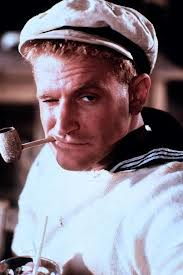
    PHOTO: I yam what I yam!

  • Lilo & Stitch Viral Trend Explained

    Lilo & Stitch Viral Trend Explained

    All right, this has been sweeping the internet for a little while now. I suppose I had better share it and move on. Besides, it makes my job that much easier, since I’m supposed to be writing. I haven’t seen “Lilo & Stitch” (I deduce the origin from the Hawaiian garb), so best not to ask too many questions.

  • Howard Hanson Bold Island Inspiration

    Howard Hanson Bold Island Inspiration

    For many people, having to work through vacation can be a real drag; but for the creative artist, vacation can be a time to really get things done.

    For 40 years, Howard Hanson was the director of the Eastman School of Music. In that capacity he nurtured and championed innumerable American composers, giving literally thousands of premieres at the helm of the Eastman-Rochester Orchestra, an ensemble he founded. The lucky ones found their way onto records, issued on the Mercury label.

    Hanson, of course, was himself a composer. He was awarded the Pulitzer Prize for Music in 1944, for his Symphony No. 4 “Requiem,” written in memory of his father. But his best known music, undoubtedly, is his Symphony No. 2 “Romantic,” composed in 1930.

    The famous “Hanson sound” is one of heart-on-the-sleeve romanticism, characterized by glowingly nostalgic melodies, though he also had his severe side. After all, he was born in Wahoo, Nebraska, to Swedish immigrants, and a certain Nordic austerity can be detected, especially in his later works.

    This Sunday night on “The Lost Chord,” we’ll be listening to three pieces inspired by Hanson’s summer home on Bold Island, which is located in the North Atlantic, off the coast of Maine. The major work will be the Symphony No. 6, written in 1967 for the New York Philharmonic and dedicated to Leonard Bernstein.

    The piece is more tightly argued than Hanson’s earlier, more famous symphonies, structured in six brief movements, built on a recurring motif. At times, it can sound a bit like Sibelius, though Hanson very much remains his own man. Hanson being Hanson, he doesn’t really skimp on the lyricism, but he doesn’t exactly indulge it to the same extent he does in the earlier works. Still, predictably, the symphony was derided as old-fashioned by the genuinely austere musical establishment of the day.

    The Bold Island connection is through Hanson’s “Summer Seascape No. 2,” written a few years earlier, and clearly the blueprint for the symphony. In fact, the opening of the symphony is identical.

    The first “Summer Seascape” was the centerpiece of the “Bold Island Suite,” a separate work composed in 1961. The suite also contains movements with the descriptive titles “Birds of the Sea” and “God in Nature.”

    For Howard Hanson, summer in the North Atlantic was clearly a time to give his Nordic sensibility free rein. Join me for “August Hanson,” tonight at 10 ET, with a repeat Friday morning at 3. You can also listen to the show later as a webcast at http://www.wwfm.org.

    PHOTO: Not-very-austere Puffins off the coast of Maine

  • Bard Music Festival Focuses on Schubert

    Bard Music Festival Focuses on Schubert

    The Bard Music Festival gets underway today at Bard College in idyllic Annandale-on-Hudson, NY. This year’s focus is on Franz Schubert and his world. The festival brings together world-renowned scholars and performers with Bard’s stellar music faculty, all under the supervision of the indefatigable Leon Botstein.

    Among area participants will be Princeton University professor of music history Scott Burnham and New Jersey Symphony Orchestra concertmaster Eric Wyrick. You can read more about it in my article in today’s Trenton Times.

    http://www.nj.com/times-entertainment/index.ssf/2014/08/princeton_professor_scott_burn.html

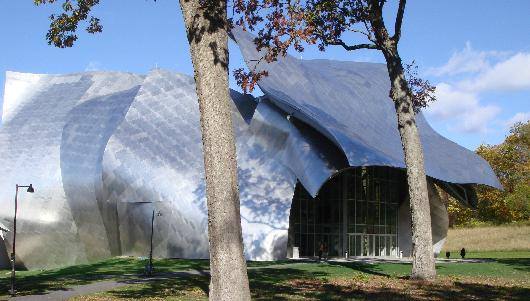
    PHOTO: The Richard B. Fisher Center for the Performing Arts at Bard College (or as I like to call it, The Armadillo)

  • Friendly Alien Film Scores E.T. & Beyond

    Friendly Alien Film Scores E.T. & Beyond

    People of Earth! We come in peace!

    This week on “Picture Perfect,” we listen to scores from films about benevolent extra-terrestrials. Friendly E.T.’s have been out of fashion now for quite some time. We seem to be mired in some neo-‘50s zeitgeist, as far as paranoia and invaders are concerned. But that certainly wasn’t the case back in 1982, when Steven Spielberg’s “E.T. The Extra-Terrestrial” almost singlehandedly turned everything on its head.

    No more invaders from Mars. Spielberg would get to that a couple of decades later, when he remade H.G. Wells’ “The War of the Worlds.” No, during the Reagan Era, with the Cold War winding down and terrorism not yet so much in the news, cinematic E.T.’s were benevolent at best, or at worst, just trying to do their thing. They were there to be misunderstood and even imperiled by man until the warm, fuzzy, often poignant finale.

    Spielberg had already explored the concept of the benevolent visitor from space, of course, with 1977’s “Close Encounters of the Third Kind.” But there was an ambiguity for much of the film as to what exactly the aliens’ intentions were. In fact, there is at least one sequence that would give a child nightmares (at least by 1977 standards). Whatever tension is generated dissolves in a euphoric finale, centered around the communicative power of music. Like so many films back then and so few now, “Close Encounters” doesn’t so much exhaust the viewer as leave him or her with a feeling of hope.

    John Williams wrote the music for both “Close Encounters” and “E.T.” (winning his fourth Academy Award for the latter), and the two scores couldn’t be more different. In particular, he absorbs the avant garde syntax of composers like Gyorgy Ligeti and Krzysztof Penderecki for the eerier sequences of “CE3K” before reverting to unabashed lyricism for the transcendent finale. For “E.T.,” he takes a much more intimate approach for a moving story of friendship between a boy and a stranded space botanist. I admit to feeling mild dread when first seeing the trailer for “E.T.,” already thinking Spielberg had traveled this route before. Little did I realize that within a few weeks I would assess it as his masterpiece (John Williams’, too), as I still do today.

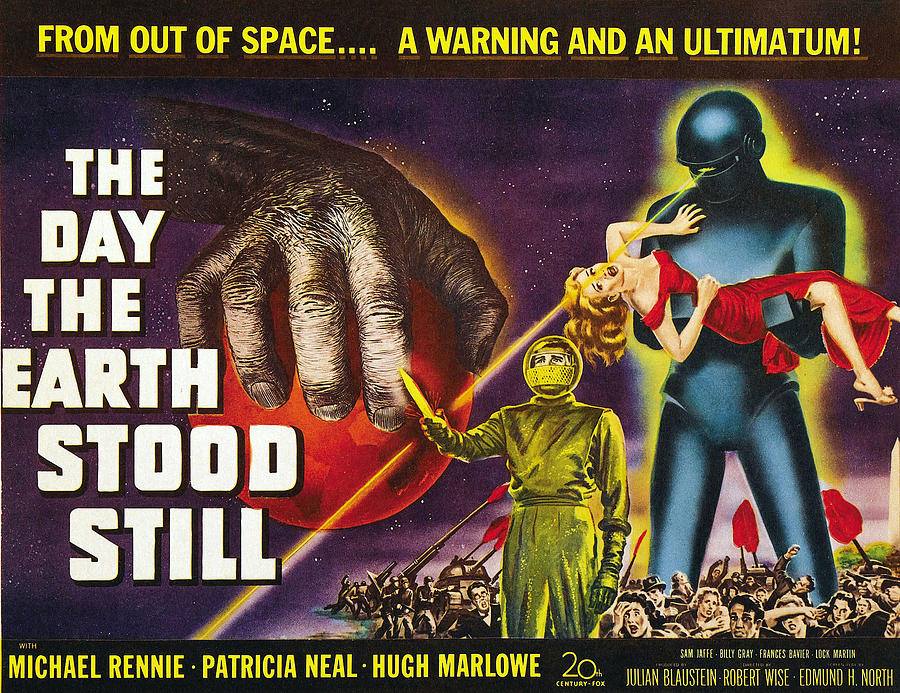
    The “friendly” alien of “The Day the Earth Stood Still,” Klaatu, may come in peace, but it is a message delivered with tough love. If mankind refuses to abide, his robot Gort will destroy the planet. At a time when Martians invariably meant trouble (1951), this was actually progressive. Bernard Herrmann’s score is one of his best, and certainly one of his most interesting. Always an eccentric orchestrator, Herrmann’s concept of extra-terrestrial music incorporates violin, cello, electric bass, two theremins, two Hammond organs, a large studio electric organ, three vibraphones, two glockenspiels, two pianos, two harps, three trumpets, three trombones and four tubas. Overdubbing and tape-reversal techniques were also employed. Now this guy was a composer!

    Finally, Ron Howard’s “Cocoon” is one of the more worthwhile of the seemingly endless procession of extra-terrestrial films to be released in the wake of “E.T.” At least this one took a different approach by bringing alien forces into contact with a Florida retirement community with the unexpected result of rejuvenating its inhabitants. A modern take on the fabled Fountain of Youth, the film is a showcase for veteran actors Hume Cronyn, Jessica Tandy, Jack Gilford and Don Ameche (who won an Academy Award). James Horner’s score is much sought after by collectors.

    People of Earth! Be there for the touchdown of friendly alien films, on “Picture Perfect” – music for the movies – this Friday evening at 6 ET. Or listen to it later as a webcast at http://www.wwfm.org.

    Klaatu barada nikto!

Tag Cloud

Aaron Copland (93) Beethoven (95) Composer (114) Film Music (140) Film Score (143) Film Scores (255) Halloween (94) John Williams (195) KWAX (229) Leonard Bernstein (103) Marlboro Music Festival (125) Movie Music (155) Mozart (89) Opera (210) Philadelphia Orchestra (89) Picture Perfect (174) Princeton Symphony Orchestra (108) Radio (88) Ross Amico (244) Roy's Tie-Dye Sci-Fi Corner (290) The Classical Network (101) The Lost Chord (268) Vaughan Williams (103) WPRB (396) WWFM (881)

DON’T MISS A BEAT

Receive a weekly digest every Sunday at noon by signing up here


RECENT POSTS