Category: Daily Dispatch

  • Moross The Cardinal & Holy Movie Missions

    Moross The Cardinal & Holy Movie Missions

    Tomorrow is the birthday of Jerome Moross, whose music for “The Big Country” secures his place in the pantheon of the great film composers. It was my intention to at least acknowledge him on this week’s “Picture Perfect.” However, since I just did a program devoted to Moross’ western scores only a few months ago, it was necessary to come up with something else. The more I thought about it, the more I saw red – cardinal red.

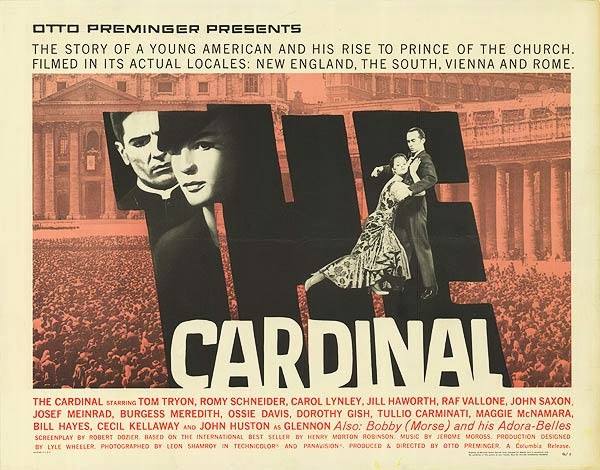
    Otto Preminger’s “The Cardinal” was released in 1963. Based on the novel by Henry Morton Robinson, the story follows a fictional Boston Irish Catholic priest from his ordination in 1917 to his appointment as cardinal on the eve of World War II. Tom Tryon played the lead. Tryon would later become a best-selling author himself (as Thomas Tryon), with books like “The Other” and “Harvest Home.”

    An interesting factoid: The Vatican’s liaison officer for the production was Joseph Ratzinger, the future Pope Benedict XVI.

    As always, Moross’ score is irrepressibly lyrical, even buoyant. The man never seemed to run out of good tunes.

    We’ll also have music from “The Shoes of the Fisherman,” from 1968, another film based on a best-selling novel, this time by Morris L. West.

    Anthony Quinn played Kiril Pavlovich Lakota, an archbishop who serves 20 years in a Siberian labor camp. He is released and sent to Rome where is promoted to the cardinalate. When the Pope dies, suddenly, Lakota, a dark horse candidate, is elected as a replacement. The story balances Lakota’s internal struggles and personal torments with mounting global turmoil.

    The music was by Alex North, who sets the melancholy lyricism of Russian folksong against the steely grandeur of his music for the Vatican.

    The remainder of the program will be devoted to movies about missionaries. Georges Delerue provided a noble, austere score for the 1991 Bruce Beresford film “Black Robe,” based on a novel by the Irish Canadian writer Brian Moore, in which a Jesuit priest treks through 1500 miles of Canadian wilderness on a mission to convert the native tribes of the Huron and the Algonquin.

    Ennio Morricone’s moving music for Roland Joffé’s 1986 film “The Mission,” which featured Jeremy Irons as a Jesuit priest and Robert DeNiro as a reformed slave hunter in the South American jungle, has received a great deal of exposure over the years, both through its use in television commercials and by figure skaters, who made “Gabriel’s Oboe” a recognizable hit. It has become one of Morricone’s best-loved scores.

    Join me for “Holy Men and Missions” this week, on “Picture Perfect” – music for the movies – this Friday evening at 6 ET, or listen to it later as a webcast at http://www.wwfm.org.
  • Amico Method Scripting Challenge Two New Comics

    Amico Method Scripting Challenge Two New Comics

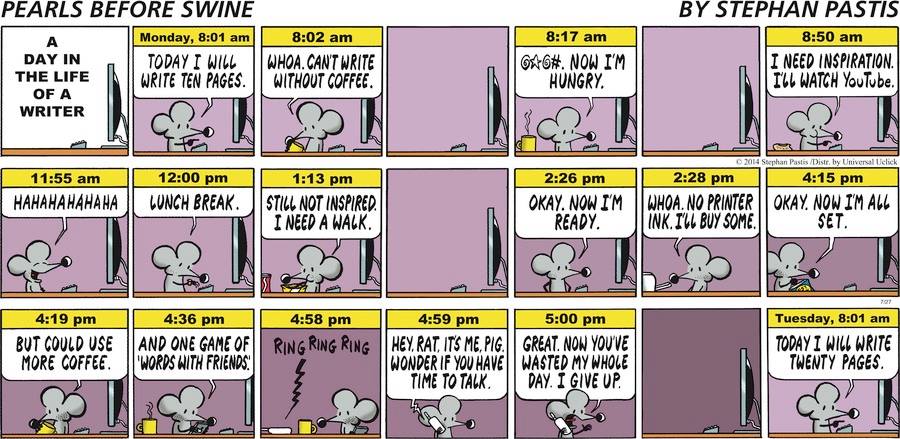
    I have two scripts to write today. This strip, which ran on Sunday, is a sadly accurate reflection of the Amico Method.

  • Mikis Theodorakis A Birthday Tribute & Zorba’s Dance

    Mikis Theodorakis A Birthday Tribute & Zorba’s Dance

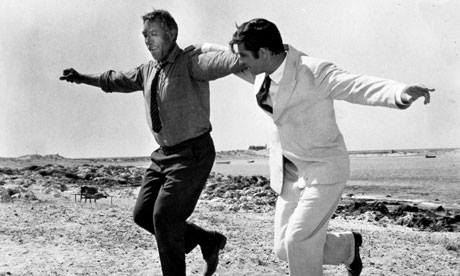
    Mikis Theodorakis’ birthday (born 1925).

    Here’s the music which made him internationally famous:

  • Rued Langgaard Eccentric Danish Genius

    Rued Langgaard Eccentric Danish Genius

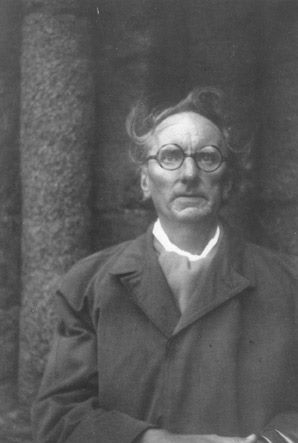
    Rued Langgaard, a name to challenge the English-speaking tongue if ever there was one, followed a vision quite unlike any other in Danish music. A precocious pianist, organist and composer, he studied theory under C.F.E. Horneman and later Vilhelm Rosenberg, with lessons in counterpoint, briefly, under Carl Nielsen.

    His first compositions were published when he was 13. By the time he was 19, his first symphony was performed by the Berlin Philharmonic. After such a promising start, sadly it was all downhill from there.

    Langgaard followed his own eccentric muse deep into the realm of late Romanticism at a time when most of the musical world was exploring modernist territory. Though he was given a state grant at 30, he failed to secure a permanent job until the age of 46, as an organist at the cathedral in Ribe, the oldest town in Denmark – which somehow seems appropriate for this most anachronistic of Danish outsiders.

    An eccentric, shabby figure with wild hair, Laangaard died in Ribe 13 years later, in 1952, just shy of his 59th birthday, still largely unrecognized as a composer.

    His reputation would not begin to gain traction for another 16 years. In all, he composed over 400 works, including 16 symphonies – which bear evocative titles such as “Yon Hall of Thunder” and “Deluge of the Sun” – and an opera, “Antikrist.”

    Langgaard believed he was living in a corrupt age, the age of Antichrist, where the clash of good and evil was coming to a furious climax. The final movement of his “Music of the Spheres” suggests an encounter between Christ and his malevolent doppelganger.

    “Music of the Spheres” was composed between 1916 and 1918. In the preface to the score, the composer describes the work as “celestial and earthly music from red glowing strings, on which life plays with claws of a beast of prey – life, with a crown of iris on its marble face and the stereotypical – yet living – demonic smile on its lily-white cheeks…”

    The descriptive titles of the movements are as follows:

    I. Like sunbeams on a coffin decorated with sweet-smelling flowers
    II. Like the twinkling of stars in the blue sky at sunset –
    III. Like light and the depths –
    IV. Like the refraction of sunbeams in the waves –
    V. Like the twinkling of a pearl of dew in the sun on a beautiful summer’s morning –
    VI. Longing – Despair – Ecstasy –
    VII. Soul of the world – Abyss – All Soul’s Day –
    VIII. I wish…! –
    IX. Chaos – Ruin – Far and near –
    X. Flowers wither –
    XI. Glimpse of the sun through tears –
    XII. Bells pealing: Look! He comes –
    XIII. The gospel of flowers – From the far distance –
    XIV. The new day –
    XV. The end: Antichrist – Christ

    Here is Langgaard’s “Music of the Spheres”:

    And his name pronounced by a native speaker, on Forvo:

    http://www.forvo.com/word/rued_langgaard/

    You go, Rued Langgaard! Happy birthday.

  • Harl McDonald Forgotten American Composer

    Harl McDonald Forgotten American Composer

    Today is one of those days with so many interesting birthday anniversaries, it’s hard to make a choice. Do I write about the brilliant composer-conductor Igor Markevitch (born 1912); the Hungarian composer of so much gorgeous music, Ernő – later Ernst von – Dohnányi (born 1877); or possibly my favorite of Spanish composers, Enrique Granados (born 1867)? I definitely need an air shift to do this one justice.

    Faced with such an embarrassment of riches, I feel a little sheepish focusing on Harl McDonald. But since he has a number of local connections, I think it fitting.

    McDonald was born in Boulder, CO, in 1899. He studied at the University of California, Berkeley, the University of Redlands and the Leipzig Conservatory. In 1927, he was appointed a lecturer at the University of Pennsylvania. He was also director of the university’s music department, its choral society and the University of Pennsylvania Glee Club.

    In addition, he worked as a business manager for the Philadelphia Orchestra for a number of years, and his compositions were performed by Leopold Stokowski and Eugene Ormandy. Both Stokowski and Serge Koussevitzky recorded selections from “San Juan Capistrano” (1938), and Stokowski a good deal else beside.

    Among his other works were four symphonies, a concerto for two pianos, a violin concerto, two piano trios and an assortment of choral works, including “Lament for the Stolen,” written in commemoration of the Lindbergh kidnapping.

    McDonald died in Princeton in 1955.

    There’s actually a surprising number of McDonald rarities posted on YouTube. In fact, my posting this morning has been delayed by so much listening.

    Here’s McDonald’s Symphony No. 1 “Santa Fe Trail”:

    If it picques your interest, there’s plenty else to explore. I have no idea where this guy got some of this stuff (air checks?), but it’s fascinating. My hat’s off to you, fellow traveler!

Tag Cloud

Aaron Copland (93) Beethoven (95) Composer (114) Film Music (140) Film Score (143) Film Scores (255) Halloween (94) John Williams (195) KWAX (229) Leonard Bernstein (103) Marlboro Music Festival (125) Movie Music (155) Mozart (89) Opera (210) Philadelphia Orchestra (89) Picture Perfect (174) Princeton Symphony Orchestra (108) Radio (88) Ross Amico (244) Roy's Tie-Dye Sci-Fi Corner (290) The Classical Network (101) The Lost Chord (268) Vaughan Williams (103) WPRB (396) WWFM (881)

DON’T MISS A BEAT

Receive a weekly digest every Sunday at noon by signing up here


RECENT POSTS