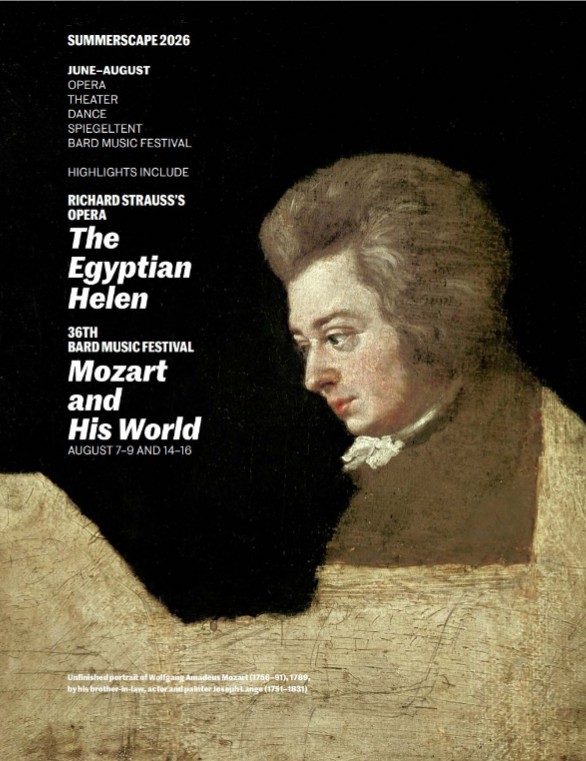
With the Bard Music Festival (“Mozart and His World”) coming up this weekend at Bard College in Annandale-on-Hudson, NY, one thing I forgot to mention is that, if you’re unable to make the pilgrimage for whatever reason, concerts at Sosnoff Hall, in the campus’ Frank Gehry designed Fisher Center at Bard, will be available for livestreaming. This might be of particular interest to anyone hoping to attend opening night, as the concert appears to be sold out. (Of course, there’s always the possibly of lucking into standby tickets.)
“The Many Facets of Mozart” (Friday at 7 p.m. EDT) will feature an assortment of orchestral, vocal, and chamber performances, with old favorites such as the “Paris” Symphony, the Sinfonia concertante for violin and viola, and the Quintet for Piano and Winds (which the composer considered his best work), but also lesser-known pieces such as the Freemasonry influenced “Eine kleine deutsche Kantate” and the concert aria “Ch’io mi scordi di te?,” a very interesting work for soprano and orchestra with piano obbligato. The musical selections will be interleaved with commentary by conductor and co-artistic director Leon Botstein.
“Mozart and Prague” (Saturday at 7 p.m. EDT) will include the “Prague” Symphony, alongside works by the composer’s older Bohemian contemporaries Christoph Willibald Gluck and Josef Mysliveček. Simone Dinnerstein will be the soloist in Mozart Piano Concerto No. 18. As an added bonus, soprano Jana McIntyre, who I made such a fuss over when writing about her appearances at the Bard Berlioz festival, two years ago, and this summer’s production of Richard Strauss’ “The Egyptian Helen,” will sing the motet “Exsultate, jubilate” and an aria from Mysliveček’s opera “Il Bellerofonte.” It’s unclear to me whether the pre-concert talk, by Columbia University’s Elaine Sisman (at 6 p.m.), will be available as part of the livestream, but it has been the case when I’ve viewed some of these concerts in the past.
“Rivalries and Conspiracies (Sunday at 3 p.m. EDT) looks to be an especially fascinating program, illuminating the true nature of the relationship between Mozart and Antonio Salieri. Included will be a collaborative effort by the two composers, rediscovered as recently as 2015, “Per la ricuperate salute di Ofelia” (“For the recovered health of Ophelia”).
The second half of the concert will juxtapose selections from two operas – Mozart’s “Der Schauspieldirektor” (“The Impresario”) and Salieri’s “Prima la musica e poi le parole” (“First the music and then the words”) – which were first performed at opposite ends of an orangery AT THE SAME TIME, with the audience seated in the middle! The aim was so that the emperor, Joseph II, could determine which of the operas would delight the court more.
Both operas satirize the behind-the-scenes antics that occur during the creation of an opera. Between the meta-concept and its Ivesian realization, it all seems surprisingly modern. Also, the mad whim of a daffy ruler. I wonder if Hugo von Hofmannsthal had this in mind when he wrote the libretto for Richard Strauss’ “Ariadne auf Naxos?” In the Strauss opera, a wealthy patron (the richest man in Vienna) decides that the two works he commissioned, a drama and a comedy, should performed simultaneously, so that the entertainment will conclude in time for a fireworks display!
The Sunday program will also include a piano sonata by another Mozart rival, Muzio Clementi, whom Mozart once faced down in a piano duel. The match was deemed a tie, when the Emperor backed Mozart, but the Grand Duchess Maria Fyodorovna of Russia chose Clementi. Regardless, it was Mozart who had the last laugh, when he used a passage from Clementi’s sonata as the germ for his overture to “The Magic Flute.”
The pre-concert talk, at 2:00, will be delivered by McGill University’s Dorian Bandy.
Livestreams will also be offered from the Fisher Center during the festival’s second weekend (“Beauty, Charity and Reason” on Friday, August 14, at 7 p.m., “Family, Friends and Students” on Saturday, August 15, at 7 p.m., and a semi-staged performance of “The Abduction from the Seraglio” on Sunday, August 16, at 3:00 p.m. EDT).
Sorry, but in order to enjoy the morning and afternoon programs and panels across campus at Olin Hall, you’ll actually have to be in attendance!
“Mozart and His World” will take place at Bard College August 7-16. For more information, follow the link.
https://fishercenter.bard.edu/what-we-do/bard-music-festival/?gad_source=1&gad_campaignid=23614040550&gbraid=0AAAAACyZZJveNzj1-YYl9V6bTicb364wl&gclid=EAIaIQobChMI1_HItIyMlgMVTkP_AR0-tRbFEAAYASABEgK4afD_BwE
Livestreamed Content from the Bard Music Festival
by
2 responses
Comments
2 responses to “Livestreamed Content from the Bard Music Festival”
-
Hey, I have a question for you…do you agree that most of these genius composers suffered from some type of mental condition, like Autism or Schizophrenia? How else do you explain how they had all that music trapped in their heads? And how they were able to channel it into the work they did…. just curious about your opinion…
-
Lesley Siedt I am not qualified to comment on that. But I will. I often have music in my head (it comes to me in my dreams), but I don’t have the facility to write it down. I’ve never been diagnosed as being autistic! But you’re talking about geniuses. On the one hand, you have composers with genuine mental health struggles, like Robert Schumann and Hugo Wolf. On the other hand, you’ve got Mendelssohn and Richard Strauss, both fairly well-adjusted artists from the upper middle class. Periods of depression seem to be common, though, but I would think that would be the case for any fairly intelligent human being. On the other hand, elevated moods can be conducive to creativity, so it’s possible that someone with wild swings, who is in a manic phase, can be playful and free and have the energy to churn out a sonata or a symphony when the rest of us are asleep. Again, I’m not bipolar, so I don’t want to promote a stereotype. My opinion is that you don’t have to have a mental condition to be a good artist. You have to have talent and inspiration and discipline, and optimally, some training, so that you have the vocabulary to express yourself and give your inspirations form, and they don’t just die unexpressed in your head or emerge inadequately realized. Someone with serious mental health issues could have struggles that actually interfere with many aspects of his or her life, creative or otherwise. It’s hard to sustain a creative existence if you can’t function, you haven’t figured out how to support yourself and keep turmoil to a minimum in your relations with others, and you don’t have discipline. “Genius,” that ability to channel ideas and bring beauty into the world and to express it in with clarity and emotion and humanity (bonus for a semblance of perfection), is a gift, but for anyone who hopes to make their living as an artist, creating is also a job. And to hold a job, you have to be able to function. You have to be able to muster the focus and the drive to show up for work, meet deadlines, and pay your bills. You may have to secure commissions or grants, which also requires one to be halfway competent with some decent life skills. At least until you get to the point where you’re successful and everyone wants you. Then you can let it all hang out!
-
Tag Cloud
Aaron Copland (93) Beethoven (95) Composer (114) Film Music (145) Film Score (143) Film Scores (255) Halloween (94) John Williams (195) KWAX (229) Leonard Bernstein (104) Marlboro Music Festival (125) Movie Music (160) Mozart (91) Opera (213) Philadelphia Orchestra (89) Picture Perfect (174) Princeton Symphony Orchestra (109) Radio (88) Ross Amico (244) Roy's Tie-Dye Sci-Fi Corner (290) The Classical Network (101) The Lost Chord (269) Vaughan Williams (105) WPRB (397) WWFM (881)
Leave a Reply