Tag: Amadeus

  • Tim Curry:  From Frank N. Furter to Mozart (With a Digression on Frank Langella’s Dracula)

    Tim Curry: From Frank N. Furter to Mozart (With a Digression on Frank Langella’s Dracula)

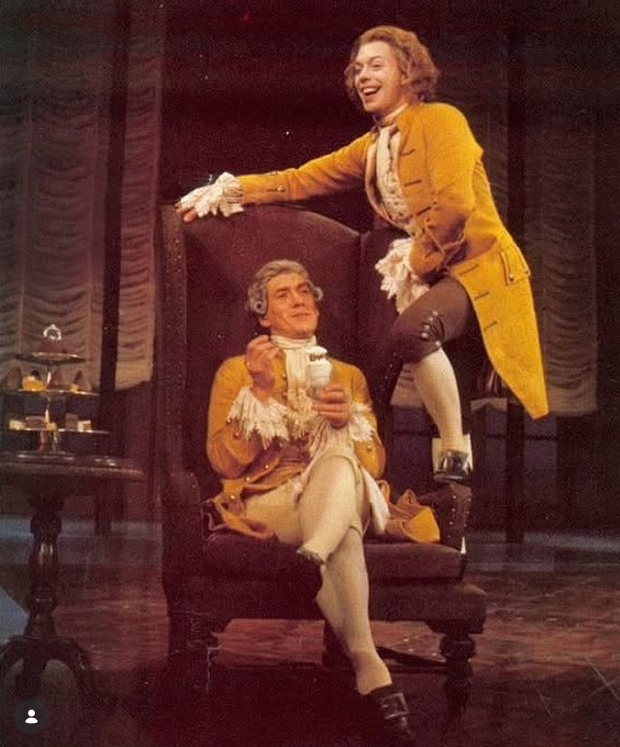
    And now Tim Curry is gone. He’ll always be remembered for his audacious turn as Frank-N-Furter, but here he is as Mozart, with Ian McKellen as Salieri, in “Amadeus.” This production of Peter Shaffer’s play opened on Broadway in December 1980, its U.S. debut, also featuring Jane Seymour as Constanze. “Amadeus” was first presented in London in 1979, with Paul Scofield as Salieri and Simon Callow as Mozart. Curry’s death was announced yesterday. He was 80 years old.

    There are a few Broadway shows I missed that I would have loved to have seen. In 1980, I was still basically a kid, and if my parents didn’t take me to see something, I didn’t see it. Thankfully, we did go to a few shows a year, mostly musicals, though my parents went to more (which I don’t begrudge them!). Given my burgeoning interest in classical music (I made them listen to a cassette of the “Eroica” Symphony on a drive in to the city), I don’t know why we didn’t see “Amadeus.”
    Another show I would have gone crazy for was the Edward Gorey production of “Dracula,” with Frank Langella (who also played Salieri on Broadway, opposite Dennis Boutsikaris as Mozart). Before I was bitten by the classical music bug, I was crazy for the Universal horror pictures. My parents did see this one. I don’t know why I wasn’t invited. I can’t complain, though. I saw a lot. I just should have seen these two!

    From what I understand, there is an audio-visual recording of the McKellen-Curry “Amadeus” archived at the New York Public Library of the Performing Arts, but it is accessible only for research purposes. I don’t know if “Dracula” was documented.
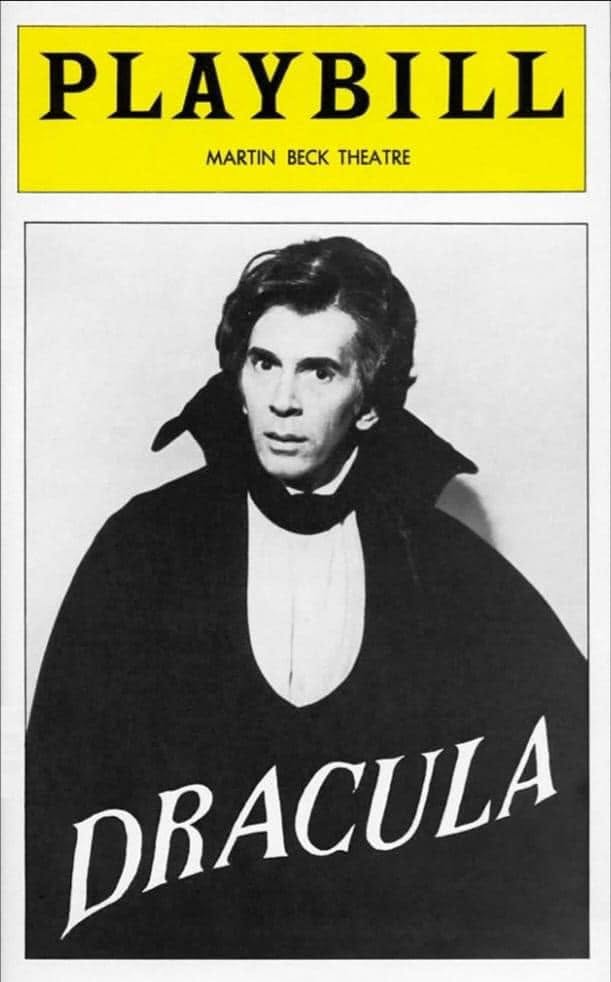
    I was beyond excited when I saw the trailer for Langella’s film version (with music by John Williams!), but by all accounts, the Broadway show was the one to see. The film was viewed as a disappointment (and, Langella aside, it is), but on Broadway it was a sensation, with Tony Awards for Gorey’s costume designs and for “Most Innovative Production of a Revival.”

    Bela Lugosi appeared in the original Broadway production in 1927, 50 years earlier. Of course, Lugosi went on to star in the classic 1931 film and was typecast as a horror actor for the rest of his life.

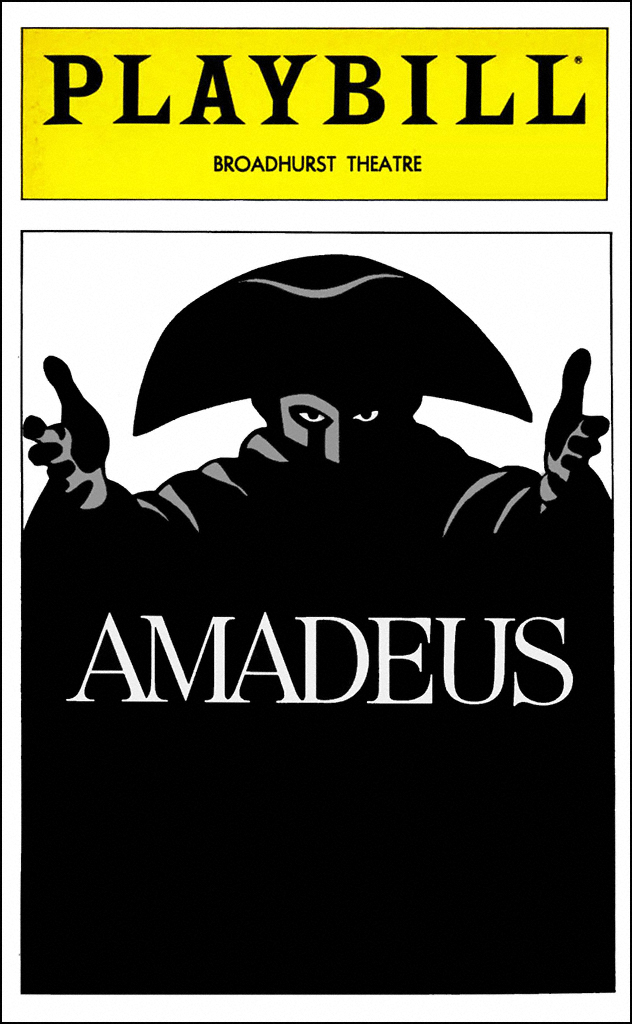
    You’ll find images of the “Amadeus” Playbill at the link:

    https://playbill.com/production/amadeus-broadhurst-theatre-vault-0000002018
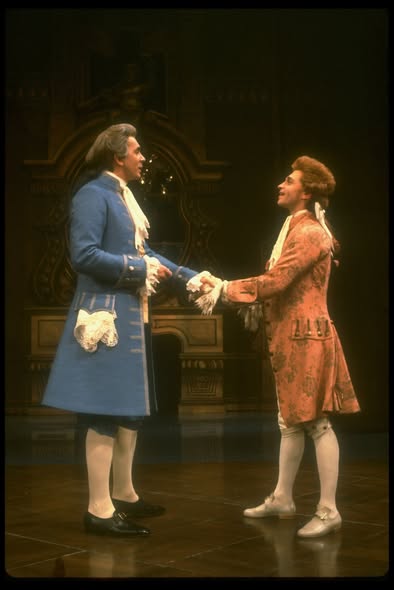
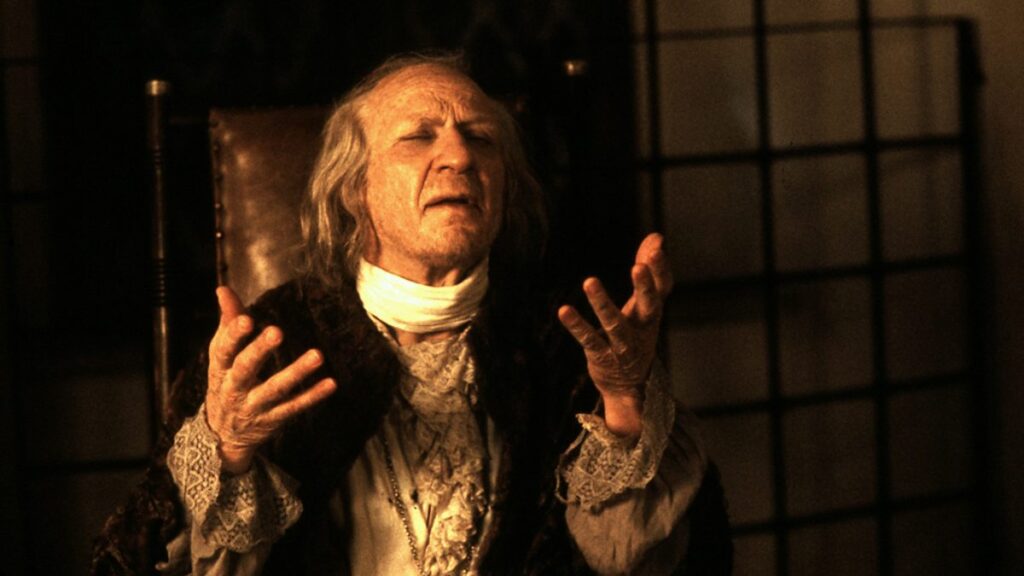
    Langella and Boutsikaris in “Amadeus”
  • Antonio Salieri:  Sustained by Centuries of Notoriety

    Antonio Salieri: Sustained by Centuries of Notoriety

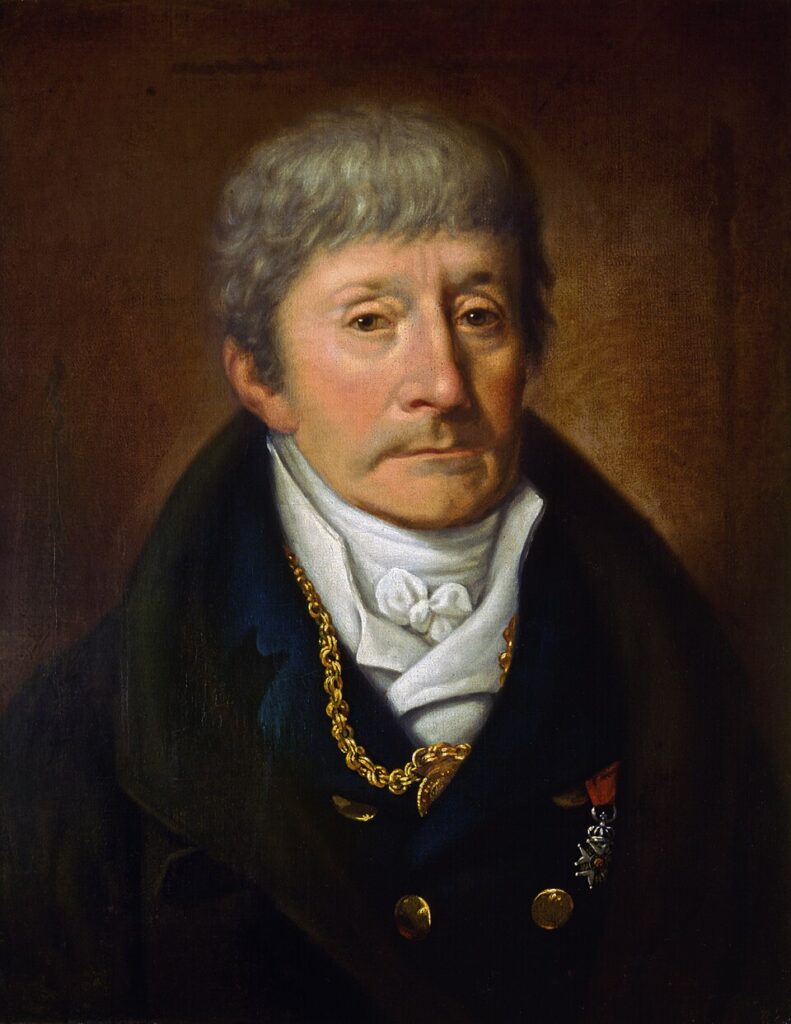
    In 1830, roughly 150 years before Peter Shaffer’s “Amadeus,” Alexander Pushkin seized onto the rumor that Antonio Salieri poisoned Mozart, for his poetic drama “Mozart and Salieri.” To put it in historical context, Salieri had died only five years earlier, at the age of 74, outliving Mozart by nearly 34 years. (Mozart died at 35 in 1791.) How did the rumor come about? Well, Mozart himself started it.

    Symptoms of the composer’s final illness were noted during the first performance of his opera “La Clemenza di Tito,” when he was observed by a friend to be pale and sad. When Mozart returned to Vienna to continue work on his Requiem, he remarked to Constanze, his wife, that he suspected he had been poisoned – with aqua toffana, a slow-acting arsenic-based agent – at least according to her recollections 25 years later, in 1824. However, such a crime would have required repeated doses, and Mozart subsequently waffled on the assertion. What’s certain is that three months later, he was dead.

    Nobody knows the whereabouts of Mozart’s body, so we can’t dig up his remains and do forensic testing (thank goodness), but his physician dismissed poisoning as a cause, with confidence.

    Ironically, Salieri actually did confess to Mozart’s murder, but he did so in an unbalanced frame of mind. He was slipping into dementia, haunted by the rumors, and even attempted suicide (only providing more grist for the mill). In more lucid moments, he repeatedly, vehemently denied it.

    The actual relationship between the two was much more nuanced, significantly less bitter and more collegial. For his part, Salieri revived “The Marriage of Figaro.” He was also responsible for arranging first performances of Mozart’s Piano Concerto No. 22 (K. 482), the Clarinet Quintet, and the Symphony No. 40. He was full of praise for “The Magic Flute.” He also took Mozart’s younger son Franz Xaver as a pupil. (Salieri’s other students included Beethoven, Hummel, Czerny, Schubert, and Liszt.)


    I’ve never actually read Pushkin’s “Mozart and Salieri” (also the basis for Rimsky-Kosakov’s one-act opera of 1897). It’s only ten pages long in my Modern Library edition of Pushkin poems, prose & plays. Is it disrespectful to read it on Salieri’s birthday?

    Hey, in 1830, Salieri was beyond feeling a thing. As far as I’m concerned, artists of Pushkin’s and Shaffer’s abilities can play with historic fact if it’s in the service of expressing greater truths. Where would Salieri be if not for “Amadeus?” Now everyone knows his name, and many of his works have been revived and recorded, thanks to his enduring notoriety.


    Compare this with actual composer-murderer Carlo Gesualdo. Your average person on the street has no idea who Gesualdo is. He still awaits his Peter Shaffer.

    FUN FACT: The relationship of Mozart and Salieri is also dealt with in Albert Lortzing’s singspiel “Szenen aus Mozarts Leben” (“Scenes from Mozart’s Life”) of 1832, for which Lortzing repurposes Mozart’s music.

    Here’s a 1958 Russian television production of Pushkin’s play, the only one of his dramatic works to be staged in his lifetime, closed captioned in English. Pushkin died from a wound received in a duel at the age of 37.


    Russian film of Rimsky-Korsakov’s opera (without subtitles)


    U.S. performance work from the 1980s, sung in English


    Beethoven’s Variations on Salieri’s “La stessa, la stessissima”


    The theme, from Salieri’s “Falstaff”


    Overture to “Les Horaces”


    Concerto for Flute, Oboe and Orchestra


    “Das Lob der Musik” (“The Praise of Music”)


    A Mozart and Salieri collaborative effort, the cantata “Per la ricuperata salute di Ofelia”


    “De Profundis”


    “I absolve you.”


  • Livestreamed Content from the Bard Music Festival

    Livestreamed Content from the Bard Music Festival

    With the Bard Music Festival (“Mozart and His World”) coming up this weekend at Bard College in Annandale-on-Hudson, NY, one thing I forgot to mention is that, if you’re unable to make the pilgrimage for whatever reason, concerts at Sosnoff Hall, in the campus’ Frank Gehry designed Fisher Center at Bard, will be available for livestreaming. This might be of particular interest to anyone hoping to attend opening night, as the concert appears to be sold out. (Of course, there’s always the possibly of lucking into standby tickets.)

    “The Many Facets of Mozart” (Friday at 7 p.m. EDT) will feature an assortment of orchestral, vocal, and chamber performances, with old favorites such as the “Paris” Symphony, the Sinfonia concertante for violin and viola, and the Quintet for Piano and Winds (which the composer considered his best work), but also lesser-known pieces such as the Freemasonry influenced “Eine kleine deutsche Kantate” and the concert aria “Ch’io mi scordi di te?,” a very interesting work for soprano and orchestra with piano obbligato. The musical selections will be interleaved with commentary by conductor and co-artistic director Leon Botstein.

    “Mozart and Prague” (Saturday at 7 p.m. EDT) will include the “Prague” Symphony, alongside works by the composer’s older Bohemian contemporaries Christoph Willibald Gluck and Josef Mysliveček. Simone Dinnerstein will be the soloist in Mozart Piano Concerto No. 18. As an added bonus, soprano Jana McIntyre, who I made such a fuss over when writing about her appearances at the Bard Berlioz festival, two years ago, and this summer’s production of Richard Strauss’ “The Egyptian Helen,” will sing the motet “Exsultate, jubilate” and an aria from Mysliveček’s opera “Il Bellerofonte.” It’s unclear to me whether the pre-concert talk, by Columbia University’s Elaine Sisman (at 6 p.m.), will be available as part of the livestream, but it has been the case when I’ve viewed some of these concerts in the past.

    “Rivalries and Conspiracies (Sunday at 3 p.m. EDT) looks to be an especially fascinating program, illuminating the true nature of the relationship between Mozart and Antonio Salieri. Included will be a collaborative effort by the two composers, rediscovered as recently as 2015, “Per la ricuperate salute di Ofelia” (“For the recovered health of Ophelia”).

    The second half of the concert will juxtapose selections from two operas – Mozart’s “Der Schauspieldirektor” (“The Impresario”) and Salieri’s “Prima la musica e poi le parole” (“First the music and then the words”) – which were first performed at opposite ends of an orangery AT THE SAME TIME, with the audience seated in the middle! The aim was so that the emperor, Joseph II, could determine which of the operas would delight the court more.

    Both operas satirize the behind-the-scenes antics that occur during the creation of an opera. Between the meta-concept and its Ivesian realization, it all seems surprisingly modern. Also, the mad whim of a daffy ruler. I wonder if Hugo von Hofmannsthal had this in mind when he wrote the libretto for Richard Strauss’ “Ariadne auf Naxos?” In the Strauss opera, a wealthy patron (the richest man in Vienna) decides that the two works he commissioned, a drama and a comedy, should performed simultaneously, so that the entertainment will conclude in time for a fireworks display!

    The Sunday program will also include a piano sonata by another Mozart rival, Muzio Clementi, whom Mozart once faced down in a piano duel. The match was deemed a tie, when the Emperor backed Mozart, but the Grand Duchess Maria Fyodorovna of Russia chose Clementi. Regardless, it was Mozart who had the last laugh, when he used a passage from Clementi’s sonata as the germ for his overture to “The Magic Flute.”

    The pre-concert talk, at 2:00, will be delivered by McGill University’s Dorian Bandy.

    Livestreams will also be offered from the Fisher Center during the festival’s second weekend (“Beauty, Charity and Reason” on Friday, August 14, at 7 p.m., “Family, Friends and Students” on Saturday, August 15, at 7 p.m., and a semi-staged performance of “The Abduction from the Seraglio” on Sunday, August 16, at 3:00 p.m. EDT).

    Sorry, but in order to enjoy the morning and afternoon programs and panels across campus at Olin Hall, you’ll actually have to be in attendance!

    “Mozart and His World” will take place at Bard College August 7-16. For more information, follow the link.

    https://fishercenter.bard.edu/what-we-do/bard-music-festival/?gad_source=1&gad_campaignid=23614040550&gbraid=0AAAAACyZZJveNzj1-YYl9V6bTicb364wl&gclid=EAIaIQobChMI1_HItIyMlgMVTkP_AR0-tRbFEAAYASABEgK4afD_BwE

  • Mozart and Salieri at the Bard Music Festival

    Mozart and Salieri at the Bard Music Festival

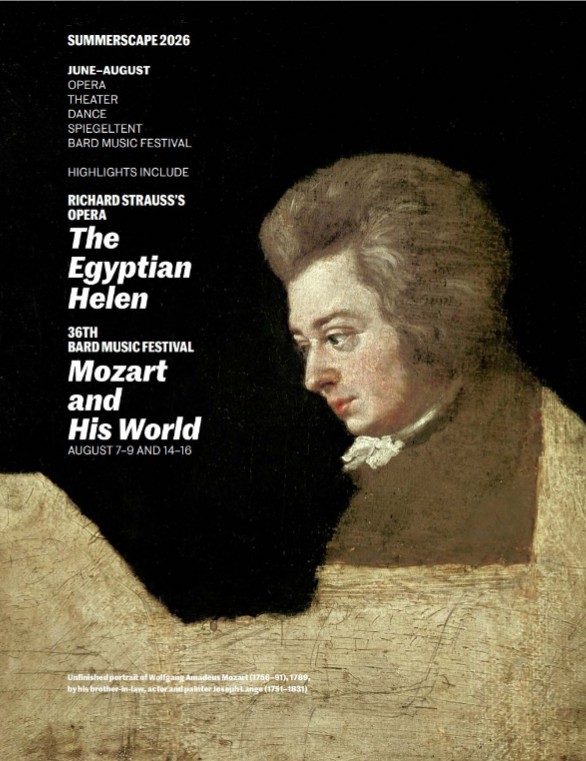
    On this date in 1778, the world’s most famous opera house, Milan’s Teatro alla Scala (La Scala for short), was opened with “L’Europa Riconosciuta,” or “Europa Revealed,” a work composed especially for the occasion by Antonio Salieri. What better opportunity to remind you that this year’s Bard Music Festival, “Mozart and His World,” will commence this weekend at Bard College in Annandale-on-Hudson, NY?

    Playwright Peter Shaffer and his forebears (notably Pushkin) would have us believe that a rivalry between the two composers drove a jealous Salieri to scheme “the monster” into an early grave. But the actual relationship between the two was much more nuanced, with Salieri promoting Mozart’s works and even instructing one of his children (as well as Beethoven, Hummel, Czerny, Schubert, and Liszt). Mozart and Salieri even collaborated on a work, rediscovered in 2015, “Per la ricuperate salute di Ofelia” (“For the recovered health of Ophelia”), which will be heard at the festival.

    In the theater and at the movies (and now television), there is no obligation for artists to adhere to historical fact in pursuit of their own dramatic ends. But I’m confident the scholars at Bard are not going to let the enduring Salieri legend slip past without comment.

    Bard missed a trick in not reviving Salieri’s La Scala opera. Instead, the festival will conclude with the Mozart opera most performed during his lifetime – not “Figaro,” “Don Giovanni,” “Cosi,” or “The Magic Flute,” but “The Abduction from the Seraglio.”

    Even so, while the focus is always on the music, the Bard experience is so much more. The programming – a careful juxtaposition of works and composers – is further illuminated by biographical, historical, and musicological context.

    This year, there are a few more familiar selections than has been the custom (the subject is, after all, Mozart), but there are more than enough detours to maintain interest. And all the concerts are organized around a particular theme. It’s possible for one to go to Bard either for the deep dive, attending preconcert talks and panels and chatting up the resident scholars, or for the simple diversion and enjoyment of musicmaking at a very high level in two venues, on a pleasant, green campus situated in the Hudson Valley against the backdrop of the Catskills.

    Some of Mozart’s well-known works will be presented to establish context, but there will be plenty of music I guarantee you will have never heard and composers you will only know perhaps from reading about them in music histories.

    As more detailed information has become available, I am delighted to find that Princeton’s Scott Burnham will be among the visiting scholars, Byron Adams will deliver the pre-concert talk for this Saturday afternoon’s concert, “Fathers and Sons” (featuring music of Mozart’s dad, Leopold, and some by the Bach boys), and pianist Simone Dinnerstein will perform two Mozart concertos on Saturday night (alongside works by Christoph Willibald Gluck and Josef Myslivecek).

    Salieri wouldn’t be the only one envious to attend.

    “Mozart and His World” will be held at Bard College August 7-16. Here’s the complete schedule at a glance.

    https://fishercenter.bard.edu/what-we-do/bard-music-festival/

    ———-

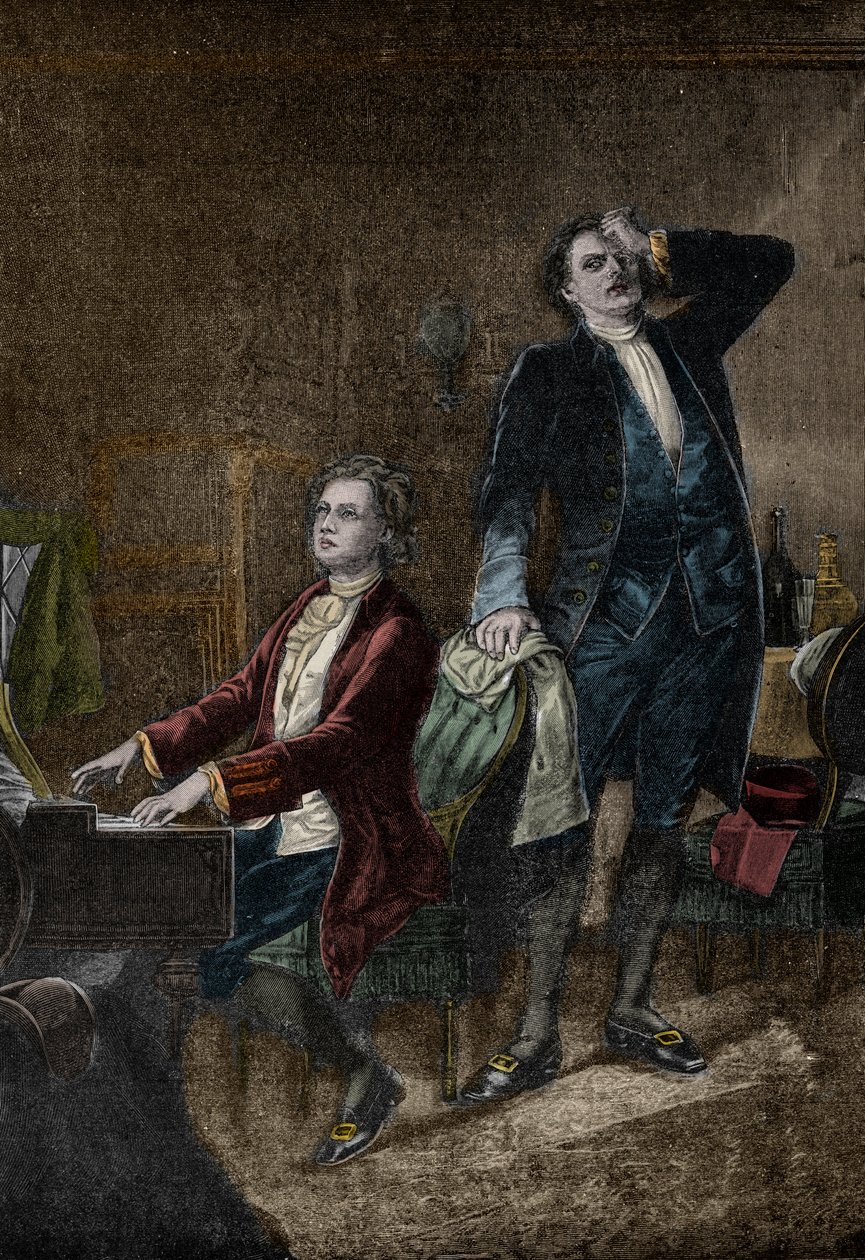
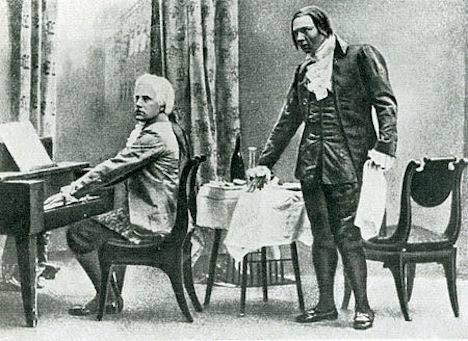
    IMAGE: Illustration for Pushkin’s “Mozart and Salieri,” 1830

  • Amadeus at 40 Examining Genius and Jealousy

    Amadeus at 40 Examining Genius and Jealousy

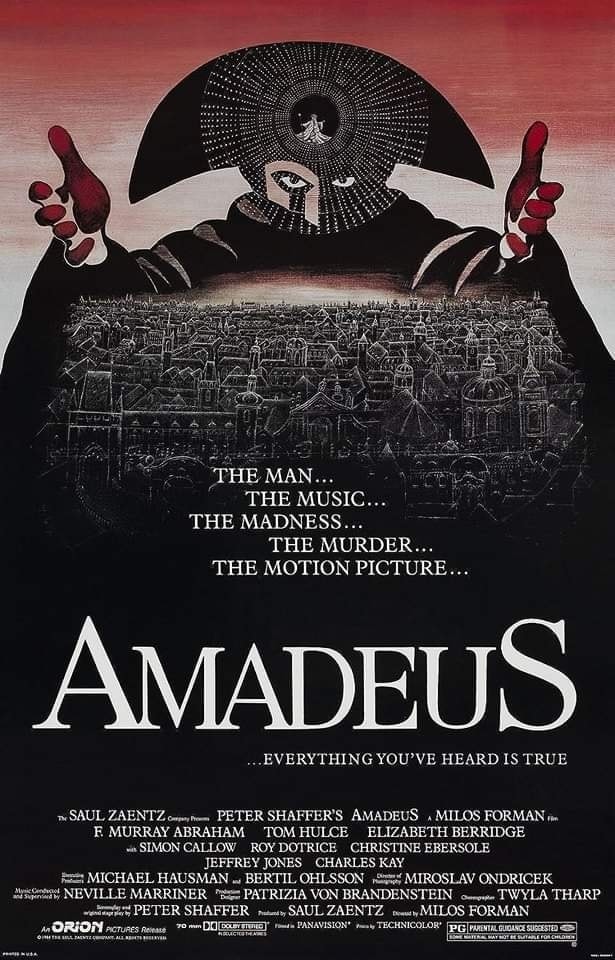
    “Amadeus” opened nationwide on this date 40 years ago.

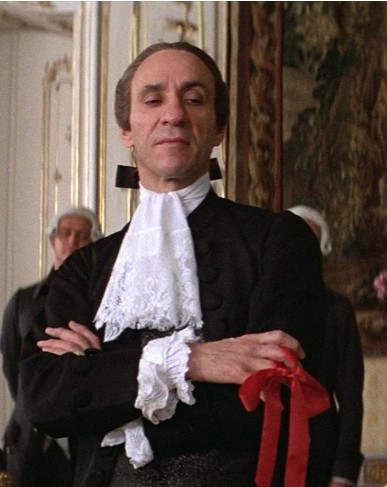
    Milos Forman’s film of Peter Shaffer’s play is that rarest of animals: popular entertainment set in the world of classical music that doesn’t talk down to the audience and actually for the most part gets it right.

    By this I do not mean the historical facts, with which the creators play fast and loose (to the best of our knowledge, Salieri did NOT plot Mozart’s death, and in fact got along with him as well as any rival possibly could), but rather the broader truths underlying the all-too-human dilemmas that face the film’s “antagonist,” with whom every one of us can relate.

    Why does this jerk I work with get all the recognition? What does this idiot have that I don’t? What is the source of genius? Why does it so seldom match up with personal ambition? How can a spark of the divine exist in this… creature? What is the nature of creativity? Why is talent so random? What do I do with these feelings of resentment? How does jealousy corrupt?

    Furthermore, the film is a hell of a lot of fun, with plenty of broad, crowd-pleasing moments – the emperor is a boob, the court musicians ludicrous schemers, and the artists flagrant bohemians who swill from wine bottles as they stride the colorful streets of Vienna (really Prague), shop for fright wigs, and have very silly laughs – without ever teetering over into farce.

    Critics AND audiences lapped it up, and the film was decorated with eight Academy Awards, including those for Best Picture, Best Director, Best Adapted Screenplay (for Shaffer), and Best Actor (F. Murray Abraham in the performance of his career).

    Avoid the director’s cut, except as a curiosity or “bonus feature.” It was assembled too long after the fact and changes the tone of the picture, expanding the running time by 20 minutes and hardening the original PG rating to an R. A new 4K UHD Blu-Ray of the theatrical cut is imminent, if it’s not out already.

    Sadly, they just don’t make ‘em like this anymore. Happy 40th, “Amadeus.”

Tag Cloud

Aaron Copland (93) Beethoven (95) Composer (114) Film Music (143) Film Score (143) Film Scores (255) Halloween (94) John Williams (195) KWAX (229) Leonard Bernstein (104) Marlboro Music Festival (125) Movie Music (158) Mozart (90) Opera (212) Philadelphia Orchestra (89) Picture Perfect (174) Princeton Symphony Orchestra (108) Radio (88) Ross Amico (244) Roy's Tie-Dye Sci-Fi Corner (290) The Classical Network (101) The Lost Chord (269) Vaughan Williams (105) WPRB (397) WWFM (881)

DON’T MISS A BEAT

Receive a weekly digest every Sunday at noon by signing up here


RECENT POSTS