Category: Daily Dispatch

  • Czech Composers’ Forbidden Love Affairs

    Czech Composers’ Forbidden Love Affairs

    Anyone at all acquainted with the life story of Leoš Janáček knows about his relationship with Kamila Stasslova. Stasslova was the married woman, 38 years Janáček’s junior, who was the recipient of his “intimate letters” (hence, the subtitle of his autobiographical String Quartet No. 2). Though the relationship was chaste one, she instilled in the composer an ardor which propelled him into the creation of a series of masterworks that spanned his final decade. This is the music which essentially made Janáček’s reputation as a composer for the ages.

    This Sunday night on “The Lost Chord,” we’ll have two more examples of Czech extramarital love that resulted in flowering creativity. Vitězslava Kaprálová undoubtedly would be much better known had she not died of tuberculosis at the age of 25. The brilliant Kaprálová seemed poised to become the best-known woman composer and conductor in Europe. Her teachers included Vitězslav Novák, Václav Talich, Charles Munch, Nadia Boulanger and Bohuslav Martinů.

    Her relationship with Martinů deepened into one of romantic love, which fueled some of the older composer’s most powerful works, as he grappled with his emotional turmoil, caught as he was between his wife and an irresistible attraction to his star pupil.

    Kaprálová reciprocated, producing a number of pieces under Martinů’s influence, generally submitting them for his approval. One such work was the “Partita for Piano and String Orchestra,” composed in 1938 and 1939. Martinů is said to have made a substantial contribution to its final version.

    The idea for this particular thesis came from a consideration of Zdeněk Fibich, the unsung Czech master who was roughly nine years younger than Dvořák. Fibich led something of a turbulent emotional life. When his first wife was about to give birth to twins, one of her sisters came to help out with the delivery. The sister and one of the newborns fell ill and died. They were followed within two years by the other child and Fibich’s wife.

    Fibich promptly married another of his wife’s sisters, only to abandon her and the son she bore him, in favor of one of his pupils, Anežka Schulzová. He documented the affair, musically, in his collection of piano pieces, “Moods, Impressions and Reminiscences,” composed between 1892 and 1899. He referenced material therein in a number of works written during the last decade of his life.

    One of these was the Symphony No. 2, which incorporates the musical reminiscence about the day he declared his love to Schulzová. This occurs in the second movement of the symphony, with another full-blown statement in the finale.

    I hope you’ll join me for “Bohemian Lifestyle: Illicit Love in Czech Music,” this Sunday night at 10 ET. “The Lost Chord” repeats Friday morning at 3, or you can listen to it later as a webcast, at http://www.wwfm.org.

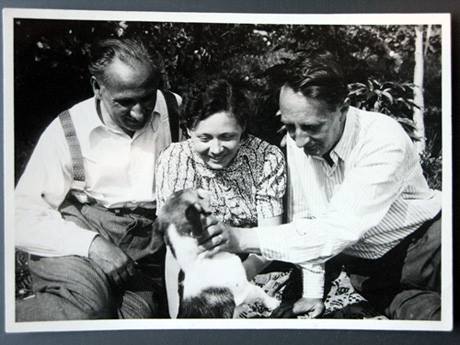
    PHOTO: (left to right) Václav Kaprál, Vítězslava Kaprálová аnd Bohuslav Martinů, with friend

  • Conan’s Great Movie Music Soundtracks

    Conan’s Great Movie Music Soundtracks

    In “Conan the Destroyer” (1984), one of Conan’s companions speculates, “I suppose nothing hurts you.”

    To which he replies, “Only pain.”

    Discriminating viewers may feel a little pain themselves watching these silly, cheesy and violent films, all of which were inspired by the writings of pulp master Robert E. Howard. Howard created the warrior Conan in 1932. The character became the center of a series of lucrative stories first published in “Weird Tales” magazine.

    In 1982, Conan made the leap to the big screen, under the guidance of director John Milius. The film, “Conan the Barbarian,” made Arnold Schwarzenegger, already a legend in the field of bodybuilding, an international superstar. While “Conan” isn’t exactly “Citizen Kane,” it does have its pleasures. The intensity of the violence can be a little disturbing, but the ponderous tone is a blast. “Conan” is a film that takes itself just seriously enough to make it occasionally hilarious.

    Another thing “Conan” had going for it was the fact that it was made on a blockbuster budget. The first-rate production values extended to the music by Basil Poledouris, who employed a full symphony orchestra to impressive ends. In fact, the “Conan” score is one of the strongest of the decade. It’s amazing that anyone would find so much inspiration in such a mediocre film, but Poledouris’ music intersperses Central Asia-style lyricism with brawny, thrilling action music.

    Sadly, the sequel, “Conan the Destroyer,” showed all-too-evident signs of penny-pinching, so that it often wound up feeling like a direct-to-video production. Poledouris was forced to make do with a smaller orchestra, which at times sounds like a television ensemble. Still, he gave it his all, and there’s something to be said for the fact that it is an original score, rather than a mere retread of the original.

    In 1997, Howard’s Kull of Atlantis was given the big screen treatment as “Kull the Conqueror.” Kevin Sorbo, TV’s Hercules, played the title role. The composer, Joel Goldsmith (son of Jerry Goldsmith), was asked to incorporate heavy metal riffs into his orchestral underscore. I haven’t actually seen this one, but for some reason I don’t feel like I’m missing anything.

    The astoundingly prolific Ennio Morricone – who has more than 500 motion picture and television scores to his name – has an uncanny knack for spinning garbage into gold. His music for “Red Sonja” (1985) lends the film an aura of ‘80s fun, perhaps more so than it deserves. This is the film that introduced Brigette Nielsen as the chain-mailed barbarian beauty. Schwarzenegger appears in the supporting role of Lord Kalidor.

    In the ‘80s, even bad films had great scores. I hope you’ll give “Conan the Barbarian” a chance this week, on “Picture Perfect” – music for the movies – this Friday evening at 6:00 ET, or enjoy it later as a webcast at http://www.wwfm.org.

    By the way, is it pronounced “Co-NAN,” as it was in the 1982 version, or “CO-nin,” as it was in the 2011 remake? Interesting meditation here:

    http://www.vulture.com/2011/08/conan_the_barbarian_has_change.html

    I pronounce it “Co-NAN” in the promo, and “CO-nin” in the show.

  • Film Scores Why Aren’t They Great Anymore

    Film Scores Why Aren’t They Great Anymore

    The Orquestra Sinfônica Brasileira strikes back with music of John Williams:

    http://www.classicfm.com/music-news/latest-news/john-williams-youtube-save-brazilian-symphony/

    Granted, the story is a year old, but clearly people still respond to this music. So why are most film scores today so anonymous, slipshod or just plain lacking in craftsmanship? I understand that a tight post-production schedule can leave little time for the film composer to do his job, but surely there must be someone of a caliber of a Jerry Goldsmith out there, who could churn out a decent score before breakfast.

    There are probably still a lot of people who don’t actively think about the fact that the music they hear in the movies is being played by very talented orchestral musicians. (That is, when it isn’t being sampled on a keyboard.) For them, perhaps, it’s just something that emanates from the screen. Exposure is key. Ironically, in an age when everything is a keystroke away, there seems to be less of that than ever before. It’s a useful endeavor to bring this music to the public and to play it with passion and commitment.

    I wonder if the day will ever come when the very best music written for film will be held on a level with incidental music written for plays by earlier masters? It would be nice to hear something more than snappy main title music dished up on pops concerts or, what seems to be the latest trend, music performed live with the actual movies. These practices have their place, but why not program a suite from “E.T.” or “Ben-Hur” or “The Bride of Frankenstein” or “The Adventures of Robin Hood” once in a while? Let the music speak for itself.

    And spare me the condescending program notes. Other folks besides Prokofiev and Walton have written great music for the screen.

    The Philadelphia Orchestra will be performing musical selections from Pixar films at The Kimmel Center for the Performing Arts this Friday at 7 p.m. and Saturday at 2 p.m. The press release promises selections from 14 films, so expect a lot of short pieces, with film clips. Still, with music by Michael Giacchino, Thomas and Randy Newman, and Patrick Doyle, why complain? They’re some of the best film composers working today, and Pixar makes some of the best movies. It seems like an ideal intro for the kids.

    http://www.philorch.org/concert/philadelphia-orchestra-pixar-concert

  • Beach Vacation with Composers Respighi Debussy Schoenberg

    Beach Vacation with Composers Respighi Debussy Schoenberg

    Do your summer plans include a trip to the beach? Here are Ottorino Respighi (top, second from the right), Claude Debussy (with umbrella), and Arnold Schoenberg (with Winfried Zillig) enjoying some time off.

    In addition, here is Respighi’s orchestration of a moody Étude-Tableau of Sergei Rachmaninoff, known as “The Sea and the Seagulls”:

    And of course Debussy’s “La Mer.” Follow the score!

    https://www.youtube.com/watch?v=ZB-Uy1sttj4

  • Hindemith’s St Francis Ballet and Giotto’s Frescoes

    Hindemith’s St Francis Ballet and Giotto’s Frescoes

    As an animal lover, I’ve always had a soft spot for St. Francis of Assisi. (Also, I was fortunate enough to visit his hometown before the devastating earthquakes of 1997.)

    On this date in 1938, Paul Hindemith’s ballet “St. Francis” was given its first performance at Covent Garden, London, with the Ballet Russe of Monte Carlo and the composer conducting. Léonide Massine was the choreographer.

    Hindemith and his wife had recently visited the Basilica of Santa Croce in Florence, the largest Franciscan church in the world. He was so impressed with the Giotto frescoes there, which adorn the Bardi Chapel, that he determined they would form the basis for his ballet.

    Just as the familiar “Mathis der Maler” Symphony was derived from episodes from Hindemith’s opera of the same name, the symphonic suite “Nobilissima Visione” was drawn from episodes in “St. Francis.” The result is one of Hindemith’s most luminous scores.

    Here it is with the composer conducting:

    More about the frescoes:

    http://www.artble.com/artists/giotto_di_bondone/paintings/bardi_chapel_frescoes

Tag Cloud

Aaron Copland (93) Beethoven (95) Composer (114) Film Music (140) Film Score (143) Film Scores (255) Halloween (94) John Williams (195) KWAX (229) Leonard Bernstein (103) Marlboro Music Festival (125) Movie Music (155) Mozart (89) Opera (210) Philadelphia Orchestra (89) Picture Perfect (174) Princeton Symphony Orchestra (108) Radio (88) Ross Amico (244) Roy's Tie-Dye Sci-Fi Corner (290) The Classical Network (101) The Lost Chord (268) Vaughan Williams (103) WPRB (396) WWFM (881)

DON’T MISS A BEAT

Receive a weekly digest every Sunday at noon by signing up here


RECENT POSTS