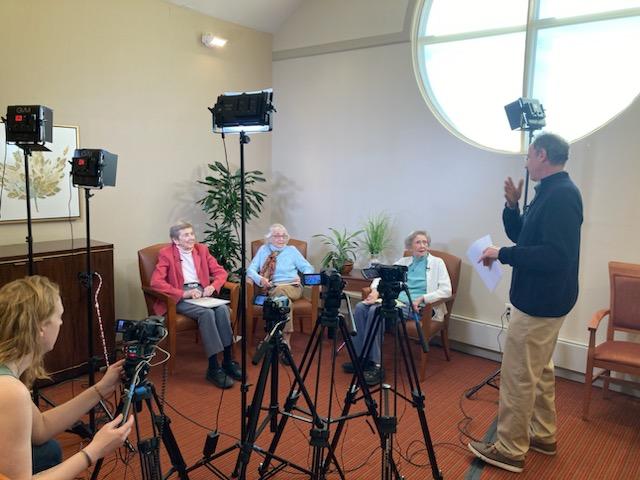
Just completed the first round of documentary/promotional/archival interviews for an oral history of The Princeton Festival. Left to right: videographer Briann Dixon, interview subjects Markell “Mickey” Shriver, Helene “Laney” Kulsrud, and Marcia Atcheson (all founding members of the festival), and yours truly. For many years, Marcia was my festival press contact when I wrote about classical music for The Trenton Times.
Category: Daily Dispatch
-

Movie Music & Literary Lives on Picture Perfect
Words on the printed page captivate us so completely that it’s natural to assume that the lives of writers must be rich, full of incident, and very dramatic indeed. Surely that is sometimes the case. Who among us could keep up with a Byron or a Pushkin or a Poe?
Yet, with even the most outlandish writers, Hollywood for some reason often feels the need to fabricate. How else to explain “Devotion” (1943), Warner Brothers’ salute to the Brontës? Then again, the temptation must be strong to characterize the sisters who penned “Jane Eyre” and “Wuthering Heights” as tortured Romantics.
Ida Lupino plays Emily, the creator of Cathy and Heathcliff, and Olivia de Havilland, Charlotte, who conceived Jane and Rochester. Nancy Coleman is their sister Anne, who wrote “The Tenant of Wildfell Hall,” and Arthur Kennedy, their dissolute brother Branwell. The film also features Sidney Greenstreet as William Makepeace Thackeray, Paul Henreid as an Irish priest, and – well, you get the idea. The casting, at times, strains credulity.
However, the music by Erich Wolfgang Korngold is up to the composer’s usual high standard. Korngold himself became so enamored of one of its themes that he recycled it for use in the first movement of his Violin Concerto. This week on “Picture Perfect,” we’ll have chance to sample some of it.
We’ll also hear selections from movies about Iris Murdoch (“Iris,” with music by James Horner), the Bard of Avon (“Shakespeare in Love,” with an Academy Award-winning score by Stephen Warbeck), and Samuel Clemens (“The Adventures of Mark Twain,” by Max Steiner).
Writers are such characters, especially when they’re depicted on the big screen. Everything’s writ large, on “Picture Perfect,” music for the movies, now in syndication on KWAX, the radio station of the University of Oregon!
Clip and save the start times for all three of my recorded shows:
PICTURE PERFECT, the movie music show – Friday at 8:00 PM EST/5:00 PM PST
SWEETNESS AND LIGHT, the light music program – ALL NEW! – Saturday at 11:00 AM EST/8:00 AM PST
THE LOST CHORD, unusual and neglected rep – Saturday at 7:00 PM EST/4:00 PM PST
Stream them, wherever you are, at the link!
-
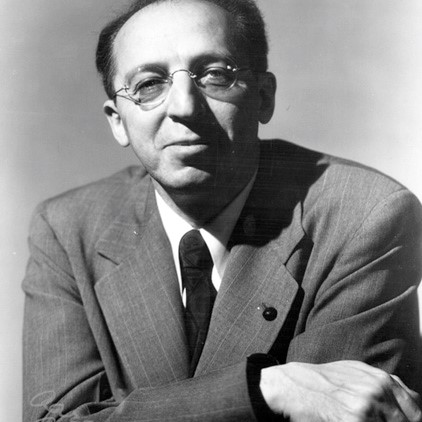
Copland’s Lincoln Portrait Still Inspires Today
Suddenly the pride and optimism of “A Lincoln Portrait” has come to seem so quaint. But I will always carry its idealism in my heart.
Incorporating texts from Lincoln’s speeches, most notably “The Gettysburg Address,” Aaron Copland’s work for speaker and orchestra has been embraced by narrators across the political spectrum, from William Warfield and Carl Sandburg to Margaret Thatcher and Charlton Heston.
Regardless of one’s personal ideology, the work has the power to stir and inspire. When it was performed under the direction of the composer in Venezuela in 1957, in the presence of reigning dictator Marcos Pérez Jiménez, it was so passionately received by the audience that it may have contributed to Jiménez’ overthrow and exile only a few days later. So clearly, it can be heady, even incendiary stuff.
Maybe it is, after all, the very thing we need at the present time. The message is one of unity, not division, in serving the greater good and honoring our responsibility to the nation and our fellow citizens in rising to the challenges of “the stormy present.” (“The fiery trial through which we pass will light us down in honor or dishonor to the latest generation.”) The elevating marriage of Lincoln’s words and Copland’s music humbles in its persuasive espousal of the American ideals of fairness and sacrifice. it’s not surprising that the work has appealed to people across the political spectrum. It’s not about partisanship. It’s about embracing the democratic ideals of the United States of America.
This weekend will bring the opportunity to experience the work live, as Copland’s “A Lincoln Portrait” will be the centerpiece of a program on American and often patriotic themes, to be presented this Friday night at 8:00 by the Main Line Symphony Orchestra, at Valley Forge Middle School in Wayne, PA.
Jamie Bernstein, Leonard Bernstein’s daughter, will be the narrator. Also on the program will be her father’s “Candide Overture,” Samuel Barber’s Violin Concerto (with Marc Rivetti, assistant concertmaster of the Philadelphia Orchestra, the soloist), William Schuman’s “New England Triptych” (based on melodies of Revolutionary Era composer William Billings), and selections from John Williams’ “Lincoln” and “The Patriot.”
The conductor will be the orchestra’s music director, Don Liuzzi, whose day job is as principal timpani of the Philadelphia Orchestra.
The program will be repeated at Reform Congregation Keneseth Israel in Elkins Park, PA, on Sunday at 2 p.m.
On Aaron Copland’s birthday (today), it’s a timely reminder of the kind of thinking that really made this country great. For more information on these concerts and upcoming performances of the Main Line Symphony Orchestra, follow the link.
https://www.mlso.org/concerts.htm
Leonard Bernstein conducts “A Lincoln Portrait,” with William Warfield narrating. Watch for Gerard Schwarz as co-principal trumpet. Schwarz would go on to make his own recording of “A Lincoln Portrait,” as music director of the Seattle Symphony, with James Earl Jones as the speaker.
-

George Whitefield Chadwick American Composer
George Whitefield Chadwick is my favorite composer of that group commonly classified as “The Second New England School,” prominent American musicians, who largely modeled themselves on the European Romantics and were destined to be eclipsed by the later, more overtly “American” followers of Aaron Copland and George Gershwin. The school included John Knowles Paine (America’s first music professor), Horatio Parker (teacher of Charles Ives), Amy Beach (a virtuoso pianist who curtailed her compositional activity during the years of her marriage), Arthur Foote (my second favorite of the group), and Edward MacDowell (“the American Grieg”).
These composers studied abroad (there were few options then), learned their lessons well, and largely emulated the German masters in their own works. Schumann, Brahms, and Mendelssohn loomed large, with Beethoven often lurking in the background. There were exceptions, of course. Amy Beach countered Dvořák’s “New World” Symphony with her own “Gaelic Symphony.” MacDowell corresponded with Grieg, not only in his letters, but in his collections of piano miniatures.
All of them wrote worthwhile music, if you can be bothered to root around musty steamer trunks in the far corners of the attic, but for me Chadwick has the most vibrant personality. He was the most successful of the group at conveying a kind of exuberance and optimism that reflect the zeitgeist of a country ripe with possibility that was still very much on the way up. As a person, he was described as independent and self-reliant, and his students remarked on his fairmindedness and wit.
Is his music identifiably “American,” as in stereotypically Coplandesque? Not really. But he was often inspired by American subjects and he really did take Dvorak’s “American” experiments to heart. You can hear it in his string quartets, and you can hear it in his “Symphonic Sketches,” especially “Jubilee.” But his vivacious symphonies are also hard to resist. Are they world-beaters? Certainly not. Are they enjoyable? Certainly!
Chadwick had a long and varied career. While his baseline is always rooted in a fairly conservative, 19th century musical idiom, he remained curious, and he was always growing. Every once in a while, he could toss out a genuine surprise. It’s interesting to hear him flirt with contemporary musical developments of the day (Dvořákian folk-inflections, Straussian tone poem, French Impressionism). Clearly, he was no isolationist. His spirit of exploration and his artistic growth make him a standout from the stodgier American classical music milieu of the Gilded Age.
A tip of the hat to Chadwick, by George, on the 170th anniversary of his birth!
“Symphonic Sketches” (1895-1904)
String Quartet No. 4 (1896)
“Rip Van Winkle Overture” (1879)
“Cleopatra” (1904)
“Tam O’Shanter” (1914-15)
Symphony No. 2 (1883-85)
-

Kile Smith Composer Music and Coffee in Princeton
In Princeton this morning, out for coffee with my former WRTI colleague, composer Kile Smith, always interesting, a great voice, super-talented, and a person of real substance. I must say, he’s not usually so squinty. But he’s also a much better photographer than I am. (Like he probably knows not to have his subjects face the sun.) Don’t believe me? Check out his website. Then follow his Facebook page. And definitely, do yourself a favor and listen to his music. Having coffee with Kile is a great way to start a day.
Tag Cloud
Aaron Copland (94) Beethoven (95) Composer (114) Film Music (150) Film Score (143) Film Scores (255) Halloween (101) John Williams (198) KWAX (233) Leonard Bernstein (105) Marlboro Music Festival (125) Movie Music (165) Mozart (91) Opera (215) Philadelphia Orchestra (90) Picture Perfect (174) Princeton Symphony Orchestra (110) Radio (90) Ross Amico (244) Roy's Tie-Dye Sci-Fi Corner (290) The Classical Network (101) The Lost Chord (269) Vaughan Williams (107) WPRB (397) WWFM (881)