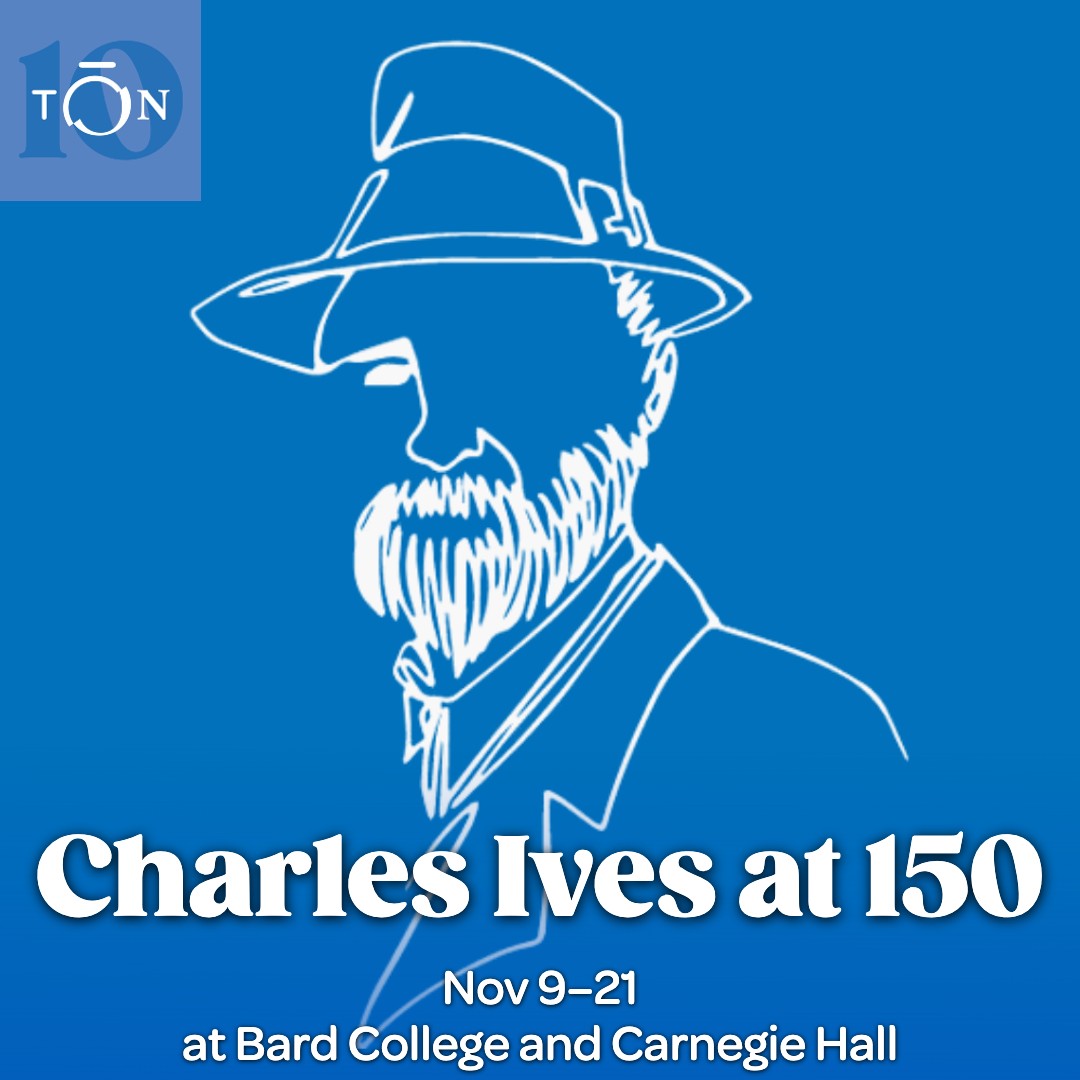
It was a damp trek to Carnegie Hall last night for an all-Ives concert with The Orchestra Now (TŌN). But I would have traveled through driving snows to attend it. As you may be aware at this point, this year marks the 150th anniversary of Ives’ birth (on October 20th). Ives was not only one of America’s most venerated and wholly unique composers, he was also a pioneer in the field of life insurance. Thankfully, no one was injured in the performance of last night’s music.
Ives’ day job allowed him the freedom to experiment wildly in his more ambitious compositions. The first half of program was devoted to wave after wave of controlled chaos – layers of sound, clashing harmonies, confused rhythms, and disorienting spatial effects – with of course plenty of recognizable hymn tunes, parlor songs, and patriotic marches tossed into the mix.
“The Fourth of July” is evocative of “a boy’s Fourth” in Danbury, Connecticut, in the decades following the Civil War. (In Ives’ commentary he fondly recollects fingers blown off, widespread drunkenness, and a fire at the town hall.) “Central Park in the Dark” juxtaposes the pursuits of man, represented by musical glimmers overheard in the middle distance (including the ragtime hit “Hello, Ma Baby,” still recognized by those of us who grew up with Merrie Melodies’ Michigan J. Frog), against a transcendental backdrop of strings, representing the eternal and ineffable. The Orchestral Set No. 2 concludes with the composer’s impressions of an episode he experienced in New York on the day the Lusitania was sunk (torpedoed by a German U-boat), killing over a thousand people. The news inspired a mass of commuters from all walks of life to spontaneously join in the singing of “The Sweet By-and-By.”
These were all masterfully rendered by The Orchestra Now, actually a Bard College graduate program, with the performers advertised as products of the world’s top conservatories. They were conducted by the orchestra’s founder and music director, Leon Botstein, who is also Bard’s president. Botstein is a brilliant and versatile thinker and always an engaging, entertaining, and often provocative speaker. He has great ideas. But there are occasions when his questing intellect seems to get in the way of the more animal enjoyments: a deeper delve into the heart of the music and a visceral commitment to its sweep and passion. The performances of the three pieces I mention above left nothing to be desired. They were cacophonous, by turns hilarious and awe-inspiring, and in the end sublime.
However, on the concert’s second half, when he came to conduct Ives’ Symphony No. 2, a work so rich in romance and nostalgia – as a breathtaking distillation of all the music, classical, sacred, and vernacular, that made Ives the unique composer he was – interpretively, I felt Botstein came up rather short. The orchestra played well, all the notes were in place, but much of the work was underarticulated. In a word, it lacked panache, and as a result, its character suffered.
This is frankly surprising, in that the concert was presented in a similar manner to those that make up the superlative Bard Music Festival (presented every August at Bard, with the emphasis on a different composer and his or her world). In this case, Ives authority J. Peter Burkholder (eminent Ives scholar and president of the Charles Ives Society) provided pre- and inter-performance commentary, and baritone William Sharp sang a number of the songs and hymns assimilated into Ives’ compositions (with Daniel Berman, another Ives authority, at the keyboard). Burkholder would make a point, Sharp would sing, and then Botstein would cue the orchestra to play a corresponding passage, prior to the performance of the complete piece. (Also before the symphony, Sharp, in fine voice all evening, provided an unexpected bonus in an old favorite from Ives’ 117 songs, “The Circus Band.”)
So our ears were attuned; but then, during the actual performance, when it came to those parts of the symphony we were told to listen for, the details were frequently just glossed over. (The brisk tempo of the opening Andante moderato did not bode well.) As a result, the work came across as mostly indistinguishable from the competent but hardly outstanding symphonies of the composers of the Second New England School, from which, on an academic level (Ives studied with a long-suffering Horatio Parker at Yale), Ives sprang, rather than one of our truly great American symphonies. It lacked poetry and it lacked resonance. (Interestingly, on this rainy night, it appeared that Botstein never removed his galoshes. It became an inadvertent metaphor for his practical, even earthbound, approach to musicmaking, at least on this particular occasion.)
Granted, I cut my teeth on Leonard Bernstein’s early recording of the symphony, on Columbia Records, and Lenny often went out of his way to make a piece of music his own, often to the extent of making little alterations to suit his sense of drama and wringing everything out of it and then some. Undoubtedly this colors my perception. It’s fairly common for anyone who loves a piece of music to hold the first performance of it he or she ever heard on a pedestal, especially if it’s a recording made familiar through countless repetitions. But I have heard my share of recorded performances of Ives’ 2nd, and this was not one of the great ones. (At least it was not janglingly wrongheaded, like Bernard Herrmann’s.)
I am thankful to Botstein for the outstanding program and for so much else that he does so very well. I hasten to add, this was the first time, in 40 years of concertgoing, that I heard ANY of these pieces played live. So that’s a big win. It was a concert with much to recommend and a very special evening. But a genuinely transcendent performance of the symphony would have sent me out of the hall oblivious to the raindrops and walking on air.
PHOTOS: Concert poster; Classic Ross Amico, doing his best Andy Capp impression; and a pre-concert conversation with, left to right, baritone William Sharp, pianist Daniel Berman, Ives scholar J. Peter Burkholder, and conductor Leon Botstein. Thanks to Paul Moon for the latter two photos!