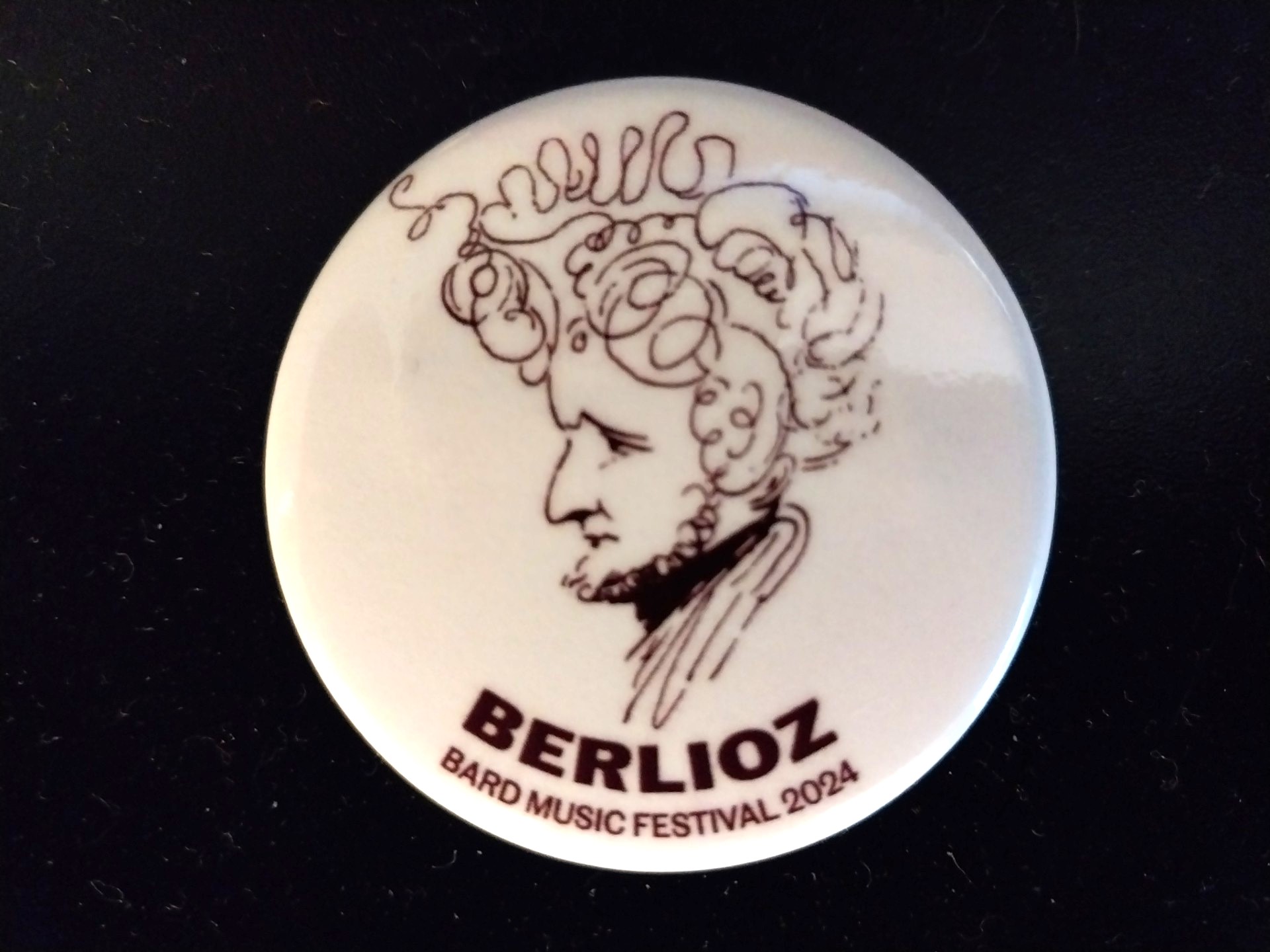
Hector Berlioz was not the kind of guy to always go about things the way you might expect. For instance, if you wanted to impress a prospective lover, would you think it would be in your best interest to write a programmatic symphony, in which your obsession with her drives you to overdose on opium? Then, under its influence, to dream about murdering her, so that you’re condemned to execution by the guillotine? Then to vividly illustrate being tormented in the Hereafter by her spirit, now transformed into a jeering, cackling witch?
Well, Berlioz, arch-Romantic that he was, was a guy who followed his gut. And what do you know, it worked! The Shakespearean actress Harriet Smithson, who inspired the piece (even though Berlioz didn’t speak English and she couldn’t speak French), said “I do.” Some chicks dig the crazy.
Not that they lived happily ever after. I know, who could have predicted it?
Anyway, this is the backdrop to Berlioz’s “Symphonie fantastique,” his most famous work, and it kicked off the Bard Music Festival, “Berlioz and His World,” at Bard College’s Fisher Center for the Performing Arts on Friday night. Leon Botstein, founder and co-artistic director of the festival (and president of Bard College), conducted The Orchestra NOW (TON for short), Bard’s graduate-level training orchestra.
As is so often the case, if you own a recording of the piece, for as transporting as it might be, it just isn’t the same as hearing it live. Reencountering Berlioz’s forward-looking symphony (which must have caused heads to explode in 1830) blew my hair back, or what’s left of it, again and again. It’s hard to believe I once had a coif every bit as impudent as the composer’s. Why, it seems like only yesterday…
But I digress.
With its faltering chromatic harmony, beefed-up orchestra (for the period), Beethovenian length, and outlandish instrumental effects, it pushed the envelope decades into the future. Wagner (among others) glommed onto Berlioz, but the composer’s legacy truly flourished with the generation of Gustav Mahler, nearly 70 years later. That’s an entire lifetime. His concept of the “idée fixe,” a recurring motif that intrudes on the flow of every movement, signifying unbidden remembrances of the composer’s beloved, was also influential.
On to the performance at hand: I may have heard wilder ones, but none quite so visceral. With the strings at stage level, the rowdier instruments were positioned on risers, and the bass drums in particular were like volcanoes that exploded into the audience. The chimes that herald the “Dies Irae,” a presentiment of the doom if ever there was one, were immediate and chilling. It was great fun to watch the strings put through their diabolical repertoire of col legno, con sordino, pizzicato, tremolo, and double stopping, and the ensemble was able to bring the energy to put the piece over the top and bring a sense of abandon at its peak moments.
Also notable was the inclusion of the obbligato cornet in the second movement, the one in which composer’s pangs of longing contrast with the spirited whirl of festivity at a ball, a touch seldom employed. Apparently Berlioz added the cornet (perhaps for the virtuoso Jean-Baptiste Arban), but it never made it into the published score in the composer’s lifetime. I love you, Berlioz, but in this instance I think your original conception was best. For me, the cornet brings unfortunate associations with the gazebo or the boardwalk, and also obscures the elegance of this waltz through the composer’s haunted mansion – but it was ear-opening to hear the alternative version for once at Bard. Part of the festival’s mission, after all, is to be a platform for scholarly inquiry and display. If the movement were going to be done this way, this was definitely the context in which to do it. (I believe the cornet soloist was Jid-anan Netthai, but this I will have to confirm.)
I confess, I had my reservations about starting the festival with such a substantial and well-known piece. When the program was first announced, I was puzzled as to why Bard, known for its exploration of unusual and the neglected repertoire, would open its festival with Berlioz’s greatest hit. But in the event, it certainly paid off and got blood pumping. I also realized after a moment’s reflection, its inclusion provided the necessary context for the full appreciation of the seldom-encountered “Lelio,” which was heard on the second half of the concert.
A sequel of sorts to the “Symphonie fantastique,” “Lelio, or the Return to Life” comes across as a much more self-indulgent affair, if only because of the extensive dramatic commentary allotted to the narrator. Again, this is a heavily autobiographical piece. Unfortunately, if you take away all the lofty references to art and Shakespeare, it’s basically the whiny “reflections” of a lovelorn 20-something.
The Bard presentation made it even more so. I have nothing against Babe Howard (the son of Debra Winger), who was presumably a late substitute for the scheduled narrator, Wyatt Mason, and I wish him all the best with his career. But here he came across as sorely miscast and underprepared, to the extent of not perhaps fully understanding the character of the figure he was meant to portray. I can think of no lower compliment than to say that I could have done it just as well myself. (I too spent much of my twenties as lofty, whiny, and lovelorn.) For me, it was just too much of a stretch to accept him as the convincing alter ego of a seething, half-mad artist, emerging from an opium-induced nightmare to grasp his breaking heart. About the only thing he played convincingly was young. Also, he didn’t impress me much as an actor accustomed to appearing on the stage. That’s not to say the technique will not come, but I imagine he would be much more at home in something more contemporary.
That aside, the music was fascinating, and very well performed. Having previously known “Lelio” only from recordings – especially Jean Martinon’s, in which the narrator delivers his part in French – it was as if the scales had fallen from my eyes. THIS is what Bard is all about! I’ve aired the concluding “Fantasy on Shakespeare’s ‘The Tempest’” on my radio shows many times, but I had no idea the entire score was so varied and beautiful, with the quality of the music quite high. That said, it’s impossible that it will ever secure a place in the public’s affection equal to that enjoyed by the “Symphonie fantastique,” especially as presented here, as the composer originally intended, emulating the salon format, so popular in that era, but also in the guise of a melodrama, a largely-defunct genre in which narration and music are combined to form a cohesive dramatic statement.
As always, the Bard Festival Chorus and vocal soloists were first-rate, with bass-baritone Alfred Walker delivering a lusty “Brigands’ Song” and tenor Joshua Blue (who returned on Saturday night to solo in Berlioz’s “Te Deum”) lending further allure to “The Fisherman Ballad” and the “Song of Happiness.” The cumulative effect was one of magnification of the impressive range of Berlioz’s genius, which ranges well beyond the heaven-storming orchestral works that are so well known, especially as a composer for voice.
I pause to wonder: whatever happened to the brigand, anyway? It’s a career that seems to have gone the way of the melodrama.
All in all, a rewarding, often captivating, and at times even thrilling evening, and presented in a manner that Bard has perfected over the past 33 seasons. Bravo, and more, please!
The Bard Music Festival continues through August 18. For more information, follow the link.
https://fishercenter.bard.edu/whats-on/programs/bard-music-festival/
Fisher Center at Bard