With a creative team like that assembled for “Saturn 3” (1980) – Hollywood legend Kirk Douglas, ‘70s icon Farrah Fawcett, and Scorsese veteran Harvey Keitel, in a story by “Star Wars” production designer John Barry, developed into a screenplay by acclaimed novelist Martin Amis, directed by “Singin’ in the Rain” maestro Stanley Donen, with a score by “Magnificent Seven” composer Elmer Bernstein – how could it possibly fail? And yet when I saw it in the theater, even as a 13 year-old, I couldn’t believe how bad it was.
But you know, sometimes the worst movies make for the best discussions. I can only guess that that’s our motivation, in selecting it as our topic for the next Roy’s Tie-Dye Sci-Fi Corner. Roy and I will offer our saturnine assessments of this claustrophobic would-be thriller, about a love triangle between a feather-haired Angel, a dimple-chinned methuselah, and a pin-headed robot.
To help dull the pain, there will also be some fun recollections from special guest Suzanne Peterson, who was Farrah’s stand-in on the film.
Join us in hectoring Hector in the comments section. We’ll do our best to eclipse “Saturn 3,” when we livestream on Facebook, YouTube, etc., this Friday evening at 7:00 EDT!
Every time I listen to Mahler, I feel like I’m in my 20s again. The whiplash emotional states, the seething, the intensity, and romance. Actually, it’s all right there still, just beneath the surface, but I try to keep a lid on it these days. Now that I’m in my 50s, I’m too old to be storming heaven all the time and hurling myself into volcanoes.
Even so, it’s nice to remember once in a while by revisiting the symphonies in concert, and last night Sir Simon Rattle brought one of the angstier ones to Philadelphia’s Kimmel Center for the Performing Arts, when he led the touring Bavarian Radio Symphony Orchestra in Mahler’s Symphony No. 6. Sometimes identified by the nickname the “Tragic,” this one has all the vertiginous highs and de profundis lows one expects from this composer – Mahler making good on his pronouncement (to Sibelius, no less) that a symphony must be like the world: it must embrace everything!
So we get plenty of foreboding and ardent love music and weird macabre passages, crashing cymbals, and eerie harps, and most notoriously, that magnificent hammer delivering the blows of fate. Of course, I’m not convinced it always has quite the effect Mahler intended, as he was savagely lampooned for it in his lifetime, and even last night it elicited big grins and conspiratorial nods from the audience. When you want to suggest something very serious, it’s probably a good idea not to have your percussionist solemnly ascend stairs to a riser to swing a five-foot Bugs Bunny style circus mallet. That said, I wouldn’t have it any other way.
I’ve seen Rattle conduct Mahler before, of course, in the days when Philadelphia was trying way too hard to land him as its next music director. Back then, he was certainly an effective interpreter, if sometimes prone to mannerisms (which I understand he may not yet have fully shaken, though they were not on display in yesterday’s performance), in particular his obsession with bringing the music’s pianissimos down to a ridiculously hushed level.
None of that was in evidence last night, and it was satisfying to watch and hear the Bavarians rise to the occasion and ride a few killer waves, especially in the last movement. But for me, the ardent second movement was the most magically sustained, a passionate andante moderato played for all the sublimity it was worth. Rattle opted, as many do, for the composer’s original ordering of the movements, with the scherzo placed third. (Mahler had second thoughts after conducting the symphony’s first performance and decided to flip the scherzo and the andante.) In this movement, I swear, you can sense the love music for virtually every big budget fantasy movie of the 1980s – not quoted outright, necessarily, but completely in spirit. Back in the days when the movies were still wondrous and did wonderful things to your insides, much the way Mahler’s symphonies do.
Hearing Mahler in concert also reminds me just how important it is to experience these things live. The composer was a master orchestrator, and the 6th is full of unusual touches (the strange duets between Masque-of-the-Red-Death harps and leviathan brass, the bird of prey multi-cymbal effect at the end, and of course, that carnival hammer (ring the bell and you win a cigar!) that just won’t have the same impact when listening on record. Also, in these days of attention deficit classical radio, when’s the last time you heard a complete Mahler symphony, if it doesn’t turn up on a broadcast concert?
Bravo to Sir Simon, recalled again and again – at least five times – and his German musicians, who each embraced their neighbors as the applause finally began to subside in a kind of life-affirming group hug.
I would be dead by now if I continued to live my life as tightly-wound as, and at the fever pitch conjured in, Mahler’s symphonies. But it’s nice to remember once in a while what it was like to seethe and combust.
Beneath the authoritative gaze of Sir Simon: with fellow Mahlerite Robert Moran at the Kimmel – but who is that forehead-slapper photobombing us?
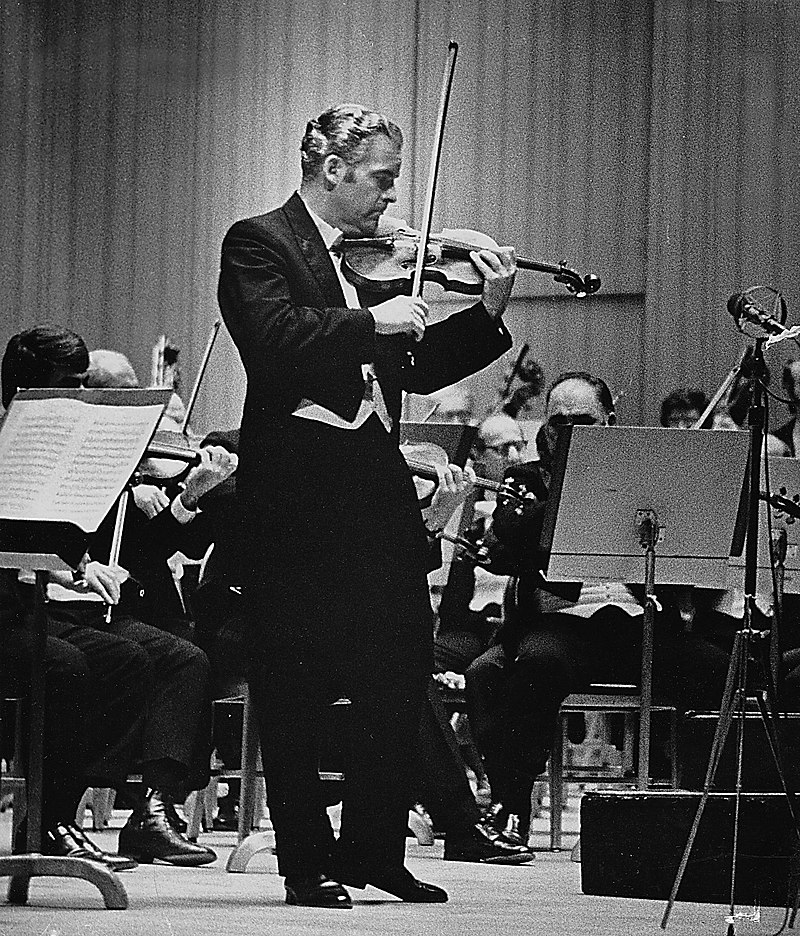
Even though I continue to attend the occasional Philadelphia Orchestra concert (most recently on April 11 to hear Mahler 7 and, coming up, Sibelius 5), for me the glory days of my attendance were from the mid-‘80s to the mid-‘90s, when I was there nearly every week, often standing in line for a couple of hours on a Friday or Saturday evening, with a cup of coffee and a friend or a book, in order to score a $2.00 seat in the amphitheater at the old Academy of Music. (The price was later raised to $2.50.) Norman Carol, therefore, will always be the Philadelphia Orchestra concertmaster closest to my heart.
Carol joined the orchestra, at the invitation of Eugene Ormandy, in 1966. He served as concertmaster (succeeding Anshel Brusilow) under Ormandy, Riccardo Muti, and Wolfgang Sawallisch. His retirement in 1994, I remember, came ahead of his scheduled performance as soloist in Samuel Barber’s Violin Concerto, the piece with which he had made his Philadelphia solo debut decades earlier. As I recall, he had been playing through excruciating shoulder pain and he just couldn’t do it anymore.
In the years of my attendance, I was fortunate to hear Carol step up from his position as leader of the orchestra to solo in many concertos. One of the most memorable, for me, was that of Benjamin Britten, which, at the time, I had never heard before.
Prior to his position in Philadelphia, Carol had played in the Boston Symphony Orchestra under Serge Koussevitzky (who extended the invitation to join when Carol was 17) and Charles Munch. He was concertmaster with the orchestra, when, under Leonard Bernstein, it gave the U.S. premiere of Britten’s “Peter Grimes” at Tanglewood in 1946.
Following service in the Korean War (André Previn relates playing with Carol and Chet Baker at the Presidio in his book “No Minor Chords”), he became concertmaster of the New Orleans Symphony and then the Minneapolis Symphony, under Antal Doráti and Stanislaw Skrowaczewski. Decades later, Carol would give the premiere of Skrowaczewski’s Violin Concerto in Philadelphia, as Skrowaczewski guest conducted.
As a student at the Curtis Institute, Carol was groomed for a solo career. He went on to record an early recital for RCA. Later, of course, he played solo violin passages on all the Philadelphia Orchestra recordings from the time he joined the group, including Ormandy’s later recordings of “Ein Heldenleben” and “Scheherazade.”
After his retirement, he continued to perform and record with the Philadelphia Piano Quartet. He also taught orchestral repertoire at Curtis. (He was on the Curtis faculty for some 40 years.) His violin, a 1743 Guarneri “del Gesù,” formerly belonged to Albert Spalding. Spalding gave the first public performances of Barber’s Violin Concerto in Philadelphia in 1941.
Carol was old school, tuning the orchestra in evening dress, his wavy hair impeccably Brylled, seemingly unflappable in his reserve. But when he played, he played like the principal of one of the greatest orchestras in the land. I knew him neither as a man nor behind the scenes, but only from my vantage in the appreciative audience. He embodied the traditions of a fabled era. His like will not come again.
Carol, who was born in Philadelphia, died on Sunday at the age of 95. R.I.P.
Carol plays the Nielsen Violin Concerto
Big band Telemann
1958 recorded recital with Julius Levine
Vaughan Williams’ “Fantasia on a Theme by Thomas Tallis,” featuring solos by Carol, violist Joseph De Pasquale, and cellist Samuel Mayes
When the sun sets this evening, we will be in the grip of Walpurgisnacht.
Walpurgis Night, the eve of the feast day of Saint Walpurga, is a time when evil spirits are believed to roam the earth.
Tradition holds that a witches’ sabbath and orgy of the damned are held atop the Brocken, the highest peak of the Harz Mountains in Central Germany. It’s the last blast of diablerie before May Day. In Goethe’s “Faust,” Mephistopheles guides his imperiled charge into a swirling cauldron of witches and demons so as to complete his moral degradation.
Of course, “Faust” has inspired innumerable pieces of music – operas, symphonies, cantatas, piano works, and songs. Here, Samuel Ramey sings “Ecco il mondo” from the Walpurgis Night scene (Act II, Scene 2) of Arrigo Boito’s “Mefistofele.” Sadly, the clip doesn’t run to the end of the act.
Another Goethe poem provides the basis for Felix Mendelssohn’s cantata “Die erste Walpurigisnacht” (“The First Walpurgis Night”), about a band of prankish Druids playing mind games with some superstitious Christians.
Johannes Brahms wrote a song, “Walpurgisnacht,” on a text of Alexis Willibald (nom de plum of Wilhelm Häring), about a mother freaking out her daughter, telling her a thunderstorm is actually the sound of witches celebrating on the Brocken. As if that isn’t enough, she adds that she herself is a witch! Ha ha! So German.
Walpurgis Night is an occasion for leaping over bonfires, vandalizing neighbors’ property, and rioting, all in the name of welcoming spring. It is not to be confused with St. John’s Eve (June 23), the night the demon Chernobog emerges from the Bald Mountain. More on that later, I’m sure.
When this Brocken’s a-rockin’, don’t come a-knockin’! Cavort responsibly, everybody, and don’t forget to keep Walpurga in Walpurgisnacht!
“The Goat of Mendes. The Devil himself!”
See comments section for one of my treasured possessions: photo inscribed to Christopher Lee by Samuel Ramey!
Luis Ricardo Falero, “Departure of the Witches” (a.k.a. “Witches Going to their Sabbath”), 1878
Ellen Taaffe Zwilich was born on this date in 1939. Today is her 85th birthday.
Zwilich made history when she became the first female recipient of the Pulitzer Prize for Music, in 1983, for her Symphony No. 1.
Seven years later, she made history for a second time for being perhaps the only living classical music composer – and to my knowledge the only woman composer – to be referenced in Charles Schulz’s beloved comic strip “Peanuts.”
In the first of three panels, Peppermint Patty and Marcie are shown attending a concert. Marcie, holding a program, says to Patty, half-asleep, that the next piece will be a Concerto for Flute and Orchestra. In the second panel, she notes, “It was composed by Ellen Zwilich who, incidentally, just happens to be a woman!” Patty springs awake, and in the last panel, she’s standing on her chair. As Marcie slumps into her seat in evident embarrassment, Patty cries, “GOOD GOING, ELLEN!” (The original strip is posted in the comments section below.)
Turnabout is fair play, and in 1996, Zwilich composed a concertino of sorts, for piano and orchestra, titled “Peanuts Gallery.” The work includes movements inspired by Schroeder, Linus, Snoopy, Charlie Brown, Lucy, and Peppermint Patty and Marcie. It was given its premiere on a Carnegie Hall children’s concert, by the pianist Albert Kim and the Orpheus Chamber Orchestra.
The piece was recorded for the Naxos label, with pianist Jeffrey Biegel and the Florida State University Symphony Orchestra. The movements are posted individually on YouTube. I have it cued up so that you can let them all play through, continuously, here:
As an alternative, here’s the entire work, performed without break, with actors and dancers, in a reduction for two pianos:
“Peanuts Gallery” became the subject of a prize-winning PBS documentary. A second Zwilich documentary was produced to trace the development of her “Gardens” Symphony: