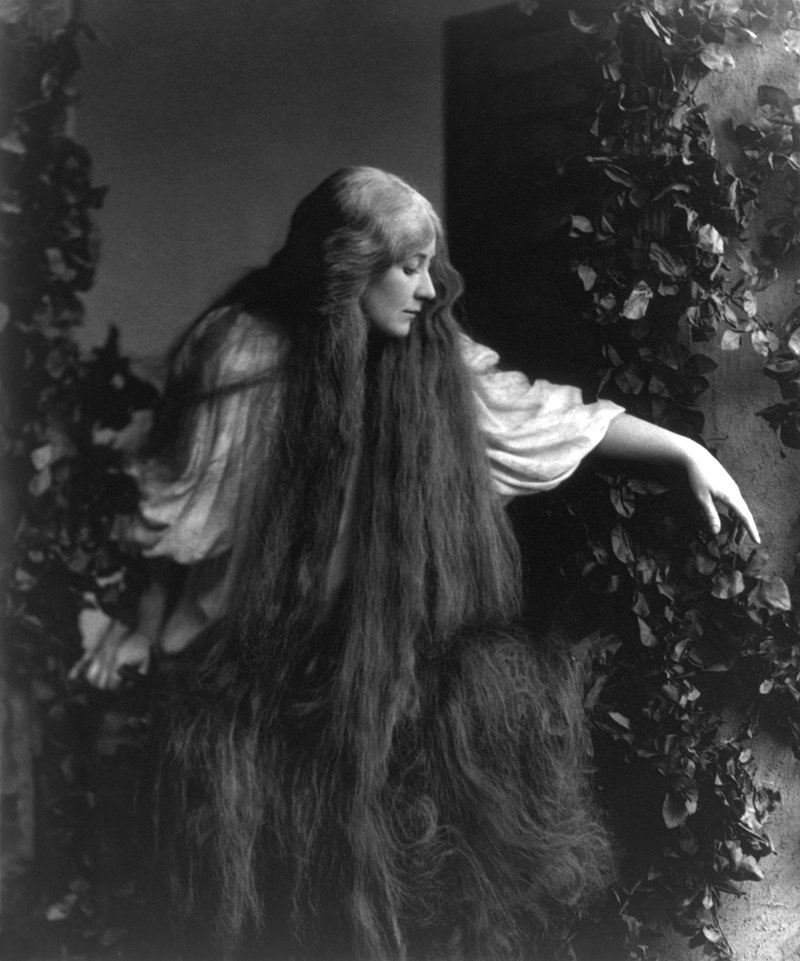
Mary Garden, “the Sarah Bernhardt of opera,” was born 150 years ago today.
The Scottish-American lyric soprano (later mezzo-soprano) lived in France for many years, where she became the leading soprano at the Opéra-Comique. There, she worked with many successful composers and participated in several world premieres, including that of Claude Debussy’s “Pelléas et Mélisande” in 1902. She also collaborated with Jules Massenet, who wrote his Cherubino opera, “Chérubin,” specifically for her.
In 1901, she entered into an affair with André Messager, who had conducted her in Gustave Charpentier’s “Louise,” the work in which she made her unscheduled debut, stepping in for an ailing Marthe Rioton. When the Opéra-Comique director Albert Carré asked her to marry him, she graciously declined, coyly admitting there was someone else in her life.
She created a sensation when she performed the French version of Richard Strauss’ “Salome,” a role she eventually brought with her to America. Though she executed the Dance of the Seven Veils in a bodystocking, audiences were scandalized when she languorously kissed the severed head of John the Baptist.
It was Oscar Hammerstein who lured her back to the United States, where she joined the Manhattan Opera House in 1907. She scored further successes in Boston, Philadelphia, and Chicago. She sang the world premiere of Victor Herbert’s “Natoma” in Philadelphia in 1911. In 1912, she joined Enrico Caruso at the Metropolitan Opera to raise funds for survivors of the Titanic.
In 1921, she became director of the Chicago Grand Opera Company. There, she directed the world premiere of Prokofiev’s “The Love for Three Oranges.” The company went bankrupt in 1922, but as always, Garden landed on her feet. She became director of the Chicago Civic Opera, with which she sang until 1931.
Long a household name, she also appeared in two silent films for Samuel Goldwyn: “Thaïs” (1917), one of her signature operatic roles, and “The Splendid Sinner” (1918). After retiring from opera in 1934, she became a talent scout for MGM. Later, when Orson Welles described to composer Bernard Herrmann the kind of opera he envisioned for the painful Susan Alexander montage in “Citizen Kane,” he characterized it as a Mary Garden vehicle.
Garden’s firsthand experiences with Debussy and his music provided ample material for her later lectures and recitals. In 1951, she retired to Scotland, where she lived her last 30 years, and published an autobiography, “Mary Garden’s Story.”
By all accounts, she was a force to be reckoned with, the archetypal diva, who engaged in epic feuds and forbidden love affairs. Invariably, she got what she wanted and emerged the stronger for it. She lived a flamboyant lifestyle and was a relentless self-promoter.
In a 1954 interview, she declared, “I was never a singer. You go to hear Caruso. You go to hear Melba. But you come to SEE me.”
She died in Aberdeen in 1967, at the age of 92.
Garden singing Mélisande with Debussy at the piano in 1904, and a selection from a Garden interview about the composer:
INTERVIEWER: “Is it true that Debussy was in love with you?”
GARDEN: “Oh, no. Never. He may have been in love with my work, but I never was in love with anybody with whom I created. No, no. Not in the musical world. They’re all crazy.”
Radio interviews from 1937 to 1961 – beginning with Bing Crosby! Interesting content aside, the advance in technology over 24 years is striking.
Garden as “Thaïs”
“Depuis le jour” from Charpentier’s “Louise”
Allegedly, the only one of Garden’s recordings she could bear to listen to
Bernard Herrmann’s Garden-influenced pastiche opera for “Citizen Kane”
Clip 1 https://www.youtube.com/watch?v=fFAq27TK9l8
Clip 2 https://www.youtube.com/watch?v=AmSoDkXJ2aw
I posted a good deal more about the segment in August of 2020
Leave a Reply