Category: Daily Dispatch

  • Daniel Gregory Mason Rediscovered

    Daniel Gregory Mason Rediscovered

    “I do not propose to write an ode to dejection, but to brag as lustily as Chanticleer in the morning, standing on his roost, if only to wake my neighbors up.” So wrote Henry David Thoreau in his preface to “Walden” (now on my bedstand, just in time for the season of consumerism run amuck).

    The quote serves as a superscription for Daniel Gregory Mason’s “Chanticleer Festival Overture.” Mason was born in Brookline, MA, on this date 150 years ago. His father was Henry Mason, cofounder of the Mason & Hamlin piano company, and his grandfather was Lowell Mason, composer of some 1600 hymn tunes, including “Nearer, My God, to Thee.”

    Daniel studied theory and composition at Harvard under John Knowles Paine, continuing his lessons with George Whitefield Chadwick and others. He became a writer on music and a lecturer at Columbia University. After 1907, his compositional output increased. He acquired further polish in Paris, studying with Vincent d’Indy, in 1913.

    Of course, 1913 was the year that Stravinsky’s “The Rite of Spring” shook the musical world, but Mason remained resistant to its charms. Instead, he continued to create cocooned in a Romantic sensibility, and a rather conservative one.

    In his way, he sought to increase respect for American music, incorporating indigenous and popular themes into a number of his works, urging native composers to stop imitating European models (though he himself evidently admired the Austro-German canon), and criticizing European conductors working in the U.S. for not including American works on their programs. On the other hand, he wasn’t overly happy with George Gershwin or Aaron Copland, nor was he thrilled by jazz or the influence of Stravinsky.

    In common with many of his time, Mason held some complicated views. He publicly condemned anti-Semitism and embraced what were then described as Negro spirituals. However, he was pretty firm in his belief that American culture should be “Anglo-Saxon,” and went a little overboard in expressing his xenophobia, to the extent that he felt compelled to write an apology in the New York Times in 1933, stating that he had been misinterpreted and clarifying that he was opposed to “jingoism and Hitlerian nationalism.”

    Mason was a man of contradictions, to be sure. Among his writings are 18 books on music, so there is certainly plenty to sift through. One can only imagine what he made of American music at the time of his death in 1953.

    Mason’s “Chanticleer Festival Overture” dates from 1926. Gershwin’s “Rhapsody in Blue” was composed in 1924, and Copland’s jazz-inflected “Music for the Theater” appeared in 1925.

    “All climates agree with brave Chanticleer. He is more indigenous even than the natives. His health is ever good, his lungs are sound, his spirits never flag.”

    Mason’s own music is now virtually forgotten. But it is not without its charms. His Thoreau-derived rooster portrait is still something to crow about. A tip of the cockscomb to Daniel Gregory Mason on his sesquicentennial.

    Symphony No. 3 “Lincoln,” conducted by Sir John Barbirolli

    String Quartet in G minor on Negro Themes

    “Variations on Yankee Doodle in the Styles of Various Composers”

  • Living Remake: Nighy vs. Kurosawa

    Living Remake: Nighy vs. Kurosawa

    Last night, I finally got around to watching “Living,” a fairly good remake of Akira Kurosawa’s (let’s face it) untouchable classic, “Ikiru” (1952). Bill Nighy plays a tight-buttoned public servant, a hidebound functionary, referred to behind his back by a young coworker as “Mr. Zombie.” (She gets out before she’s worn down on the lathe.) He seems all the world as if he’s stepped from a Magritte painting, though lacking any sense of the surreal. At least until the day he is forced to come to terms with his unremarkable life, frittered away in routine, silently riding the steam railroad back and forth to London to sit in a quiet office behind a heavy desk and dutifully pass the buck in the Public Works Department. It is an existence without drama, without personality, and woefully without consequence. Suddenly, late in the game, he is forced to self-examine and grapple in his understated way (it is, after all, Bill Nighy) with finding meaning and grace in his final months.

    The film is gorgeously executed, though perhaps a bit too seductive to successfully reflect the dour world of the bureaucrat. I understand the drama, such that it is, is in transformation. But from the get-go, the workaday is captured so alluringly. Everyone heads off to work impeccably dressed in period costume, filing past spotless, stately architecture and bright double-decker buses. Everything is bathed in sunlight. The film’s titles are self-consciously retro. Dvořák whirls gracefully on the soundtrack. If this is what it’s like to live the life of a cog, sign me up!

    To lend further verisimilitude to the enterprise – another exercise in “Masterpiece Theatre porn” guaranteed to titillate fans of “Downton Abbey” – the screenplay is by Merchant-Ivory scribe Kuzuo Ishiguro.

    But the real reason I mention the film at all is that in its closing moments, what should well up on the soundtrack, but the “Fantasia on a Theme by Thomas Tallis.” Chalk up another victory for Ralph Vaughan Williams.

    “Living” is now available for streaming, if you want to check it out. But watch “Ikiru” first.


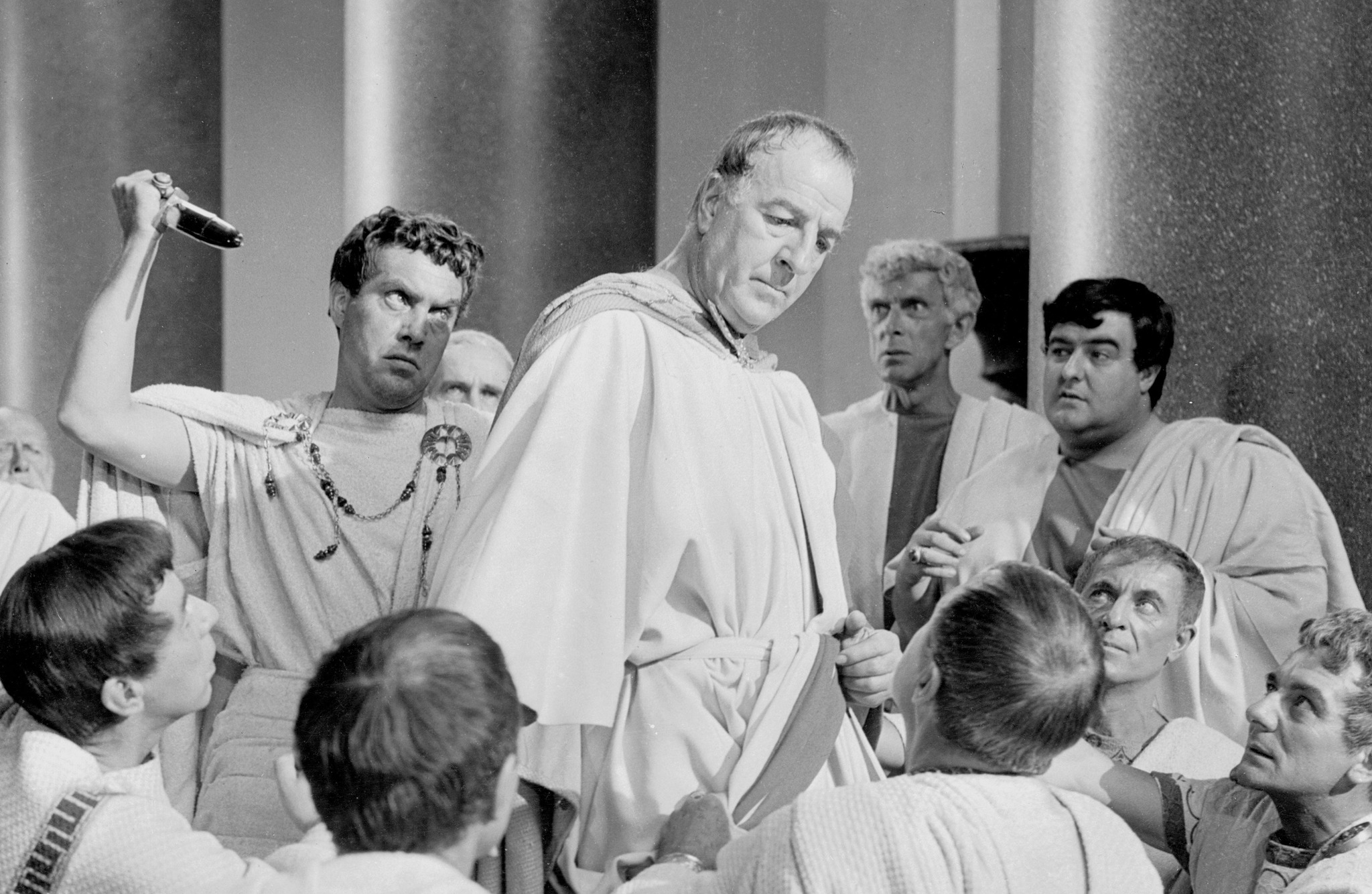
    PHOTOS: Bill Nighy (left) and Takashi Shimura, in the swing

  • Ormandy’s Lost Chord American Music

    Ormandy’s Lost Chord American Music

    This week on “The Lost Chord,” for Eugene Ormandy’s birthday, it’s the second installment in a three-part series of Ormandy conducting the Philadelphia Orchestra in rarely-heard recordings of American music.

    Samuel Barber was born in West Chester, Pa., not far from Philly, in 1910. He attended Philadelphia’s Curtis Institute of Music and had his first orchestral work, the “School for Scandal Overture,” performed by the Philadelphia Orchestra in 1931, when he was 21 years-old.

    His “First Essay for Orchestra” was sent to Arturo Toscanini in the same mail as his “Adagio for Strings.” Toscanini performed both works with the NBC Symphony in 1938, but it was Eugene Ormandy who made the first recording of “Essay,” with the Philadelphians, in 1940.

    Vincent Persichetti was born in Philadelphia in 1915, and he died there in 1987. In between, he attended Combs College of Music, the Curtis Institute (where he studied conducting with Fritz Reiner) and the Philadelphia Conservatory. He taught at Combs and the Philly Conservatory. Then he received an invitation from William Schuman (some of whose music we heard last week) to take up a professorship at Juilliard.

    Persichetti was one of our great composers, but to this day he remains underappreciated, more respected than loved. His Symphony No 4 of 1951 must be one of his most immediately attractive works.

    Finally, John Vincent may be the most undeservedly neglected composer in Ormandy’s entire discography. Ormandy described his recording of Vincent’s Symphony in D (“A Festival Piece in One Movement”) as “one of the best we have ever done,” and the piece itself as “one of the finest compositions created by an American composer in the past decade.” The 1954 work sounds at times like Sibelius gone to the rodeo, but my, is it good stuff!

    I hope you’ll join me for “All-American Ormandy II.” Ormandy recommends a visit to the Barber (pictured), then convinces with the Vincents, on “The Lost Chord,” now in syndication on KWAX, the radio station of the University of Oregon!

    Happy birthday, Eugene Ormandy!


    Remember, KWAX is on the West Coast, so there’s a three-hour difference for the Trenton-Princeton area. Here are the respective air-times of my recorded shows (with East Coast conversions in parentheses):

    PICTURE PERFECT, the movie music show – Friday on KWAX at 5:00 PACIFIC TIME (8:00 PM EST)

    THE LOST CHORD, unusual and neglected rep – Saturday on KWAX at 4:00 PACIFIC TIME (7:00 PM EST)

    Stream them here!

    https://kwax.uoregon.edu/


    PLEASE NOTE: Ormandy’s recording of John Vincent’s Symphony in D was reissued yesterday, November 17, as part of Sony Classical’s new 88-CD box, “Eugene Ormandy/The Philadelphia Orchestra: The Columbia Stereo Collection.” I opened my set this morning with trembling hands!

    Persichetti’s Symphony No. 4 was reissued in 2021, as part of Sony’s laudable 120-CD box of Ormandy’s Philadelphia mono recordings, “Eugene Ormandy: The Columbia Legacy.”

    Both Sony releases are newly-remastered.

  • MLSO Shines with Gipps Bloch & Vaughan Williams

    MLSO Shines with Gipps Bloch & Vaughan Williams

    The Main Line Symphony Orchestra and conductor Don Liuzzi deserve breakfast in bed – an English breakfast, of course – for last night’s impressive rendering of Ruth Gipps’ Symphony No. 2, a work I never dreamed I would ever get to hear live. Their performance of Ernest Bloch’s “Schelomo,” with the Philadelphia Orchestra’s Yumi Kendall the cello soloist, was also very fine. Of course, I can turn down no opportunity to hear Vaughan Williams’ Symphony No. 5. The program will be repeated at Reform Congregation Keneseth Israel in Elkins Park, PA, this afternoon at 1:00. Thank you, MLSO!

    For more information, visit http://www.mlso.org.

  • David Del Tredici: A Life in Music Remembered

    David Del Tredici: A Life in Music Remembered

    How quickly time passes.

    It seems only yesterday that David Del Tredici was one of America’s brightest young composers. Now I learn that he has died at the age of 86.

    Del Tredici began his studies as a pianist. (He said if he hadn’t become one, he would have become a florist.) He was mentored by Bernhard Abramovitch and Robert Helps at the University of California, Berkeley. At the same time, he began to venture into composition. He performed his work, “Opus 1,” for a favorably-disposed Darius Milhaud.

    Subsequently, Del Tredici attended Princeton University, where his teachers included Roger Sessions, Earl Kim, and Seymour Shifrin. At Princeton, he received a grounding in serialism. Later, he gravitated back toward tonality and became a pioneer of the Neo-Romantic movement.

    He achieved considerable recognition for a cycle of works inspired by the writings of Lewis Carroll. One of these, “Child Alice,” was awarded the Pulitzer Prize for Music in 1980. “Child Alice” was inspired by two prefatory poems from Carroll’s “Through the Looking Glass, and What Alice Found There” and “Alice’s Adventures in Wonderland.” If Carroll and Gustav Mahler had had a love-child, it would probably have come out sounding something like this.

    Here’s an excerpt from Part One, “In Memory of a Summer Day,” conducted Gil Rose. If you like what you hear, I highly recommend Rose’s recording of “Child Alice” with Boston Modern Orchestra Project (BMOP).

    One day, back in 1990, when I was in my early 20s and living in a cramped efficiency in Philadelphia, I opened my apartment door, and who happened to be standing there in the hall, but Del Tredeci. This was just a few years after Bernstein recorded his orchestral work, “Tattoo,” for release on Deutsche Grammophon. What a surreal experience that was. It turns out he was an acquaintance of my landlord, who lived upstairs. It’s sobering to think, at the time, Del Tredici was younger than I am now.

    Del Tredici taught at Harvard, Yale, Boston University, Juilliard, the University of Buffalo, and City College of New York. He was composer-in-residence with the New York Philharmonic from 1988 to 1990.

    He also composed a lot of song settings, many of them on “gay” themes.

    Del Tredici is the subject of this “Capricorn Conversation,” hosted by my friend, the documentarian H. Paul Moon.

    An earlier interview with Bruce Duffie

    https://www.bruceduffie.com/tredici.html

    “Del Tredici is that rare find among composers – a creator with a truly original gift. I venture to say that his music is certain to make a lasting impression on the American musical scene. I know of no other composer of his generation who composes music of greater freshness and daring, or with more personality.” – Aaron Copland

    R.I.P.

Tag Cloud

Aaron Copland (93) Beethoven (95) Composer (114) Film Music (124) Film Score (143) Film Scores (255) Halloween (94) John Williams (188) KWAX (229) Leonard Bernstein (101) Marlboro Music Festival (125) Movie Music (139) Opera (202) Philadelphia Orchestra (89) Picture Perfect (174) Princeton Symphony Orchestra (106) Radio (87) Ralph Vaughan Williams (85) Ross Amico (244) Roy's Tie-Dye Sci-Fi Corner (290) The Classical Network (101) The Lost Chord (268) Vaughan Williams (103) WPRB (396) WWFM (881)

DON’T MISS A BEAT

Receive a weekly digest every Sunday at noon by signing up here


RECENT POSTS