50 years ago today: Leonard Bernstein delivers the first of six lectures, collectively titled “The Unanswered Question,” while serving as Charles Eliot Norton Professor of Poetry at Harvard University.
Category: Daily Dispatch
-
Remembering Finnish Composer Rautavaara
The great Finnish composer Einojuhani Rautavaara was born on this date in 1928. In his later years, he was rightly regarded as one of the world’s great composers, the grand old man of Finnish music and the spiritual heir of Jean Sibelius. As a young man, he had actually worked as Sibelius’ chauffeur! In all, he composed eight symphonies, nine operas, 14 concertos, and dozens of other orchestral and vocal compositions. After he died in 2017 at the age of 87, I presented a five-hour marathon of his music on WPRB Princeton.
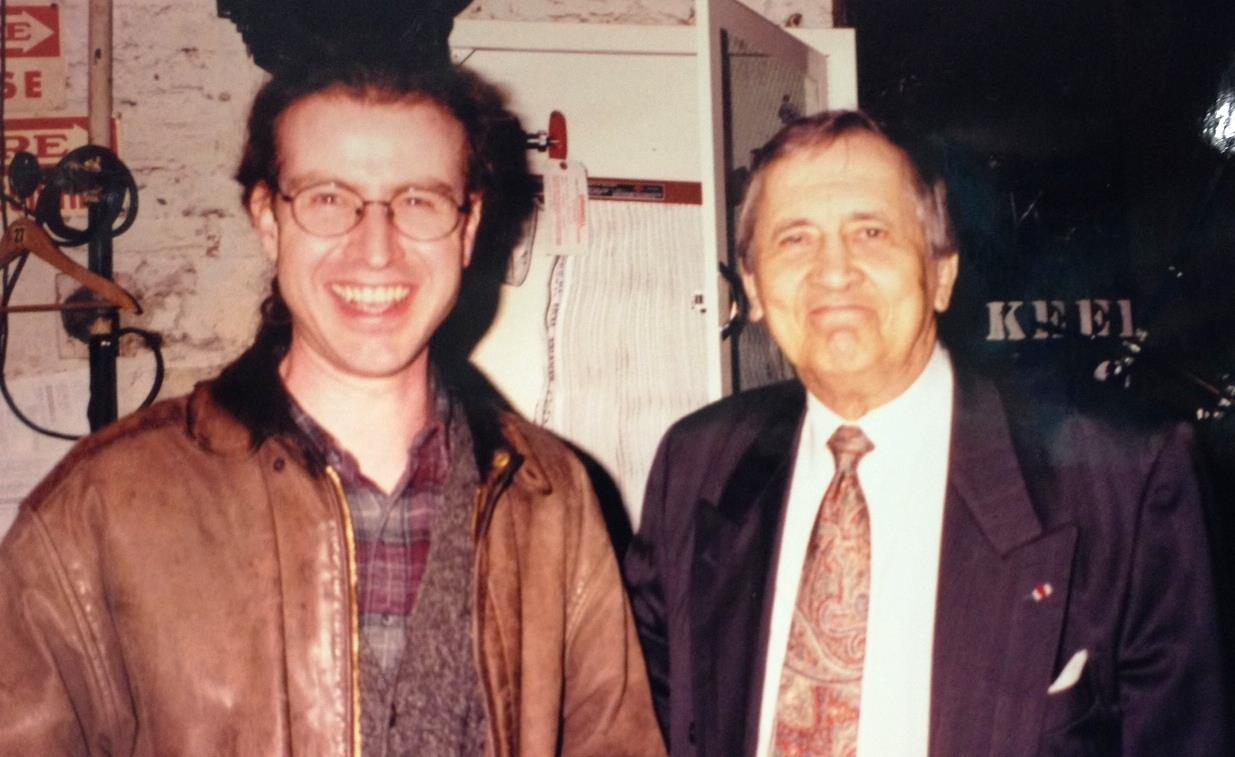
I was lucky to meet him once, in 2000, backstage at Philadelphia’s Academy of Music, prior to the first performance of his Symphony No. 8. He was kind enough to sign my Naxos CD of his Symphony No. 3, the Piano Concerto No. 1, and the so-called concerto for birds and orchestra “Cantus Arcticus.” I wonder what he thought of this peculiar, 33-year-old, American fan?
Here’s a performance of the Piano Concerto No. 1, with my recent acquaintance, Yifei Xu of the New Jersey Festival Orchestra, as the soloist.
The Philadelphia Orchestra touring Rautavaara’s Symphony No. 8, “The Journey.” I didn’t even know this video existed!
https://www.youtube.com/watch?v=llL8YGvVkkc
“Cantus Arcticus,” with bird songs recorded by the composer in the bogs of Liminka, near the Arctic Circle:
PHOTO: Ross and Rautavaara. Holding the camera: Sibelius’ grandson, the filmmaker Anssi Blomstedt!
A more complete account here:
-
American Werewolf in London & Monster Memories
From the time I was a little kid, I was fascinated by monsters. I used to sit on the couch next to my mother, transfixed by the old Universal horror classics on Chiller Theatre on WPIX out of New York. Saturday afternoons were spent at my grandparents’ house with Dr. Shock on Channel 17 out of Philadelphia. I remember the smell of the print and pulp of Forrest Ackerman’s “Famous Monsters of Filmland,” of the stale chewing gum in Topp’s Creature Feature trading cards, and of Testors Glue, with its warning of harmful vapors on the tube, as I assembled with sticky fingers Aurora monster models acquired from Hobby Hang-Out.
Monsters were my first passion. Then came comic books. Then came “Star Wars.” Then came classical music. Parallel to these ran a lifelong love of the movies, and movie monsters were my favorites.
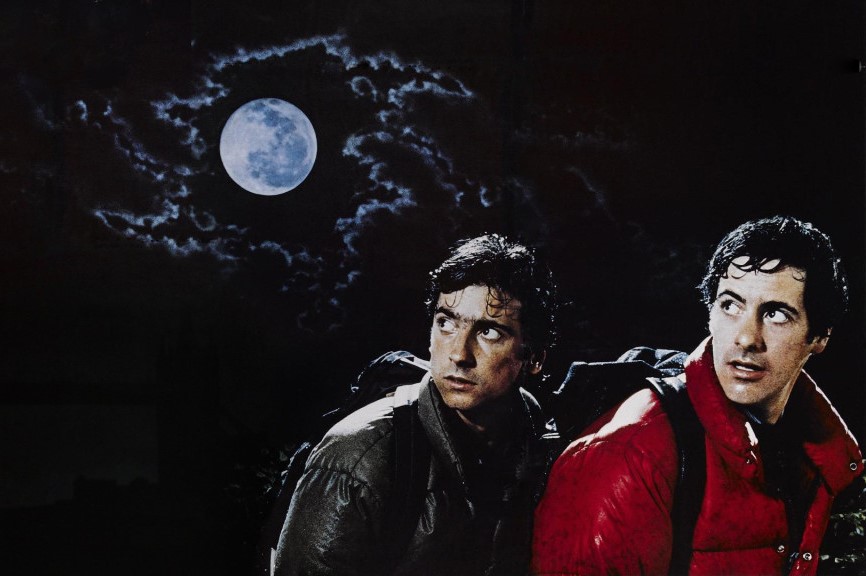
I offer all this as preamble to the fact that Roy and I will be discussing “An American Werewolf in London” tomorrow night, as we continue our month-long celebration of Halloween, on Roy’s Tie-Dye Sci-Fi Corner.
Ironically, I was a rather squeamish kid. I may have been drawn to monsters, but I always had complex feelings about the anguish and tragedy that were part and parcel of their existence, and certainly I didn’t want to see any blood. So into my teens I had mixed feelings about the Hammer films of the 1950s and ‘60s, with their buckets of Technicolor gore. And I was definitely very wary of anything more modern that ran the risk of splatter or viscera. I remember, I had a lot of apprehension when my mother took me to see “Day of the Dolphin” in the theater – not a monster movie, but rated PG!
My favorite monster was always the werewolf. I still have Nancy Garden’s book on the history of the werewolf (“Werewolves,” from Lippincott’s “The Weird and Horrible Library”) that my parents bought me at F.A.O. Schwarz on one of our trips in to New York City. Later, I acquired Sabine Baring-Gould’s 1865 study “The Book of Were-Wolves.” On one memorable occasion, when I was about 10 years old, my parents allowed me to stay up and watch “The Werewolf of London” with Henry Hull and Warner Oland.
The thing is, there weren’t very many good werewolf movies. I assume it’s because, of all the movie monsters, the werewolf was the hardest to pull off. Put a guy in a cape and give him fangs and you’ve got a vampire. But it took some real skill to engineer a palatable werewolf, especially in the old days. Even among all the monster cereals spawned by Count Chocula, including Franken Berry, Boo Berry, and the only vaguely recollected Yummy Mummy, Frute Brute was always the weakest.
Since I was weaned on the Universal films, I was all about atmosphere, broodingly-lit Gothic landscapes full of shadows and mists. Of course, these were necessary in order to effectively sustain believability, when nobody back in the day vaguely resembled a wolf. In the classic 1941 version of “The Wolfman,” always the best of the vintage werewolf movies, Bela Lugosi’s supporting character was represented, in monster form, by a genuine canine; but when it came to Lon Chaney, they gave him a toupée, teeth, and whiskers. Not that I loved him any the less for them. I hasten to add, the transformations, for the time, and certainly Jack Peirce’s makeup, were brilliant.
But by the 1980s, effects had come a long way, and now we could witness the genuine process of shapeshifting. What was sacrificed in terms of the power of suggestion was superseded by eyepopping elongation of limbs and growing fur. 1981 brought a werewolf bumper crop, between Joe Dante’s “The Howling,” with Rob Bottin’s never-look-away transformations, and John Landis’ “An American Werewolf in London,” with Rick Baker’s excruciating, interminable, and astonishing metamorphoses.
I was 15 years-old, dipping a toe into contemporary horror, but still apprehensive about anything too lurid. I was nervous about seeing “Excalibur,” of all things, as I was afraid, with its R rating, that there might be some arm-loppings. (There were.) I was a very sensitive teenager.
Yeah, there were some gross elements to “American Werewolf,” a real change of pace for director John Landis, then known pretty much for his comedies-of-excess “Animal House” and “The Blues Brothers,” but like “The Wolfman,” the film managed to insinuate itself into my consciousness, and I remember thinking about it for days afterward.
It’s been years since I’ve last seen it, and I have not really kept up with developments in the werewolf genre, being interested in neither graphic violence nor CGI, so “American Werewolf,” for me, was always the film that met the high-water mark set by Chaney. The scares and pathos were there, but bizarrely, at the time, there were also some pretty good jokes. The film ran with all the wild grace of a lone wolf. I can’t wait to rewatch it and talk about it tomorrow night.
There will be a bad moon rising, on the next “Roy’s Tie-Dye Sci-Fi Corner.” Bring your silver bullets to the comments section. It will be our time to howl, on Facebook, YouTube, etc., this Sunday evening at 7:00 EDT!
https://www.facebook.com/roystiedyescificorner
Last night, Roy’s special guest was filmmaker Jeffrey Morris, who dropped by to discuss some of his favorite episodes of “Space: 1999.” Morris is raising funds for a documentary about the cultural impact of the Eagle, the iconic spacecraft from the cult television series. Here’s a link to the show, if you’re a “1999” fan.
Also, the documentary’s Kickstarter page, if you would like to see it happen. Among the subjects who have agreed to take part in the project are actor Nick Tate, who played Alan Carter on the show, and Academy Award winning special effects artist Brian Johnson (both of whom have been past guests on “Roy’s Tie-Dye Sci-Fi Corner”). There are only five days left in the fundraiser, so think about it, and if it’s something you want to support, make your pledge. Morris is a dynamic personality, a passionate and skilled filmmaker who knows how to get things done. Every cent will be onscreen. The documentary is bound to bring fresh attention to a fondly-remembered show that is, nevertheless, always slipping further into the past. You can read more about Morris’ vision here:
https://www.kickstarter.com/projects/1924935609/the-eagle-has-landed-sci-fi-documentary
-

Andrzej Panufnik Rediscovering a Polish Giant
Andrzej Panufnik is the sleeping giant of Polish music. He’s one of those figures, like Bohuslav Martinu, who always seems poised on the verge of greatness, and yet never quite achieves the full degree of recognition he deserves.
To begin with, his particular brand of modernism was eclipsed by the avant-garde experiments of his friend and compatriot, Witold Lutoslawski. Panufnik’s relationship with Lutoslawski dated back to the war years. During the Nazi occupation, the two formed a piano duo that played in Warsaw cafés – at the time the only way to share live music in public, since there was a ban on organized gatherings.
In the meantime, Panufnik quietly produced subversive works celebrating Polish heroism and the resistance. Following the war, he was instrumental in the re-establishment of the Warsaw Philharmonic. However, increasing friction with Poland’s communist regime led to the composer’s defection, under hair-raising circumstances, in 1954. He was granted asylum in England, where he received a knighthood in 1991, the year of his death.
This week on “The Lost Chord,” we’ll pay tribute to Panufnik with two of his ten symphonies, both of them markedly “Polish” in character.
His “Sinfonia Rustica” (1948, revised in 1955), as the title implies, is a work very much of the people, making use of fragmented Polish themes, meant to reflect the rustic, semi-abstract, paper-cut art of the peasantry. Not only the symphony’s framework, but also the layout of the orchestra, is meant to reflect the symmetry found in Polish folk art. Nevertheless, despite the work’s direct character, it was denounced in 1949 as “alien to the great socialist era.”
Whenever I listen to Panufnik’s “Sinfonia Sacra” (1963), I always think of Henryk Sienkiewicz’s 1884 epic, “With Fire and Sword,” set in the 17th century Polish-Lithuanian Commonwealth during the Khmelnytsky Uprising. With its evocation of winged hussars in courageous battle against the Cossacks, Sienkiewicz’s monumental page-turner whipped readers living in a partitioned Poland into a patriotic fervor.
Conceived as a tribute to Poland’s millennium of Christianity and statehood, the symphony reflects the composer’s religious and patriotic sentiments. Panufnik based the work on the first known hymn in the Polish language, “Bogurodzica.” Throughout the Middle Ages, this served as something of a national anthem, sung not only in the church, but also on the battlefields by Polish knights.
Watch your toes – the giant stirs! Join me for two symphonies by Andrzej Panufnik, on “Andrzej the Giant,” on “The Lost Chord,” now in syndication on KWAX, the radio station of the University of Oregon!
Remember, KWAX is on the West Coast, so there’s a three-hour difference for the Trenton-Princeton area. Here are the respective air-times of my recorded shows (with East Coast conversions in parentheses):
PICTURE PERFECT, the movie music show – Friday on KWAX at 5:00 PACIFIC TIME (8:00 PM EDT)
THE LOST CHORD, unusual and neglected rep – Saturday on KWAX at 4:00 PACIFIC TIME (7:00 PM EDT)
Stream them here!
-

Vaughan Williams Symphony No. 5 in NJ & PA
Thanks, New Jersey Festival Orchestra and conductor David Wroe, for a glorious performance of Ralph Vaughan Williams’ Symphony No. 5, presented last night in the acoustically-impressive St. Helen’s Church in Westfield, NJ. You did RVW proud!
It was also my great pleasure to meet Facebook friend Jim Barclay Jr., who, like me, traveled a little over an hour to get there. RVW devotees unite!
Two further area performances of this symphony coming up – astonishing as, to my knowledge, it has not been performed in the Philadelphia area since André Previn led the Curtis Orchestra in 1995.
On November 4 at 7:30 p.m., the Southeastern Pennsylvania Symphony Orchestra will perform the Fifth at Calvary Baptist Church, 1380 S. Valley Forge Road, in Lansdale, PA – again, for me about an hour’s drive. Also on the program will be Elgar’s “Enigma Variations.” Two of my favorite pieces in English music! Allan R. Scott will conduct.
https://www.spso.info/concert-ii-elgars-enigma/
The Main Line Symphony Orchestra will perform the Fifth on November 17 at 8 p.m., also about an hour away, at Valley Forge Middle School in Wayne, PA. The latter concert is especially attractive in that the Symphony No. 2 by Vaughan Williams pupil Ruth Gipps will also be performed. Ernest Bloch’s “Schelomo” will feature as soloist Philadelphia Orchestra cellist Yumi Kendall. The conductor will be Don Liuzzi, also of the Philadelphia Orchestra.
https://www.mlso.org/concerts.htm
Prior to yesterday, I only ever heard the Fifth in concert twice! (The other time was with Leon Botstein conducting at a Bard Music Festival devoted to Sibelius in 2011.)
As always, I ask everyone to keep me apprised of Vaughan Williams performances on the East Coast. To hear the Fifth Symphony live, as it was played last night, can be transformative. It’s a hard heart indeed that can resist its third movement Romanza, but the whole thing is a wonder.
PHOTO: Vaughan Williams conducting the Fifth Symphony at Royal Albert Hall
Tag Cloud
Aaron Copland (94) Beethoven (95) Composer (114) Film Music (151) Film Score (143) Film Scores (255) Halloween (102) John Williams (198) KWAX (233) Leonard Bernstein (105) Marlboro Music Festival (125) Movie Music (166) Mozart (91) Opera (215) Philadelphia Orchestra (90) Picture Perfect (174) Princeton Symphony Orchestra (110) Radio (90) Ross Amico (244) Roy's Tie-Dye Sci-Fi Corner (290) The Classical Network (101) The Lost Chord (269) Vaughan Williams (107) WPRB (397) WWFM (881)