Category: Daily Dispatch

  • Vaughan Williams Birthday: Ken Russell’s Portrait

    Vaughan Williams Birthday: Ken Russell’s Portrait

    On the birthday of Ralph Vaughan Williams, a party favor:

    A link to Ken Russell’s quasi-documentary, “Vaughan Williams: A Symphonic Portrait” (1983) – aptly named, since the hour is structured around the composer’s nine symphonies, with a few welcome digressions to accommodate reflections on the “Tallis Fantasia,” “The Lark Ascending,” and the Oboe Concerto.

    The film is surprisingly reverential by Russell standards – this, after all, is the guy who directed “Tommy” and “Lisztomania” – though it is not without its moments of impishness. Russell himself appears prominently, as does his crew, who are made part of the supporting cast, as they are shown shooting on various locations with the composer’s widow, Ursula. The style is part documentary, part deconstruction, with touches straight out of French New Wave, as when Russell calls in a script supervisor to sit down with Ursula to go over her “lines,” when she leaves something out of one her personal reminiscences! There are a number of instances of filmmaker and subjects breaking the fourth wall.

    There is also a recurring bit with Russell and his daughter, Molly, clearly engaged and asking questions, as he flips through photographs in a book about Vaughan Williams. By the end, cumulatively, I found this surprisingly moving.

    A number Vaughan Williams associates and champions also appear: David Willcocks, Vernon Handley, and Evelyn Barbirolli – widow of the conductor John Barbirolli (Glorious John, as Ralph called him), for whom RVW composed his Oboe Concerto – composer and Vaughan Williams pupil Elizabeth Maconchy, and violinist Iona Brown, arguably the foremost interpreter in her day of “The Lark Ascending.”

    I’m afraid you’ll have to ignore the Swedish subtitles. The only other option I could find is dubbed into German!

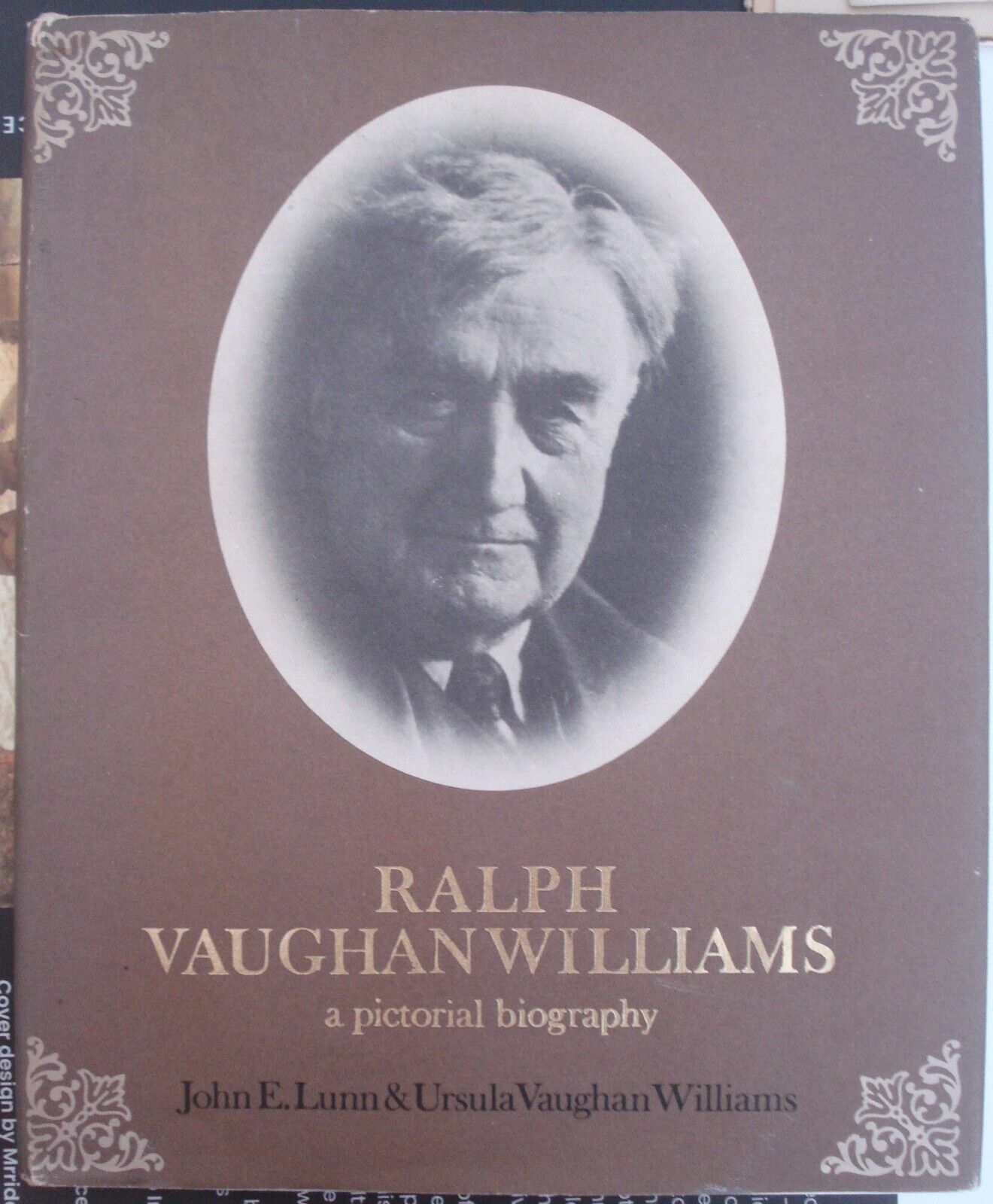
    I figured out that the book the Russells are reading is “Ralph Vaughan Williams: A Pictorial Biography,” a volume I had somehow overlooked. Since viewing the film, I was able to track down a copy, signed by Ursula and her co-author, John E. Lunn. This will now reside in my library alongside Jerrold Northrop Moore’s “Vaughan Williams: A Life in Photographs.”

    Enjoy the film, and happy birthday, Ralph Vaughan Williams!

  • Vaughan Williams Birthday Music Memories

    On the birthday of Ralph Vaughan Williams, another party favor:

    Musicologist Diana McVeagh, as near as I can calculate, was just weeks shy of her own 97th birthday, when she shared these recollections about her experiences with Gerald Finzi, Herbert Howells, Ursula Vaughan Williams, and “Uncle Ralph” himself, with wonderful side-stories about Sir Edward Elgar and Sir Charles Villiers Stanford, among others. Enjoy these priceless eyewitness accounts. They’re guaranteed to elicit a few chuckles. McVeagh is the author of several books, two of which I ordered immediately after listening to her anecdotes. “Elgar the Musicmaker” turned up inscribed by the author (to a previous owner). Thank you to Byron Adams, who conducted the interview, via video communication, during this summer’s Bard Music Festival.

    https://www.youtube.com/watch?v=8SjZTNK_3aI

    Happy Birthday, Ralph Vaughan Williams!

  • Princeton Symphony Conjures Mazzoli’s Magic

    Play Missy for me.

    According to composer Missy Mazzoli, her Violin Concerto (Procession) “casts the soloist as a soothsayer, sorcerer, healer and pied piper-type character, leading the orchestra through five interconnected healing spells.”

    Jennifer Koh, the violinist for whom the work was written, will weave her magic with the @[100043116381457:2048:Princeton Symphony Orchestra] this weekend.

    Also on the program will be Felix Mendelssohn’s beguiling “Hebrides Overture (Fingal’s Cave),” inspired by a trip to Scotland, and Jean Sibelius’ alchemical Symphony No. 2, embraced at its premiere as a symbol of Finnish nationalism, but described by its composer as “a confession of the soul.“

    Kenneth Bean will conduct at Richardson Auditorium in Princeton University’s Alexander Hall, this Saturday at 8 p.m. and Sunday at 4 p.m. For more information, visit princetonsymphony.org.

  • Opera Ballet Scandals Wagner Verdi

    Opera Ballet Scandals Wagner Verdi

    In the 19th century, when your opera was accepted in Paris, it meant you definitely needed a ballet. It was tradition. It provided a danced divertissement for French audiences, who were accustomed to a little light entertainment in the middle of an evening heavy on singing.

    Richard Wagner bemoaned the fact, when “Tannhäuser” was accepted there, and he ruffled quite a few feathers when he frontloaded his ballet, essentially “getting it out of the way,” by including it in the first act as a bacchanale – which makes perfect dramatic sense in the Venusberg, the sensual realm of Venus.

    Nevertheless, Parisian aristocrats were none too happy, as this conflicted with their dining schedules. (There’s a reason they call it “fashionably late.”) French soldiers too were accustomed to arriving with full bellies and light spirits to ogle dancers during their traditional appearance in a later act.

    For this, among other reasons, “Tannhäuser” was met with whistles and catcalls. By the third performance, the backlash had become so intense, with interruptions of up to 15 minutes at a time, that Wagner finally withdrew the opera.

    Giuseppe Verdi wasn’t crazy about the whole ballet idea either. Nevertheless, when he was invited to submit “Macbeth,” originally composed in 1847, for performance in Paris (first in 1852, and when he didn’t follow through, for a second time in 1864), he acquiesced. Of course, Verdi being Verdi, it became a much more involved undertaking than he had anticipated, and he wound up revising the entire opera.

    Privately, he expressed reservations about the inclusion of ballet in opera, but unlike Wagner, he figured out ways for it to suit the drama AND at the accepted place in an evening’s entertainment. In short, when life gave him lemons, he made limoncello.

    Verdi was a canny enough showman to know to give the public what it wanted: cavorting witches!

    You go, Joe! Happy birthday!


    Totally Goth witches’ chorus from “Macbeth”:

    https://www.youtube.com/watch?v=7b4tKhV5mcg

    Act III Witches’ Dance from Taiwan:


    “The Three Witches from Macbeth” (1827) by Alexandre-Marie Colin

  • Saint-Saëns’ Danse Macabre Halloween Classic

    I don’t care how stealthily one creeps through the graveyard at midnight. You won’t get through the Halloween season without encountering Camille Saint-Saëns’ “Danse Macabre.”

    Saint-Saëns, born on this date in 1835, originally set Henri Cazalis’ poem – about the personification of Death summoning the departed from their graves to cut a rug until cockcrow – as a chanson, or art song, for voice and piano in 1872. Two years later, he expanded it, putting some flesh on its bones and crafting it into the beloved symphonic poem, which has been a staple of Halloween programs ever since.

    Someone married the classic 1937 cartoon short “Skeleton Frolic” – pretty well, I think – to the orchestral version.

    It’s also used effectively in this modern trailer for the 1922 silent classic “Häxan.”

    And featured prominently in this scene from Jean Renoir’s 1939 film “Rules of the Game.”

    Here it is, in its original version. José Van Dam sings it, with Jean-Philippe Collard at the piano.

    That’s celebrating Saint-Saëns‘ birthday, with some rather “grave” thoughts! Bon anniversaire, mon vieux!


    Translation of the text, by Henri Cazalis:

    Zig, zig, zig, Death in cadence
    Striking a tomb with his heel
    Death at midnight plays a dance-tune
    Zig, zig, zag, on his violin

    The winter wind blows, and the night is dark;
    Moans are heard in the linden trees
    White skeletons pass through the gloom
    Running and leaping in their shrouds

    Zig, zig, zig, each one is frisking
    You can hear the cracking of the bones of the dancers
    A lustful couple sits on the moss
    So as to taste long lost delights

    Zig zig, zig, Death continues
    The unending scraping on his instrument
    A veil has fallen! The dancer is naked
    Her partner grasps her amorously

    The lady, it’s said, is a marchioness or baroness
    And her green gallant, a poor cartwright
    Horror! Look how she gives herself to him
    Like the rustic was a baron

    Zig, zig, zig. What a saraband!
    They all hold hands and dance in circles
    Zig, zig, zag. You can see in the crowd
    The king dancing among the peasants

    But hist! All of a sudden, they leave the dance
    They push forward, they fly; the cock has crowed
    Oh what a beautiful night for the poor world!
    Long live death and equality!

Tag Cloud

Aaron Copland (94) Beethoven (95) Composer (114) Film Music (151) Film Score (143) Film Scores (255) Halloween (102) John Williams (198) KWAX (233) Leonard Bernstein (105) Marlboro Music Festival (125) Movie Music (166) Mozart (91) Opera (215) Philadelphia Orchestra (90) Picture Perfect (174) Princeton Symphony Orchestra (110) Radio (90) Ross Amico (244) Roy's Tie-Dye Sci-Fi Corner (290) The Classical Network (101) The Lost Chord (269) Vaughan Williams (107) WPRB (397) WWFM (881)

DON’T MISS A BEAT

Receive a weekly digest every Sunday at noon by signing up here


RECENT POSTS