
I’ve been invited to beam down to Captain Phil’s Planet (of the Vampires) this afternoon to be his guest on WUSB, the radio station of Stony Brook University. Therefore, I’ve been hastily compiling sound files of some Halloween tricks and treats. Nobody told me there would be costumes! Join us today for an engaging and amusing mix of music and conversation, as we sip our elderberry wine and arsenic, from 3:00 to 5:00 p.m. EDT!
Category: Daily Dispatch
-
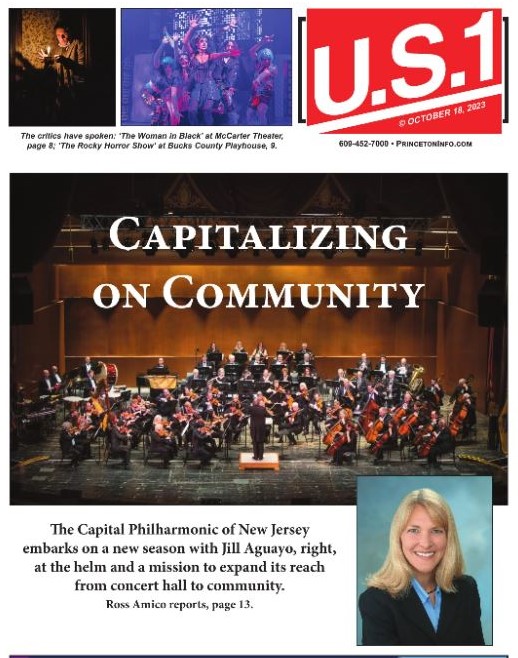
Capital Philharmonic NJ Anniversary
Speaking of the Princeton weekly U.S. 1 (see yesterday’s post about Dan Aubrey’s article that reveals a surprising connection between magicians Penn & Teller and composer Othmar Schoeck), I’ve scored this week’s cover story.
The Capital Philharmonic of New Jersey embarks on its tenth anniversary season with Rachmaninoff’s Piano Concerto No. 3, with Maja Rajković the soloist, and Mussorgsky’s “Picture at an Exhibition.” The latter will be accompanied by projections of works by local artists inspired by the music.
It’s one way in which the Capital Phil will be expanding its reach from concert hall to community in what promises to be the orchestra’s most adventurous season yet. Keep an eye out for George Antheil’s “Ballet Mecanique” at the Roebling Machine Shop this spring!
Thanks to executive director Jill Aguayo for taking the time to chat and to fill me in on some of the orchestra’s plans.
Read all about it in this week’s U.S. 1 Newspaper – PrincetonInfo, available in area vending machines and at local businesses through Tuesday, or access it online here:
New Jersey Capital Philharmonic Orchestra
-

Penn & Teller, Schoeck, and a Lost Composer
Okay, this is a few weeks out of date, as I just finally got around to reading Dan Aubrey’s cover story on the magic duo Penn & Teller in the Princeton weekly U.S. 1, dated September 20, prior to the team’s appearance at the State Theatre in New Brunswick. I once spotted Penn in the middle of the night at Diner on the Square in Philadelphia, and a few years later Teller wandered into my book shop looking for, unsurprisingly, books on magic. Yes, he can speak, and apparently, his mother lived nearby.
Be that as it may, imagine my surprise on reading Dan’s article to find the Swiss composer Othmar Schoeck mentioned copiously. Schoeck, apparently, was the favorite whipping boy of Wier Chrisemer, a college friend of Teller, who discovered some of his music in the school’s radio station library and thought it was godawful – so bad that he decided to present two or three concerts a year under the auspices of the Othmar Schoeck Memorial Society for the Preservation of Unusual and Disgusting Music. None of the concerts featured any of Schoeck’s music.
While I can certainly see the humor in this, I think the boys were a little hard on old Othmar, whom I’ve celebrated on this page in the past. And yes, I happen to like his music.
Schoeck (1886-1957) may be largely forgotten now, but he once enjoyed international recognition for his art songs, which he composed prolifically. He also produced opera, orchestral, and instrumental works. His ambitious Violin Concerto – some 40 minutes in length – was composed at white heat, out of love for Stefi Geyer, the same violinist who captivated Béla Bartók and inspired Bartók’s Violin Concerto No. 1.
Schoeck was born in Switzerland and spent most of his life there, other than a brief period during which he lived in Leipzig, where he studied with Max Reger. He had considered pursuing a career in the visual arts, as had his father, before finally committing himself to music. He was fortunate enough to secure patronage so that he could compose more or less undisturbed.
When Ferruccio Busoni settled in Switzerland during the First World War, the two developed a friendship, despite some disagreements on certain artistic matters. In fact, Busoni provided the libretto for Schoeck’s opera “Das Wandbild” (“The Picture on the Wall”), marked by the kind of chinoiserie that characterized Busoni’s own “Turandot” (in no way to be confused with the later, more famous opera by Puccini).
Schoeck’s music experienced a stylistic shift as he became acquainted with the works of Alban Berg and Arthur Honegger. A torrid affair with the pianist Mary de Senger seems to have changed him for good. When their relationship ended, so did Schoeck bid farewell to his earlier, Romantic style.
Though he was no Nazi sympathizer, Schoeck had the bad judgment or naivete to attend the premiere of one of his operas in Berlin in 1943. This led to a lot of stress at home, with the Swiss unhappy with his actions. Schoeck suffered a heart attack, but continued to compose. He died in 1957.
I seem to recall his reputation was such that the writer Hermann Hesse referred to Schoeck in one of his books – I think it was “Journey to the East” – in the same breath as Richard Strauss. I suppose it didn’t hurt that Hesse and Schoeck were friends and Schoeck set some of Hesse’s poems (as did Strauss). Hesse pitched the idea of an operatic collaboration, and even wrote a libretto, but the proposal never came to anything.
You know what? This is good. I was just writing about Frederic Chopin’s fear of premature burial yesterday, and this allows me to share a link to a song cycle by Schoeck called “Lebendig begraben,” or “Buried Alive,” from 1926. The text is from a collection of poems by Gottfried Keller. A man wakes to find himself mistakenly buried. He panics and hopes that his girlfriend or a grave robber will come to his rescue. Then he begins to reminisce in his coffin about his childhood, youth, and first love. Finally, he casts his soul into eternity with the acceptance of his fate. Perfect for the Halloween season!
This is the piece that once so moved James Joyce that he declared Schoeck a better composer than Stravinsky. So you see, he may have been a figure of fun for Penn & Teller and their friend, Wier Chrisemer, but he’s still ace with Hesse, Joyce, and me. Lucky for you, nobody’s asking you to choose sides.
What’s that? “Buried Alive” not your cup of tea? Try Schoeck’s lovely pastoral intermezzo, as the composer described it, “Summer Night.” Again inspired by a Keller poem, this time the music is purely orchestral. The poem describes a summer harvest, during which field hands come to the aid of a widow and work through the night in order to bring in her crop, before setting out for their own day jobs.
Here’s a song, “Summer Night,” on a text of Hesse.
https://www.youtube.com/watch?v=AflKXAZaUsY
And the composer’s Violin Concerto. I know one of my radio colleagues found the piece maddening when I programmed it on my syndicated show, “The Lost Chord,” since, according to him, the soloist never stops playing. It didn’t get Schoeck the girl, so to speak, either. As stated above, he wrote it out of his fondness for Stefi Geyer.
You can learn more about Penn & Teller’s connections to Trenton, Lambertville, Princeton, and Philadelphia, and Wier Chrisemer’s disdain for Othmar Schoeck, in Dan Aubrey’s article here:
In the interest of full disclosure, Dan is my long-suffering arts editor at U.S. 1. Now that I see his article runs to well over 2600 words, I don’t feel so bad!
PHOTOS: Penn & Teller, Hesse & Schoeck (sporting hats in the belfry), and the composer mustachioed
-
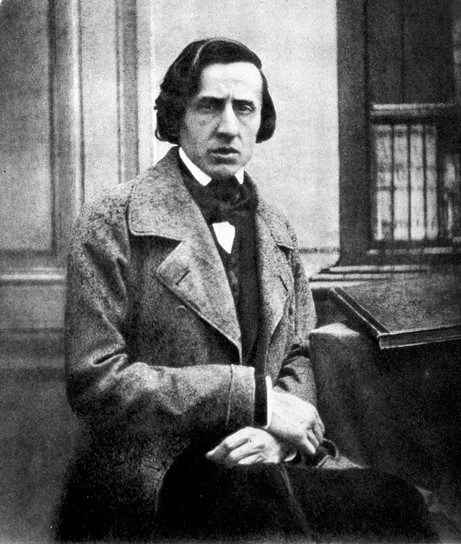
Chopin’s Heart: A Postmortem Journey
“Swear to make them cut me open so I won’t be buried alive!”
No, that was not Edgar Allan Poe, but rather the pianist and composer Frederic Chopin.
Chopin died on this date in 1849.
His music may go straight to the heart, but did you know that when the composer died, his heart went right to Poland?
Chopin had lived in exile in Paris since he arrived there in 1831 and became one of its most celebrated pianists; this in a city teeming with great pianists (including Chopin’s friend and rival, Franz Liszt).
For most of his life, Chopin struggled against poor health. When he sensed his impending death in 1849, he made the request of his sister, Ludwika Jędrzejewicz, that his heart be removed from his corpse and transported back to the land of his birth.
Ludwika complied, smuggling her brother’s heart under her cloak in a jar full of booze (probably cognac), and delivering it to Holy Cross Church in Warsaw. The heart is now immured there in a pillar. A decorative monument to the composer soon became a rallying point for Polish nationalists.
During World War II, understanding the significance of Chopin as a source of national pride, the Nazis stole the heart (paging Indiana Jones!), but it was returned after the war and reinterred.
At Chopin’s funeral in Paris, Mozart’s Requiem was played, as were Chopin’s own Preludes No. 4 in E minor and No. 6 in B minor. His body was buried in Père Lachaise Cemetery. At his graveside was heard the famous and now-hackneyed “Funeral March” from his Piano Sonata No. 2, in an orchestration by Napoléon-Henri Reber. The plinth on his grave is capped by a statue of Euterpe, muse of music, weeping over her broken lyre.
Mozart’s Requiem has been performed annually at Holy Cross Church, per the composer’s request, as part of a solemn mass conducted every year on the anniversary of his death. The International Chopin Piano Competition also takes place during this time.
While the ultimate cause of Chopin’s early demise (at 38) has been the subject of speculation – his death certificate reads tuberculosis, but modern medicine has posited, among other things, cystic fibrosis, cirrhosis, and alpha-1 antitrypsin deficiency – an examination of Chopin’s preserved heart in 2014 (through the unopened jar) suggests the likely cause of his passing was a rare case of pericarditis indeed caused by complications of chronic tuberculosis.
To avoid risking a public outcry, the composer’s heart was exhumed by church officials, scientists, and medical experts under cloak of night. Their motive was no more sinister than ensuring that the container preserving the heart had not cracked. Happily, even though the patient appears to have died of tuberculosis, his heart remains in excellent health.
Actually, despite the recurring fate of premature burial in a number of his fictions, Poe did not seem to have any extraordinary concerns about being buried alive himself. However, taphophobia is definitely a thing.
Arturo Benedetti Michelangeli plays Chopin’s Funeral March
Samson François plays the Piano Concerto No. 2
Ballade No. 4
Sviatoslav Richter fires off an Étude
Alexander Brailowsky reduced to offal by Ophüls
-

Sibelius Line Extends Conductor Stasevska Welcomes Baby
The Sibelius family tree has a new shoot!
Dalia Stasevska has given birth to a baby daughter.
Stasevska, chief conductor of the Lahti Symphony Orchestra and principal guest conductor of the BBC Symphony Orchestra, is married to Lauri Porra, Sibelius’ great-grandson. Porra trained on the cello but found fame as the bassist for Finnish metal band Stratovarius.
Get a load of this awesome electric guitar concerto.
Stasevska conducted a satisfying performance of Sibelius’ 5th Symphony in Philadelphia last season. Here’s 90 seconds of her conducting Sibelius’ 3rd, the work over which the composer’s grandson and I bonded. Ask me about it sometime.
The couple announced the pregnancy on August 22. The birth occurred on October 12. Congratulations to the happy parents!
Tag Cloud
Aaron Copland (94) Beethoven (95) Composer (114) Film Music (151) Film Score (143) Film Scores (255) Halloween (102) John Williams (198) KWAX (233) Leonard Bernstein (105) Marlboro Music Festival (125) Movie Music (166) Mozart (91) Opera (215) Philadelphia Orchestra (90) Picture Perfect (174) Princeton Symphony Orchestra (110) Radio (90) Ross Amico (244) Roy's Tie-Dye Sci-Fi Corner (290) The Classical Network (101) The Lost Chord (269) Vaughan Williams (107) WPRB (397) WWFM (881)