Hammer Studios could always bank on the antipodean artistry of Don Banks, born in Australia 100 years ago today.
Jazz was Banks’ first love, but he also studied classical composition with Mátyás Seiber and took lessons with total serialist Milton Babbitt. Unlikely as it may seem, both shared Banks enthusiasm for jazz. Another one of Banks’ tutors was Luigi Dallapiccola, also steeped in serialism. He found perhaps greater sympathy in his association and friendship with “third stream” master Gunther Schuller.
What really buttered Banks’ bread was his commercial music, with a primary source of income derived from writing scores for Hammer films, including those for “The Reptile,” “Rasputin the Mad Monk,” “The Evil of Frankenstein,” and “The Mummy’s Shroud.” In all, he scored 19 feature films, 22 documentaries, and more than 60 television shows. Nearly half of his film scores were for Hammer, where he could really let his hair down. In addition, he wrote music for cartoon shorts, advertisements, and animated television series.
In the 1970s, he returned to Australia, where he held several education and administrative posts.
Some of the scores he wrote for Hammer were jazz-inflected, including that for “Hysteria.”
In New York the other night at Old John’s Luncheonette, prior to catching a performance of Ralph Vaughan Williams’ Symphony No. 8 with the New Conductors Orchestra, I was asked by my companion for the evening, the filmmaker H. Paul Moon, off the top of my head, for the quintessential piece of Halloween music. With my back to the wall, I blurted out George Crumb’s “Black Angels.”
This spinetingling piece, for electric string quartet, has lived in my head and fired my imagination for some 40 years. The first time I ever encountered it was on George Diehl’s “Music Through the Centuries,” on Philadelphia’s late, lamented classical music station, WFLN. Diehl, one time program director of the station, who also provided program notes for the Philadelphia Orchestra, engagingly introduced Crumb’s otherworldly, often hair-raising piece by placing it in context, deftly illuminating its structure, and supplementing it with recordings of other works referenced within. This was fascinating radio. I have no hesitation in crediting “Music Through the Centuries” as a principal influence on my own radio show, “The Lost Chord.” So, thank you, George Diehl, wherever you are!
Sure, “Black Angels,” subtitled “Thirteen Images from the Dark Land,” was conceived as a reaction to the Vietnam War, but real-life horrors aside, this is one haunting, magical piece. It’s not for nothing that it was embraced by David Bowie, that it inspired David Harrington to form the Kronos Quartet (after he too encountered it on the radio), and that William Friedkin included a passage in “The Exorcist.”
There are references to Schubert’s “Death and the Maiden,” Tartini’s “The Devil’s Trill,” and the medieval plainchant “Dies Irae” (“Day of Wrath”) – quoted in so many works by Berlioz, Liszt, Rachmaninoff, and others, as well as making an appearance under the opening credits of Stanley Kubrick’s “The Shining.”
But it was not Crumb’s intention to evoke jeering demons, necessarily. The composer saw it as “a kind of parable on our troubled contemporary world. The numerous quasi-programmatic allusions in the work are therefore symbolic, although the essential polarity – God versus Devil – implied more than a purely metaphysical reality. The image of the ‘black angel’ was a conventional device used by early painters to symbolize the fallen angel.”
Its thirteen movements are divided into three larger groups.
I. Departure
Threnody I: Night of the Electric Insects (tutti)
Sounds of Bones and Flutes (trio)
Lost Bells (duo)
Devil-music (solo)
Danse Macabre (duo)
II. Absence
Pavana Lachrymae (trio)
Threnody II: Black Angels! (tutti)
Sarabanda de la Muerte Oscura (trio)
Lost Bells (Echo) (duo)
III. Return
God-music (solo)
Ancient Voices (duo)
Ancient Voices (Echo) (trio)
Threnody III: Night of the Electric Insects (tutti)
Each player is required to play a variety of instruments and to employ extended techniques.
Violin 1
• maraca
• 7 crystal glasses
• 6″ glass rod
• 2 metal thimbles
• metal pick (paper clip)
Violin 2
• 15″ suspended tam-tam and mallet
• contrabass bow (for use on tam-tam)
• 7 crystal glasses
• 6″ glass rod
• 2 metal thimbles
• metal pick (paper clip)
Viola
• 6 crystal glasses
• 6″ glass rod
• 2 metal thimbles
• metal pick
Cello
• maraca
• 24″ suspended tam-tam, soft and hard mallets
• contrabass bow
Of course, Crumb was more than simply a “Halloween” composer, though his music can be creepy as hell. Many of his chamber works, especially those that employ percussion and voice, are models of economy and elegance. I always think of him as a kind of spiritual descendent of Charles Ives, in that many of the curious sonorities he explored, especially in the context of his song settings, seem to suggest truths beyond our workaday concerns.
That said, here’s some sensational Crumb to play when you’re alone with the lights out.
Crumb died last year at the age of 92. Remembering him, blackly, on his birthday.
“Star-Child” (Watch out for that “Musica Apocalyptica,” beginning at 11:47!)
“Ancient Voices of Children” in concert (“Ghost Dance” at 17:55)
George Crumb was the recipient of the Pulitzer Prize for Music in 1968, for “Echoes of Time and the River,” and a Grammy Award for Best Contemporary Composition in 2001, rather appropriately, for “Star-Child.” All or most of his music is available in the “Complete Crumb Edition,” an ongoing project on Bridge Records, Inc.
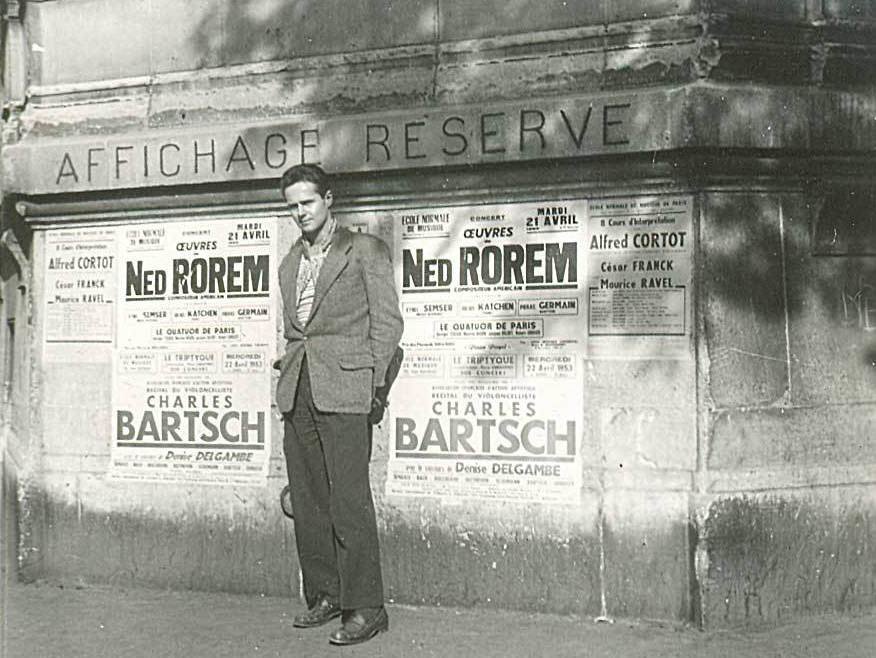
I’m up to my ears in housecleaning, digging through stacks of old boxes, exhuming all sorts of interesting concert programs and program guides, theater schedules, and personal writings, documents, and artwork, some of them dating back 40 years. The chain I’ve forged in life!
Leave it to me not to throw anything away…
But more on that in another post.
For now, I wanted to quickly acknowledge American composer Ned Rorem, who would have been 100 today. Rorem died last year on November 18.
I hope you’ll pardon me for stacking up a few links from last year.
The gap to Pazuzu remains unbridgeable! I am sorry to announce that once again we have to postpone our discussion of “The Exorcist.” And since next Sunday is our annual Halloween crossover celebration with Mike and Marybeth of SciFi Distilled (during which we’ll talk about the 1985 film “Fright Night”), the postponement is indefinite. We will cover “The Exorcist” at some point in the near future. Perhaps I’ll try to convince Roy to make it our Christmas movie! In the meantime, if you’re desperate for a taste of tie-dye, you can scroll through our archived shows at Roy’s Tie-Dye Sci-Fi Corner. Keep the holy water handy. We hope to see you for “Fright Night,” next Sunday evening at 7:00 EDT!
It’s Franz Liszt’s birthday, and I usually give him a pretty good write-up, since on top of all his musical achievements – his innovations, his influence, and his transcendental technique – he also happened to be a pretty good guy, if not without his foibles. In particular, he was exceptionally generous, often engaged in charitable causes and championing the needy, whether they be pupils, colleagues, or anonymous victims of disaster, and he always did so quietly and with the greatest humility. In a lot of ways, he also basically changed music, though it was often the case that others implemented or assimilated his original ideas with greater success.
Of course, as was the case with any Romantic virtuoso, there was also a whiff of diablerie about his reputation.
If you want to check out some of my previous posts on the subject, you can search Facebook under “Classic Ross Amico Liszt.” If you have the option to click on “photos” under the search bar, it could bring many of them up in a conveniently browsable form. Then just click on the photos for the texts.
Sadly, I’ve got a lot to do today, so I must sheepishly defer to a silly cartoon. I love Liszt, and that’s a fact.
You can learn more about his “Mephisto Waltzes” here: