By the 1980s, bubblegum entertainment was all about teens at the center of their hermetic universes, with their own television sets and telephone extensions (pre-cell), cocooned in self-affirming ‘80s pop culture – ‘80s posters and toys, ‘80s fashions and hairstyles, and most of all ‘80s music. If parents are present, they are mostly clueless, often single, and equally self-absorbed. So when a vampire moves in next door to 17 year-old Charley Brewster, it’s hardly surprising it’s all about him.
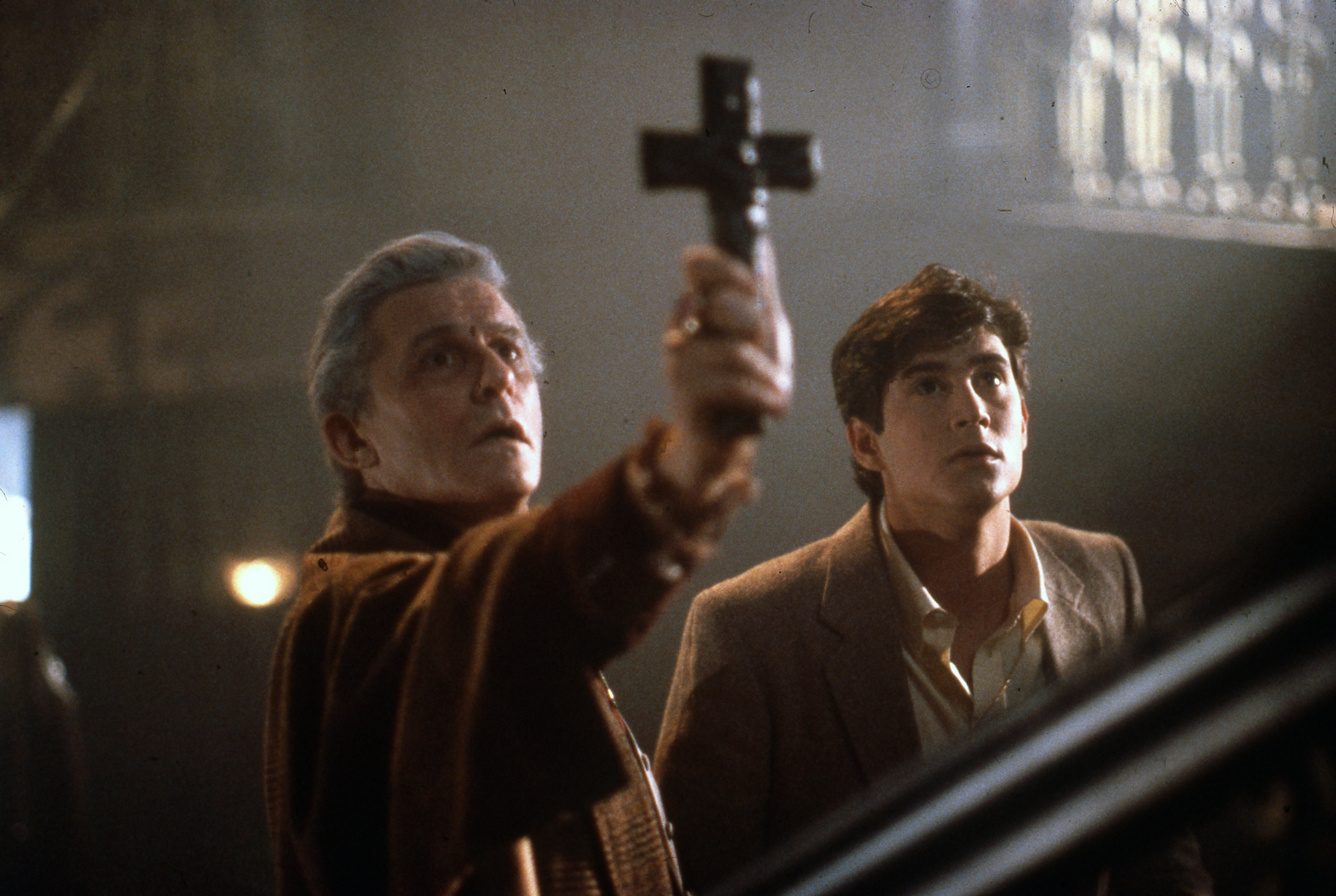
In the 1950s, it would have been Jimmy Stewart peering in on Raymond Burr, wondering why he kept leaving and returning with a suitcase in the middle of the night. In the 1980s, it’s up to teens to save the world. What’s interesting about “Fright Night” (1985) is that, in common with “Gremlins,” it’s also set during the twilight of televised creature features with their local horror hosts.
It was an inspired choice for writer-director Tom Holland to include Roddy McDowall as Peter Vincent (the name clearly a portmanteau of Peter Cushing and Vincent Price), a self-doubting cinematic vampire slayer who has seen better days. Vincent is fresh out of a job introducing good old-fashioned lurid monster movies, among them a number of his own faded glories. But when the chips are down, the reluctant Vincent brings all his accumulated lore to bear on battling the undead (a suave Chris Sarandon).
Mike and Marybeth of SciFi Distilled will join Roy and me – in costume! – for our fourth annual Halloween crossover episode, and a discussion of “Fright Night,” on the next Roy’s Tie-Dye Sci-Fi Corner. Order extra garlic on your pizza. The stakes will be high in the comments section, when we livestream on Facebook, YouTube, etc., this Sunday evening at 7:00 EDT!
With Halloween only days away, it’s time to get the frock coat out of moth balls. This week on “The Lost Chord,” we’ll celebrate Edgar Allan Poe, with an hour of music inspired by his mad and melancholy verse.
We’ll hear a “melo-declamation” for narrator and orchestra on “The Raven” by Arcady Dubensky (1890-1966), a violinist in the New York Philharmonic. The piece was given its world premiere at the Academy of Music in Philadelphia in 1932, captured in an experimental recording by RCA Victor, on 35mm optical film. It was issued on a special 78 rpm, 2-record set, with the poem, together with monochrome engravings of Stokowski and Poe etched into the shellac. Benjamin de Loache is the speaker.
Then we’ll have a symphonic poem inspired by Poe’s “Ulalume” by English composer Joseph Holbrooke (1878-1958). Holbrooke evidently adored Poe, as he wrote a number of pieces inspired by his writings, including “The Raven,” “The Bells” (which predated the work by Rachmaninoff), and “The Masque of the Red Death.” “Ulalume” was first performed in 1905. The composer thought it one of his finest pieces. Again, the source poem is a gloomy meditation on the loss of a loved one.
Then, from the Princeton-based Affetto label, we’ll hear selections from a song cycle, “Lenoriana,” by Benjamin C.S. Boyle (b. 1979). Boyle was on the faculty of Westminster Choir College of Rider University, as were the performers, baritone Elem Eley and pianist J.J. Penna. Of the seven songs, we’ll sample Boyle’s settings of “Annabel Lee,” “The Conqueror Worm,” and “To Helen.”
Finally, we’ll have an orchestral etude on “The Haunted Palace,” which Poe incorporated into his story “The Fall of the House of Usher.” The French composer Florent Schmitt (1870-1958) knew the work from a translation by Stéphane Mallarmé. It tells of a king of olden times full of presentiments of impending doom to his palace and himself. The house and the royal family are destroyed, and remnants of the court may still be glimpsed as phantoms flickering in the windows and doors.
“The Haunted Palace” may be the first piece of music by a French composer to be inspired by Poe. It was completed in 1904, and first performed the following year.
Prepare to brood over many a quaint and curious volume of forgotten lore. That’s “Edgar Allan Poems,” on “The Lost Chord,” now in syndication on KWAX, the radio station of the University of Oregon!
Remember, KWAX is on the West Coast, so there’s a three-hour difference for the Trenton-Princeton area. Here are the respective air-times of my recorded shows (with East Coast conversions in parentheses):
PICTURE PERFECT, the movie music show – Friday on KWAX at 5:00 PACIFIC TIME (8:00 PM EDT)
THE LOST CHORD, unusual and neglected rep – Saturday on KWAX at 4:00 PACIFIC TIME (7:00 PM EDT)
This week on “Picture Perfect,” it’s all widow’s peaks and plastic fangs, as we listen to music from film adaptations of novels about vampires.
“Interview with the Vampire” (1994), based on the novel by Anne Rice, featured some pretty counterintuitive casting, including Tom Cruise as Lestat (Rice would have preferred Rutger Hauer), but thanks largely to director Neil Jordan the film still managed to deliver the goods. Elliot Goldenthal’s music was nominated for an Academy Award. Interestingly, Princeton’s American Boychoir sings the opening “Libera me.”
Frank Langella’s characterization of Bram Stoker’s Dracula drove the critics wild when the play by Hamilton Deane and John L. Balderston was revived on Broadway in 1977. (It was the same adaptation that launched Bela Lugosi on his big screen career.) But when the film “Dracula” (1979) was released a couple of years later, reviews were mixed. Langella retained his dreamy magnetism, and the producers managed to secure Sir Laurence Olivier and Kate Nelligan for the parts of Van Helsing and Mina, respectively, but I wonder if John Badham was the best choice for director. Badham had just come off the enormous box office success of “Saturday Night Fever,” and it looks as if his Dracula retains John Travolta’s hair. You know, just for luck.
I remember being so excited, as a 13 year-old, watching the trailer at the movies. When Langella leaped through a window and transformed into a wolf in mid-flight to John Williams’ dramatic music, it was almost more than I could bear. Watch the trailer here:
How could a film called “Abraham Lincoln: Vampire Hunter” (2012) ever live up to its title? The answer is, it can’t, but the adaptation of Seth Grahame-Smith’s supernatural-historical mash-up wasn’t as terrible as everyone says it was. Sure, I would have preferred it had Daniel Day-Lewis played Lincoln, but put anybody in a stove-pipe to fight vampires with an axe, and I’m happy. I probably wouldn’t have been so permissive had I seen it in the theater, where the noise and effects would have pushed me over the edge, but it was a diverting rental, with a gothic score by Henry Jackman that ping-ponged between Americana lyricism and an orchestra bolstered by electronics and heavy metal guitars. But what are you going to listen to when you’re fighting vampires, a string quartet?
James Bernard’s music for Hammer Studios’ “Dracula,” released in the United States as “Horror of Dracula” (1958), is one of his best-known efforts. His Dracula theme, with its clashing harmonies, laid the groundwork for the sound of the film’s numerous sequels, most of which featured Christopher Lee in his most iconic role. Bernard became so closely associated with Hammer and vampires that he was approached late in life to provide a new score for the silent classic “Nosferatu.”
Finally, “Bram Stoker’s Dracula” (1992), despite the claims of utmost fidelity in its very title, was not a faithful adaptation of Stoker’s book. Why? WHY??? The film was lovely to look at, with eye-popping costumes and production design that combined Universal Studios in-the-camera trickery and honest-to-goodness miniatures with a few more Jean Cocteau references than perhaps was for its own good. This could have been THE Dracula film. Alas, it wasn’t. However, for me, it had THE Dracula score. It was a stroke of genius to hire Polish composer Wojciech Kilar to give the film just the right Eastern European sound.
Get your blood up, with page-to-screen vampires this week, on “Picture Perfect,” now in syndication on KWAX, the radio station of the University of Oregon!
Remember, KWAX is on the West Coast, so there’s a three-hour difference for the Trenton-Princeton area. Here are the respective air-times of my recorded shows (with East Coast conversions in parentheses):
PICTURE PERFECT, the movie music show – Friday on KWAX at 5:00 PACIFIC TIME (8:00 PM EDT)
THE LOST CHORD, unusual and neglected rep – Saturday on KWAX at 4:00 PACIFIC TIME (7:00 PM EDT)
Zdeněk Mácal, former music director of the New Jersey Symphony Orchestra, has died. Macal led the orchestra from 1993 to 2002. Together, they made some distinguished recordings, including a Grammy Award winning album of Dvořák’s Requiem and Symphony No. 9 “From the New World.”
Mácal fled communist Czechoslovakia for West Germany with his family after the Soviet Union and Warsaw Pact members crushed the liberal Prague Spring movement in 1968.
He found work at the WDR Symphony Orchestra Cologne and NDR Orchestra of Hanover. He also conducted in the U.K., Australia, and the U.S., making his American debut with the Chicago Symphony Orchestra in 1972.
Following an advisory position in San Antonio and a principal conductorship with Chicago’s Grant Park Music Festival, he became music director of the Milwaukee Symphony Orchestra in 1986. From Milwaukee, he came New Jersey to take over the NJSO.
He returned to his homeland only after the communist regime was toppled in 1989. From 2003 to 2007, he served as chief conductor of the Czech Philharmonic Orchestra.
Mácal died in Prague late yesterday. He was 87 years-old.
From Dvořák’s Requiem, with Princeton’s Westminster Symphonic Choir the New Jersey Symphony Orchestra
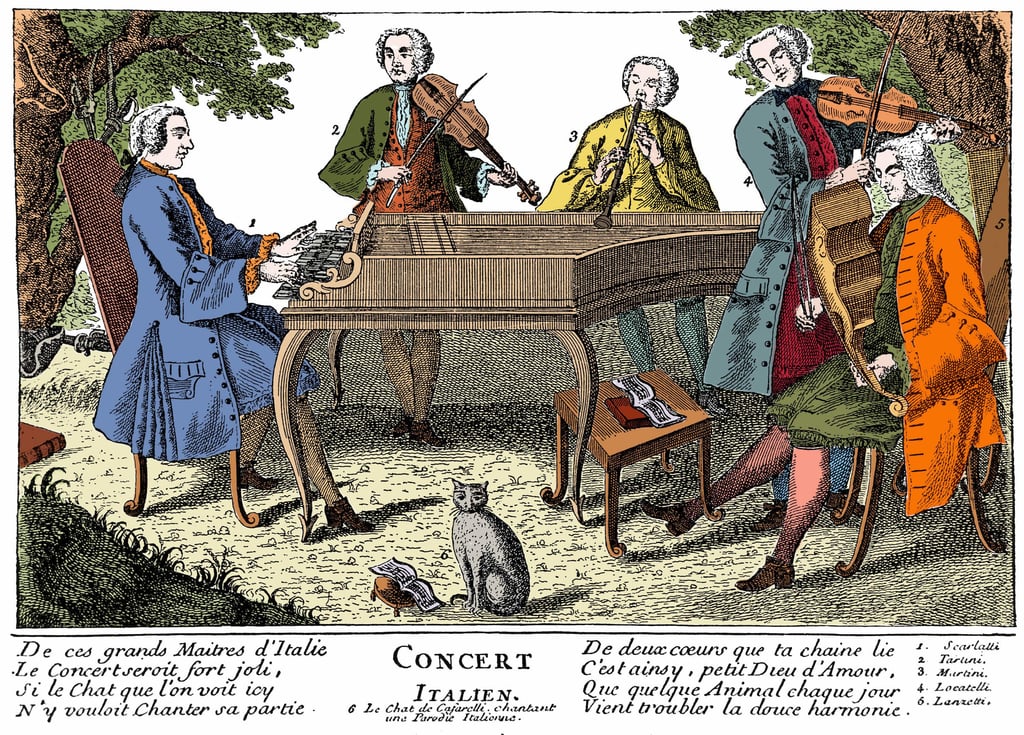
I’ve related both of these stories here perhaps several times before, but they are enlivened somewhat by the discovery of this whimsical engraving of superstar Italian musicians performing at a jam session with a singing cat.
At the harpsichord is Domenico Scarlatti, whose birthday it is today; on the violins are Guiseppe Tartini and Pietro Locatelli; on the flute Giovanni Battista Martini; and on the cello (held most peculiarly) Salvatore Lanzetti.
There’s a famous anecdote, perhaps spurious, about Scarlatti’s cat, Pulcinella, walking across his master’s keyboard. Scarlatti is said to have seized a sheet of paper and jotted down the notes sounded for use as the lead subject of one of his most famous sonatas, the work commonly known as the “Cat’s Fugue.”
As a bonus: Tartini claimed to have once been visited in a dream by the Devil, who perched himself at the foot of his bed while playing Tartini’s own instrument. “How great was my astonishment on hearing a sonata so wonderful and so beautiful, played with such great art and intelligence, as I had never even conceived in my boldest flights of fantasy,” he recollected.
Then he woke up, lit a candle, and scribbled down what he could. Yet he found the result lacking. “The music which I at this time composed is indeed the best that I ever wrote, and I still call it the ‘Devil’s Trill,’ but the difference between it and that which so moved me is so great that I would have destroyed my instrument and have said farewell to music forever if it had been possible for me to live without the enjoyment it affords me.”
As is so often case, the Devil grants a wish (indenturing himself in exchange for Tartini’s soul in the dream), only to drive his “master” to despair through the composer’s inability to recapture the perfect beauty of what he had experienced. Still, it went on to become Tartini’s most famous piece.