Okay, Halloween is past. It’s All Saints’ Day. Not only that, but it also happens to be the start of Spagvemberfest!
What’s that, you say? Why, it’s a month-long challenge to view a spaghetti western a day.
What exactly is a “spaghetti western?” It’s a term bestowed by American film critics on Italian-produced oaters. Characteristically, they are filmed by Italians, often in Spain, sometimes in the American southwest. They likely feature an international cast, with a recognizable rising or fading star as their lead or leads. All the voices are dubbed in post-production, often to humorous effect. The characters are motivated by revenge or a lust for gold. In terms of morality, only a few degrees tend to separate the hero and the villain. Often there is an adherence to the conventions of the American western, however with the intent of deflating the western myth. There is certainly a preponderance of stylized violence. And if it’s worth watching, it probably features Somerville, New Jersey’s own Lee Van Cleef (pictured).
Admittedly, the genre is an acquired taste. I don’t know about you, but I’m really going to need this, as we begin the inexorable slide toward the holidays.
Wholly by coincidence, I’ll be doing my part by presenting a heaping helping of spaghetti western scores for the birthday of composer Ennio Morricone on my radio show, “Picture Perfect,” on Friday, November 10, at 8 p.m. EDT.
The sun rises on November 1st. Time to put away the vampires and get all saintly and thankful. Here’s Vaughan Williams’ “Sine Nomine” (“For All the Saints”), performed by the Choir of Trinity College, Cambridge, the composer’s alma mater.
The day began with a pumpkin doughnut, and now I am pondering weak and weary over what to add to my Halloween playlist. Universal monster classics vie with lurid Hammer horror, devil operas, and macabre comedies.
Readings from Poe have punctuated the season. I lay down last night with Fortunato being led into the catacombs to test a pipe of Amontillado and recalled how much fun I had reading this story for the first time as a kid.
I do miss being able to share some of my Halloween favorites with you as part of a live air shift. My impulse is to lend to the savor of the day by mixing the familiar and the unusual. Frederic Curzon’s “Dance of an Ostracised Imp” or Thomas S. Allen’s “Dance of the Lunatics” always put me in a proper trick-or-treat mood. So much “Halloween” music for all occasions and from all eras, and so little of it ever played. Quoth the Raven, “Nevermore.”
Well, at least I can still record.
How about you? Any good reading, listening, or viewing planned for the day? Any excuse to array yourself in widow’s weeds or motley?
Whatever your pleasure, I wish you a Happy Halloween!
Since I am such a musical anglophile, and since Halloween happens to be my favorite holiday, I suppose it’s hardly surprising that my thoughts would gravitate to the influence of the occult on English music.
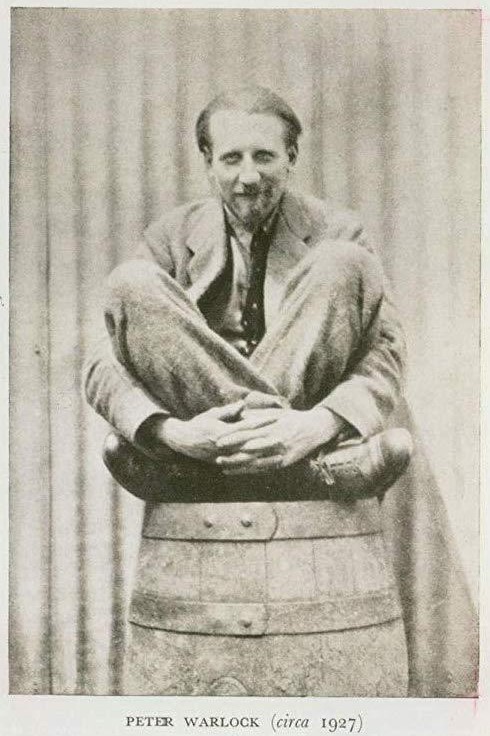
Most notorious, perhaps, would be the case of Philip Heseltine, who composed under the name of Peter Warlock. Heseltine was born on this date in 1894. He lived a scandalous life – carousing, trolling his enemies, riding naked on a motorcycle, and using one of D.H. Lawrence’s manuscripts as toilet paper – while pursuing his fascination with “the science known as Black Magic.” His life ended when he was only 36 years-old, his body found in his flat – the cause of death: gas poisoning. He left behind 100 songs, a number of choral works, and a handful of orchestral pieces. Whether or not his end was accidental has never been unanimously accepted.
The first time Heseltine assumed the pen name Warlock was for a 1916 article on the chamber music of Eugene Goossens. Goossens, who would later be honored with a knighthood, spent the better part of a decade in Australia, conducting the Sydney Symphony Orchestra and directing the NSW State Conservatorium of Music.
It wasn’t all work and no play, however. During his leisure hours, Goossens entered into a passionate affair with Rosaleen Norton, soon to be known as the Witch of Kings Cross. Norton was an artist and occultist, whose paintings of demons and phalluses were decidedly out-of-step with the spirit of the time.
In 1955, a scandal involving a mentally ill woman who claimed she had participated in a Satanic Black Mass at Norton’s flat had a domino effect. Sure, Norton had her own coven, but she denied ever being a Satanist. She did however stand by her charms and hexes. Her paintings were removed from public exhibitions and photographs were confiscated from her home. Arrests on obscenity and blasphemy charges came fast and furious. The tabloids had a field day.
Unfortunately, Goossens became collateral damage. Incriminating letters, which he had asked Norton to destroy after reading, were found stashed beneath her sofa. Though he was in England when the storm broke, wholly ignorant of the antipodean moral panic, the authorities lay in wait upon his return. Among his luggage were found 800 “pornographic” photos, film, masks, and incense. As a high-profile musical figure, for all intents and purposes, the conductor’s Goossens was cooked.
Then there was the matter of the Hermetic Order of the Golden Dawn. The order, which sported Aleister Crowley among its members, was a secret society devoted to occult, metaphysical, and paranormal activities. I once wrote a post about the composer John Ireland’s relationship with Welsh writer of the supernatural Arthur Machen, who also belonged to the society. Ireland wrote several works profoundly influenced by Machen’s philosophies and dedicated his piece for piano and orchestra, “Legend,” to him.
Even Sir Edward Elgar, composer of “Land of Hope and Glory,” had his brush with the occult, by way of supernatural writer Algernon Blackwood, also a member of the Hermetic Order. Elgar provided incidental music for “The Starlight Express,” based on Blackwood’s “A Prisoner in Fairyland.” The two men struck up a friendship, and though there is no evidence to link Elgar to actual involvement with the Golden Dawn, there are those who allege there to be Rosicrucian symbols in the “Enigma Variations,” completed years earlier, in 1899.
Sir Arthur Conan Doyle, Gustav Meyrink, Sax Rohmer, Bram Stoker, and William Butler Yeats were also members of the secret order. I imagine them all, like something out of Dennis Wheatley, gathering in their robes to offer up sacrifices to the Goat of Mendes!
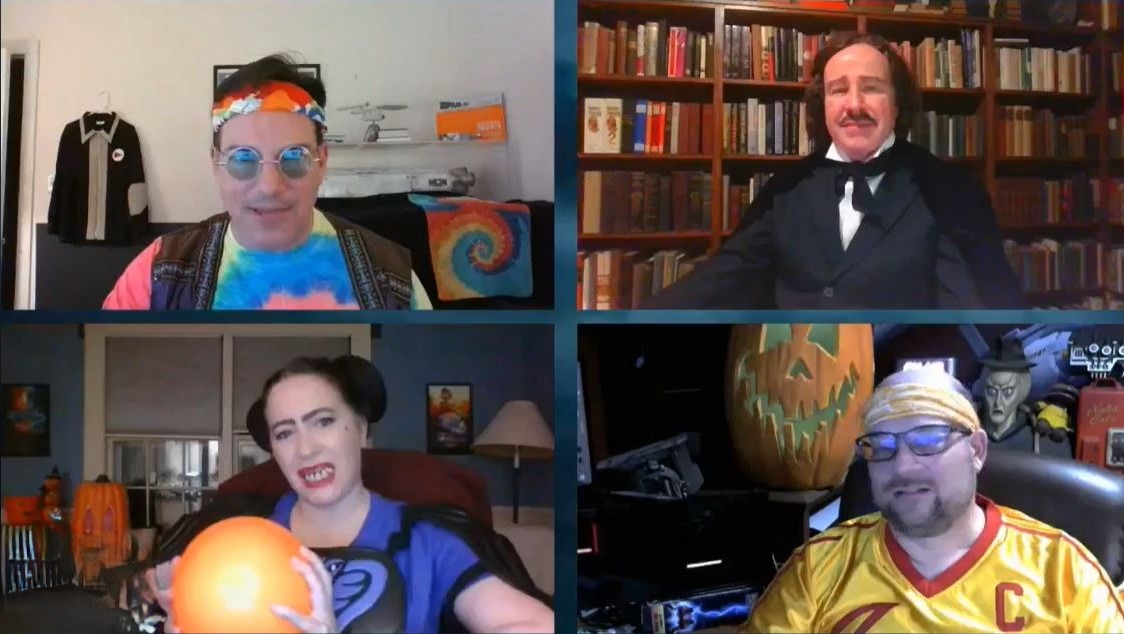
Last night on Roy’s Tie-Dye Sci-Fi Corner, the unlikely convergence of Hippie Roy, Fran and Peter La Fleur from “Dodgeball,” and Edgar Allan Poe resulted in a spirited conversation about “Fright Night” (1985).
Okay, so it’s not exactly Steve Allen.
Thanks to Mike and Marybeth from SciFi Distilled for joining us for this fourth-annual Halloween crossover celebration. It’s been archived here.
This month turned out to be a crazy one, full of cancellations and postponements, so that none of the October shows wound up airing during our usual Friday night time slot, but instead got pushed back to Sundays. I guess we needed the added protection of the Sabbath.
One of the weekends had to be cancelled altogether, so we’ll be playing catch-up next week with a 50th anniversary discussion of “The Exorcist” (1973). That will be on Friday evening, November 3, at 7:00 EDT. With the protection of All Saints, will we finally shake the Exorcist Curse?
I realize I’ve been pretty lax about follow-up posts this month, so here are links to this year’s other Halloween-oriented episodes:
“Burnt Offerings” (10/1)
“An American Werewolf in London” (10/15)
M&M’s “SciFi Distilled,” ordinarily seen on Wednesdays, will present a special episode this Tuesday, Halloween night, at 7:00 EDT.
Of course, Roy and I hope to see you in the comments section for “The Exorcist.” Have your Ouija boards on hand, when we livestream on Facebook, YouTube, etc., this Friday evening at 7:00 EDT!