Category: Daily Dispatch

  • Lost Worlds Movie Music on KWAX

    Lost Worlds Movie Music on KWAX

    It’s a shame you’ve got to stream all the way from the West Coast now to enjoy “Picture Perfect,” but there it is. Dropped from its natal station, the show can now be heard only in syndication (distributed exclusively by me). Stream it today on KWAX, the radio station of the University of Oregon.

    It seems only appropriate that the focus of such a fine show, so ignominiously dismissed, should be “Lost Worlds and Lands That Time Forgot.”

    While the concept of the “Lost World” dates at least as far back as Plato’s Atlantis, it wasn’t until the Victorian Era that the idea really blossomed in the public consciousness. At the time, of course, lost civilizations were genuinely being discovered – which might help to explain, in part, the incredible of success of “King Solomon’s Mines.” The author, H. Rider Haggard, wrote the book on a bet that he could churn out an adventure story half as good as Robert Louis Stevenson’s “Treasure Island,” which had been published two years earlier.

    “King Solomon’s Mines” became the literary sensation of 1885. Its protagonist, Allen Quatermain, is a direct ancestor of Indiana Jones. The book inspired reams of sequels and at least five film adaptations.

    The two best known of these starred Stewart Granger and Princeton-born Paul Robeson, respectively. Robeson, who played Umbopa, a king in disguise, received top billing in 1937. It’s music for THAT version that we’ll be sampling. There was no score for the 1950 Granger version, beyond some tribal drumming (although Miklós Rózsa did provide a cue for the film’s trailer). The score for the 1937 adaptation is by Mischa Spoliansky.

    Haggard achieved another “Lost World” hit with “She,” first issued in book form two years later, in 1887 – another adventure about Europeans in Africa, who meet a seemingly immortal white queen, known as the all-powerful “She” or “She-Who-Must-Be-Obeyed.”

    “She” has been adapted to film six times. The 1965 version starred Ursula Andress, Peter Cushing, and Christopher Lee. The music is by Hammer Studios house composer, James Bernard. It’s nice to hear Bernard, who wrote mostly horror scores for the likes of Dracula and Frankenstein, provide something a little more nuanced for a change. She’s theme is so sensuous, it sounds as if it could have been cast off from Ravel’s “Daphnis and Chloe.”

    Rudyard Kipling’s “The Man Who Would Be King,” published in 1888, was clearly influenced by the writings of Haggard. In this case, two British adventurers in India strike out for a remote corner of Afghanistan to set themselves up as kings. The story was made into one of the great adventure films of the 1970s, directed by John Huston, and starring Sean Connery and Michael Caine. That Christopher Plummer appears as Kipling himself is only icing on the cake. Maurice Jarre wrote the rousing score.

    Finally, James Hilton’s “Lost Horizon,” published in 1933, imagines Shangri-La, a Utopian society nestled in a sheltered valley somewhere in the mountains of Tibet. A British diplomat is one of a handful of passengers who survives a plane crash to be taken into the lamasery.

    “Lost Horizon” was made into a film twice. The less said about the 1973 version, a musical with songs by Burt Bacharach, the better. Frank Capra directed the classic 1937 version, which starred Ronald Colman, Jane Wyatt, and outstanding character actors of the day – actors like Edward Everett Horton, Thomas Mitchell, Sam Jaffe, and H.B. Warner.

    The score, Dimitri Tiomkin’s first major contribution, was also one of his most ambitious. Seldom was it so obvious that he had studied at the St. Petersburg Conservatory under Alexander Glazunov.

    I say unto to you what my former employers said unto to me: Get lost! I hope you’ll join me for music for lost civilizations this week, on “Picture Perfect” – music for the movies – this Friday evening, now on KWAX!

    See below for streaming information.


    Keep in mind, KWAX is on the West Coast, so there’s a three-hour difference for the Trenton-Princeton area. Here are the respective air-times of my shows (with East Coast conversions in parentheses):

    PICTURE PERFECT – Friday on KWAX at 5:00 PACIFIC TIME (8:00 PM EDT)

    THE LOST CHORD – Saturday on KWAX at 4:00 PACIFIC TIME (7:00 PM EDT)

    Stream them here!

    https://kwax.uoregon.edu/


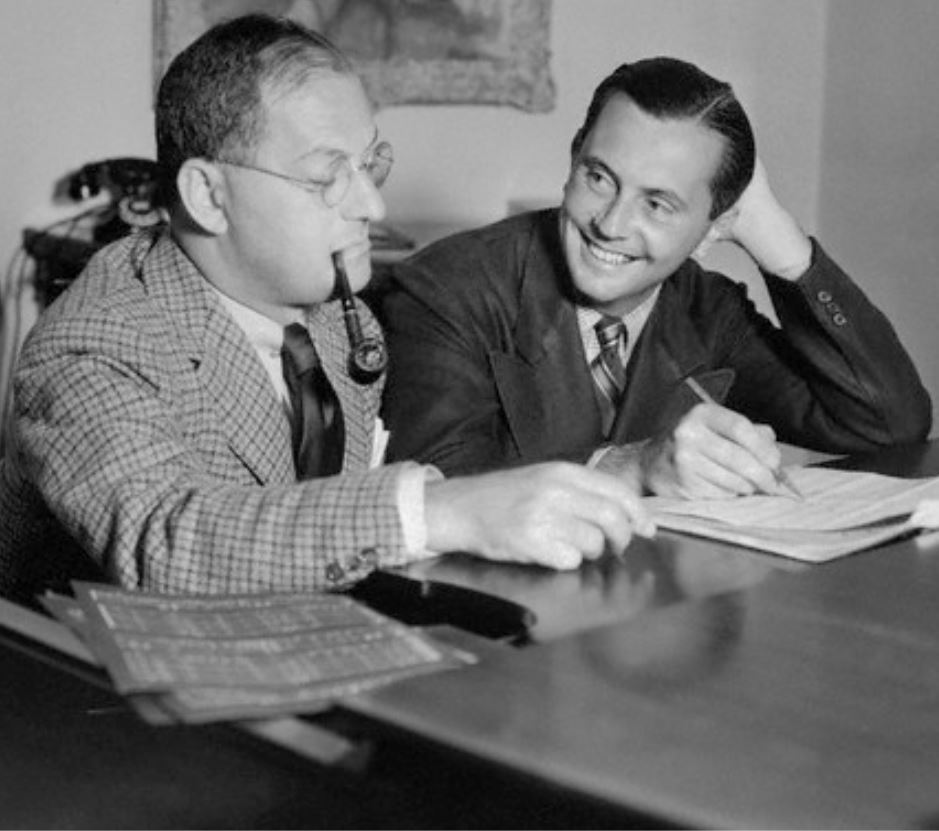
    PHOTO: Connery (right) with the man who would be Caine

  • Schumann’s Ghost Variations Lemonade From Madness

    Schumann’s Ghost Variations Lemonade From Madness

    When life gave him syphilis, he made lemonade. Or something like that.

    In 1854, after a twenty-year latency, Robert Schumann began to lose his grip on sanity. He complained of a persistent “A” note ringing in his ears, hallucinated that he was being hounded by devils, and hurled himself into the Rhine. He would spend his final years in an asylum, to which he committed himself at the age of 44.

    Even in the best of times, Schumann often struggled with what we now call manic-depression or bipolar disorder. His two extremes are reflected in the assumed literary doppelgangers, Florestan (the impetuous) and Eusebius (the introspective), also frequently referenced in his piano music. Evidently, there could be an undercurrent of intensity about him, even when he was at his dreamiest.

    Both before and after Schumann’s icy plunge from the bridge, he was at work on his final composition, the “Ghost Variations,” believing the theme to have been dictated to him by the spirit of Mendelssohn or Schubert. In reality, Schumann had used the theme several times before, including, only a few months earlier, in his Violin Concerto.

    Clara, his wife, wouldn’t allow the piece to be published. No doubt it held for her extremely personal, likely unpleasant associations. Still, family friend Johannes Brahms, whom Schumann had mentored and championed, would quote it in his own composition, “Variations on a Theme by Robert Schumann.”

    Brahms dedicated his tribute to Clara, who, awkwardly, also happened to be his secret (?) crush. When Schumann went into the asylum, she was pregnant with her seventh child and left to care for the family herself. She was discouraged from visiting her husband until the very end, for fear of triggering a relapse. In the meantime, Brahms was her only link, as he could enter and leave the sanatorium freely.

    The “Ghost Variations” may not be Schumann’s healthiest music, but what do you expect? It is undeniably intimate and achieves a kind of fragile beauty. You won’t encounter it very often.

    It’s also bittersweet. Kind of like a glass of lemonade.

    Happy birthday, Robert Schumann.

  • Time for Three Kicks Off Princeton Festival

    Time for Three Kicks Off Princeton Festival

    Tomorrow night, make time for Time for Three.

    The charismatic, genre-hopping, Grammy Award-winning trio will open The Princeton Festival, blurring the boundaries between classical, Americana, and modern pop.

    This year’s festival, which will run June 9-25, will also encompass opera (Rossini’s “The Barber of Seville”), chamber and instrumental music, musical theater, contemporary dance, R&B and soul, a klezmer “good vibes explosion,” and a special family concert, all presented on the grounds of Morven Museum & Garden at 55 Stockton Street (Route 206).

    Vibrant Baroque music and an intimate program for guitar and cello will be offered across the way at Trinity Church Princeton, at 33 Mercer Street.

    The festival’s “big top” will be an 11,000 square-foot, clear-span (no poles or obstructed views), open-sided performance pavilion, allowing for easy access to refreshments, ample picnicking opportunities, a garden stroll, or the simple enjoyment of a late-spring/early-summer evening.

    The Princeton Festival is the premier summer arts program of the Princeton Symphony Orchestra. For complete listings and ticket information, visit princetonsymphony.org/festival.

    Then check out my preview in the Princeton weekly U.S. 1 Newspaper – PrincetonInfo.

    https://www.communitynews.org/princetoninfo/eeditions/page-page-12/page_58fa5c3c-6e2a-5848-acb1-58218381fe73.html

  • Roy’s Tie-Dye Sci-Fi Corner Anniversary

    When I got home, I had to get my sound files for “Picture Perfect” and “The Lost Chord” in to KWAX for the next few weeks (they’re on the West Coast and therefore three hours behind), but now that I’m cooking dinner, I can finally take a few minutes to acknowledge my convivial lunch today with Roy! It’s all about the food, people…

    Yes, indeed, it’s my third anniversary as cohost of @[100063986017424:2048:Roy’s Tie-Dye Sci-Fi Corner], the pandemic antidote that reunited two old friends after an intermission of, I think, 34 years. Thank you, Roy, for inviting me on your show. I guess I’m one of those nightmare guests who never knows when to leave.

    Here we are this afternoon, a couple of high-end tie-dye models, taking in lungs full of carcinogenic smoke from burning Canada, so you don’t have to. Sending condolences and best wishes to our friends north of the border (including the four-legged ones). Who would have thought we’d all live to see the kind of dystopia we used to encounter only in bad 1970s science fiction movies. All that’s missing is Jan Michael Vincent and some giant scorpions.

    Thanks to all of you who have tuned in week after week for the past few years. I’ve really enjoyed getting to know a lot of you through your witty and insightful commentary.

    If you haven’t tuned in, what are you waiting for? Oh. I guess we’re not on this week. But we’ll be back on June 16 at 7:30 PM EDT! If you really can’t wait, listen to what we have to say about “A Clockwork Orange,” at the link:

    https://www.facebook.com/watch/live/?ref=watch_permalink&v=634665158576124

    Or visit some of our other past shows, all archived on the “Roy’s Tie-Dye Sci-Fi Corner” Facebook page:

    https://www.facebook.com/roystiedyescificorner

    Here’s to a live-long-and-prosperous fourth year! Nanu nanu!

  • George Szell Composer Conductor?

    George Szell Composer Conductor?

    Did you know that one of the most revered – and feared – conductors of the 20th century was also a composer? Or at least he was, at one time.

    George Szell, the musical martinet who built the Cleveland Orchestra into one of the world’s finest – even as he drove 40 percent of its musicians to seek psychiatric help, according to clarinetist Murray Khouri, who wasn’t joking – at 11 toured Europe as “the next Mozart.”

    By 17, Szell added conducting to his precocious skills as a pianist-composer and soon determined the latter discipline was where his future lay.

    If his own music reminds you of Richard Strauss, Szell was very much from that world. At 18, Szell was appointed to Berlin’s Royal Court Opera, where Strauss was music director. He quickly earned the older composer’s admiration and friendship. Strauss once said that he could die a happy man knowing that there was someone who could perform his music so perfectly.

    It’s good that he felt that way, because Szell wound up having to conduct the first half of the world premiere recording of Strauss’ “Don Juan,” when the composer overslept. Since a 78-rpm record could only accommodate four minutes of music per side, the session was planned in four parts. Strauss walked in just as Szell was completing the second and thought it so good, he allowed it stand. The complete performance was issued under Strauss’ name.

    Szell credited Strauss as being a major influence on his conducting style. For Strauss’ part, he continued to keep track of his protégé even after Szell settled in the United States.

    By then, for Szell, there would be no more composing. He did, however, keep up with his pianism, which came in handy during rehearsals. Occasionally, he also played and recorded chamber music.

    He brought all his experience to bear on his quest for artistic excellence on the podium. That he was a triple-threat was like gilding the lily for one already as threatening as George Szell.


    One of Szell’s early compositions, “Variations on an Original Theme”

    World premiere recording of “Don Juan” (1917), with Szell and Strauss conducting

    Szell as a Mozart pianist

    Szell’s benchmark modern orchestra Haydn

    While on tour with the Cleveland Orchestra in Tokyo, and with only two months to live (he was terminally ill with cancer), Szell conducted what may very well be the most thrilling performance of Sibelius’ Symphony No. 2 I have ever heard, certainly on a par with the classic Barbirolli account with the Royal Philharmonic Orchestra

    Szell speaks!

    Szell on “The Bell Telephone Hour” on NBC. These days, you won’t even find something like this on PBS.

    Szell rehearses Beethoven

    Szell conducts Beethoven and Bruckner in Vienna

    https://www.youtube.com/watch?v=vuXODojyfME

    Happy birthday, G.S.!

Tag Cloud

Aaron Copland (93) Beethoven (95) Composer (114) Film Music (124) Film Score (143) Film Scores (255) Halloween (94) John Williams (188) KWAX (229) Leonard Bernstein (101) Marlboro Music Festival (125) Movie Music (139) Opera (202) Philadelphia Orchestra (89) Picture Perfect (174) Princeton Symphony Orchestra (106) Radio (87) Ralph Vaughan Williams (85) Ross Amico (244) Roy's Tie-Dye Sci-Fi Corner (290) The Classical Network (101) The Lost Chord (268) Vaughan Williams (103) WPRB (396) WWFM (881)

DON’T MISS A BEAT

Receive a weekly digest every Sunday at noon by signing up here


RECENT POSTS