Category: Daily Dispatch

  • Aram Khachaturian Composer of the Sabre Dance

    Aram Khachaturian Composer of the Sabre Dance

    Aram Khachaturian may have been the most renowned Armenian composer of the 20th century, but he was actually born in Georgia, in the capital city of Tiflis (Tblisi) or thereabouts, on this date in 1903. Tiflis had a large Armenian population and served as a major Armenian cultural center.

    Following the Sovietization of the Caucasus, Khachaturian moved to Moscow in 1921. There, he studied cello and composition at the Gnessin Musical Institute – which it is said he entered without any formal musical training – and the Moscow Conservatory, where Nikolai Myaskovsky was among his teachers.

    In his lifetime, he was celebrated both at home and abroad. Everyone knows the manic “Sabre Dance” from his ballet “Gayane,” once the preferred music of plate-spinners everywhere, and frequently employed at the circus. Liberace played the “Sabre Dance” on his TV show. In 1968, Stanley Kubrick used the Adagio from “Gayane” on the soundtrack to “2001: A Space Odyssey.” The same year, the Adagio from the ballet “Spartacus” was featured in the film “Mayerling,” starring Omar Sharif and Catherine Deneuve. More recently, the Coen Brothers used “Spartacus” (as well as the “Sabre Dance”) in “The Hudsucker Proxy.”

    In the West, the public loved him, even as his music came in for critical brickbats, variously described as “lightweight,” “pop” and “schlock.”

    At home, that’s precisely what they loved about him. Anyone who got too introspective or innovative was in danger of being labeled “formalist” and “anti-people.”

    From the late 1930s, Khachaturian was rewarded with several high posts in the Union of Soviet Composers. But nobody was allowed to get too big in Stalin’s USSR. So in common with just about every other Soviet composer, Khachaturian was denounced, busted down, and humiliated, only to be built back up when it was thought he had been sufficiently humbled. As punishment, he was sent to Armenia – which I would think would be the equivalent of sending someone to their room, with all their things around them, when grounded!

    Once Khachaturian was restored to favor, he taught at the Gnessin Institute and the Moscow Conservatory. As a conductor, he toured Europe, Latin America, and the United States. In 1957, he was appointed Secretary of the Union of Soviet Composers, a position he held until his death in 1978.

    There’s plenty of great Khachaturian footage on YouTube. Below are some links to “Kach” at your convenience.

    Happy birthday, Aram Khachaturian!


    Khachaturian conducting his Violin Concerto, with a 13-year-old Yoko Sato the soloist

    David Oistrakh and Leonid Kogan have a go at it

    Khachaturian conducts his Piano Concerto, with Nikolai Petrov, the soloist (complete)

    Petrov plays the Concerto-Rhapsody for Piano and Orchestra, in color (complete)

    Mstislav Rostropovich plays the Concerto-Rhapsody for Cello and Orchestra (complete)

    Khachaturian at the keyboard

    Khachaturian conducting his biggest hit, the “Sabre Dance,” at the Bolshoi

    A “making of” featurette with lots of Khachaturian footage

    https://www.youtube.com/watch?v=MsuE8x77id0


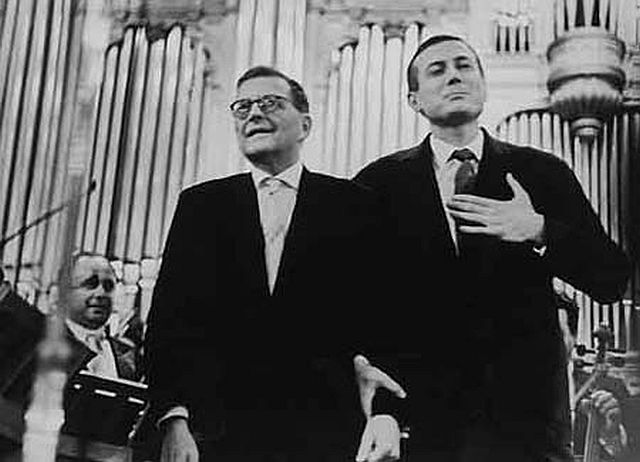
    The Manny, Moe and Jack of Soviet music: (left to right) Prokofiev, Shostakovich, and Khachaturian in 1945

  • Daniel Pinkham Centenary and Christmas Cantata

    Daniel Pinkham Centenary and Christmas Cantata

    Whenever I think of composer Daniel Pinkham, the first things that spring to mind are warm memories of listening to his “Christmas Cantata” on cold December nights, broadcast from the dearly departed, fondly remembered WFLN. The recording, made in the days of vinyl, featured the Dale Warland Singers, and in the tranquil slow movement, I could hear the stylus glide reassuringly along the grooves of the record. What a treat it was to encounter this old friend every year. Astonishingly, although there is a more recent recording featuring the same forces, to my knowledge, this beloved LP version, on the Augsburg label, has never been issued on compact disc. For me, it’s still the one to beat.

    And why aren’t there more recordings to choose from? It’s a very popular work among choruses, and audiences love it. In fact, I would say it is Pinkham’s most popular work (though I understand his “Wedding Cantata” also gets a lot of play).

    Daniel Pinkham was born 100 years ago today. Like Sir Thomas Beecham and Francis Poulenc, he was born into a prominent family that built its fortune in the pharmaceutical trade.

    Pinkham studied at Harvard with Walter Piston and later with Aaron Copland, among others. He studied harpsichord with Putnam Aldrich and Wanda Landowska, organ with E. Power Biggs, and composition with Samuel Barber, Arthur Honegger, and Nadia Boulanger.

    He himself went on to teach at the Boston Conservatory and the New England Conservatory of Music. At the latter, he created and chaired its program on early music performance.

    For 42 years, he was organist at Boston’s King’s Chapel. The position gave him ample opportunities to write music for the church.

    In addition, he performed regularly with the Boston Symphony Orchestra as both an organist and a harpsichordist.

    He produced music in virtually every genre, from symphonies to art song, and he embraced many styles. But I will always hold dearest his little, ten-minute Christmas present, most effective – and affecting – in its simplicity. The “Christmas Cantata,” scored for chorus, double brass and organ, is influenced by plainchant and medieval-style modal writing, though filtered through a distinctly 20th century sensibility.

    Pinkham died in 2006 at the age of 83.

    Thank you, and happy centenary, Daniel Pinkham!


    “Christmas Cantata;” not the earlier Dale Warland album (pictured), the audio from which doesn’t appear to be posted online, but it will do

    Sonata No. 1 for Organ and Strings

    From the Concerto for Celesta and Harpsichord Soli

    Symphony No. 2 (posted as a playlist; let the four movements play through)

    Interview with Bruce Duffie

    http://www.bruceduffie.com/pinkham.html

  • WWFM Cancels Shows Webcasts Remain Briefly

    WWFM Cancels Shows Webcasts Remain Briefly

    I am reluctant to direct anyone to the WWFM website at this point, after having been treated so shabbily. However, I wanted to let you know, if you are a fan of “Picture Perfect” or “The Lost Chord,” that webcasts of my recorded shows have been brought up to date and will remain accessible there for an undetermined amount of time.

    This is not the same as indefinitely. As soon as upper management gets around to it, they will be removed. So it could be a week, or they could last the summer, or it could take six months. Certainly, as the shows begin to gain traction elsewhere, I will want them taken down myself. In the meantime, you can listen to them here:

    PICTURE PERFECT

    https://www.wwfm.org/show/picture-perfect-with-ross-amico

    THE LOST CHORD

    https://www.wwfm.org/show/the-lost-chord-with-ross-amico

    If you haven’t heard the news, both have been dropped from the WWFM on-air line-up, as part of a bewildering and characteristically slow-moving shake-up. Their inherent qualities aside, both have amassed large followings on the strength of their longevity alone, with “Picture Perfect,” the movie music show, a presence on the station for 13 years, and “The Lost Chord,” devoted to unusual and neglected music, running for 20.

    With only ten days’ notice, I was contacted by the station manager via email and told that the shows would be “sunsetting” at the end of April. (Then, for some reason, “Picture Perfect” ran for another two weeks beyond the stated time.) I was given a Hobson’s choice to continue “Picture Perfect” on a once-a-month basis, to be aired in rotation with three other shows on Friday evenings at 6:00. All episodes would be newly-recorded. Should I be amenable to this, I would have the privilege of producing them without pay. I was given a week to get back to them with my decision. (Did this mean I would be permitted, finally, after three years, to come in and use the station facilities?)

    Obviously, for a professional broadcaster whose show had run weekly for 13 years, the terms were unacceptable. Matters of exploitation aside (nothing new at the station, unfortunately), the show would be lost in a rotating line-up. How do you build and hold onto an audience when you’re only on the air for an hour the first Friday of every month?

    I hasten to add, despite my disappointment, I sent a temperately-worded response, hoping to keep the channels open for the possibility of future collaboration, but in turn I received, after two weeks, what was essentially a Dear John letter.

    All the same, webcast audio for the the recent shows, especially, has been brought up to date. I also now have copies of every sound file in my possession, so I will begin promoting and distributing to other markets, with the possibility of getting the shows on another local terrestrial radio station.

    To further ensure their rehabilitation, I have ordered recording equipment so that I can begin supplementing archival material with newly-produced programs, which I have been chafing to do, especially as my collection and contacts have continued to grow for three otherwise stagnant years, as I was led to believe I would be welcomed back into the WWFM studios. And certainly I have no shortage of ideas.

    Thankfully, in the meantime, the shows ARE syndicated. For now, I have a foothold at KWAX, the radio station of the University of Oregon. You can listen to them there at the following times, with East Coast conversions in parentheses:

    PICTURE PERFECT – Fridays on KWAX at 5:00 PACIFIC TIME (8:00 PM EDT)

    THE LOST CHORD – Saturdays on KWAX at 4:00 PACIFIC TIME (7:00 PM EDT)

    https://kwax.uoregon.edu/

    KWAX is an excellent station that demonstrates evident respect for everything it broadcasts, presenting the music complete, and with minimal chatter. Do make it a point to check out their programming, especially during the week. After three years of classical radio swamp gas in central New Jersey, it’s like a breath of fresh air. The station manager? Fellow WWFM exile Peter Van de Graaff.

    Whatever my future success, having been associated with the station for 28 years, it’s hardly surprising that I view the handling of the entire situation by upper management as a betrayal, of both me and the shows’ listeners and supporters. And it would be one thing (two things?) if it were only MY shows, but the entire station is seemingly in free-fall.

    Remember, if you’re not happy with the changes the station has undergone in the past few years, it’s not too late for you to voice your dissatisfaction.

    WWFM announced the cancellation of “Picture Perfect” and “The Lost Chord” (along with Carl Hemmingsen’s “Half Past”) on its Facebook page, WWFM The Classical Network, on May 13. You can scroll down to the relevant post after following the link.

    https://www.facebook.com/wwfmtheclassicalnetwork

    But if you really want to reach the top, consider emailing the station manager at alice@wwfm.org.

    Don’t believe it if they blame the changes on finances. Live on-air hosts cost money, for sure, but none of us have been paid for our recorded shows for a long, long time, well-predating the pandemic. To cancel a popular show like “Picture Perfect” and to drop “The Lost Chord” from a Sunday-at-10 p.m. timeslot – not exactly prime real estate, but a great cult slot – demonstrates a baffling lack of awareness. What’s airing at those times now? More canned music from that service in Minnesota.

    I’m pretty confident that it’s because of listener blowback from good people like you that the webcasts are being kept up for the moment. So thank you to those of you who have already come forward. Don’t think that your complaints don’t make a difference. Even if the shows are not restored, management should know when it’s made an unpopular decision, even as it continues to circle the drain.

    The one silver lining is that it looks like the station finally removed that horrible looking photo of me from its website, thank goodness. Lord, how I hated that photo.

    I thank WWFM for all the opportunities it has afforded me over the years to share great music with an incalculable number of listeners. And thank YOU for being among them. I am sorry for all of us that it is not the same quality classical music station it was 28 years ago.

    On the bright side, there’s nowhere to go but up. Excelsior!

  • Havergal Brian’s Gothic Symphony A Colossal Masterpiece

    Havergal Brian’s Gothic Symphony A Colossal Masterpiece

    According to the Guinness Book of World Records, Havergal Brian’s Symphony No. 1, the “Gothic Symphony,” composed between 1919 and 1927, is the longest symphony ever written.

    It’s certainly one of the largest, requiring multiple choirs and orchestras. The work calls for vocal soloists, two double choruses, brass bands, and a much-enlarged symphony orchestra, including 32 woodwinds, 24 brass, two timpani, assorted other percussion (requiring 17 players), celesta, two harps, organ, and a greatly expanded string section. In addition, two horns, two trumpets, two tubas, and one set of timpani combine in each of the four brass bands – a total of nearly 200 players. And that’s before factoring in the singers!

    The composer had to paste multiple sheets together in the writing of the piece in order to accommodate its titanic demands. Brian dedicated the work to Richard Strauss, who declared it magnificent.

    We’ll get to sample but a fraction of it this week, on “The Lost Chord.”

    A contemporary of Ralph Vaughan Williams and Gustav Holst, Brian dropped out of school at the age of 12 and went to work in a coal mine. He also worked for timber firms and as a carpenter’s apprentice, the whole while nursing a secret desire to write music.

    Though attracting early admiration from the likes of Sir Edward Elgar, Sir Thomas Beecham, and Sir Donald Francis Tovey, Brian was destined always to be a cult figure. But there were and are enough people out there that believe strongly enough in his music, that most of his major works have been recorded.

    Among them are 32 symphonies – 20 of them composed after the age of 80 and the last at the age of 93. Brian died in 1972, the result of a fall, two months shy of his 97th birthday.

    The “Gothic” falls into two parts, subdivided into three movements each. Part One was inspired by Goethe’s “Faust,” and Part Two is a gargantuan setting of the “Te Deum” – combined they present a symphonic vision of the Gothic Age, a period of incalculable expansion in human knowledge. The music in Part Two is essentially modeled on Gothic architecture. It’s literally Brian’s conception of a cathedral in sound.

    Clearly, this is one musical edifice that’s too big for an hour, so well cut to the chase and grapple with the last 40 minutes. As a curtain raiser, we’ll enjoy Brian’s comedy overture “The Tinker’s Wedding,” composed in 1948, at the age of 72.

    Of course, there will be plenty of biographical information along the way. I hope you’ll join me for “Life of Brian,” now in syndication on KWAX, the radio station of the University of Oregon.

    Keep in mind that KWAX is on the West Coast, so there’s a three-hour time difference (conversion included in parentheses) – actually rather convenient for those of us located in the vicinity of the show’s erstwhile home at WWFM.

    THE LOST CHORD – Saturdays on KWAX at 4:00 PACIFIC TIME (7:00 PM EDT)

    And don’t forget my movie music show, PICTURE PERFECT, now on Fridays on KWAX at 5:00 PACIFIC TIME (8:00 PM EDT)!

    https://kwax.uoregon.edu/

  • A Clockwork Orange Anniversary

    A Clockwork Orange Anniversary

    Our govoreeting about Stanley Kubrick’s “A Clockwork Orange” (1971) purred away real horrorshow last night, with angel trumpets and devil trombones, and some dobby clips from past episodes to celebrate my third anniversary on Roy’s Tie-Dye Sci-Fi Corner. It was gorgeousness and gorgeousity made flesh. The very thing for leering and smacking over eggiwegs and lomticks of toast, my brothers. Viddy well!

Tag Cloud

Aaron Copland (93) Beethoven (95) Composer (114) Film Music (124) Film Score (143) Film Scores (255) Halloween (94) John Williams (188) KWAX (229) Leonard Bernstein (101) Marlboro Music Festival (125) Movie Music (139) Opera (202) Philadelphia Orchestra (89) Picture Perfect (174) Princeton Symphony Orchestra (106) Radio (87) Ralph Vaughan Williams (85) Ross Amico (244) Roy's Tie-Dye Sci-Fi Corner (290) The Classical Network (101) The Lost Chord (268) Vaughan Williams (103) WPRB (396) WWFM (881)

DON’T MISS A BEAT

Receive a weekly digest every Sunday at noon by signing up here


RECENT POSTS