I know there are some “Columbo” fans out there. I watched an episode, now and again, if I happened to be in the room when it was on, and since my stepfather enjoyed the show, it meant I had plenty of opportunities. For me, as I assume it was for many, Falk was the whole show. No doubt someone will challenge me on that, and I’m fine with it. I’ve just never really been into the whole murder-of-the-week-with-celebrity-guests kind of thing.
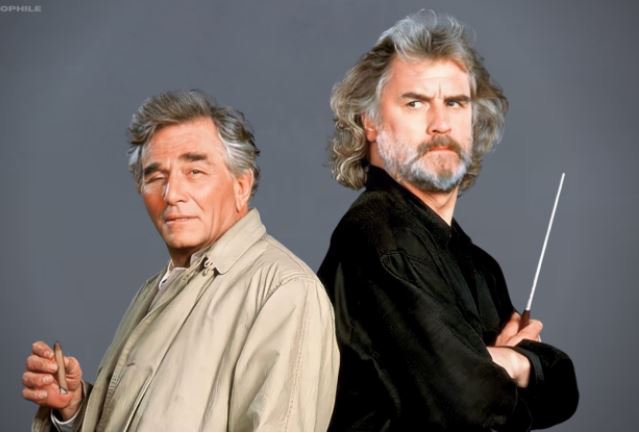
That said, how have I never heard about “Murder with Too Many Notes?” This particular episode involves an Oscar-winning film composer (played by Billy Connolly) who stands to lose everything when his protégé threatens to reveal that most of his scores were, in fact, ghostwritten.
It’s been pointed out that Connolly bears an uncanny resemblance to Michael Kamen, composer of “Die Hard,” “Robin Hood: Prince of Thieves,” and “Mr. Holland’s Opus,” among others. But Kamen at least was open about employing assistants, who acted primarily as orchestrators. The practice is not unusual, nor is it particularly unethical, when the musicians are credited at the end of the film.
What it is unethical, to my thinking, is when a composer does little or even no work on a score as it’s heard in a movie, and the hard-working, underpaid composers who actually bring the music to fruition remain anonymous, with only the “big shot” appearing in the credits. And they get no points for originality.
Sure, Kamen did a lot of work in the popular sphere, working for instance on Pink Floyd’s “The Wall,” but he also had classical training, having studied English horn at Juilliard and composition with Vincent Persichetti and Jacob Druckman. He was not just some computer-noodler with garage-band experience and no idea how to string his ideas together in a convincing manner when dealing with larger forms. (He wrote ballets before he came to Hollywood.)
Kamen never won an Academy Award, but he was nominated for two, and won three Grammy Awards, two Golden Globes, and an Emmy. He actually seemed like a pretty good guy, setting up the Mr. Holland’s Opus Foundation to bring instruments and music education to kids in underserved communities. Furthermore, the foundation stepped up to create an emergency fund in the wake of Hurricane Katrina.
So any similarity to Kamen, I hope, was purely coincidental. Because this “Columbo” villain-of-the-week seems a lot more like a few other composers I can think of, including the one most responsible for the current lowest-common-denominator approach to film-scoring. You know, the one with the team of soundalikes that’s squashed the soul of cinema with its electronic cliches of ominous drones and hyperintense ostinati. I’m not hearing any John Williamses or Jerry Goldsmiths or Elmer Bernsteins emerging from the galley.
Kamen died of a heart attack at 55 on November 18, 2003. He was still alive when “Murder with Too Many Notes” aired on March 12, 2001.
It turns out the behind-the-scenes story of this particular episode is much more fascinating than anything that made it on-screen, as a much-compromised realization of screenwriter Jeffrey Cava’s original vision. Film music was Cava’s passion. And it pains me to think that Patrick McGoohan was largely responsible for a life-imitates-art appropriation of his work.
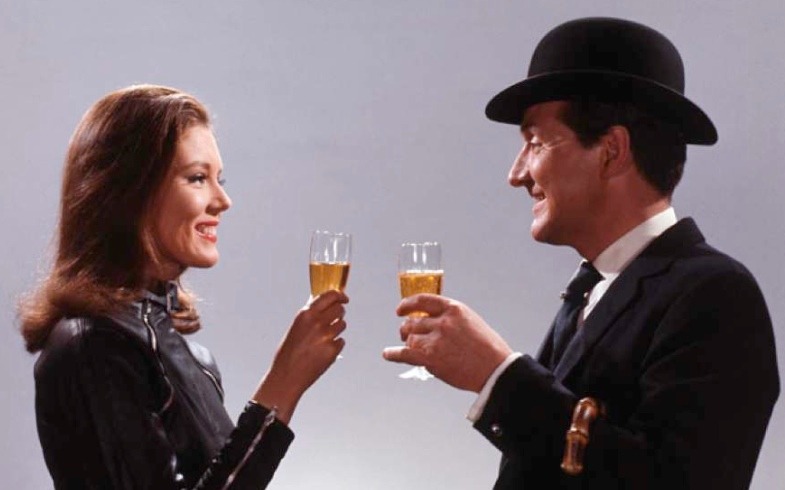
Columbo and The Prisoner? That’s right. I know it’s not the only time McGoohan was involved with the series. But it was his last, as the show was nearing the end of its run.
Thanks to Lukas Kendall for directing his readers to this a number of weeks ago on his blog. Kendall is the founder and longtime editor of Film Score Monthly.
The whole sordid tale on columbophile.com:
Peter Falk describes his working relationship with McGoohan:
http://web.archive.org/web/19981206185852/http://www.clark.net/pub/bjpruett/pmweb/columbo.htm
More of Kendall’s musings here: