If you haven’t had a chance to check it out yet, here’s the inspirational commencement speech Maya Shankar delivered last month at Juilliard. There are lessons in it I think we can all benefit from.
Category: Daily Dispatch
-
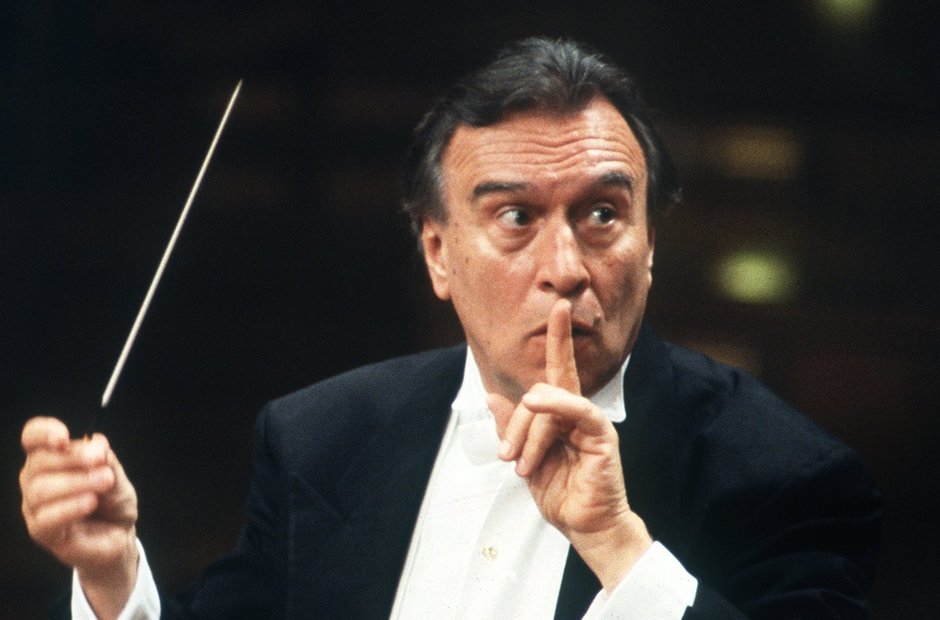
Abbado at 90 A Personal Take
I noted earlier that Claudio Abbado would have been 90 today. While I do enjoy some of his recordings, I haven’t always found most of his interpretations to be all that interesting. That is to say, they haven’t always connected with me, personally.
Undoubtedly, there will be those who feel differently. As I mentioned in my previous post, I’ve got some Abbado recordings that I do like, but I don’t know that I would describe any of them as desert island material, except perhaps for his recordings with Argerich.
Granted, there is probably no conductor who has been equally successful at everything, and every conductor has an off-day. Also, music is tied to performance, so it’s always different. One night an interpretation will sing, and the next it will sink.
I’m curious, are there any other big-name conductors who, more often than not, hit you the way I describe? I know I’ve got a few.
And in case you are offended by what is, after all, merely my opinion, remember: Abbado has been adored by millions, and I’m just some schmo on the internet.
-

Remembering Claudio Abbado at 90
Claudio Abbado would have been 90 today. Funny, I still think of his appointment as chief conductor of the Berlin Philharmonic as being fairly recent. Seeing this video – obviously from video tape – makes me realize just how long ago it was! 1989! He certainly had some big shoes to fill, in the wake of Karajan. I don’t know that I ever entirely bought in to the marriage, though the first time Abbado conducted the orchestra was all the way back in 1966.
For me, and I imagine for most, his best, or rather his most consistent recordings, date from his London years, or at any rate before Berlin. That’s not to say he wasn’t still capable of great work. And I’m just going by the recordings I’ve heard. I never had the privilege to hear him live.
After years of ill health (he was diagnosed with stomach cancer in 2000), Abbado died in 2014 at the age of 80.
I don’t pretend to have heard everything, but here are some of my favorite Abbado recordings:
Debussy: Three Nocturnes; Ravel: Daphnis and Chloe Suite No. 2; Scriabin: Poem of Ecstasy (w/Boston Symphony Orchestra)
Debussy: La Damoiselle élue (w/soprano Maria Ewing and the London Symphony Orchestra)
Mendelssohn: Complete Symphonies (w/London Symphony Orchestra)
Schubert: Rosamunde: Complete Incidental Music (w/Chamber Orchestra of Europe)
Prokofiev: Piano Concerto No. 3, etc. (w/Martha Argerich and the Berlin Philharmonic)
Mussorgsky works for orchestra and chorus (w/London Symphony Orchestra)
I am less well-versed in his recordings of contemporary works by Luigi Nono, Iannis Xenakis, Pierre Boulez, etc.
I am also not as familiar with many of his opera recordings (beyond Mussorgsky’s “Boris Godunov” and “Khovanshchina” and Schubert’s “Fierrabras”), but some of them are said to be very fine indeed. I would think Debussy’s “Pelleas and Melisande” is a safe bet, and Berg’s “Wozzeck” is regarded as a classic. But some of his Verdi recordings (“Macbeth,” “Simon Boccanegra”) have been ecstatically reviewed.
Some of the recordings I recommend are from after 1989, but of those, none of them are in Berlin. Even the one Berlin recording is from well before he was chief conductor there.
Great video of Argerich and Abbado, in all their glory, live in concert
https://www.youtube.com/watch?v=yIKn4hz0A7I
Young Abbado conducting Prokofiev’s “Romeo and Juliet”
Prokofiev, Argerich and Abbado live in Paris
Rehearsing the storm in Beethoven’s “Pastoral” Symphony
-

Rainy Day Fun Princeton Books Music Crossword
You wouldn’t guess it now in the Princeton area, but there’s more rain on the way this afternoon. In fact, rain is in the forecast, to a greater or lesser extent, for the next week or more, mostly in the form of scattered thunderstorms. But you know how it is. It’s a very unstable time of year.
When it pours down rain, you can waste the opportunity by doing what I can’t help noticing a lot of people do much of the day anyway – flip through your phone. OR you could unplug and enjoy some quiet time with a book.
Even if I were Burgess Meredith in a post-apocalyptic world with “time enough at last,” my life couldn’t possibly be long enough to read everything I would like to. And that goes for listening to music also.
Having just polished off the “Kalevala” – the Finnish national epic that inspired so much of Sibelius’ music – and recently posted a photo of my library, reading is much on my mind lately.
Here’s one of many Classic Ross Amico crossword puzzles I compiled while we were all sitting at home during the first wave of COVID in 2020-21, a puzzle that celebrates two of life’s great pleasures – books and music!
To fill out the puzzle, follow the link and select “solve online” at the bottom of the page. You’ll then be able to type directly into the squares. Once you feel you’ve exhausted the puzzle, you’ll find the solutions by clicking on “Answer Key PDF.”
Rain or shine, summer is a great time to catch up on your reading. Pour yourself something cheering, relax, and enjoy!
-

Wagner Debussy Holst Early Symphonies on KWAX
Mighty oaks from little acorns grow, and even giants started small.
Young composers who went on to great things tackle that most daunting of musical forms, the symphony, this week on “The Lost Chord,” now in syndication on KWAX, the radio station of the University of Oregon.
What’s that? Wagner wrote symphonies? That’s right. He took a crack at writing two of them, in Beethovenian style, before finding his niche as a revolutionary opera composer. We’ll hear his Symphony in E.
We’ll also enjoy an early symphony by Gustav Holst, composer of “The Planets,” and one by an 18-year-old Claude Debussy.
Judging from their mature works, these three would be among the least likely to attempt sonata form.
Impetuous youth! I hope you’ll join me for “Bold Heads on Young Shoulders.” Composers at the start of their careers find the courage to strive for symphonic mastery, on KWAX!
See below for streaming information.
Keep in mind, KWAX is on the West Coast, so there’s a three-hour difference for the Trenton-Princeton area. Here are the respective air-times of my recorded shows (with East Coast conversions in parentheses):
PICTURE PERFECT, the movie music show – Friday on KWAX at 5:00 PACIFIC TIME (8:00 PM EDT)
THE LOST CHORD, unusual and neglected rep – Saturday on KWAX at 4:00 PACIFIC TIME (7:00 PM EDT)
Stream them here!
LEFT TO RIGHT: Young Debussy, Wagner, and Holst, feeling their oats
Tag Cloud
Aaron Copland (94) Beethoven (95) Composer (114) Film Music (151) Film Score (143) Film Scores (255) Halloween (103) John Williams (198) KWAX (233) Leonard Bernstein (105) Marlboro Music Festival (125) Movie Music (166) Mozart (91) Opera (215) Philadelphia Orchestra (91) Picture Perfect (174) Princeton Symphony Orchestra (110) Radio (90) Ross Amico (244) Roy's Tie-Dye Sci-Fi Corner (290) The Classical Network (101) The Lost Chord (269) Vaughan Williams (107) WPRB (397) WWFM (881)