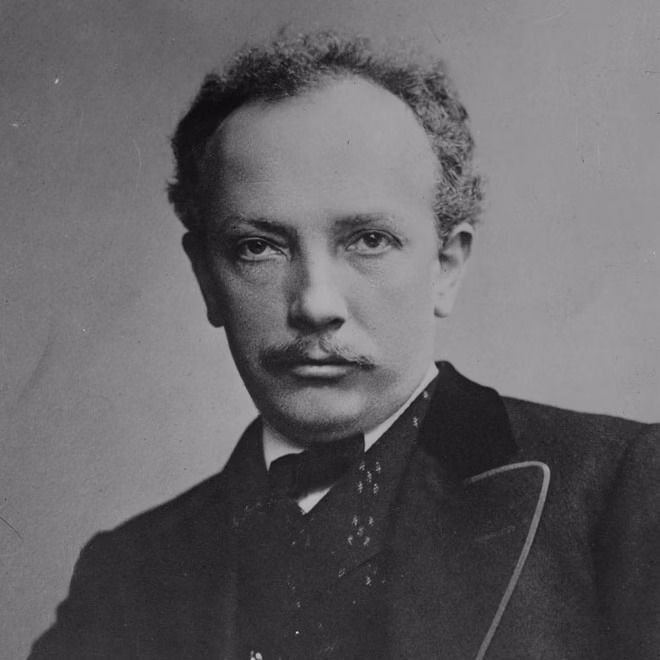
Yesterday was the birthday of Richard Strauss, but I had another party to attend, and after an afternoon of carbs, sugar, and heat, I was more fit for a nap than “Also sprach Zarathustra.” I always thought the younger Richard Dreyfuss bore an uncanny resemblance to Strauss. Not so much now. Mr. Holland’s “opus” would have been that much more satisfying had the music sounded like “Ein Heldenleben.”
Category: Daily Dispatch
-
Remembering Philadelphia’s WFLN
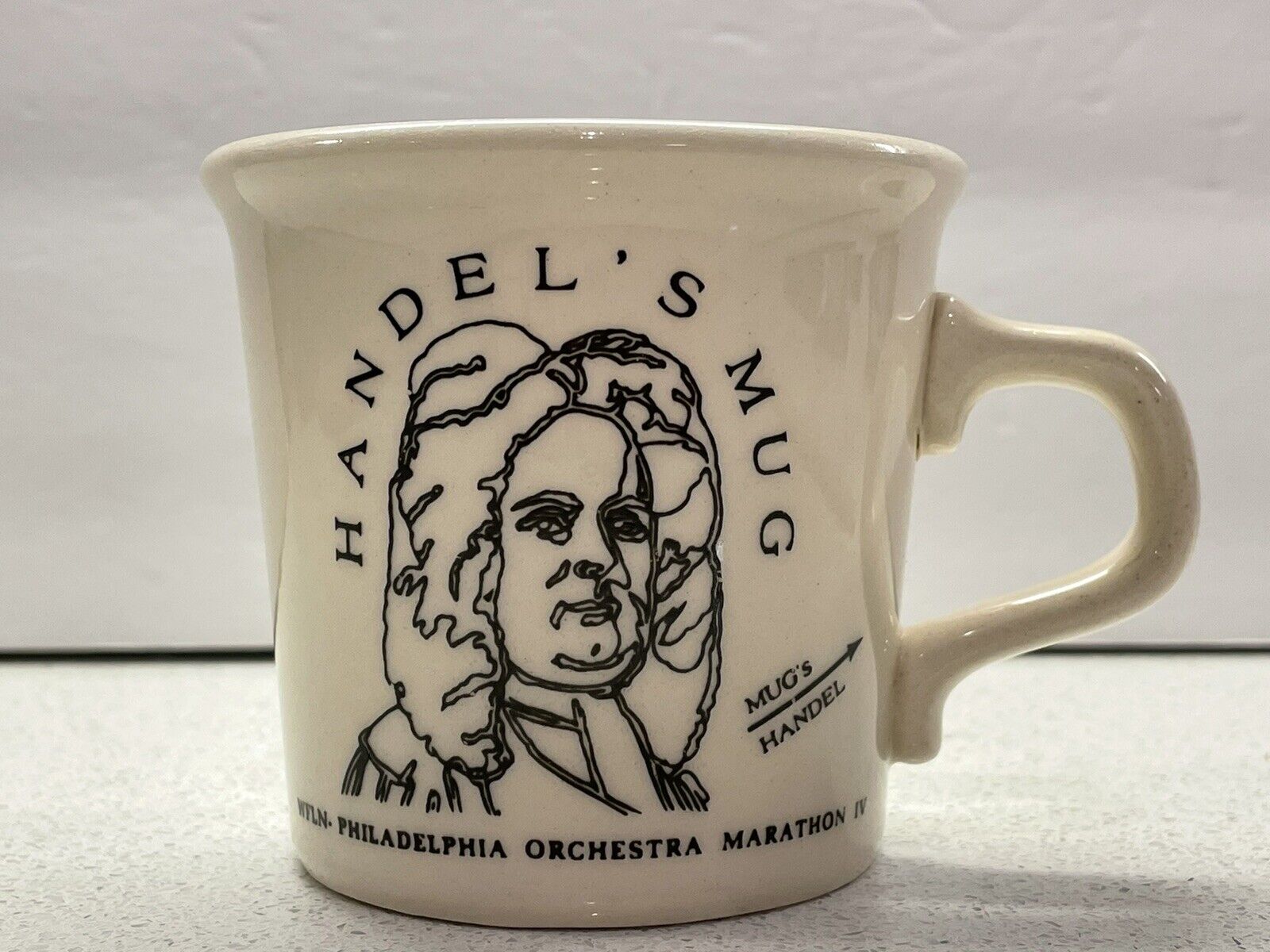
Anybody else remember this?
I found it yesterday in a secondhand shop, and I had to pick up, because of my fond memories of WFLN, Philadelphia’s classical music station for 48 years.
So much did I love that station that I still remember useless bits of trivia about it, such as the fact that it was Frank Kastner who signed on for the first time in 1949 and hosted the first two hours, which included recordings (on 78 rpm) of Brahms’ “Academic Festival Overture,” Rachmaninoff’s Piano Concerto No. 2, and Sibelius’ Symphony No. 2.
Frank was a piece of living history. He returned to WFLN years later, and I had the opportunity to meet and converse with him several times. I remember discussing neglected music with him, and our talking about Giuseppe Martucci. I also remember once Frank hilariously playing Peter Maxwell Davies “Eight Songs for a Mad King” at around 9:00 on a weekend morning. Definitely NOT music authorized by the program director!
For a number of years, the station would host a joint fundraiser with the Philadelphia Orchestra. These were frequently broadcast with WFLN announcers and celebrity guests (such as Celeste Holm) appearing in a public location, so that you could drop by and pick up your “thank you” premium. These were often in the form of a mug or an autographed CD.
Apparently, there was a Bach’s Mug, a Mozart’s Mug, a Beethoven’s Mug, a Brahms’s Mug, and a Tutti Per Muti Mug (a reference to then-Philadelphia Orchestra music director Riccardo Muti). These all came up in the course of my Google searches this morning.
The one pictured, of course, is Handel’s Mug. 3-1/2 inches tall. 3-1/2 inches wide. I’ll add it to my collection of broadcast trophies and memorabilia, including a Metropolitan Opera mug, once owned by WCLV’s Robert Conrad, and Ralph Collier’s briefcase, debossed with his birth initials. (He was born Ralph Kisch.) I also own a number of Collier’s neckties, including his Abraham Lincoln tie from the Union League of Philadelphia.
Needless to say, I hung on to a selection of the old WFLN program guides. I’ve got one from October 1982 on my bedside table right now. I especially treasure those from around the holidays. That’s back when classical music Christmas was really classical music Christmas, hardcore! And I’ve got a few of the station’s annual limited-edition posters.
In my memory, the programming was not the most adventurous, but it was cozy. I’m always saying I learned the entire standard repertoire from listening to WFLN. However, revisiting the October 1982 program guide reveals plenty of surprises, with, for instance, Witold Lutoslawski’s Cello Concerto scheduled for around 3:00 on a weekday afternoon. I also remember hanging around one day waiting to start a cassette tape because I saw they would be playing Roy Harris’ “Folk Song Symphony.” I heard Olivier Messiaen’s “Turangalîla Symphony” for the first time on a New York Philharmonic broadcast, with Leonard Bernstein conducting. So clearly, this was an invaluable resource that presented more than just the three B’s.
The announcers were familiar without ever coming across as fake, and nobody blathered on about inanities – except in the mornings, when Dave Conant would needle Dick James from Schuylkill Valley Nature Center about the weather.
Each day part was capped by a signature tune, drawn from Haydn (the last movement of the Symphony No. 6 “Le matin”), Fauré (“Masques et bergamasques” and “Pavane”), Sibelius (the “Entr’acte” from “Pelleas and Melisande”), and Johann Ernst Altenburg (the Concerto for 7 Trumpets). I have so many happy memories associated with that music. Truly, this station was like home. So much of it was entwined with my youth.
Here’s a biography of Frank Kastner in his own words:
https://www.broadcastpioneers.com/frankkastner.html
And a preserved aircheck from 1990, opening with Ralph Collier doing an ad for Jack Kellmer Jewelers; then Dave Conant, host of the drivetime show “Morning Potpourri” (also the station’s GM); with Dick James banter starting around 39 minutes in:
Wish I could find more like this, especially from the early ‘80s.
Almost too painful to listen to: the format change in 1997. Philadelphia has not had a full-time classical music station since.
https://www.youtube.com/watch?v=oV4unQHkqgI
Some of the WFLN staff was picked up by WRTI at Temple University. The rest drifted away to other stations around the country or changed careers.
I actually interviewed with Conant a few times at WFLN, back in the 1980s, while I was still in college. He was very nice man, very patient. He put me in a booth, and recorded me onto reel-to-reel tape, and then he’d critique it and tell me I could come back. I did, three times – it was an hour bus ride from center city to the studios in Roxborough – but eventually I gave up.
I found my own way into radio, as a community broadcaster for nine years, before getting hired at WWFM in 1995.
Interestingly, Conant and I finally did work together, during his twilight years as general manager and early morning host at WRTI. I was hired at WRTI in 2014 as an on-call classical announcer. I wound up doing regular jazz overnights on the weekends, but when I was called in on a weekday, either to do 12-6 a.m. jazz or the 10 a.m. classical shift, Conant and I would switch chairs.
Even having done radio for nearly 40 years, I will never be as good as he was. I’ll never have the pipes, for one thing. I’m stuck with a frustratingly high voice, so that listeners are often surprised to find that I stand well over six feet. But Conant just exuded radio. He had that resonant voice, and he’s just one of those people who is one with the mic.
I probably should have added more cigarettes and bourbon to my regimen. Those WFLN announcers were old-school.
A brief history of WFLN (since I know this has already been a lot to Handel):
-
Cancel Culture & Russian Art?
It’s a sad world, in which artists, especially artists of the past, are too often held accountable for the sins of the current leadership of whatever their home country happens to be – leaders whose ideologies, in most instances, if they were still alive, they would privately, if not openly, oppose.
In the weeks following the Russian invasion of Ukraine, orchestras in the West began dropping Tchaikovsky and Shostakovich as if they were blistering samovars. As recently as last month, the New York Philharmonic replaced a series of performances of Shostakovich’s “Leningrad Symphony,” allegedly because of a “scheduling conflict” (the reason I was given right before I turned back my tickets); but if you ask me, I think they were uncomfortable with the work’s significance as a symbol of Soviet resistance.
Seriously? Come on, NY Phil! It was World War II, for crying out loud. Soviet citizens were being starved to death as their city was blockaded by the Nazis! Shostakovich was no crazed nationalist. He did what he had to do in order not to get a bullet in the back of the head, but I think it’s fairly evident that the man was a humanist who understood the insanity of war, and even more so, the fear and suffering that came with having to live under an authoritarian regime.
You think that Tchaikovsky, or Rachmaninoff, or Prokofiev, all who had personal connections to Ukraine, would support the Russian invasion? Yet for all the displays of anti-Russian indignation, where is the embrace of Ukrainian music? Why is no one programming Boris Lyatoshynsky, or Mykola Lysenko, or even Reinhold Glière – Ukrainians all, who composed much attractive music? Every once in a while, someone will program a short piece by Valentin Silvestrov, maybe. He’s the only Ukrainian composer anyone in the West seems to know.
As is too often the case, concert programmers are lazy, they can’t be bothered to step outside their comfort zone, or they’re scared to frighten off subscribers. How else to explain their unwillingness to adapt? We want peace and universal brotherhood? Let’s do Beethoven! After the Ukrainian national anthem, of course. Why not try Lyatoshynsky’s Symphony No. 3? The last movement bears the superscription “Peace will defeat war.” You can’t get much more relevant than that.
Be that as it may, this is all preamble to stating that, for as justifiably unpopular as Russia is right now, I’m not sure if I’m supposed to feel guilty for so thoroughly enjoying the films of Aleksandr Ptushko, who lived from 1900 to 1973. You’ll note Ptushko died 49 years before the invasion of Ukraine.
Sometimes referred to as the Soviet Walt Disney, Ptushko was more akin to Willis O’Brien, or George Pal, or Ray Harryhausen, for his pioneering role in animation. Eventually, he expanded into directing live-action films steeped in fantasy, horror, and Russian mythology. I’m particularly fond of his films based on Russian fairy tales. I watched my first of these, “Sadko” (1952), just before the invasion, and since then, I’ve been ordering the rest of his movies surreptitiously off eBay, like I’m smuggling porn out of a convenience store in a brown paper wrapper.
I would think that classical music lovers, especially, would be susceptible to their charms, as a good number of them are based on Pushkin or Gogol or other sources that provide the bases for so many of the great Russian operas. The score for “Sadko” is actually adapted from Rimsky-Korsakov.
However, in the case of “Ruslan and Ludmila” (1972), I was intrigued to note, the score is not lifted from Glinka, composer of the famous opera, but rather it’s an original contribution by Tikhon Khrennikov, whose birthday it is today.
History has not been kind to Khrennikov, who often comes across as perhaps the most loathsome bureaucrat in Soviet music. He used his position as Secretary of the Union of Soviet Composers to make life miserable for many of his more talented colleagues, especially Shostakovich, Prokofiev, and Mieczyslaw Weinberg. It’s said that cellist Mstislav Rostropovich, who was a large man, once stormed into Khrennikov’s office and gave him a good shaking by his lapels for being such an A-one a-hole.
But Khrennikov was also one of the great survivors. Following the death of Stalin in 1953, he managed to ride out each successive regime, for four more decades, holding on to his influential post until the collapse of the Soviet Union.
Allegedly, there are some who claim that Khrennikov was actually quite the sensitive fellow, who used his influence to quietly protect some of his more vulnerable colleagues. Whether or not that is true, I cannot say. He was a controversial figure, no doubt.
At any rate, he wrote the score for Ptushko’s “Ruslan.” As I watched the film, which I must say is yet another Ptushko delight, I began to notice that the insinuating love theme sounded awfully familiar. When the movie ended, I went to my library and confirmed, sure enough, it was reused as the Adagio from “A Hussar’s Ballad,” Khrennikov’s ballet from 1978 (not to be confused with a score he wrote for a film on the same subject in 1961). It’s actually a rather lovely piece.
But just because Khrennikov was an artist doesn’t mean that he was a nice person. Later in life, he disparaged Perestroika and lauded Stalin as a genius. It takes a special kind of apparatchik to express admiration for Stalin, well after he was dead and couldn’t do anything about it one way or the other.
Khrennikov himself died in 2007 at the age of 94. He enjoyed a longevity in that area of the world reserved only for the unprincipled, and he was as resilient as a cockroach.
I’ll try not to think about it tonight, as I watch Ptushko’s “Ilya Muromets” (1956), based on the same legend treated in symphonic form by the previously-mentioned, Ukrainian-born Reinhold Glière.
There is good and evil in the world, no doubt, but such characteristics cannot – and should not – be determined based exclusively on one’s nationality.
Adagio from “A Hussar’s Ballad”
Ptushko’s “Ruslan and Ludmila”
Boris Lyatoshynsky, Symphony No. 3 “Peace Will Defeat War”
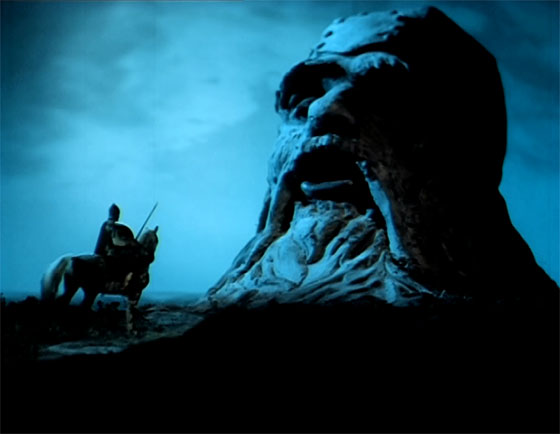
PHOTO: Ruslan’s parley with the giant head
-

Mount St Helens Blows Up The Lost Chord This Week
I suppose I should apologize on behalf of my former employer for all the smoke this week. You can’t burn a bridge that’s stood for 28 years without kicking up a little pollution.
That said, my unnatural dismissal from a certain local classical music station puts me in mind of some more natural disasters. With my broadcast base shifting for the time being to the Pacific Northwest and KWAX, the radio station of the University of Oregon, my thoughts drift back to 1980 and the fearsome eruption of Mount St. Helens. When Helens blew, she killed 57 people, reduced hundreds of square miles to wasteland, and caused over a billion dollars in damage. The most active volcano in the contiguous United States, Helens is situated only a three-hour drive north of Eugene (home of KWAX).
This week on “The Lost Chord” we’ll be dancing around the mouth of the volcano, as it were. Composer Alan Hovhaness was always acutely attuned to nature. For decades, he lived outside Seattle, where he enjoyed a fruitful relationship with the Seattle Symphony. Mountains, in particular, inspired a number of his more reverential works. Commenting on his best-known music, the Symphony No. 2, “Mysterious Mountain,” composed in 1955, he wrote, “Mountains are symbols, like pyramids, of man’s attempt to know God. Mountains are symbolic meeting places between the mundane and spiritual worlds.”
The friction of the natural and the transcendent certainly informs the progression of his Symphony No. 50, the “Mount St. Helens” Symphony, composed in 1983: from a sense of grandeur in the first movement, a prelude and fugue in praise of Helens; the placidity of Paradise Lake, the beauty of which disappeared forever; and the volcano itself, recalled in the third and final movement, most percussively rendered. The violence subsides, and the dawn hymn of the opening returns in triumph.
Hovhaness’ volcano symphony is like a walk in the park alongside the mad inspirations of Icelandic genius Jon Leifs. Leifs’ “Hekla,” from 1961, is probably the closest you’ll ever want to get to a volcanic eruption. Requiring 19 percussionists banging away on anvils, stones, sirens, plate bells, chains, shotguns, cannons, and a large wooden stump, it has been called the loudest piece of classical music ever written. For their own well-being, the performers were instructed to wear earplugs.
As a bonus, with what’s left of our hearing, we’ll also enjoy “Volcanic Eruption and Atonement” from Leifs’ ballet, “Baldr.”
In this graduation season, if there was a degree awarded for distinguished achievement in volcanology, these composers undoubtedly would have graduated “Magma Come Loudly.”
Prepare to be blown away, this Saturday on “The Lost Chord,” now in syndication on KWAX!
See below for streaming information.
Keep in mind, KWAX is on the West Coast, so there’s a three-hour difference for the Trenton-Princeton area. Here are the respective air-times of my shows (with East Coast conversions in parentheses):
PICTURE PERFECT, the movie music show – Friday on KWAX at 5:00 PACIFIC TIME (8:00 PM EDT)
THE LOST CHORD, unusual and neglected rep – Saturday on KWAX at 4:00 PACIFIC TIME (7:00 PM EDT)
Stream them here!
-

Time for Three Shines at Princeton Festival
At last night’s opening concert of The Princeton Festival, Time for Three affirmed its strong musical bond. The musicians have been playing together since their student days at the Curtis Institute of Music. In 2023, they became Grammy Award winners.
Left to their own devices, the trio presents an eclectic and electric blend of classical, Americana, and modern pop. This was their second appearance at the Princeton Festival, and the crowd was clearly energized.
In March, the group will return to perform with the Princeton Symphony Orchestra, as soloists at Richardson Auditorium in Pulitzer Prize winner Kevin Puts’ triple concerto, “Contact.” Time for Three was recently honored with a Grammy for the Deutsche Grammophon release, “Letters for the Future,” which includes a recording of the work and that of another concerto by Philadelphia composer (and Pulitzer winner) Jennifer Higdon.
The Princeton Festival, which runs through June 25, will continue tonight at 7:00 with Drama Desk Award nominee Capathia Jenkins and a tribute to the “Queen of Soul,” Aretha Franklin. The concert will feature three-time Grammy-nominated artist Ryan Shaw, with the Princeton Symphony Orchestra led by its former assistant conductor, John Devlin (now music director of the Wheeling Symphony Orchestra of Wheeling, WV). The program will include such Franklin favorites as “Respect,” “Think,” “A Natural Woman,” and “Chain of Fools.”
Then tomorrow afternoon, something completely different, as internationally-acclaimed pianist Christopher Taylor will perform a recital of contrasting works by Sergei Rachmaninoff, Nikolai Kapustin, Sofia Gubaidulina, and Sergei Prokofiev. That concert will take place at 4:00.
Further festival events will encompass opera (Rossini’s “The Barber of Seville”), chamber music, musical theater, contemporary dance, a klezmer “good vibes explosion,” and a special family concert, all presented on the grounds of Morven Museum & Garden at 55 Stockton Street (Route 206).
Vibrant Baroque music and an intimate program for guitar and cello will be offered across the way at Trinity Church Princeton, at 33 Mercer Street.
The festival’s “big top,” an 11,000 square-foot, clear-span (no poles or obstructed views), open-sided performance pavilion, allows for easy access to refreshments, ample picnicking opportunities, a garden stroll, or the simple enjoyment of a late-spring/early-summer evening.
The Princeton Festival is the premier summer arts program of the Princeton Symphony Orchestra. For complete listings and ticket information, visit princetonsymphony.org/festival.
And if you haven’t had a chance to take a look at it yet, here’s my preview in the Princeton weekly U.S. 1 Newspaper – PrincetonInfo.
Photo by Carolo Pascale
Tag Cloud
Aaron Copland (94) Beethoven (95) Composer (114) Film Music (151) Film Score (143) Film Scores (255) Halloween (103) John Williams (198) KWAX (233) Leonard Bernstein (105) Marlboro Music Festival (125) Movie Music (166) Mozart (91) Opera (215) Philadelphia Orchestra (91) Picture Perfect (174) Princeton Symphony Orchestra (110) Radio (90) Ross Amico (244) Roy's Tie-Dye Sci-Fi Corner (290) The Classical Network (101) The Lost Chord (269) Vaughan Williams (107) WPRB (397) WWFM (881)