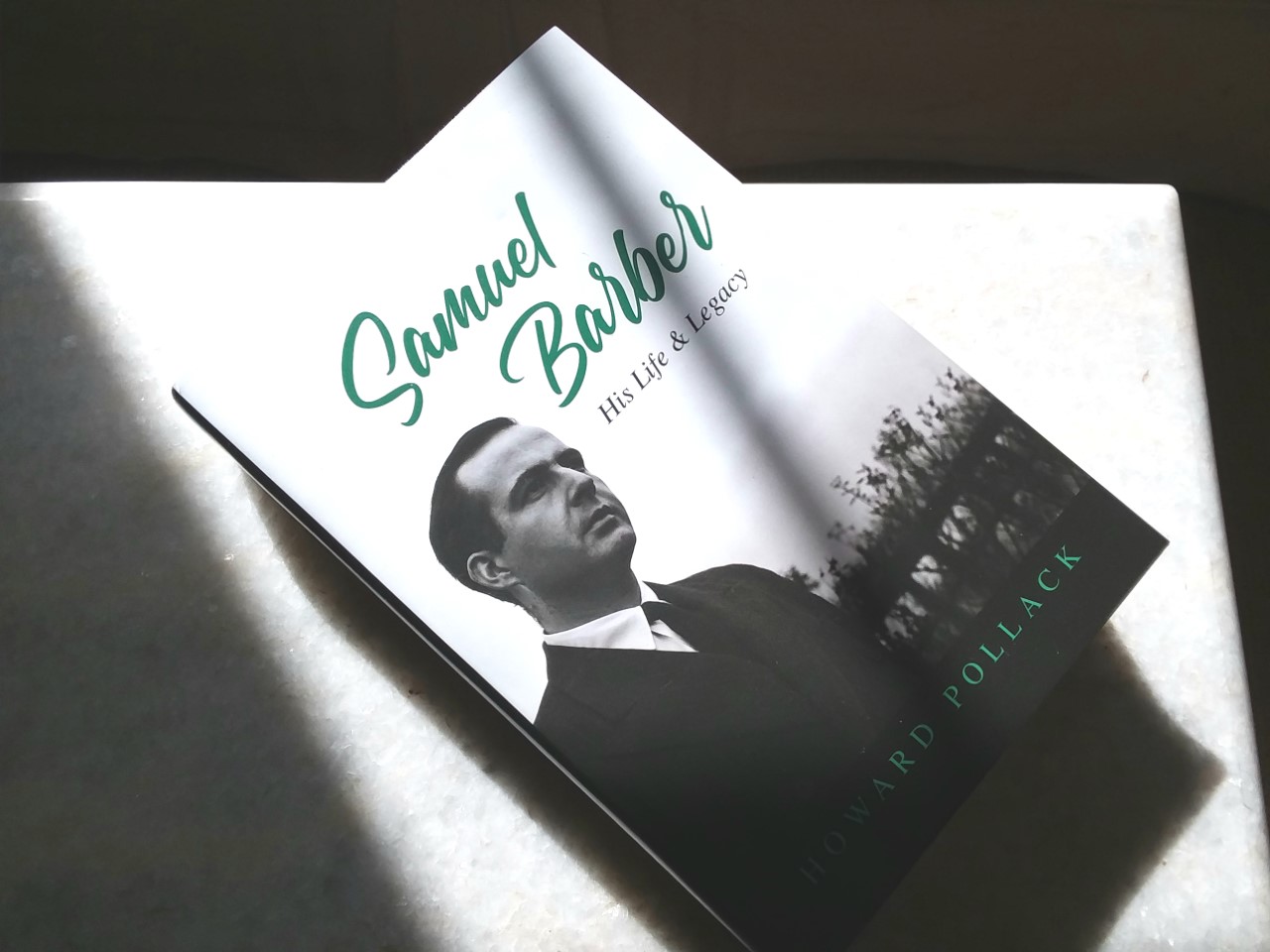
One of the pleasures of reading Howard Pollack’s latest biography, “Samuel Barber: His Life and Legacy,” is being reminded of just how many interesting musicians Barber encountered. As a lover of film music, I’ve long been aware of Alex North’s birthplace of Chester, PA, not far south of Philadelphia, but I never really thought about the fact that he and Barber were exact contemporaries and indeed classmates at West Chester High School.
Later, Barber knew Nino Rota from the Curtis Institute (but disliked his music) and Bernard Herrmann, who invited him to guest conduct the CBS Orchestra for his radio series “Invitation to Music.”
Fascinatingly, Barber sang one of his breakout masterpieces, “Dover Beach,” for Ralph Vaughan Williams, during the latter’s visit to Bryn Mawr to deliver a series of lectures in 1932. The text, by Victorian poet Matthew Arnold – a honeymoon poem written shortly after his marriage to Frances Lucy Wightman – is pervaded by melancholy: in an uncertain world, love is the only source of comfort and peace.
“He seemed delighted,” Barber recollected of Vaughan Williams’ reaction. “He congratulated me and said, ‘I tried several times to set ‘Dover Beach,’ but you really GOT it!’”
Traveling on a scholarship to Vienna in 1934, he met George Antheil, Trenton’s “Bad Boy of Music,” whose “Ballet Mécanique” had caused a riot in Paris in 1926. The two talked music and shared scores. Barber liked what he saw and heard, and Antheil, ten years older, was “surprisingly enthusiastic” about the young man’s work. Barber found Antheil likeable and sincere and wrote to his family that the two had “parted, the best of friends.”
Barber would earn further admiration internationally, with works performed in Europe and the Soviet Union. The idea of Yevgeny Mravinsky conducting Barber is as tantalizing as Gustav Mahler’s interest in performing Charles Ives.
As someone born in small-town Pennsylvania, and later having lived in Philadelphia for over three decades, I was also very interested to learn about some of the early works Barber composed for his hometown of West Chester and for Longwood Gardens. Barber knew the Du Ponts and performed on the organ there. Of course, he studied at Philadelphia’s Curtis Institute of Music, on Rittenhouse Square, and had many works performed by the Philadelphia Orchestra.
The book follows the pattern of Pollack’s Copland biography, interleaving biographical detail with chapters in which the music is treated in greater depth. I hasten to add that the writing is not overloaded with technical jargon, so that it always remains fully accessible – and interesting – to the general reader. Of course, it helps if music is your passion. At the same time, there are abundant notes in the book’s appendices for anyone who would like to dig deeper.
Most happily, the book accomplishes what any undertaking of this sort should do, and that’s inspire the reader to revisit Barber’s music. I don’t own a smartphone, so I’m not one of those people who is always riveted to an electronic device in public. I generally have some reading material or my thoughts to keep me company. However, last week I found myself in a situation where I was stuck someplace with nothing to do, and kept myself entertained by trying to remember the musical details of as many of Samuel Barber’s pieces as possible. It’s astonishing, the amount of information we’re able to call up from our brains!
The composer adored Brahms at a time when such an enthusiasm might have seemed regressive to more limited souls. His close relationships with Gian Carlo Menotti, his teachers, his advocates, and his patrons, ensured he often had one foot in Europe.
He was seldom as overtly “American-sounding” as Copland or Bernstein or Roy Harris or William Schuman. His music is imbued with more Old-World elegance, perhaps, than was common among his peers. If anything, it makes it seem all the sturdier, and all the more enduring.
Howard Pollack’s “Samuel Barber: His Life and Legacy,” published by University of Illinois Press, is out today, available online or through your local bookstore. For more information, follow the link.
“To Longwood Gardens”
“Fresh from West Chester”: II. Let’s Sit It Out, I’d Rather Watch
“Dover Beach,” with Barber and the Curtis String Quartet
The Brahmsian “School for Scandal Overture”
Leave a Reply