Tag: American Composer

  • Quincy Porter Lost Thanksgiving Gem New England Episodes

    Quincy Porter Lost Thanksgiving Gem New England Episodes

    Here’s another piece I used to play every year for Thanksgiving, but like so many other recordings I drew from my own collection, it disappeared from the air waves when I was given the boot during COVID and was never asked back. One of these days, I’ll have to send it out into syndication on “The Lost Chord.”

    Quincy Porter is yet another one of those largely forgotten American composers of the generation of Aaron Copland and George Gershwin. Born in New Haven, CT, in 1897, he attended Yale, where he studied with Horatio Parker (Charles Ives’ longsuffering teacher) and David Stanley Smith. He also studied with Vincent d’Indy at the Schola Cantorum in Paris and Ernest Bloch in New York.

    In 1923, he joined the faculty of the Cleveland Institute of Music. He was there for five years, until he made the decision to devote himself exclusively to composition. A Guggenheim Fellowship allowed him to return to Paris. The money held out for three productive years, but in the end he was back at the Cleveland Institute. Briefly. The next year he was teaching at Vassar. In 1938, he was appointed dean and later director of the New England Conservatory of Music. In the 1946, he returned to Yale, where he taught until 1965.

    With Copland and Howard Hanson, he cofounded the American Music Center in 1939. He served as chairman of the organization’s board from 1958 until his death in 1966.

    In 1944, he received the Pulitzer Prize for Music for his “Concerto Concertante” for two pianos and orchestra. Where is he now?

    “New England Episodes” was given its premiere in Washington, D.C., in 1958. According to the liner notes to my recording, “The subject of this evocative suite is the puritan past of New England with its hymns, its rigidities, its moments of lightness and its melancholy.”

    There’s a moment when the chimes take on the character of church bells, which I find an especially nice touch, but I find the entire work transporting. I hope you do too.
  • Virgil Thomson Thanksgiving Birthday Music

    Virgil Thomson Thanksgiving Birthday Music

    Virgil Thomson was not only a composer, he was a writer on music, who wielded power of a kind unimaginable in this day of eroded standards, as a critic at the New York Herald-Tribune.

    Perhaps his brand of “faux-naïf” Americana is not for everyone. Still, it earned him a wide and enduring audience. His music for Robert Flaherty’s “Louisiana Story” (1948) remains the only film score ever to be awarded a Pulitzer Prize.

    For Thomson’s birthday, here’s some music to get you in the mood for Thanksgiving.

    His “Symphony on a Hymn Tune” was composed during his Paris years. Thomson, like Aaron Copland and so many others, studied in France with Nadia Boulanger. The symphony was inspired by the composer’s memories of his Kansas City boyhood. The “Sunday best” of the church hymns occasionally gets tangled up in a few modernistic burrs – the exchanges between the violin, cello, trombone, and piccolo at the end of the first movement, for instance – but in 1928, it was a landmark in terms of helping to establish a distinctly American idiom.

    More austere, perhaps, is Thomson’s symphonic poem “Pilgrims and Pioneers” – but just stick around for the fiddle tunes.

    Finally, a seasonal work: the Concertino for Harp, Strings and Percussion, “Autumn” – according to Thomson, actually more of a “portrait of an artist ageing.”

    Happy birthday, Virgil Thomson (1896-1989) – and Happy Thanksgiving!


    Check out Thomson on TV!


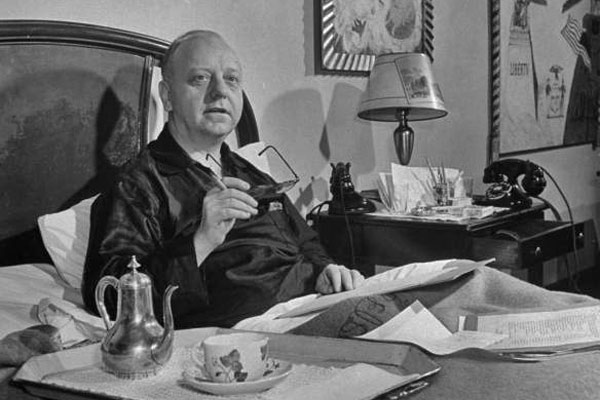
    PHOTOS: Thomson, enjoying all his pleasures at once

  • George Whitefield Chadwick American Composer

    George Whitefield Chadwick American Composer

    George Whitefield Chadwick is my favorite composer of that group commonly classified as “The Second New England School,” prominent American musicians, who largely modeled themselves on the European Romantics and were destined to be eclipsed by the later, more overtly “American” followers of Aaron Copland and George Gershwin. The school included John Knowles Paine (America’s first music professor), Horatio Parker (teacher of Charles Ives), Amy Beach (a virtuoso pianist who curtailed her compositional activity during the years of her marriage), Arthur Foote (my second favorite of the group), and Edward MacDowell (“the American Grieg”).

    These composers studied abroad (there were few options then), learned their lessons well, and largely emulated the German masters in their own works. Schumann, Brahms, and Mendelssohn loomed large, with Beethoven often lurking in the background. There were exceptions, of course. Amy Beach countered Dvořák’s “New World” Symphony with her own “Gaelic Symphony.” MacDowell corresponded with Grieg, not only in his letters, but in his collections of piano miniatures.

    All of them wrote worthwhile music, if you can be bothered to root around musty steamer trunks in the far corners of the attic, but for me Chadwick has the most vibrant personality. He was the most successful of the group at conveying a kind of exuberance and optimism that reflect the zeitgeist of a country ripe with possibility that was still very much on the way up. As a person, he was described as independent and self-reliant, and his students remarked on his fairmindedness and wit.

    Is his music identifiably “American,” as in stereotypically Coplandesque? Not really. But he was often inspired by American subjects and he really did take Dvorak’s “American” experiments to heart. You can hear it in his string quartets, and you can hear it in his “Symphonic Sketches,” especially “Jubilee.” But his vivacious symphonies are also hard to resist. Are they world-beaters? Certainly not. Are they enjoyable? Certainly!

    Chadwick had a long and varied career. While his baseline is always rooted in a fairly conservative, 19th century musical idiom, he remained curious, and he was always growing. Every once in a while, he could toss out a genuine surprise. It’s interesting to hear him flirt with contemporary musical developments of the day (Dvořákian folk-inflections, Straussian tone poem, French Impressionism). Clearly, he was no isolationist. His spirit of exploration and his artistic growth make him a standout from the stodgier American classical music milieu of the Gilded Age.

    A tip of the hat to Chadwick, by George, on the 170th anniversary of his birth!


    “Symphonic Sketches” (1895-1904)

    String Quartet No. 4 (1896)

    “Rip Van Winkle Overture” (1879)

    “Cleopatra” (1904)

    “Tam O’Shanter” (1914-15)

    Symphony No. 2 (1883-85)

  • Tobias Picker at 70 A Composer Celebration

    Tobias Picker at 70 A Composer Celebration

    American composer Tobias Picker is 70 today.

    His serene “Old and Lost Rivers” has long been a favorite. Commissioned by the Houston Symphony Orchestra to commemorate the sesquicentenary of Texas, the work was given its first performance in 1986. At the time, Picker was the orchestra’s composer-in-residence. His program note about the piece elucidates the title:

    “Driving east from Houston along Interstate 10, you will come to a high bridge which crosses many winding bayous. These bayous were left behind by the great wanderings, over time, of the Trinity River across the land. When it rains, the bayous fill with water and begin to flow. At other times — when it is dry — they evaporate and turn green in the sun. The two main bayous are called ‘Old River’ and ‘Lost River.’ Where they converge, a sign on the side of the highway reads: ‘Old and Lost Rivers.’”

    The work also exists in a version for solo piano. Enjoy the orchestral version at the link:

    Picker also wrote a piano concerto for the centenary of the Brooklyn Bridge. Here’s the world premiere, from 1983, preceded by news footage, including commentary by the composer, and intercut with celebratory fireworks for the occasion. The audio on the news clip is somewhat muted, compared to the much more immediate performance of the music, so be ready for it!

    Then, tying in with yesterday’s post about the sudden seeming ubiquity of Robert Schumann, it seems only appropriate to include Picker’s “Romances and Interludes.” Schumann composed his “Three Romances,” Op. 94, for oboe and piano, as a Christmas gift for his wife, Clara, in 1849. Picker orchestrated the piece and added his own prelude and connective tissue in 1989.

    He’s also composed seven operas. “Emmeline” was broadcast nationally on PBS in 1996.

    Among his other works in the genre are adaptations of Roald Dahl’s “The Fantastic Mr. Fox,” Stephen King’s “Dolores Claiborne,” and Oliver Sacks’ “Awakenings.”

    Finally, Picker converses with filmmaker H. Paul Moon as part of the series “Capricorn Conversations,” an occasional podcast of interviews with important figures relating to American music that grew out of Moon’s work on his nationally-televised documentary, “Samuel Barber: Absolute Beauty.”

    Happy birthday, Tobias Picker!

  • Lou Harrison Solstice Ballet Summer Music

    Lou Harrison Solstice Ballet Summer Music

    It’s 4:40 EDT.

    Join the Sun Lion, the Moon Bull, and Mother Earth in welcoming summer with the ballet “Solstice” (1949) by American composer Lou Harrison. The actual music starts at the 2-minute mark. Before that is a brief spoken intro.

Tag Cloud

Aaron Copland (92) Beethoven (95) Composer (114) Film Music (123) Film Score (143) Film Scores (255) Halloween (94) John Williams (187) KWAX (229) Leonard Bernstein (101) Marlboro Music Festival (125) Movie Music (138) Opera (202) Philadelphia Orchestra (89) Picture Perfect (174) Princeton Symphony Orchestra (106) Radio (87) Ralph Vaughan Williams (85) Ross Amico (244) Roy's Tie-Dye Sci-Fi Corner (290) The Classical Network (101) The Lost Chord (268) Vaughan Williams (103) WPRB (396) WWFM (881)

DON’T MISS A BEAT

Receive a weekly digest every Sunday at noon by signing up here


RECENT POSTS