For many, the prospect of having to work through vacation can be a real drag; but for the creative artist, getting away can be a welcome opportunity to really get things done.
This week on “The Lost Chord,” we’ll hear three pieces associated with Bold Island, Maine, the summer home of Howard Hanson.
For 40 years, Hanson was director of the Eastman School of Music. In that capacity he nurtured and championed innumerable American composers, giving literally thousands of premieres at the helm of the Eastman-Rochester Orchestra, an ensemble he founded. The lucky ones made it onto Hanson’s records on the Mercury label.
Hanson, of course, was himself a composer. He was awarded the Pulitzer Prize for Music in 1944, for his Symphony No. 4 “Requiem,” written in memory of his father. But his best-known music, undoubtedly, is his Symphony No. 2 “Romantic,” composed in 1930.
The famous “Hanson sound” is one of heart-on-the-sleeve romanticism, characterized by glowingly nostalgic melodies, though he also had his severe side. After all, he was born in Wahoo, Nebraska, to Swedish parents, and a certain Nordic austerity can be detected, especially in his later works.
His Symphony No. 6, of 1967, is more tightly argued than his earlier, more famous symphonies. Its six brief movements are built on a recurring motif. At times, it can sound a bit like Sibelius, though Hanson very much remains his own man. Hanson being Hanson, he doesn’t really skimp on the lyricism, but he doesn’t exactly indulge it to the same extent he does in the earlier works. Still, predictably, the symphony was derided as old-fashioned by the genuinely austere musical establishment of the day.
The Bold Island connection is through Hanson’s “Summer Seascape No. 2,” written a few years earlier, and clearly the blueprint for the symphony. In fact, the opening of the symphony is identical.
Hanson’s first “Summer Seascape” forms the centerpiece of his “Bold Island Suite,” a separate work composed in 1961. The suite also contains movements with the descriptive titles “Birds of the Sea” and “God in Nature.”
The North Atlantic inspires some august music, on “August Hanson,” on “The Lost Chord,” now in syndication on KWAX, the radio station of the University of Oregon!
Keep in mind, KWAX is on the West Coast, so there’s a three-hour difference for the Trenton-Princeton area. Here are the respective air-times of my recorded shows (with East Coast conversions in parentheses):
PICTURE PERFECT, the movie music show – Friday on KWAX at 5:00 PACIFIC TIME (8:00 PM EDT)
THE LOST CHORD, unusual and neglected rep – Saturday on KWAX at 4:00 PACIFIC TIME (7:00 PM EDT)
I do much of my reading in bed, in the hour or two before lights-out, frequently beneath drooping eyelids and interrupted by intervals of nodding; so it can take me a while sometimes to get through a book. In this case, it took me five or six weeks, probably, but they were unquestionably pleasurable ones, passed in the company of one of America’s greatest composers.
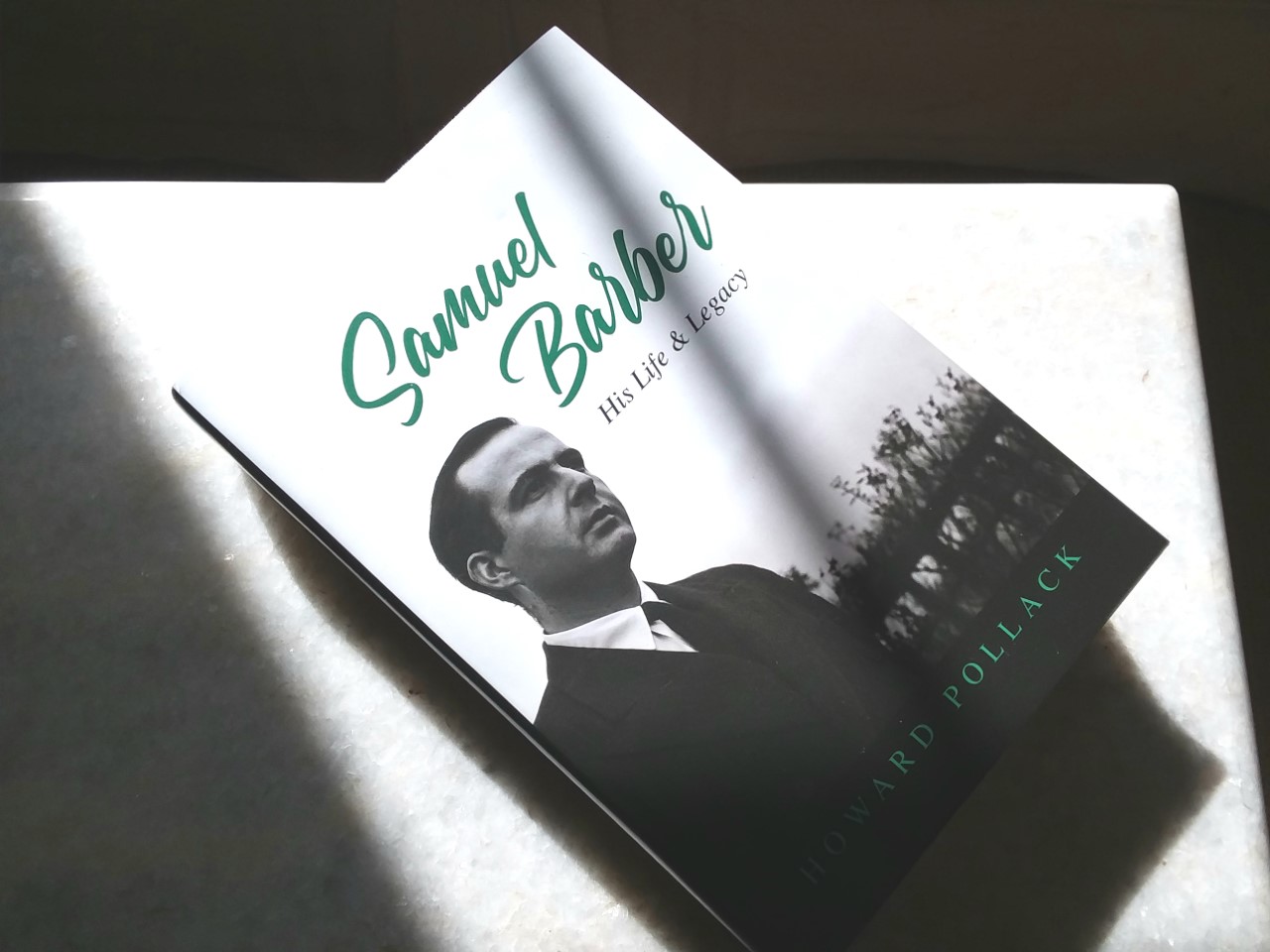
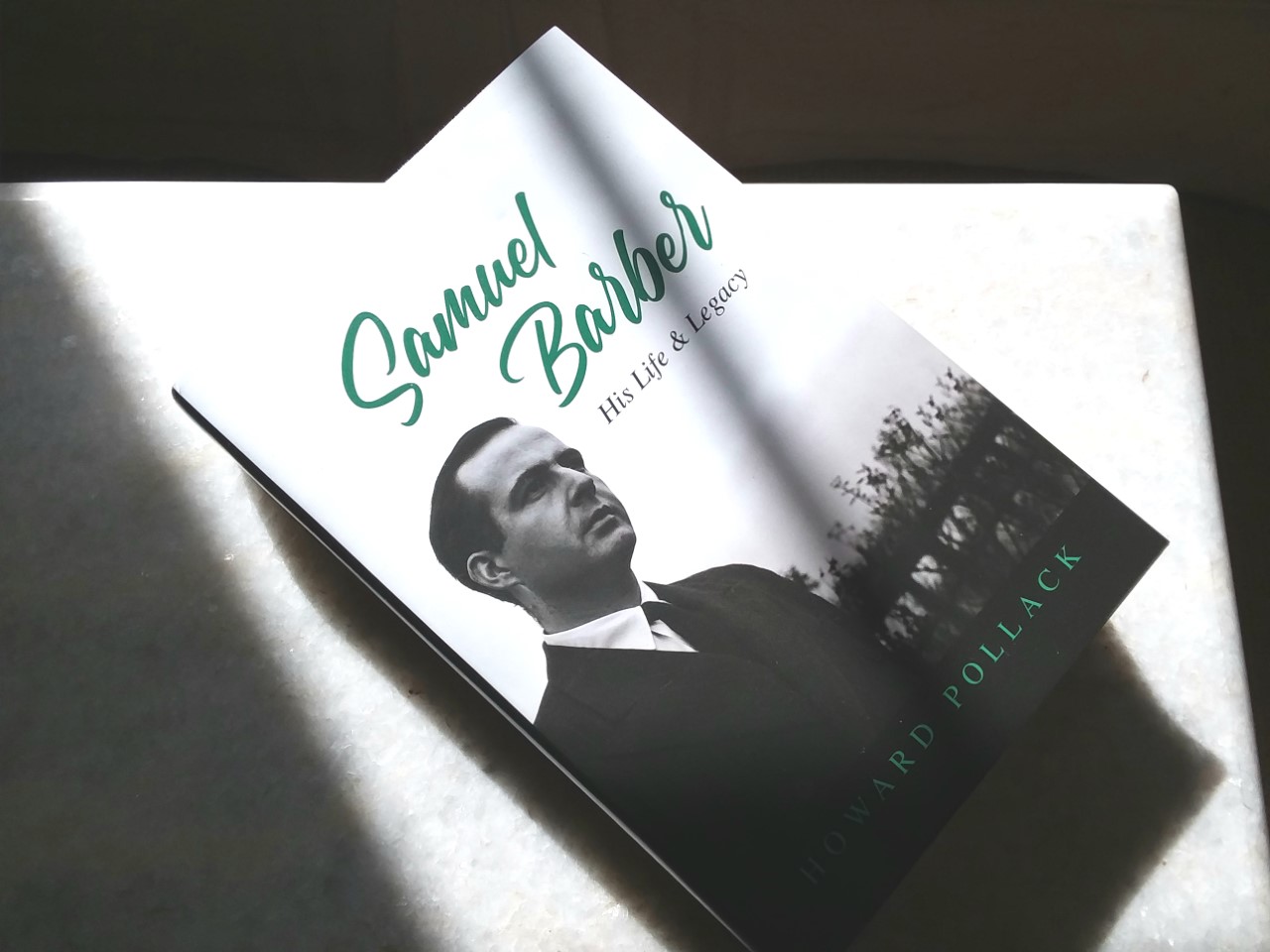
If you’re at all interested in American art music of the mid-20th century, I’m confident you too will enjoy Howard Pollack’s exhaustive biography “Samuel Barber: His Life & Legacy,” issued last month by University of Illinois Press.
The book has to be the culmination of years of research – of the 686 numbered pages, 118 are devoted to footnotes and index – yet the content is often astonishingly up-to-date, with references to performances, recordings, and even YouTube content so recent, it would seem as if it couldn’t possibly have been included by the time the book went to press.
It’s also pleasant to find people I’ve known or worked with drifting in and out of the narrative. For instance, I had no idea that Karl Haas, longtime host of the radio series “Adventures in Good Music,” was responsible for commissioning Barber’s “Summer Music.” Nor did I realize the series began in 1959!
Another radio personality, David Dubal, now host of “The Piano Matters,” but then music director of New York’s WNCN, preempted the station’s regularly-scheduled programming to broadcast an hour of Barber’s music in the afternoons during the composer’s final days, and Barber listened.
And H. Paul Moon, who I have interviewed on the air a couple of times about his film projects, and now count among my concertgoing companions and friends, is acknowledged for his lovely, award-winning documentary, “Samuel Barber: Absolute Beauty.” Paul also receives credit for assisting the author in compiling the book’s photographs.
Of course, Barber had many important connections to the Philadelphia area, having attended and taught at the Curtis Institute of Music and had many of his works, including a few premieres, played by the Philadelphia Orchestra. He also exhibited a lifelong affection for his birthplace of West Chester, PA – which, as a small-town Pennsylvania boy myself, I find relatable and touching.
Barber was buried in West Chester in 1981, next to a gravesite held vacant for Gian Carlo Menotti, his friend, frequent collaborator, and romantic partner of decades. The two met during their student days at Curtis. Menotti would be buried in Scotland, but the West Chester would-be grave is marked by a headstone that reads, as per Barber’s request, “To the Memory of Two Friends.”
Pollack’s biography is successful not only in expanding the reader’s knowledge of the composer’s sizeable and varied output – more varied than one might suspect on the evidence of his most frequently played works – but also in conveying a real sense of the man, who could be patrician and impeccably turned out, often aloof in public, with a waspish sense of humor, but also warm and supportive to his friends. And even, on occasion, unexpectedly whimsical. He once remarked that because of his fondness for soup, his coffin should be pelted with croutons. At his burial service, his friends took him up on it.
There is also a charming anecdote earlier in the book, about how once Barber was attempting to get something straightened out with a utility company. In an unorthodox method of identity confirmation, the phone representative asked the composer to sing a few bars of his “Sure on This Shining Night.” Barber later remarked, “I’m afraid I sounded nervous. I had never sung for the telephone company before.”
Pollack’s writing is everything it should be: lucid, informative, and engrossing. There’s nothing to jerk a reader out of the narrative (save perhaps the frequent use of “tellingly,” which after a while becomes endearing). One doesn’t have to be a specialist to get something out of the book, and it is frequently an enjoyable read, though I grant that some chapters will be more compelling than others, depending on the depth of one’s devotion to Barber’s music. The chapters of purely biographical and historical interest are especially absorbing. One will learn a lot, unquestionably, as even I have.
With so many interviews and so much information to assimilate, I really don’t know how Pollack does it. I only just finally got around to reading his Copland bio, “Aaron Copland: The Life and Work of an Uncommon Man,” this past November, and the book, which was released over twenty years ago, is equally praiseworthy. And he’s done similar service for Marc Blitzstein, John Alden Carpenter, George Gershwin, Walter Piston, and lyricist John LaTouche. This guy deserves every award he’s ever received.
80 years ago today, Barber’s “Commando March,” written while he was serving in the U.S. Army Air Force, received its first performance in Atlantic City, with the Army Air Force Technical Training Command Band under the direction of the composer. Hear it performed at the link by “The President’s Own” U.S. Marine Band:
Barber’s final work, and one of his loveliest – the trunk of an oboe concerto he was too ill to complete – the “Canzonetta,” first performed posthumously in 1981:
“Sure on This Shining Night,” frequently heard in an arrangement for choir, here sung by a baritone, as it would have been by Barber himself to the telephone company:
“Summer Music,” commissioned on the recommendation of Karl Haas:
The eeriest thing about Peter Mennin is not that he was born in Erie, PA, but that his music is now almost never performed. His Symphony No. 3 was shortlisted for a Pulitzer Prize in 1950. Good luck ever hearing it unless it’s on a recording.
Mennin’s studies with Norman Lockwood at the Oberlin Conservatory were interrupted by World War II, during which he served in the U.S. Army Air Force. Later, he studied with Howard Hanson at the Eastman School. He completed his Third Symphony on his 23rd birthday to fulfill his PhD requirements. The work immediately catapulted him to fame.
He lost the Pulitzer to Gian Carlo Menotti and the opera “The Consul.” However, a performance of the symphony by the New York Philharmonic paved the way for his appointment to the composition faculty of the Juilliard School.
Mennin was also a successful administrator. In 1958, he was named director of the Peabody Conservatory. In 1962, he became Juilliard’s president, a position he held until his death in 1983. In that capacity, he oversaw the school’s move from Claremont Avenue to Lincoln Center. He introduced both the drama and dance departments, he commenced the Master Class Program, and he attracted many high-profile artists as teachers.
In all, he composed nine symphonies (the first two were later withdrawn); also concertos for piano, cello, and flute, sundry orchestral pieces (including “Concertato: Moby Dick”), chamber works, choral pieces, and instrumental music.
Mennin was born to Italian immigrants one hundred years ago today. His brother was the composer Louis Mennini, who retained the family surname.
I just found the Albany Symphony Ochestra’s CD of Mennin’s Symphonies Nos. 5 & 6, with “Concertato: Moby Dick,” at Princeton Record Exchange only last week. The price: $1.00. That’s a penny a year. Somebody give this guy some performances, already!
Buon Centenario, Peter Mennin!
Symphony No. 3, with Dimitri Mitropoulos and the New York Philharmonic
John Ogdon plays the Piano Concerto
Fantasia for String Orchestra
“Concertato: Moby Dick”
“Folk Overture”
In the Erie Hall of Fame
How nice it would have been to acknowledge this important anniversary by sharing some of Mennin’s music over the radio, had my shows not been dropped by WWFM!
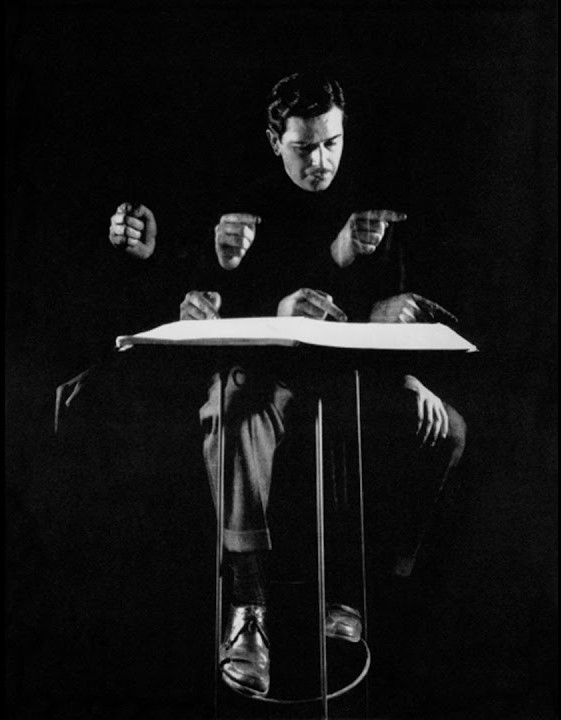
PHOTO: An eerie Octo-Mennin, courtesy of Gordon Parks
One of the pleasures of reading Howard Pollack’s latest biography, “Samuel Barber: His Life and Legacy,” is being reminded of just how many interesting musicians Barber encountered. As a lover of film music, I’ve long been aware of Alex North’s birthplace of Chester, PA, not far south of Philadelphia, but I never really thought about the fact that he and Barber were exact contemporaries and indeed classmates at West Chester High School.
Later, Barber knew Nino Rota from the Curtis Institute (but disliked his music) and Bernard Herrmann, who invited him to guest conduct the CBS Orchestra for his radio series “Invitation to Music.”
Fascinatingly, Barber sang one of his breakout masterpieces, “Dover Beach,” for Ralph Vaughan Williams, during the latter’s visit to Bryn Mawr to deliver a series of lectures in 1932. The text, by Victorian poet Matthew Arnold – a honeymoon poem written shortly after his marriage to Frances Lucy Wightman – is pervaded by melancholy: in an uncertain world, love is the only source of comfort and peace.
“He seemed delighted,” Barber recollected of Vaughan Williams’ reaction. “He congratulated me and said, ‘I tried several times to set ‘Dover Beach,’ but you really GOT it!’”
Traveling on a scholarship to Vienna in 1934, he met George Antheil, Trenton’s “Bad Boy of Music,” whose “Ballet Mécanique” had caused a riot in Paris in 1926. The two talked music and shared scores. Barber liked what he saw and heard, and Antheil, ten years older, was “surprisingly enthusiastic” about the young man’s work. Barber found Antheil likeable and sincere and wrote to his family that the two had “parted, the best of friends.”
Barber would earn further admiration internationally, with works performed in Europe and the Soviet Union. The idea of Yevgeny Mravinsky conducting Barber is as tantalizing as Gustav Mahler’s interest in performing Charles Ives.
As someone born in small-town Pennsylvania, and later having lived in Philadelphia for over three decades, I was also very interested to learn about some of the early works Barber composed for his hometown of West Chester and for Longwood Gardens. Barber knew the Du Ponts and performed on the organ there. Of course, he studied at Philadelphia’s Curtis Institute of Music, on Rittenhouse Square, and had many works performed by the Philadelphia Orchestra.
The book follows the pattern of Pollack’s Copland biography, interleaving biographical detail with chapters in which the music is treated in greater depth. I hasten to add that the writing is not overloaded with technical jargon, so that it always remains fully accessible – and interesting – to the general reader. Of course, it helps if music is your passion. At the same time, there are abundant notes in the book’s appendices for anyone who would like to dig deeper.
Most happily, the book accomplishes what any undertaking of this sort should do, and that’s inspire the reader to revisit Barber’s music. I don’t own a smartphone, so I’m not one of those people who is always riveted to an electronic device in public. I generally have some reading material or my thoughts to keep me company. However, last week I found myself in a situation where I was stuck someplace with nothing to do, and kept myself entertained by trying to remember the musical details of as many of Samuel Barber’s pieces as possible. It’s astonishing, the amount of information we’re able to call up from our brains!
The composer adored Brahms at a time when such an enthusiasm might have seemed regressive to more limited souls. His close relationships with Gian Carlo Menotti, his teachers, his advocates, and his patrons, ensured he often had one foot in Europe.
He was seldom as overtly “American-sounding” as Copland or Bernstein or Roy Harris or William Schuman. His music is imbued with more Old-World elegance, perhaps, than was common among his peers. If anything, it makes it seem all the sturdier, and all the more enduring.
Howard Pollack’s “Samuel Barber: His Life and Legacy,” published by University of Illinois Press, is out today, available online or through your local bookstore. For more information, follow the link.
I’ve been reading Howard Pollack’s absorbing biography, “Samuel Barber: His Life and Legacy,” in advance of its release on Tuesday by University of Illinois Press.
Barber is one of our great American composers. You’ll probably recognize his “Adagio for Strings,” at the very least, from its use in so many movies (“Platoon,” “The Elephant Man,” “Lorenzo’s Oil,” “Amélie”) and on occasions of national mourning (such as the deaths of presidents and the terrorist attacks of 9-11).
I must say, Pollack is doing a fabulous job of shedding light on the composer’s multifaceted character. Barber’s manner could be reserved – some would say aloof – and his patrician demeanor and assumed mid-Atlantic accent, rooted in an upper-middle-class upbringing in West Chester, Pennsylvania, and his close identification with his New England forebears, may now seem like affectations from a bygone world.
But he also had a sense of humor, offering the occasional sardonic, or even barbed observation. Once in while, he even teetered over into the downright zany. From the passage below, you’ll see he was a very capable practical joker. I thought it only appropriate to share it with you for this April Fool’s Day.
Barber had moreover what his cousin Katharine Homer Fryer called, in reference to the Beatty side of the family, a “Beatty sense of humor,” meaning, explained Barbara Heyman, “a love of the ridiculous.” As an example, one might cite Barber’s remark to [Nathan] Broder, apropos for his fondness for soups, “I would like to be buried with a sprinkling of croutons over my coffin.” Barber showed a proclivity for childish stunts and mischievous pranks, whether in his student years interrupting a tedious concert by noisily spilling coins on a dare from [Gian Carlo] Menotti, or in later years pretending to topple down a flight of stairs spewing manuscript pages to the amusement of his sister and her children. Planning a visit home while at the American Academy in Rome in the mid-1930s, he hatched a particularly elaborate ruse, telling his parents that he was sending them a portrait of himself and arranging for Menotti, then in New York, to bring a life-size frame to West Chester. “So I brought this empty frame to West Chester,” recalled Menotti, “and I said [to Barber’s parents], ‘Now you all get out of the room because I want to unveil it.’ So then Sam sneaked into the house and he sat inside the frame and then I unveiled the thing and there was Sam who said ‘Hello.’ Poor Mrs. Barber almost fainted!”
“Samuel Barber: His Life & Legacy” is scheduled for release on April 4. I haven’t finished it yet, but if you think it’s the kind of thing that might interest you, it’s a great read. I’ll have a more complete report by the end of the book. In the meantime, you’ll find more about it here: