Tag: American Composer

  • Remembering Ned Rorem A Composer’s Legacy

    Remembering Ned Rorem A Composer’s Legacy

    After writing up a little salute to Ned Rorem the other week, on the occasion of his 99th birthday, I happened to read an interview he gave with Bruce Duffie, in which he confessed that it was important to him that his music will be remembered. It made me recollect how, upon hearing of the death of Aaron Copland, I wished I had written him a letter to let him know how much his music meant to me. I easily could have. Copland died in 1990.

    Similarly, Rorem’s remark made me think maybe I should send him a note. But I let the moment pass. In truth, his music never occupied the same kind of place in my heart as does Copland’s, but I am certainly grateful for it.

    Rorem died yesterday at the age of 99. Here’s a sampler of his music, with links to the Duffie interview and my write-up, in case you missed it.

    Leon Fleisher plays “3 Barcarolles” (1949)

    With Thanksgiving right around the corner, here’s a piece for string orchestra, called “Pilgrims” (1958). The composer hastens to point out that it has nothing to do with Plymouth Rock. Rather, it was inspired by a novel of Julien Green called “Le voyageur sur la terre.” The title in turn is borrowed from the Book of Hebrews: “These also died in faith, not having received the promises, but having seen them afar off… and confessed that they were strangers and pilgrims on the earth…” (Hebrews 11:13). Rorem points out that the music is less programmatic than it is a mood of remembrance.

    Typical of many of Rorem’s larger works, his Violin Concerto (1984) eschews a classical three-movement structure in favor of a suite of shorter movements, generally becoming lovelier and more heart-felt the closer you get to the center. In this case, there’s also a programmatic element, in that the movements are supposed to mirror a dusk-to-dawn progression.

    Bernstein conducts the world premiere of Rorem’s Symphony No. 3 at Carnegie Hall (1959)

    Anyone who’s ever read Rorem’s writings knows he definitely had his saucy side. He confessed he was shocked at having been awarded the Pulitzer Prize (for “Air Music” in 1976), since he figured the establishment would prefer to punish him for being such a naughty boy. “But it sort of gives you a certain authority,” he reflected. “My name is now always preceded by ‘Pulitzer Prize-winning composer.’ So if I die in a whorehouse, at least the obit will say ‘Pulitzer Prize-Winning Composer Ned Rorem Dies in Whorehouse.’”

    “Air Music” can be heard at the link, as part of a collection recorded by the Louisville Orchestra. The opening work, “Design for Orchestra” (1953), is certainly attractive.

    Rorem was always most highly-regarded for his art songs. He himself thought his song cycle “Evidence of Things Not Seen” (1998) – 36 songs for voice and piano – his finest work. Here are just a few selections.

    Rorem’s interview with Bruce Duffie

    http://www.bruceduffie.com/rorem.html

    My salute on October 23, with personal recollections of the composer
  • Ned Rorem Remembered American Composer Dies at 99

    Ned Rorem Remembered American Composer Dies at 99

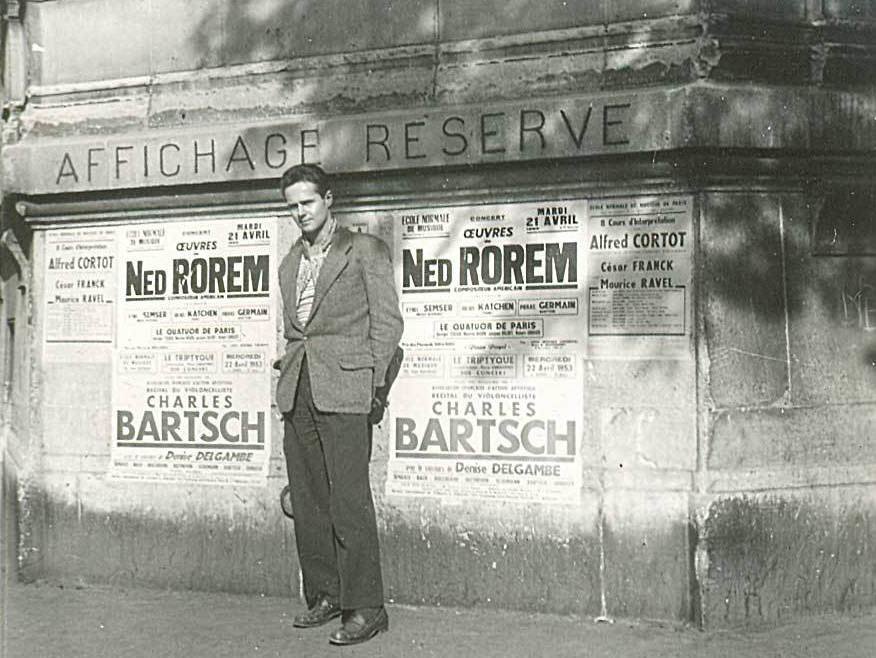
    I am very sorry to learn that the American composer Ned Rorem has died, only weeks after my extensive write-up in celebration of his 99th birthday. If you missed it, hopefully you’ll be able to get there by clicking the link.

    So long, Ned. Thanks for all the music.

  • Romeo Cascarino Lost American Composer

    Romeo Cascarino Lost American Composer

    O Romeo, Romeo, wherefore art thou Romeo? Why does no one play your music?

    It is well-crafted. It has heart. It is full of beauty. All it lacks is exposure.

    This Sunday night on “The Lost Chord,” we salute Romeo Cascarino, in anticipation of the 100th anniversary of his birth on September 28, 1922.

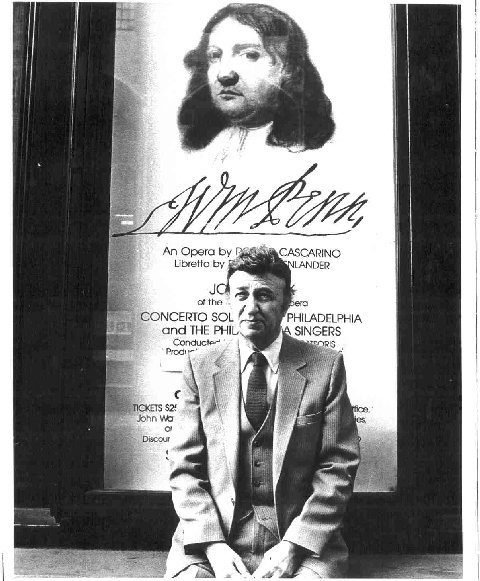
    Cascarino grew up in an unforgiving neighborhood in South Philadelphia. With a name like Romeo, he had to learn how to use his fists! While navigating the School of Hard Knocks, he taught himself privately, gleaning the mechanics of music theory from books checked out of the Free Library of Philadelphia. He was discovered by composer Paul Nordoff, who recognized his genius, and the two formed a bond that was more like a friendship than master-disciple.

    For many years, Cascarino was a professor of composition at Combs College of Music. The recipient of two Guggenheim Fellowships, he labored at his magnum opus, the opera “William Penn,” for the better part of three decades. The work received its premiere at Philadelphia’s Academy of Music in 1982 to mark the 300th anniversary of the founding of the city.

    Metropolitan Opera singer bass-baritone John Cheek sang the title role, Cascarino’s wife, soprano Dolores Ferraro, created the part of Gulielma, Penn’s wife, and Christofer Macatsoris conducted the Philadelphia Singers and the Concerto Soloists of Philadelphia.

    Ferraro and arts writer Tom Di Nardo will join me to share their reminiscences and insights into Cascarino, the man and the composer, who died in 2002. I’ve assembled some of their remarks and punctuated the conversation with rare audio from the family archives, as well as studio recordings made by JoAnn Falletta and Sol Schoenbach, former principal bassoonist of the Philadelphia Orchestra.

    A seductive, twilit beauty informs much of Cascarino’s output. If only he had completed “William Penn” 30 years earlier, it would now be regarded one of the great American operas of mid-century, spoken of in the same breath as Carlisle Floyd’s “Susanna” and Robert Ward’s “The Crucible.”

    I hope you’ll join us in “Remembering Romeo,” this Sunday night at 10:00 EDT, on WWFM – The Classical Network and wwfm.org

  • Lukas Foss A Centennial Remembrance

    Lukas Foss A Centennial Remembrance

    Today would have been the 100th birthday of Lukas Foss.

    Foss was a multi-talented musician, who received considerable recognition in his lifetime, certainly, but I wonder if was as much as he deserves. Part of the problem is pinning him down. As a composer, it was always difficult to categorize him, as he drew from so many different styles. With Foss, you never knew what you were going to get. Serialism? Aleatory? Populism? Polystylism?

    He was born Lukas Fuchs in Berlin in 1922. A piano prodigy, he began studies at the age of 6. In 1933, his family moved to Paris, where he also studied composition and flute. He arrived in Philadelphia in 1937. By then, the family had changed its name, and Foss entered the Curtis Institute of Music. At Curtis, he studied piano with Isabelle Vengerova, composition with Rosario Scalero, and conducting with Fritz Reiner.

    Leonard Bernstein, a classmate, described him as an “authentic genius.” Bernstein would conduct first performances of several of Foss’ works. In return, Foss would conduct the premiere of Bernstein’s “West Side Story Symphonic Dances.” He also appeared as piano soloist in two recordings of Bernstein’s Symphony No. 2, “The Age of Anxiety,” both with Bernstein conducting.

    In addition, he was one of four esteemed American composer-pianists on Stravinsky’s recording of “Les noces.” (The others were Aaron Copland, Samuel Barber, and Roger Sessions.)

    Foss pursued further studies in conducting with Serge Koussevitzky, during summers at the Berkshire Music Center (Tanglewood), and composition with Paul Hindemith. He became an American citizen in 1942.

    In 1953, he replaced Arnold Schoenberg as composition professor at UCLA. Later, in 1991, he taught at Boston University. He served as music director of the Buffalo Philharmonic (1963-70) and the Brooklyn Philharmonic (1971-88) and as conductor of the Milwaukee Symphony (1981-86).

    As a young man, he was frequently categorized as one of the “Boston School” of composers. Other notable members included Bernstein, Irving Fine, Arthur Berger, Harold Shapero, Ingolf Dahl, and Louise Talma.

    I met him once at a reception at the Academy of Music in Philadelphia, back in the 1980s, following a concert with the Curtis Symphony Orchestra, a student band, but one of a very high caliber. A significant number of seats in U.S. orchestras, including a disproportionate number of principal chairs, are occupied by Curtis graduates. Nearly half of the Philadelphia Orchestra is made up of Curtis alumni.

    Foss hadn’t been Curtis’ first choice for this particular occasion. Bernstein was originally scheduled to appear, but this was toward the end of Bernstein’s life, and he was canceling concerts like crazy. The original program was to consist of Ives’ “Decoration Day,” Tchaikovsky’s “Francesca da Rimini,” and Sibelius’ Symphony No. 1. Sadly, when Foss took over, the Sibelius was swapped out for Brahms.

    Nevertheless, it was great to have a chance to talk with him. Foss was living history, not least as friend and frequent collaborator of Bernstein, and a significant composer in his own right. Even so, in our few minutes of conversation, he impressed me as modest and low-key. Maybe it was because he had just been conducting for two hours.

    I was a little awed at first and reluctant to approach him. But somebody urged me to go ahead, that he would really appreciate it. And so it proved. He had been lingering in a corner, looking a little aimless and nursing a glass of water. He seemed especially pleased that I knew his Bach record.

    I first discovered Foss all the way back in the infancy of my record collecting, from a Turnabout LP on which he appeared as soloist and conductor of the Jerusalem Symphony Orchestra. The repertoire consisted of Bach’s Keyboard Concertos Nos. 1 & 5. Foss played them on a modern piano. To my knowledge, this has never been reissued on CD, but in my early teens, it sounded pretty good. It was probably among my first five or ten classical LPs.

    Years later, I met his son at the opening of the reconstituted Charles Ives Studio at the American Academy of Arts and Letters in New York City. By then, Foss had already been gone for five years. He died in 2009 at the age of 86.

    On October 3, JoAnn Falletta, music director of the Buffalo Philharmonic Orchestra – Foss’ former group – will honor him with a centenary concert at Carnegie Hall. The program is set to include some of his most attractive music.

    https://www.carnegiehall.org/Calendar/2022/10/03/Lukas-Foss-Centennial-Celebration-0700PM

    Happy birthday, Lukas Foss!


    “Three American Pieces”

    “Renaissance Concerto”

    Bernstein conducts the premiere of Foss’ “Phorion,” including an interview with the composer. The concert is introduced by Milton Cross. The interview begins around the 13-minute mark.

    Foss plays Bach in 1961 (not the same performance as on my LP)

    Stravinsky’s “Les noces,” with Foss, Copland, Barber, and Sessions on pianos

    An early recording of Bernstein’s “The Age of Anxiety”

    In conversation with Bruce Duffie

    http://www.bruceduffie.com/foss.html

    Check out some additional nifty Foss photos in the comments section!

  • Virgil Thomson: Thanksgiving Composer

    Virgil Thomson: Thanksgiving Composer

    When it falls to America’s great composers to wrest the Tesseract from Thanos, these are the guys Nick Fury assembles. Then Bernstein conducts “West Side Story,” and it is the orchestra that snaps.

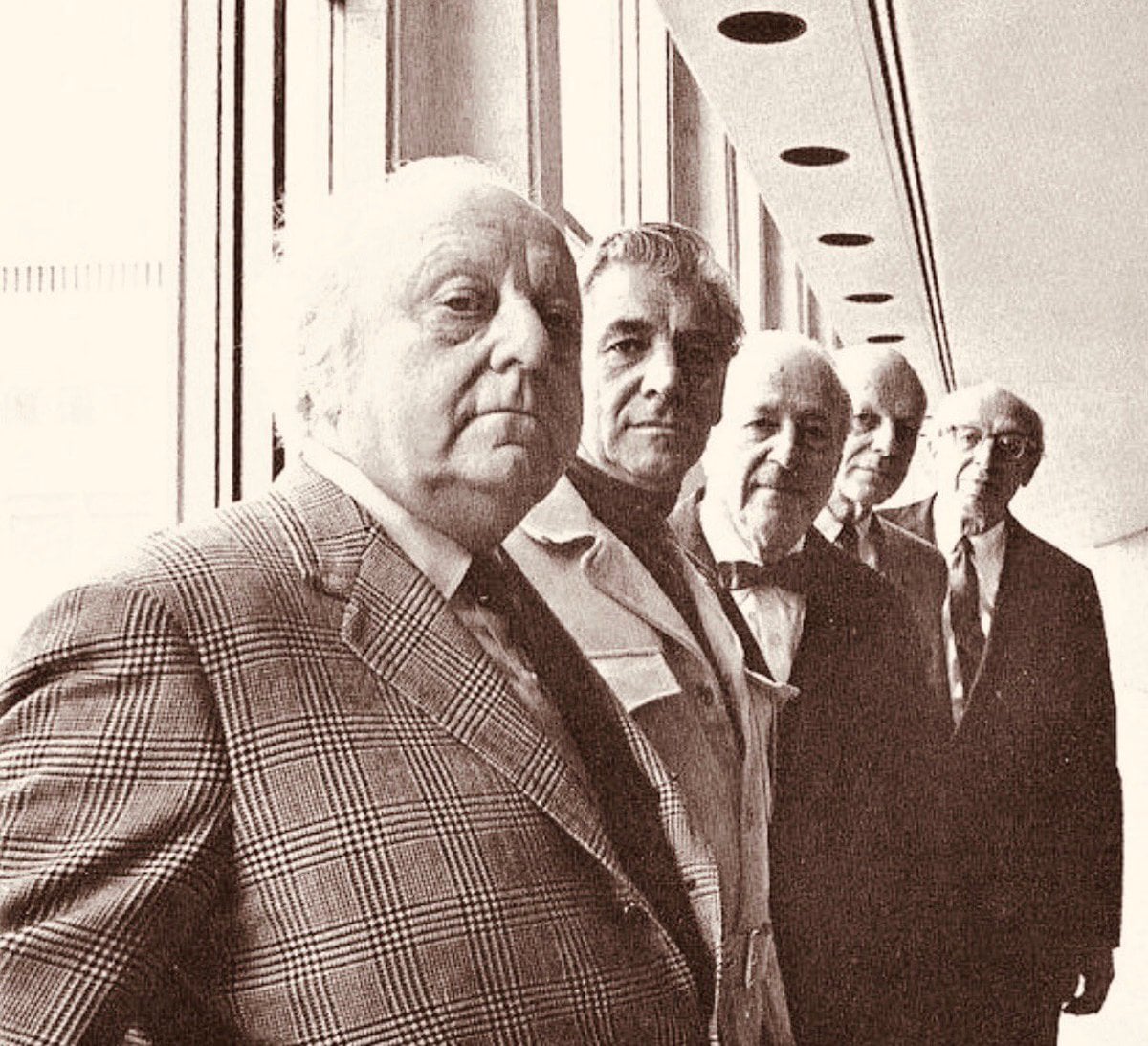
    Back-to-front, we have Aaron Copland, William Schuman, Walter Piston, Leonard Bernstein, and Virgil Thomson – all of them, with the exception of Lenny, recipients of the Pulitzer Prize for Music. Piston was honored twice.

    At the fore, Thomson defies us to take our best shot. His superpower is that he was not only a respected composer, but also a feared critic at the New York Herald-Tribune. This is a man even Thanos would think twice about crossing.

    He is especially powerful on this date every seven years or so, during the alignment of his birthday with Thanksgiving.

    I understand there are some who remain resistant to his charms. His brand of “faux-naïf” Americana is perhaps not for everyone.

    His “Symphony on a Hymn Tune” was composed during his Paris years. Thomson, like Copland and so many others, studied there with Nadia Boulanger. The symphony was inspired by the composer’s memories of his Kansas City boyhood. The “Sunday best” of the church hymns occasionally gets tangled up in a few modernistic burrs – the exchanges between the violin, cello, trombone, and piccolo at the end of the first movement, for instance – but in 1928, it was a landmark in terms of helping to establish a distinctly American idiom. To me, it is perfect Thanksgiving music.

    More austere, perhaps, is Thomson’s symphonic poem “Pilgrims and Pioneers” – but just stick around for the fiddle tunes.

    Finally, a seasonal work: the Concertino for Harp, Strings and Percussion, “Autumn” – according to Thomson, actually more of a “portrait of an artist ageing.”

    And Thomson sure did age. Hard to believe I was already doing radio in his later years.

    Happy birthday, Virgil Thomson (1896-1989) – and Happy Thanksgiving!


    Check out Thomson on TV!


    PHOTO: Just don’t make him angry. You wouldn’t like him when he’s angry. THOMSON SMASH!

Tag Cloud

Aaron Copland (92) Beethoven (95) Composer (114) Film Music (123) Film Score (143) Film Scores (255) Halloween (94) John Williams (187) KWAX (229) Leonard Bernstein (101) Marlboro Music Festival (125) Movie Music (138) Opera (202) Philadelphia Orchestra (89) Picture Perfect (174) Princeton Symphony Orchestra (106) Radio (87) Ralph Vaughan Williams (85) Ross Amico (244) Roy's Tie-Dye Sci-Fi Corner (290) The Classical Network (101) The Lost Chord (268) Vaughan Williams (103) WPRB (396) WWFM (881)

DON’T MISS A BEAT

Receive a weekly digest every Sunday at noon by signing up here


RECENT POSTS