Tag: American Composer

  • Charles Ives: An American Original

    Charles Ives: An American Original

    With the birthday of Connecticut cranky Yankee, Charles Ives, the autumn of my content deepens, as golden leaves find parallel in the Golden Age of American music and a run of composer birthdays that stretch clear into early December (Howard Hanson, Aaron Copland, Virgil Thomson, Irving Fine, Morton Gould, etc.). As a radio programmer of so many years, I am sensitive to these types of patterns!

    Ives, born on this date in 1874, was the first of our modern giants, and his influence has been the furthest reaching. While piling up acorns in the insurance business, he had the freedom to pursue his idiosyncratic muse. He composed in the evenings, on weekends, and on holidays, creating works of all stripes, tonalities, and quasi-tonalities, even atonality, navigating with remarkable certainty for some 30 years. And he did so in the relative isolation of a prophet, with very few performances to affirm his chosen course.

    Ives retired in 1930, which allowed him to devote himself wholeheartedly to music. Ironically, by then, he found he was no longer able to compose. His wife recalled a day in 1927 when he came downstairs with tears in his eyes and confessed that everything sounded wrong to him. After that, he labored mostly at revision and publication.

    By the time his works finally began to gain recognition, it had already been 20 years since he had stopped composing. At the time of his death, in 1954, he was still widely misunderstood and much of his music remained unperformed. Nevertheless, he had some important champions. He was a recipient of the Pulitzer Prize for Music in 1947, for his Symphony No. 3, “The Camp Meeting,” a work he had written in 1904. His reaction? “Prizes are for boys, and I’m all grown up.” He gave away the prize money, half of it to Lou Harrison, who had conducted the belated premiere.

    Even in the 1960s, the world was still grappling with Ives. In 1965, Leopold Stokowski gave the first performance of the Symphony No. 4. At the time, the work’s complex, kaleidoscopic tempos and layered, shifting meters required multiple conductors, and Stokowski enlisted the aid of David Katz and a young Jose Serebrier. The performance took place at Carnegie Hall with the American Symphony Orchestra and the Schola Cantorum of New York.

    The piece was composed between 1910 and the mid-1920s. The first two movements had been performed by members of the New York Philharmonic under the direction of Eugene Goossens in 1927. This was the only occasion on which Ives would hear any of the music performed live by an orchestra. (He died in 1954.)

    Bernard Herrmann conducted an arrangement of the lovely third movement, the simplest and most conservative of the four (why, then, the need for an arrangement?), in 1933. The music as Ives wrote it was not heard until Stokowski’s complete performance.

    The composer’s biographer, Jan Swafford, describes the work as “Ives’ climactic masterpiece.”

    Stokowski recorded the symphony a few days after the premiere and led a televised studio performance, which can be seen here:

    Stoky kicks off twenty minutes of spoken introductory material (including commentary from producer John McClure) at the 4:30 mark. The symphony proper begins 25 minutes in.

    When’s the last time you saw anything like this on television?

    Marveling at how out of step with musical convention his own compositions could be, Ives once famously remarked, “Are my ears on wrong?” Musicians are still scrambling to address this “unanswered question.”

    Happy birthday, Charles Ives!


    Ives’ “Hallowe’en” for string quartet and piano – watch out for that big drum!

    Leonard Bernstein on the Symphony No. 2:

    My preferred recording of the symphony, so beautiful (though not always entirely accurate, in regard to Ives’ intentions), with Bernstein and the New York Philharmonic in 1958:

    The Yale-Princeton Football Game:

    Ives sings!

  • Romeo Cascarino Rediscovering a Forgotten Composer

    Romeo Cascarino Rediscovering a Forgotten Composer

    O Romeo, Romeo, wherefore art thou Romeo? Why does no one play your music?

    It is well-crafted. It has heart. It is full of beauty.

    On the 99th birthday of Romeo Cascarino, I am asking, is there no one out there who might be able to program something to mark the composer’s centenary in 2022?

    Cascarino was born into a rough neighborhood in South Philadelphia in 1922. With a name like Romeo, you have to learn how to use your fists! While navigating the School of Hard Knocks, he taught himself privately, gleaning the mechanics of music theory from books checked out of the Free Library of Philadelphia. He was discovered by composer Paul Nordoff, who recognized his genius, and the two became more like friends than master-disciple.

    For many years, Cascarino was a professor of composition at Combs College of Music. The recipient of two Guggenheim Fellowships, he labored at his magnum opus, the opera “William Penn,” for the better part of three decades. The work received its premiere at Philadelphia’s Academy of Music in 1982 to mark the 300th anniversary of the founding of the city.

    Metropolitan Opera singer bass-baritone John Cheek sang the title role, Cascarino’s wife, soprano Dolores Ferraro, created the part of Penn’s wife, Gulielma, and Christofer Macatsoris conducted the Philadelphia Singers and the Concerto Soloists of Philadelphia.

    Cascarino died in 2002, at the age of 79. He left too little music. Fortunately, every piece is a treasure. A seductive, twilit beauty informs much of his output. If only he had completed “William Penn” 30 years earlier, I believe it would be as highly-regarded as Carlisle Floyd’s “Susanna” or Robert Ward’s “The Crucible.”

    Here’s hoping for a Cascarino revival, however modest, in 2022.


    “Pygmalion,” conducted by JoAnn Falletta

    “The Acadian Land,” performed by members of The Chamber Orchestra of Philadelphia

    The concise Bassoon Sonata, written for Cascarino’s Army buddy, Sol Schoenbach, for twenty years principal bassoonist of The Philadelphia Orchestra

    “Blades of Grass” for English horn and orchestra, after Carl Sandburg, performed by Orchestra 2001

    “Little Blue Pigeon,” from “Pathways of Love,” sung by Dolores Ferraro

    “Meditation and Elegy,” inspired by Edgar Allan Poe’s “Annabel Lee,” performed by Philadelphia Sinfonia

    Bruce Duffie interviews the composer

    http://www.kcstudio.com/cascarino2.html

    A list of his works

    https://romeocascarino.org/list_of_works.html

  • William Grant Still: An American Original

    William Grant Still: An American Original

    I am proud to say I was a William Grant Still advocate before it was cool to be so. When I first encountered his “Afro-American Symphony” in the early 1980s, it was love at first sound. It remains one of my favorite symphonies by an American composer.

    Perhaps it’s not “The Great American Symphony,” self-consciously aspirational, oratorical, or grandiose in the manner the third symphonies of Roy Harris, William Schuman, or Aaron Copland; but it does go straight to the heart, which is something none of the composers of that great American triumvirate do, at least in those particular works.

    Still’s symphony is poetic, it’s genuinely reflective, it’s beautiful, and it brims with great tunes. It’s congenial, and in the end quite moving. When I want “big statements” made on an Olympian scale, I will turn to those Lincoln Center composers, who would have us believe they are eating out of lunch pails, in their spare time, and riveting skyscrapers, or busting sod in denim overalls. But let’s face it, they are mostly hobnobbing in suits, jostling to get their music conducted by “Lenny.”

    Still is a composer in the mold, if not the manner, of Charles Ives. He’s a perpetual outsider, and always true to himself. His music grows directly out of his autobiographical experience, the blues, ballads, and spirituals of his childhood, in Woodville, Mississippi and Little Rock, Arkansas, and later his experience playing in pit bands during the Harlem Renaissance.

    He also studied at the Oberlin Conservatory and privately with George Whitefield Chadwick and Edgard Varèse, of all people. There is no Varèse to be found in Still’s music.

    He composes with the directness of a Virgil Thomson, but with none of Thomson’s affected naiveté. He shares with George Gershwin a refreshing lack of pretention – or at any rate his music does (he did, after all, subtitle one of his symphonies “Autochthonous”) – and a wonderful facility with melody.

    Of course, any discussion of Still must come with a litany of “firsts.” His “Afro-American Symphony” was the first written by a black composer to be performed by a major orchestra (the New York Philharmonic at Carnegie Hall). He was the first to be given the opportunity to conduct a major orchestra (the Los Angeles Philharmonic, at the Hollywood Bowl). His opera, “Troubled Island,” became the first to be produced by a major company (the New York City Opera). Another of his operas, “A Bayou Legend,” was the first to be performed on national television (as late as 1981). His works were performed internationally by the Berlin Philharmonic, the London Symphony Orchestra, the BBC Symphony, and the Tokyo Philharmonic.

    For years, all I could find was the “Afro-American Symphony,” and that only in two out-of-print, albeit very fine recordings (with Karl Krueger and the Royal Philharmonic, and Paul Freeman and the London Symphony Orchestra). It wasn’t until the digital era that the other four symphonies gradually – very gradually – became available. Thankfully, all of them now have been recorded and are available for purchase.

    It was only a couple of months ago that I discovered the official William Grant Still website, williamgrantstillmusic.com, run by the composer’s family. Through them, many of his scores, recordings, and written material may be acquired. I purchased a book about Still’s opera, “Troubled Island,” and its troubled history, combined with a CD-R of a live recording of the piece at its world premiere performance, a fascinating historical document. In all these years, I’ve only ever come across a single modern recording of any of his nine operas, “Highway One U.S.A,” with Philip Brunelle and Vocal Essence. This is a particular shame, since, as an opera lover himself, Still so wanted to add something significant to the repertoire.

    For all the love Florence Price has had lavished on her recently (the Philadelphia Orchestra just announced it will be recording her complete symphonies for Deutsche Grammophon), it would great if a world-class American band would take up the cause of Still.

    For me, William Grant Still is still the one.

    Happy birthday, WGS (1895-1978).


    “Afro-American Symphony”

    “Troubled Island”

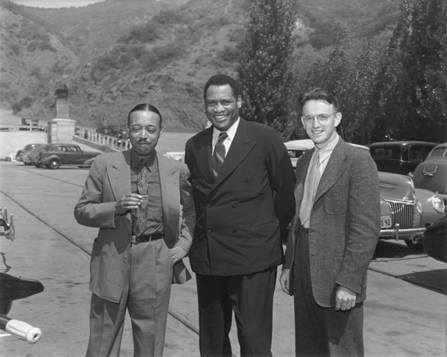
    “Joe Hill” by Earl Robinson, sung by Paul Robeson


    PHOTO: Still (left), with Paul Robeson and Earl Robinson

  • John Antes Moravian Composer

    John Antes Moravian Composer

    At a time when ants, for some inexplicable reason, begin to make their way indoors (isn’t it just getting nice outside?), I suppose it’s only appropriate that we acknowledge the anniversary of the birth of John Antes.* The Moravian composer was born in Frederick, Montgomery County, PA, on this date in 1740.

    Antes is credited with being one the first American composers to write chamber music. He was also the creator of the earliest surviving bowed string instrument made in America by someone actually born in the colonies. Antes’ violin, made in 1759, is housed in the Museum of the Moravian Historical Society in Nazareth, PA. A viola, made by Antes in 1764 (again believed to be the earliest surviving of American origin), is housed in the Lititz Moravian Congregation Collection in Lancaster County. Antes created at least seven such instruments.

    In 1752, Antes attended school in Bethlehem, PA. In 1760, he was admitted into the Single Brethren’s choir there. From Bethlehem, he travelled to Herrnhut, Germany, the international center of the Moravians, to prepare for a career as a missionary. In the meantime, he also took up watchmaking. He was ordained a minister in 1769, and then set out for Egypt. There, he served as a missionary to the Coptic Church in Grand Cairo. After a largely uneventful decade, he was captured and bastinadoed by followers of Osman Bey.

    During his convalescence, he occupied himself with the composition of three string trios. He also sent a copy of six quartets to Benjamin Franklin, whom he had known in America. The quartets are now lost (nice job, Ben), but the trios survive.

    Apparently, Antes also delved into making keyboard instruments (he completed a few for friends), but then the church elders reined him in. An Antes cello was discovered in somebody’s attic in 2018.

    https://apnews.com/article/e88096710de44cde9c4db7fae41b1760

    Video comparison of the three surviving Antes instruments:

    https://www.youtube.com/watch?v=-WhWs-3u-EI

    Selections from the String Trio No. 2 in D minor:

    Here’s a shout-out to all my peeps in the Lehigh Valley.


    *Pronounced “Anties.”

  • Florence Price Rediscovered A Women’s Day Gift

    Florence Price Rediscovered A Women’s Day Gift

    Only yesterday, I was enjoying BBC Radio 3’s programming of wall-to-wall women composers, for International Women’s Day (after first attending a Ruth Gipps video conference in honor of her centenary), and now this comes my way from two different sources – a rediscovered piece by American composer Florence Price. If you haven’t heard it yet, I’m sharing it here.

    https://www.bbc.com/news/entertainment-arts-56322440

Tag Cloud

Aaron Copland (92) Beethoven (95) Composer (114) Film Music (123) Film Score (143) Film Scores (255) Halloween (94) John Williams (187) KWAX (229) Leonard Bernstein (101) Marlboro Music Festival (125) Movie Music (138) Opera (202) Philadelphia Orchestra (89) Picture Perfect (174) Princeton Symphony Orchestra (106) Radio (87) Ralph Vaughan Williams (85) Ross Amico (244) Roy's Tie-Dye Sci-Fi Corner (290) The Classical Network (101) The Lost Chord (268) Vaughan Williams (103) WPRB (396) WWFM (881)

DON’T MISS A BEAT

Receive a weekly digest every Sunday at noon by signing up here


RECENT POSTS