Tag: American Composer

  • William Henry Fry: American Music Pioneer Died in St. Croix

    William Henry Fry: American Music Pioneer Died in St. Croix

    William Henry Fry died in Saint Croix on this date in 1864.

    Born in Philadelphia in 1813, Fry was pioneering figure in American music, the first native-born composer to write on a large scale. He composed orchestral works and the first opera by an American to be performed publicly during his lifetime (“Leonora,” in 1845). He was also an outspoken advocate of American music – that is to say, music composed by Americans – at a time when German imports ruled the roost. It would be decades before American music would gain a toehold in the concert halls, which makes Fry an even more remarkable figure.

    He studied music with a former bandleader in Napoleon Bonaparte’s army, who went on to become the head of Philadelphia’s Musical Fund Society. Fry himself would become the society’s secretary.

    He was also a journalist, a writer on music, and the first music critic to write for a major American newspaper. He was a foreign correspondent for the Philadelphia Public Ledger and acted as music critic for the New York Herald Tribune.

    Fry composed seven symphonies, all of them of a descriptive nature. My personal favorite is the “Niagara Symphony,” written for P.T. Barnum, conceived for enormous forces augmented by eleven timpani (because ten just won’t do).

    Fry died of tuberculosis, “accelerated by exhaustion,” at the age of 51. Sure, he died in Saint Croix (a.k.a. Santa Cruz), but he lives on in this “Santa Claus Symphony” (1853), more fussily detailed in its program than anything by Richard Strauss. Forget Macy’s. There’s more of Moore in this jolly old elf than there is Coca-Cola.


    NASTY SANTA: Illustration by Thomas Nast (c. 1872)

  • William Henry Fry’s Fry Day Surprise

    William Henry Fry’s Fry Day Surprise

    Raising the false hopes of workers everywhere, Monday is “Fry Day” this week – as today happens to coincide with the birthday of William Henry Fry. Maybe.*

    Fry was born in Philadelphia in 1813. A pioneering figure in American music, he was the first native-born composer to write on a large scale. He composed orchestral works and the first opera by an American to be performed publicly in his lifetime (“Leonora,” in 1845). He was an outspoken advocate of American music – that is, music composed by Americans – at a time when German imports ruled the roost. It would be decades before American music would gain a toehold in the concert halls, which makes Fry an even more remarkable figure.

    Fry studied music with a former bandleader in Napoleon Bonaparte’s army, who went on to become the head of Philadelphia’s Musical Fund Society. Fry himself would become the society’s secretary.

    He was also a journalist, a writer on music, and the first music critic to write for a major American newspaper. He was a foreign correspondent for the Philadelphia Public Ledger and acted as music critic for the New York Herald Tribune.

    He composed seven symphonies, all of them of a descriptive nature. His “Santa Claus Symphony,” after Clement Moore, is more of a Straussian tone poem. My personal favorite, though, is the “Niagara Symphony.” Written for P.T. Barnum, the work is conceived for enormous forces augmented by a mind-blowing eleven timpani.

    Hear this sublime work this afternoon on The Classical Network in a recording on the Naxos label. The album features liner notes by my friend and colleague Kile Smith. For 18 years, Kile was curator of the Fleisher Collection of Orchestral Music at the Free Library of Philadelphia, the world’s largest lending library of orchestral performance materials, where Fry’s scores are housed.

    Kile, of course, is also an entertaining writer, a personable radio presence, and a terrific composer. His latest album, “The Arc in the Sky,” was released last month on Navona Records, a subsidiary of Parma Recordings. The hour-long work was commissioned by the Grammy Award winning choir, The Crossing. It is one of five CDs of Kile’s music to be issued over the past year.

    I’ll further exploit the Fry connection to share some of Kile’s music this afternoon, following on the heels of the “Niagara Symphony.” Out of the Fry and into the Kile, so to speak.

    It will be more fun than going over the falls in a barrel, from 4 to 7 p.m. EDT, on WWFM – The Classical Network and wwfm.org.


    • There is some discrepancy regarding the date of Fry’s birth, with some sources giving August 10, and others August 19. So maybe it is just Monday, after all.

    More about Kile Smith here: kilesmith.com

  • Remembering Douglas Moore American Composer

    Remembering Douglas Moore American Composer

    Today is the 50th anniversary of the death of American composer Douglas Moore. Does anyone remember him?

    Moore was born into an old Long Island family that had lived there since the island’s settling in the 17th century. He attended, among other institutions, Yale University, where he earned two degrees; then he was off to Paris to study with Vincent d’Indy, Ernest Bloch, and Nadia Boulanger (lending credence to Ned Rorem’s famous observation, “Myth credits every American town with two things: A 10-cent store and a Boulanger student”).

    Moore went on to serve as president of the National Institute and American Academy of Arts and Letters and director of music at the Cleveland Museum of Art. In 1926, he joined the faculty of Columbia University, where he remained until his retirement in 1962. With Otto Luening and Oliver Daniel, he cofounded the CRI (Composers Recordings, Inc.) label.

    In addition to his work in the classical world, he also dabbled in the popular realm. He wrote the Yale fight song, “Goodnight, Harvard.” He also authored two books: “Listening to Music” (1932) and “From Madrigal to Modern Music” (1942).

    As a composer, Moore must have seemed, even then, a little old-fashioned. He worked mostly in a Romantic idiom. Though sometimes hinting at American folk song and occasionally popular trends, his works lack the kind of zest evident in, say, Aaron Copland’s distillation of French neoclassicism into his much snappier frontier ballets. On the other hand, Moore enjoyed more success on the operatic stage than Copland ever did.

    He collaborated with Stephen Vincent Benet on an adaptation of Benet’s short story, “The Devil and Daniel Webster.” (He would dedicate his Symphony No. 2 to Benet’s memory.) “Giants in the Earth” was the recipient of the Pulitzer Prize for Music in 1951.

    But his most enduring and beautiful music might just be that for “The Ballad of Baby Doe,” which was championed and recorded by Beverly Sills.

    Also, some may dimly recollect Howard Hanson’s performance of “The Pageant of P.T. Barnum,” part of Hanson’s series of recordings of American music set down with the Eastman-Rochester Orchestra for the Mercury label.

    At the time of his death, Moore was 75 years old. Sadly, now, at a half century’s distance, it seems that Moore is less.


    Douglas Moore introduces Beverly Sills in “The Willow Song” from “The Ballad of Baby Doe.”

  • Dominick Argento A Remembrance

    Dominick Argento A Remembrance

    American composer Dominick Argento died on February 20 at the age of 91. Acclaimed particularly for his vocal works, Argento was awarded the Pulitzer Prize for Music for his song cycle, “From the Diary of Virginia Woolf,” in 1975. This Sunday night on “The Lost Chord,” I’ll offer a remembrance of the man and his achievements.

    Argento was born in York, PA, to Sicilian immigrant parents, who were inn-keepers and restaurateurs. However, it was in the Twin Cities that he would flourish. He became a professor of music at the University of Minnesota and one of the founders of what is now Minnesota Opera.

    He was recognized as a master of modern opera, the most significant American operatic composer between Gian Carlo Menotti in the 1950s and Philip Glass in the 1970s. His success is all the more remarkable, considering Argento spent virtually his entire career very far away from the artistic centers on either coast.

    Largely self-taught as a child, he was accepted into the Peabody Conservatory, after service in WWII. There, among his teachers, were Nicolas Nabokov and Hugo Weisgall. Later, he continued his studies with Luigi Dallapiccola in Florence. Howard Hanson, Bernard Rogers, and Alan Hovhaness were also important mentors. Argento received his doctorate from the Eastman School in 1958. He then moved to Minneapolis, where he lived for the next six decades, summering in Florence with his wife, the soprano Carolyn Bailey.

    In Minneapolis, he worked closely with the newly-formed Guthrie Theatre. His local successes attracted national nation and led to commissions from major opera houses from all over the country. His song cycles were championed by some of the great singers, including Frederica von Stade, Janet Baker, and Håkon Hågegard. “Casa Guidi,” a song cycle on texts of Elizabeth Barrett Browning, was recorded by Von Stade and received a Grammy Award in 2004 for Best Contemporary Classical Composition.

    Beginning in the early ‘70s, Argento also devoted himself to choral music, in large part because of his association with Philip Brunelle and the Plymouth Music Series of Minneapolis’ Plymouth Congregational Church.

    In common with Benjamin Britten, Argento’s musical language could be, on occasion, a little quirky, yet always he strove for accessibility. Among his own students were Libby Larsen and Stephen Paulus.

    We’ll hear music from one of his 14 operas, “The Dream of Valentino,” from 1993. Accordionist William Schimmel will strut and slither in “Valentino Dances.”

    That will be followed by “Six Elizabethan Songs” from 1958. Originally scored for voice and piano, it was subsequently arranged by the composer in 1962 for voice and Baroque ensemble. The added colors of flute, oboe, violin, cello, and harpsichord lend the work a kind of refracted authenticity, conjuring a loosely apposite sound world to the individual texts by Thomas Nash, Samuel Daniel, William Shakespeare, Henry Constable, and Ben Johnson. The performance will be by Patrice Michaels and the Rembrandt Chamber Players.

    Finally, Argento was composer laureate of the Minnesota Orchestra, having been commissioned to write no less than seven works for the ensemble. We’ll hear “A Ring of Time,” conceived for the 1972-73 season, the orchestra’s 70th anniversary. Argento considers different measurements of the passage of time – the seasons of the year and the times of the day – in the work’s four movements: “Spring,” “Summer,” “Fall,” and “Winter.” The Minnesota Orchestra will be conducted by Eiji Oue.

    Time has passed for Domenick Argento. I hope you’ll join me for an hour of musical remembrances on “Argento Mementos,” this Sunday night at 10:00 EST, on WWFM – The Classical Network and wwfm.org.

  • Rediscovering Ulysses Kay: A Neglected American Voice

    Rediscovering Ulysses Kay: A Neglected American Voice

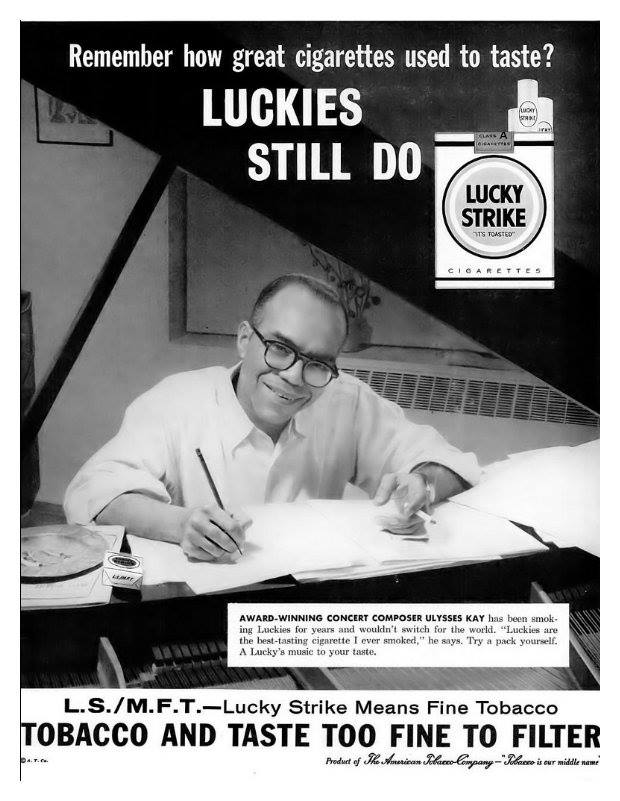
    Regrettably, the music of Ulysses Kay is under-represented in the current catalogue. His delightful “Six Dances for String Orchestra,” probably the lightest music he ever wrote, has been available sporadically on the Vox label, though always badly in need of a new recording. This Sunday night on “The Lost Chord,” we’ll hear one of those dances as part of an hour devoted to Kay’s music.

    Born in Tuscon, AZ, in 1917, Kay was the nephew of jazz musician King Oliver. His uncle encouraged him to study music formally. Likewise, he received moral support from William Grant Still, then recognized as the “Dean of Afro-American Composers.” Kay attended the University of Arizona, before heading on to the Eastman-School, where he studied with Howard Hanson and Bernard Rogers. Also influential were studies with Paul Hindemith at the Berkshire Music Center, and then Yale.

    Kay served in the United States Navy during World War II. He then continued his studies at Columbia with Otto Luening. A recipient of multiple scholarships, grants and awards, he was able to live and study abroad, in Rome, where he attended the American Academy, for several years.

    From 1953 to 1968, he worked for BMI. He was then appointed professor at Lehman College of the City University of New York, where he remained until his retirement, two decades later. A longtime resident of Teaneck, NJ, he composed orchestral, chamber, choral and instrumental works, and five operas. He died in 1995 at the age of 88.

    In addition to that dance for strings, we’ll also hear Kay’s work for trumpet and piano, “Tromba,” from 1985; a long out-of-print LP of his “Concerto for Orchestra,” recorded in 1953; and a suite from his film score to “The Quiet One,” from 1947. A quasi-documentary about an abused African American child and his subsequent coming of age, “The Quiet One” received an Oscar nomination for Best Story and Screenplay, and was listed by the New York Times and the National Board of Review as one of the ten best movies of 1948.

    I hope you’ll join me for “Giving Kay His Say,” this Sunday night at 10:00 EST, on WWFM – The Classical Network and wwfm.org.


    An interview with Kay conducted by Bruce Duffie:
    http://www.bruceduffie.com/kay.html


    PHOTO: Kay gets Lucky!

Tag Cloud

Aaron Copland (92) Beethoven (95) Composer (114) Film Music (123) Film Score (143) Film Scores (255) Halloween (94) John Williams (187) KWAX (229) Leonard Bernstein (101) Marlboro Music Festival (125) Movie Music (138) Opera (202) Philadelphia Orchestra (89) Picture Perfect (174) Princeton Symphony Orchestra (106) Radio (87) Ralph Vaughan Williams (85) Ross Amico (244) Roy's Tie-Dye Sci-Fi Corner (290) The Classical Network (101) The Lost Chord (268) Vaughan Williams (103) WPRB (396) WWFM (881)

DON’T MISS A BEAT

Receive a weekly digest every Sunday at noon by signing up here


RECENT POSTS