Category: Daily Dispatch

  • Secret of the Incas: The REAL Raiders of the Lost Ark?

    Secret of the Incas: The REAL Raiders of the Lost Ark?

    What is the “Secret of the Incas?” That George Lucas and Steven Spielberg plundered its treasure to create “Raiders of the Lost Ark!”

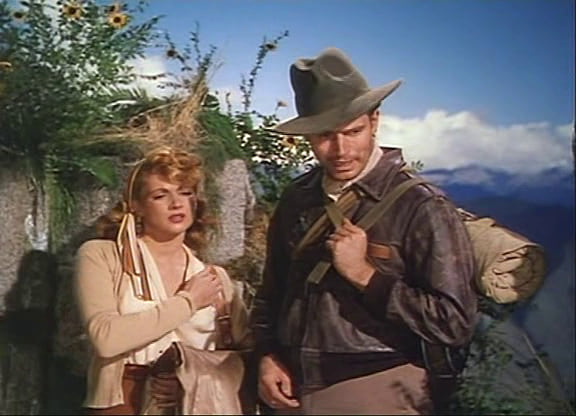
    The archaeological quest, the Peruvian jungle setting, the cynical antihero, the bantering romance, the collegial betrayal, the cryptic secret of the burial chamber/map room, the moral tug-of-war between greed and responsibility, even the signature Indiana Jones fedora, leather jacket, and multi-day stubble. The only things missing are the bullwhip and Indy’s scoundrel charm.

    Sure, “Raiders” is the slicker, more breathlessly-paced contemporary entertainment, but “Secret of the Incas” (1954) is a solid representative of the grand, old school, Technicolor, shot-on-location Hollywood adventure.

    Charlton Heston is the hard-edged “hero,” Harry Steele, who frequents a local saloon while fielding business and other propositions. Nicole Maurey is the sultry woman with a past, on the run from agents from behind the Iron Curtain. Thomas Mitchell is Harry’s slippery business partner, who periodically tries to kill him. And Peruvian soprano Yma Sumac lends a touch of verisimilitude with her mind-blowing, five-octave range. Oh yeah, there’s also a supporting part for Robert Young as a nice-guy archaeologist, who’s everything Heston’s character isn’t. If you were Maurey, which one would you choose?

    To mark the 40th anniversary of “Raider’s” release, on June 12, 1981, we’ll discuss “Secret of the Incas” on the next Roy’s Tie-Dye Sci-Fi Corner – with ample reflections on Indiana Jones along the way. So while you’re at it, be sure to brush up on those films too. The comments section will be alive with asps, as I crack the whip on Roy, livestreamed on Facebook, this Friday evening at 7:00 EDT!

    https://www.facebook.com/roystiedyescificorner/


    PHOTO: If adventure has a name, it must be… Harry Steele?
  • Carl Nielsen Awaits Rediscovery

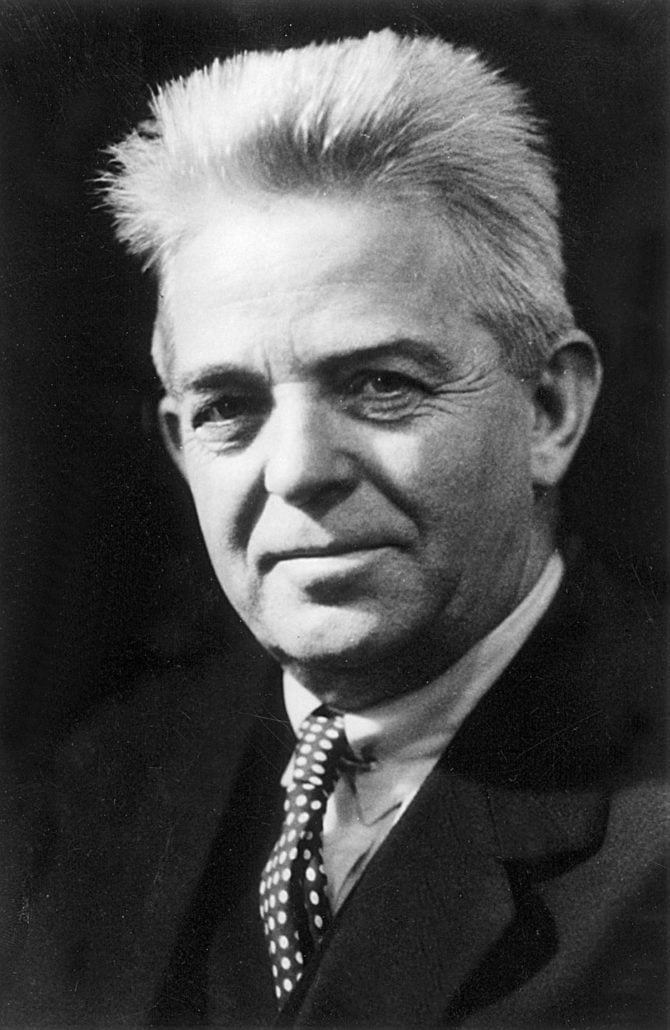
    Carl Nielsen Awaits Rediscovery

    Great Dane or Ugly Duckling? In the case of Carl Nielsen, the two are not necessarily mutually exclusive.

    While Nielsen retains his status as Denmark’s most celebrated composer, internationally, he has had difficulty emerging from the shadow of that other great bard of the North, Jean Sibelius.

    This is a shame, since, far from being a Sibelius knock-off, Nielsen forged his own, immediately-recognizable style – which can’t always be said, with as much conviction, about a lot of other fin de siècle Scandinavian composers. Not that I don’t love their music.

    Leonard Bernstein believed Nielsen’s rightful place was as Sibelius’ equal.

    “I think many people are in for pleasant surprises as they get to know Nielsen,” he said at a centennial celebration of the composer’s birth, “his rough charm, his swing, his drive, his rhythmic surprises, his strange power of harmonic and tonal relationships – and especially his constant unpredictability – all these are irresistible. I feel confident that Nielsen’s time has come.”

    Here’s Bernstein, conducting the Danes on their own turf, in what may be my favorite Nielsen symphony, the Symphony No. 3:

    That was in 1965. Sadly, fifty-six years on, with many more recordings and performances to choose from, Nielsen’s music remains, stubbornly, an acquired taste. But it is a rewarding one. There really is nothing else quite like it. The puckish wit, the ambiguity, the quirky juxtaposition of seemingly disparate melodies, harmonies, and key signatures, all very often shot through with a sense of hope and optimism that rises above the chaos.

    Next to Sibelius, Nielsen doesn’t really have that many imitators. The English composer Robert Simpson was evidently a great admirer of both. This is Simpson’s centenary year. (He was born on March 2, 1921.) His own symphonies often resemble Nielsen’s, but without the big moments.

    Simpson’s Symphony No. 2:

    Simpson introduces Nielsen:

    “Espansiva: A Portrait of Carl Nielsen” (featuring Simpson):

    Rare glimpses of Nielsen on film:

    Happy birthday, Carl Nielsen, and thanks for the advocacy, Robert Simpson.

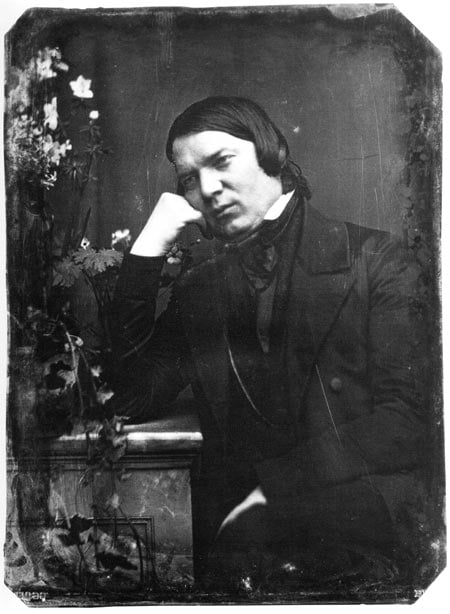
  • Robert Schumann Tormented Genius

    Robert Schumann Tormented Genius

    A would-be concert pianist, he’s said to have destroyed his hand through the use of a finger-strengthening device of his own design.

    He took his underage sweetheart’s father – who also happened to be his teacher – to court, to sue for the right to marry, ultimately winning that right the day before she came of age.

    He went mad from syphilis, hurled himself into the Rhine, and spent his final months in an asylum.

    His name was Robert Schumann, and he was one of the most romantic of Romantic composers.

    It’s hardly surprising that such an overheated personality would write such emotionally turbulent music. Whether tender (as per “Kinderszenen,” his reminiscences of childhood) or troubled (the “Nachtstücke,” a premonition of his brother’s death), Schumann was the ne plus ultra of tormented genius.

    Happy birthday, Florestan! Or should that be Eusebius?


    “Kinderszenen” (“Scenes from Childhood”), performed by Clara Haskil

    “Nachtstücke” (“Night Pieces”), performed by Emil Gilels

    “Fantasie in C major,” performed by Valdimir Horowitz

    The “Fantasie” was completed in 1839, during Schumann’s enforced separation from Clara Wieck, his future wife. He wrote to her: “The first movement is the most passionate I have ever composed; it is a profound lament on your account.”

    In the end, he dedicated the work to Franz Liszt. Liszt returned the favor by dedicating his Piano Sonata in B minor to Schumann in 1854. By that time, Liszt had long been persona non grata to the Schumanns. Clara, in particular, loathed him and his music.

    She confided in her diary: “Liszt sent Robert today a sonata dedicated to him and several other things with a friendly letter to me. But the things are dreadful! [Johannes] Brahms played them for me, but they made me utterly wretched … This is nothing but sheer racket – not a single healthy idea, everything confused, no longer a clear harmonic sequence to be detected there! And now I still have to thank him – it’s really awful.”

    In any case, Robert, at 44, was already in the asylum.

  • Albinoni’s Adagio Mystery: Fact or Fiction?

    Albinoni’s Adagio Mystery: Fact or Fiction?

    I’ve told this story so many times, I thought surely I had shared it here before. Maybe I have. But it’s not turning up in a search of my old posts, so please forgive me if I’m repeating myself.

    Today is the 350th anniversary of the birth of Tomaso Albinoni.

    Albinoni is one of those Italian Baroque composers (Venetian, to be exact) who wrote so much agreeable, fairly interchangeable music. Perfect for morning or afternoon drivetime. For the most part, his works are short – ten minutes at average, as an educated guess. Those in a major key are bright, those in a minor key don’t dig too deeply. Oboe concertos. Concertos for strings. Thanks to Albinoni, the term “concerto a cinque” is heard fairly commonly on classical music radio stations.

    In his lifetime, his works were viewed as being on a par with those of Arcangelo Corelli and Vivaldi. Bach also found his music of interest, basing at least two of his fugues on Albinoni themes and using the composer’s basslines for instructional purposes. It is this matter of the bassline that has secured Albinoni’s immortality in the hearts of music-lovers everywhere.

    During World War II, a significant portion of Albinoni’s output was lost in the bombing of Dresden. (Which makes me wonder, how much did this guy actually write, anyway?) Then in 1958, seemingly out of nowhere, a musicologist by the name of Remo Giazotto (1910-1998) published a previously-unknown “Adagio in G minor.” This he claimed to have reconstructed from surviving fragments – a bassline and the wisp of a violin melody – from an Albinoni manuscript that had been housed in the Dresden State Library.

    Sad and soulful, perhaps even desolate – wholly of a piece, in fact, with the tale of its recovery from the ruins of a city that had been leveled in a three-day Allied attack – it has become Albinoni’s most-frequently performed work. It’s been used in countless movies and television shows – “Gallipoli” comes to mind – and it is included in just about any collection of greatest hits of the Baroque.

    The thing is, did Albinoni really write it?

    Curiously, for whatever reason, Giazotto never produced the actual manuscript from which he claimed to have reassembled the work. This has led to a widespread belief that the piece is not by Albinoni at all, but Giazotto’s own creation. But if that’s indeed the case, why not own it? It’s beautiful music, man!

    Perhaps he was afraid of being laughed out of academia. “Respectable” music at this point in time was teetering into the avant-garde. At the very least, it wasn’t tonal.

    Interestingly, following Giazotto’s death, one of his assistants, Muska Mangano, did find the “Albinoni” fragments among his papers. In the upper right-hand corner of the page, there was a stamp corroborating that the source material had indeed once been stored in Dresden. However, the fragments had been transcribed in a modern hand. It’s assumed that this was the source from which Giazotto worked.

    The original Albinoni manuscript has yet to be recovered. Clearly, there is still a fair amount of mystery surrounding the true provenance of this timeless, haunting classic.

    So once more, an assessment of Albinoni manages to focus very little on the merits of his own achievements! Nothing about the cantatas. Nothing about the operas, which nobody knows.

    Still, if people are still talking about him 270 years after his death, he must have done something right.

    Happy birthday, Tomaso Albinoni!


    The Albinoni Adagio

    A whole mess of Albinoni “concerti a cinque” performed by I Musici

    An aria from one of his operas

    Trailer for Peter Weir’s “Gallipoli”

  • George Szell Autocrat Genius Cleveland Orchestra

    George Szell Autocrat Genius Cleveland Orchestra

    All’s Szell that ends well.

    A notorious autocrat from an era when autocrats were tolerated, respected, and even revered on the podium, George Szell was a formidable perfectionist, even to the extent of lecturing the Severance Hall custodians on the proper way to mop a floor and what kind of toilet paper they should be supplying in the restrooms.

    When he took over as music director in Cleveland in 1946, straight off, he fired 12 of the orchestra’s 97 players and signed the rest to short-term contracts. His aim was to rebuild the ensemble into a force to be reckoned with. “A new leaf will be turned over with a bang,” he declared. By the time of his death in 1970, 40 percent of his musicians were seeing psychiatrists.

    Dietrich Fischer-Dieskau noted “his compulsive need to always have an opinion different from others and his considerable paranoia when it came to the orchestra’s ill-will.” Just because you’re paranoid doesn’t mean they don’t hope you fall down the stairs and break your neck.

    He may have been a bit of a martinet and a world-class S.O.B., but Szell’s goal was a lofty one. He whipped Cleveland into one of the country’s top orchestras – which is to say, one of the best in the world. If he expected much of his musicians, he himself never phoned-in a performance. He was always hyper-prepared, and in rehearsals, nothing escaped his notice. It was not unusual for him to take everything apart and rebuild it from the ground up, even at the expense of his musician’s nerves. Sometimes it backfired, and the orchestra was so wrung out, it had nothing left for the actual performance.

    While the uncanny precision of Szell’s Clevelanders was often praised, many of their performances were criticized for a perceived lack of warmth. Certainly, there is enough documentary evidence to prove that on occasion Szell could indeed catch fire and inspire his players. He is much kinder in filmed rehearsals than his reputation would suggest.

    He may have been a little tightly wound, but you can’t quibble with the results. Thank your lucky stars you didn’t have to work for him, but boy, he certainly could conduct!

    Happy birthday, George Szell.


    Szell’s benchmark modern orchestra Haydn:

    While on tour with the Cleveland Orchestra in Tokyo, and with only two months to live (he was terminally ill with cancer), Szell conducted what may very well be the most thrilling performance of Sibelius’ Symphony No. 2 I have ever heard, certainly on a par with the classic Barbirolli account with the Royal Philharmonic Orchestra:

    Szell as a Mozart pianist:

    One of Szell’s own, early compositions, “Variations on an Original Theme”:

    Szell speaks!

    Szell on “The Bell Telephone Hour” on NBC. These days, you won’t even find something like this on PBS.

    Szell rehearses Beethoven

    Szell conducts Beethoven and Bruckner in Vienna

    https://www.youtube.com/watch?v=vuXODojyfME

Tag Cloud

Aaron Copland (93) Beethoven (95) Composer (114) Film Music (136) Film Score (143) Film Scores (255) Halloween (94) John Williams (195) KWAX (229) Leonard Bernstein (103) Marlboro Music Festival (125) Movie Music (151) Mozart (88) Opera (208) Philadelphia Orchestra (89) Picture Perfect (174) Princeton Symphony Orchestra (108) Radio (88) Ross Amico (244) Roy's Tie-Dye Sci-Fi Corner (290) The Classical Network (101) The Lost Chord (268) Vaughan Williams (103) WPRB (396) WWFM (881)

DON’T MISS A BEAT

Receive a weekly digest every Sunday at noon by signing up here


RECENT POSTS