Category: Daily Dispatch

  • Tania León Wins Pulitzer for “Stride”

    Tania León Wins Pulitzer for “Stride”

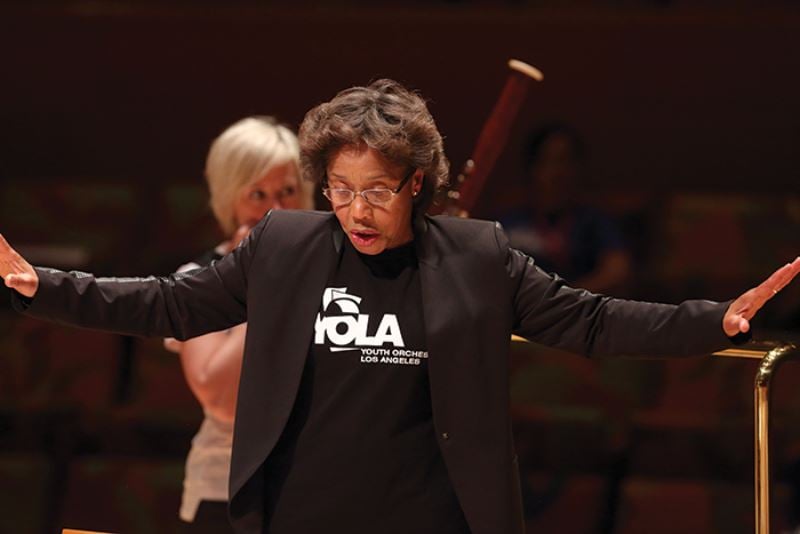
    Here, with all the hullabaloo, I forgot all about the Pulitzers being announced yesterday. Congratulations to Tania León, the recipient of this year’s prize for music, for her composition “Stride.”

    “Stride” received its world premiere by the New York Philharmonic on February 13, 2020. The music is a response to the orchestra’s “Project 19” commissioning program, for which 19 women wrote works to mark the centennial of the ratification of the 19th Amendment, which guaranteed a woman’s right to vote. The inspiration for León’s piece was Susan B. Anthony.

    León discusses “Stride”

    The work in rehearsal:

    You’ll find an interview with the composer, in which she talks about the piece, here:

    https://www.npr.org/sections/deceptivecadence/2021/06/11/1005649919/tania-leon-wins-music-pulitzer-for-stride-a-celebration-of-womens-suffrage

    León, born in Havana, settled in New York in 1967. Among her teachers was Ursula Mamlok.

    This year’s other finalists in the category were Ted Hearne, for “Place,” and Maria Schneider, for “Data Lords.”

    It’s a good thing it’s still breakfast, because I really feel like I’ve got egg on my face for having forgotten, especially after devoting this past Sunday’s “The Lost Chord” to Pulitzer Prize winning music! If you missed it, you can still catch the show as a webcast at the link below. The playlist includes works by William Schuman (the very first recipient of the music prize), William Bolcom, and Caroline Shaw (the category’s youngest honoree).

    https://www.wwfm.org/post/lost-chord-june-6-further-pulitzer-surprises
  • Raiders of the Lost Ark Secret of the Incas & More

    On the 40th anniversary of the release of “Raiders of the Lost Ark,” enjoy last night’s discussion of a movie that heavily influenced it, “Secret of the Incas” (1954).

    We’re taking Friday off next week, but Roy will be back with his son, Ryan, for a special Father’s Day edition of Roy’s Tie-Dye Sci-Fi Corner, on Sunday, June 20 – with the topic to be announced.

    Then Roy and I will reunite for yet another riveting conversation, about “Dimension 5” (1966), a time travel-espionage-thriller starring Jeffrey Hunter, France Nuyen, and Harold “Odd Job” Sakata, on Friday, June 25.

    Time travel always increases our chances of punctuality. The Facebook livestreams begin at 7 pm EDT.

    https://www.facebook.com/roystiedyescificorner

  • Richard Strauss The Conducting Secrets

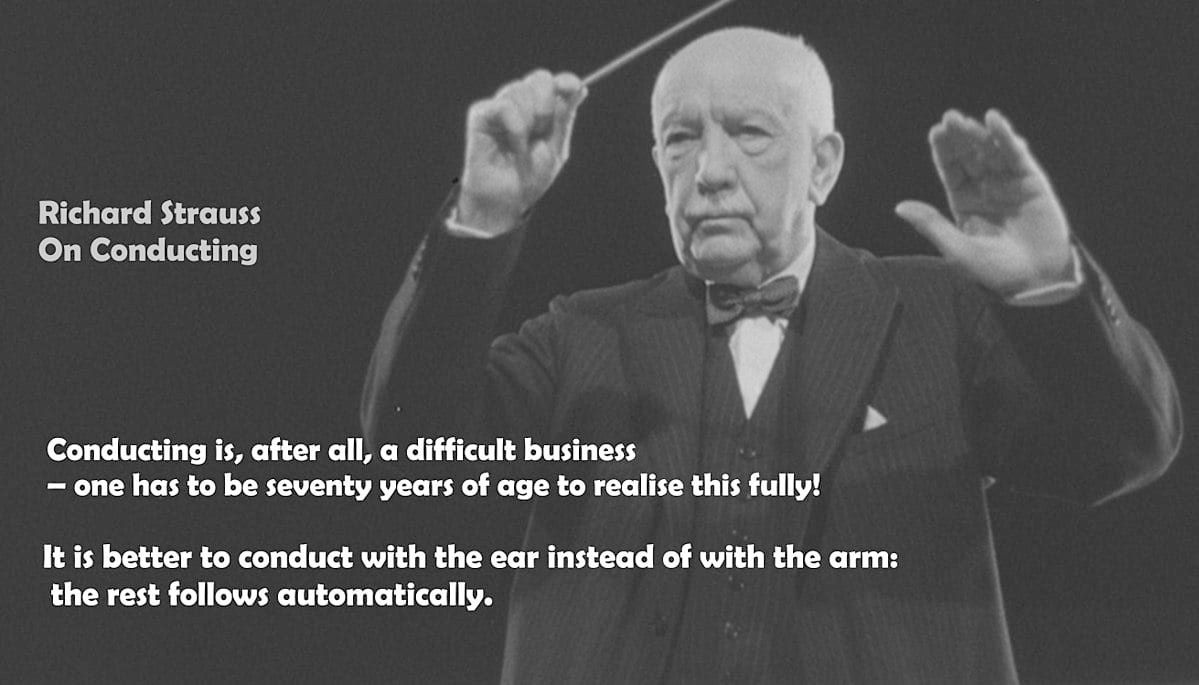
    Richard Strauss The Conducting Secrets

    Richard Strauss will probably always be remembered, first, as the composer of Dionysian tone poems, employing opulent, even hedonistic orchestration, and for the turbulent, angst-ridden operas “Salome” and “Elektra.”

    But when it came to conducting, he took a decidedly Apollonian stance. His technique might best be described as no-nonsense. Some have even remarked on his looking bored. George Szell suggested Strauss often just wanted to get a performance over with, so that he could get out and go to a card game.

    (Szell, by the way, wound up conducting the first half of the premiere recording of Strauss’ “Don Juan” in 1917, on account of the composer oversleeping.)

    Here are Strauss’ “Ten Golden Rules for the Album of a Young Conductor,” set down in 1927:

    1. Remember that you are making music not to amuse yourself, but to delight your audience.

    2. You should not perspire when conducting. Only the audience should get warm.

    3. Conduct “Salome” and “Elektra” as if they were by Mendelssohn: fairy music.

    4. Never look encouragingly at the brass, except with a brief glance to give an important cue.

    5. But never let the horns and woodwinds out of your sight. If you can hear them at all, they are still too strong.

    6. If you think that the brass is now blowing hard enough, tone it down another shade or two.

    7. It is not enough that you yourself should hear every word the soloist sings. You should know it by heart anyway. The audience must be able to follow without effort. If they do not understand the words, they will go to sleep.

    8. Always accompany the singer in such a way that he can sing without effort.

    9. When you think you have reached the limits of prestissimo, double the pace.

    10. If you follow these rules carefully, you will, with your fine gifts and your great accomplishments, always be the darling of your listeners.

    In 1948, Strauss wrote of Number 9, “Today I should like to amend this: take the tempo half as fast.”

    Some of his suggestions may seem as if they’re tongue-in-cheek, but the idea to lighten the textures makes a whole lot of sense when you consider just how overblown these works can be, and how impossible to hear the singers.

    Strauss recorded most of his orchestral works over the last two decades of his life. A few of these were captured on film.

    See for yourself if Strauss follows his own advice, or, if as Szell, suggests, all he’s really thinking about is playing cards.

    “Till Eulenspiegel’s Merry Pranks”:

    With commentary by Szell, his one-time assistant:

    “Allerseelen” (“All Souls’ Day”), with a glimpse of lederhosen!

    Happy birthday, Richard Strauss.

  • Happy 95th Birthday, Carlisle Floyd!

    Happy 95th Birthday, Carlisle Floyd!

    Today is the 95th birthday of one of the most successful opera composers this country has ever produced. Carlisle Floyd was not yet 30 when he enticed Phyllis Curtin and Mack Harrell to Tallahassee to sing in the world premiere of “Susannah” in 1956. The opera takes the Apocryphal tale of Susannah and the Elders and transplants it to rural Tennessee.

    Floyd wrote the libretto and music while on the piano faculty at Florida State University. The work’s success soon spread to New York, and “Susannah” became one of the most frequently performed of American operas. It does feature two heart-melting arias that remain favorites of aspiring American sopranos: “Ain’t It a Pretty Night” and “The Trees on the Mountain.”

    The directness of the drama and the uncluttered musical language struck a chord with both performers and audiences. Emboldened by his success, Floyd went on to compose ten more operas, all of them on his own librettos, drawing inspiration from such diverse sources as Emily Bronte’s “Wuthering Heights,” Robert Louis Stevenson’s “Markheim,” John Steinbeck’s “Of Mice and Men” and Robert Penn Warren’s “All the King’s Men.”

    “Cold Sassy Tree,” based on the novel of Olive Ann Burns, was given its premiere in 2000. The composer had intended it to be his swan song. He had become too busy caring for his wife, who suffered from Alzheimer’s disease, to devote much further thought to composition. But following her passing, he found inspiration for one last hurrah. The result was “Prince of Players,” about 17th century actor Edward Kynaston, which was given its premiere at Houston Grand Opera in March 2016.

    For a composer to have a new opera performed at the age of 90 should be an inspiration to all of us who not only care about music, but who have ever puzzled over finding meaning in our lives.

    Happy birthday, Carlisle Floyd!


    Dawn Upshaw breaks hearts with “Ain’t It a Pretty Night,” from “Susannah”:

    Cheryl Studer sings “The Trees on the Mountain,” from a complete recording of the work:

    Samuel Ramey as the Reverend Olin Blitch:

    A taste of “Prince of Players” from Little Opera Theater of New York:

    The 2021 Grammy-nominated recording (Best Opera Recording; Best Contemporary Classical Composition; Producer of the Year, Classical):

    Carlisle Floyd speaks:

    “Cold Sassy Tree”:

  • Stravinsky’s Wind Symphonies A Centennial

    Stravinsky’s Wind Symphonies A Centennial

    On this date, 100 years ago, Igor Stravinsky’s “Symphonies of Wind Instruments” was given its first performance at Queen’s Hall, London, on a concert conducted by Serge Koussevitzky. Written the previous year, and dedicated to the memory of Debussy, the chorale that concludes the piece was first published in the French magazine “La Revue musicale,” alongside memorial works by Ravel, Bartók, Falla, Dukas, Satie, and others. The issue was titled “Le Tombeau de Claude Debussy.”

    However, the opening night audience found Stravinsky’s music anything but grave. They chortled inappropriately, and Koussevitzky glanced over his shoulder to share a conspiratorial grin. Even so, at the end of the performance, any cheekiness was obliterated by applause, as Stravinsky rose to take a bow.

    The work is scored for 24 wind instruments. The term “symphonies” has nothing to do with symphonic form. Rather, Stravinsky employed the word for its broader, older connotation, from the Greek, of “sounding together.” He would reorchestrate the piece in 1947.

    Three days prior to the Queen’s Hall jeers, Stravinsky had given Londoners something to cry about, as he attended the UK premiere, in the same venue, of the concert version of his riot-inducing ballet “The Rite of the Spring.”

    It’s always refreshing to look back on a time when people were actually passionate about music.


    “Symphonies of Wind Instruments”

    Riot at “The Rite”


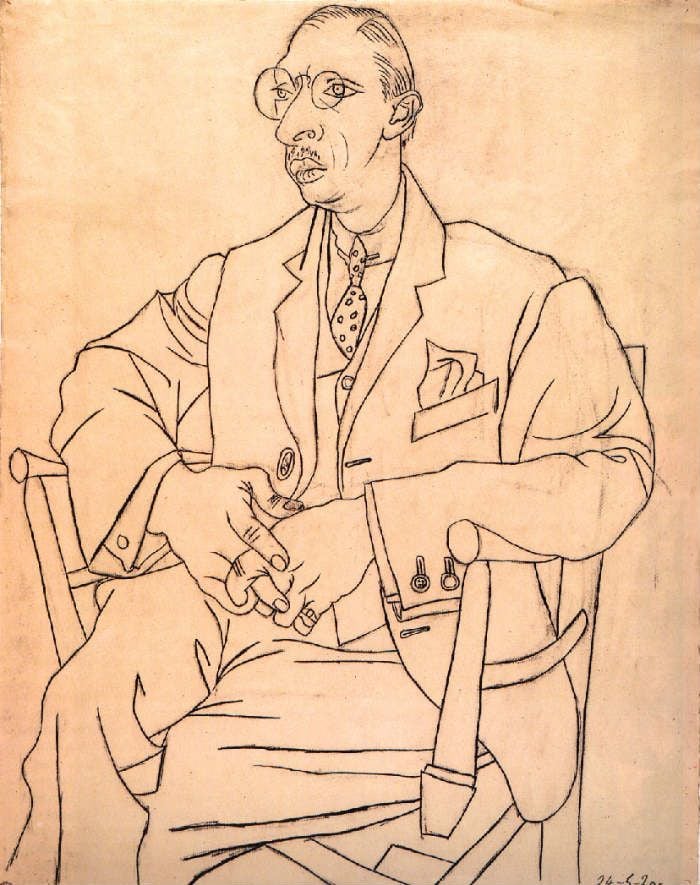
    Stravinsky as rendered by Picasso in 1920

Tag Cloud

Aaron Copland (93) Beethoven (95) Composer (114) Film Music (136) Film Score (143) Film Scores (255) Halloween (94) John Williams (195) KWAX (229) Leonard Bernstein (103) Marlboro Music Festival (125) Movie Music (151) Mozart (88) Opera (208) Philadelphia Orchestra (89) Picture Perfect (174) Princeton Symphony Orchestra (108) Radio (88) Ross Amico (244) Roy's Tie-Dye Sci-Fi Corner (290) The Classical Network (101) The Lost Chord (268) Vaughan Williams (103) WPRB (396) WWFM (881)

DON’T MISS A BEAT

Receive a weekly digest every Sunday at noon by signing up here


RECENT POSTS