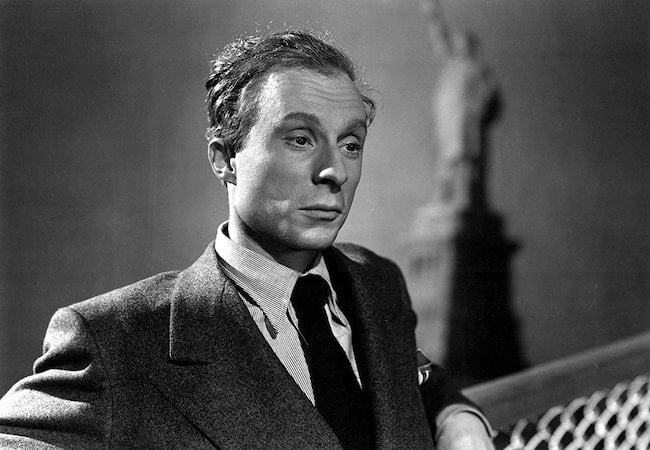
Norman Lloyd, who enjoyed an enviable career – and a long one! – working with Welles and Hitchcock, and later on “St. Elsewhere,” has died at the age of 106. He also worked as a producer and director. His final film appearance was in Judd Apatow’s “Trainwreck” in 2015.
Category: Daily Dispatch
-

Russ Tamblyn and Moderna Shot Musings
I’m not afraid of Russ Tamblyn. He just better not pull any of that “Tom Thumb” crap.
Off to get my second dose of Moderna now.
-
William Grant Still: An American Original
I am proud to say I was a William Grant Still advocate before it was cool to be so. When I first encountered his “Afro-American Symphony” in the early 1980s, it was love at first sound. It remains one of my favorite symphonies by an American composer.
Perhaps it’s not “The Great American Symphony,” self-consciously aspirational, oratorical, or grandiose in the manner the third symphonies of Roy Harris, William Schuman, or Aaron Copland; but it does go straight to the heart, which is something none of the composers of that great American triumvirate do, at least in those particular works.
Still’s symphony is poetic, it’s genuinely reflective, it’s beautiful, and it brims with great tunes. It’s congenial, and in the end quite moving. When I want “big statements” made on an Olympian scale, I will turn to those Lincoln Center composers, who would have us believe they are eating out of lunch pails, in their spare time, and riveting skyscrapers, or busting sod in denim overalls. But let’s face it, they are mostly hobnobbing in suits, jostling to get their music conducted by “Lenny.”
Still is a composer in the mold, if not the manner, of Charles Ives. He’s a perpetual outsider, and always true to himself. His music grows directly out of his autobiographical experience, the blues, ballads, and spirituals of his childhood, in Woodville, Mississippi and Little Rock, Arkansas, and later his experience playing in pit bands during the Harlem Renaissance.
He also studied at the Oberlin Conservatory and privately with George Whitefield Chadwick and Edgard Varèse, of all people. There is no Varèse to be found in Still’s music.
He composes with the directness of a Virgil Thomson, but with none of Thomson’s affected naiveté. He shares with George Gershwin a refreshing lack of pretention – or at any rate his music does (he did, after all, subtitle one of his symphonies “Autochthonous”) – and a wonderful facility with melody.
Of course, any discussion of Still must come with a litany of “firsts.” His “Afro-American Symphony” was the first written by a black composer to be performed by a major orchestra (the New York Philharmonic at Carnegie Hall). He was the first to be given the opportunity to conduct a major orchestra (the Los Angeles Philharmonic, at the Hollywood Bowl). His opera, “Troubled Island,” became the first to be produced by a major company (the New York City Opera). Another of his operas, “A Bayou Legend,” was the first to be performed on national television (as late as 1981). His works were performed internationally by the Berlin Philharmonic, the London Symphony Orchestra, the BBC Symphony, and the Tokyo Philharmonic.
For years, all I could find was the “Afro-American Symphony,” and that only in two out-of-print, albeit very fine recordings (with Karl Krueger and the Royal Philharmonic, and Paul Freeman and the London Symphony Orchestra). It wasn’t until the digital era that the other four symphonies gradually – very gradually – became available. Thankfully, all of them now have been recorded and are available for purchase.
It was only a couple of months ago that I discovered the official William Grant Still website, williamgrantstillmusic.com, run by the composer’s family. Through them, many of his scores, recordings, and written material may be acquired. I purchased a book about Still’s opera, “Troubled Island,” and its troubled history, combined with a CD-R of a live recording of the piece at its world premiere performance, a fascinating historical document. In all these years, I’ve only ever come across a single modern recording of any of his nine operas, “Highway One U.S.A,” with Philip Brunelle and Vocal Essence. This is a particular shame, since, as an opera lover himself, Still so wanted to add something significant to the repertoire.
For all the love Florence Price has had lavished on her recently (the Philadelphia Orchestra just announced it will be recording her complete symphonies for Deutsche Grammophon), it would great if a world-class American band would take up the cause of Still.
For me, William Grant Still is still the one.
Happy birthday, WGS (1895-1978).
“Afro-American Symphony”
“Troubled Island”
“Joe Hill” by Earl Robinson, sung by Paul Robeson
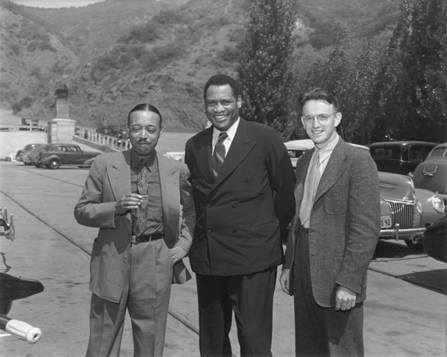
PHOTO: Still (left), with Paul Robeson and Earl Robinson
-
Celebrating Steiner and Tiomkin Movie Music Legends
On Friday, May 7, the classical music world celebrated the dual birthdays of Johannes Brahms and Peter Ilych Tchaikovsky. But for those who care about film music, there’s May 10 – the anniversary of the births of Max Steiner and Dimitri Tiomkin.
Steiner (1888-1971), the literal godson of Richard Strauss, was instrumental in transplanting the sound of fin de siècle Vienna to the realm of cinematic dreams. He composed over 300 film scores for RKO and Warner Brothers, earning 24 Academy Award nominations and winning three – for “The Informer,” “Now, Voyager” and “Since You Went Away” – though he is unquestionably better remembered today for his work on “King Kong,” “Gone with the Wind” and “Casablanca.”
Tiomkin (1894-1979), a pupil of Alexander Glazunov, was born in Ukraine. He settled in the United States, where he composed music for films in all genres, though in the 1950s he enjoyed particular success writing for Westerns, including the Academy Award-winning “High Noon.” When asked why this would be the case, that a composer born halfway around the world would have such a command of this distinctly American idiom, Tiomkin replied, “A steppe is a steppe is a steppe.”
Tiomkin was honored with four Academy Awards – three for Best Original Score (for “High Noon,” “The High and the Mighty” and “The Old Man and the Sea”) and one for Best Original Song (“The Ballad of High Noon”).
Here’s a transcript of his acceptance speech, delivered after being handed the Oscar for “The High and the Mighty” in 1955:
“Lady and gentlemen, because I working in this town for twenty-five years, I like to make some kind of appreciation to very important factor what make me successful to lots of my colleagues in this town. I’d like to thank Johannes Brahms, Johann Strauss, Richard Strauss, Beethoven, Mozart, George Gershwin, Jerome Kern, Wagner, Tchaikovsky, Rimsky-Korsakov. Thank you.”
You can watch it here:
Though Steiner and Tiomkin were both very well-connected in the wider musical world, comparatively speaking, neither left very much in the way of classical concert music. In 2019, Intrada Records put out a diverting 2-CD set of Tiomkin’s brightly-scored ballet music, dances composed in Paris for his wife, Albertina Rasch, in 1927-1932, prior to his work in film. It’s good mid-morning music, but would also be wonderful for afternoon drive-time – if only I had a live air shift! You can sample some of it by following the link. Already detectable is Tiomkin’s trademark snarling brass, in a number titled “Mars” (the second track in this YouTube playlist):
In 2020, Oxford University Press published a book by Steven C. Smith, “Music by Max Steiner: The Epic Life of Hollywood’s Most Influential Composer.” Read my impressions of this authoritative biography, unbelievably the first full-length treatment of Steiner’s life and achievements, here. Then get yourself a copy!
Also last year, while I was twiddling my thumbs, waiting to get back to work, I put together a Steiner-Tiomkin crossword puzzle. The clues not only allude to specifics of their respective lives and careers, but they should also be of ample interest, I hope, to classic movie buffs. So even if you’re convinced you don’t know a lot about music, do check it out if, like me, you happen to watch a lot of movies from the ‘30s, ‘40s, and ‘50s.
To fill out the puzzle, follow the link and select “solve online” at the bottom of the page. You’ll then be able to type directly into the squares. Once you feel you’ve exhausted the puzzle, you’ll find the solutions by clicking on “Answer Key PDF.”
Happy birthday to Max Steiner and Dimitri Tiomkin, two composers who enriched generations of movie lovers by keeping it “reel!”
Steiner’s “Now, Voyager”
Tiomkin’s “Land of the Pharaohs”
A great, two-part interview with Steiner:
Part 1 https://www.youtube.com/watch?v=eQuNnzH6_g8
Part 2 https://www.youtube.com/watch?v=jmJLTn_6UOYThe official Dimitri Tiomkin website:
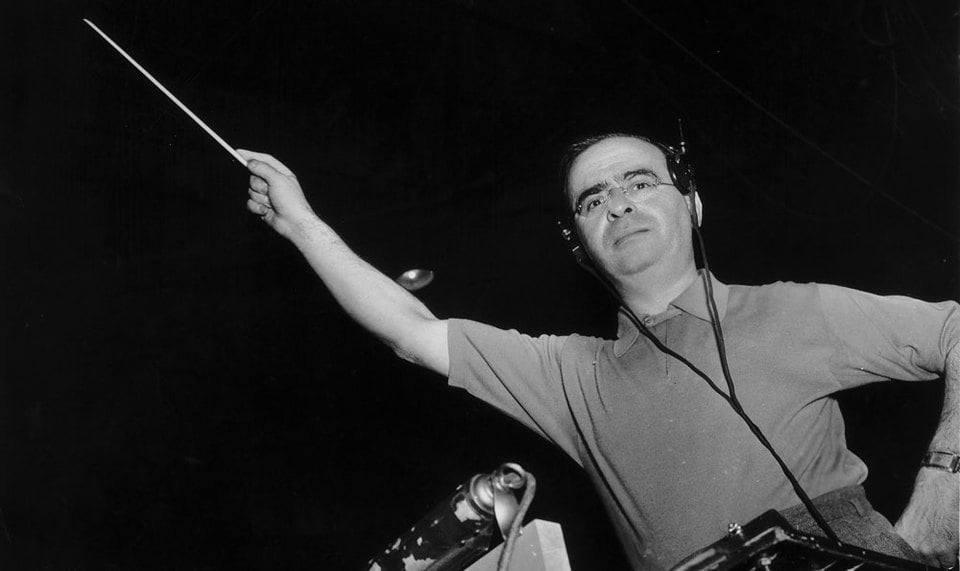
PHOTOS: Steiner conducts (top); Tiomkin composes
-

John Williams’ Western Film Scores
Looking back on the cinematic western, by the mid-1970s it was definitely time to water the horses. For much of the preceding decade, most of the important statements in the genre had gone elegiac, revisionist, spaghetti, or some combination of the three.
With the release of “Star Wars” in 1977, elements of the western survived, but beyond a handful of exceptions, the western, like the swashbuckler, had moved to outer space.
Though John Williams became inextricably linked with the intergalactic spectacle, it is little known that he, in common with most of his contemporaries, scored a number of actual, old school westerns. This week on “Picture Perfect,” we’ll listen to music from four of them.
Westerns don’t get much more primal than when revenge becomes a motivator. Mark Rydell’s “The Cowboys” (1972), one of the better of John Wayne’s later films, draws blood when Bruce Dern commits an unspeakable crime against the American West. If you’re a collector of Boston Pops records, you may be familiar with the rousing overture Williams assembled from his score.
Before he slipped into a lazy pattern of inviting his celebrity friends to goof off in front of the camera and then cashing the paycheck, Burt Reynolds made a number of effective dramatic films. In “The Man Who Loved Cat Dancing” (1973), Reynolds plays a laconic train robber haunted by a secret in his past, who finds a second chance with Sarah Miles, the wife of one of his pursuers, who rides along with his gang. Williams provided a really groovy opening number for this one.
Despite the how-could-it-possibly-miss teaming of Marlon Brando and Jack Nicholson – with “Bonnie and Clyde” director Arthur Penn at the helm – “The Missouri Breaks” (1976) bombed with both critics and audiences. (If you ever wanted to see Brando in drag, then this is the film for you.) Williams took a different approach with this one, providing a more intimate, if off-kilter score, tinged with jazz and pop elements, and featuring guitar, banjo, harmonica, honky tonk piano, electric harpsichord, etc.
“The Rare Breed” (1966), on the other hand, is straight-down-the-middle, with James Stewart and Maureen O’Hara introducing Hereford cattle to the American west. Brian Keith, as Stewart’s rival, sports a red beard and a Scottish burr, for some reason. Williams, however, is wholly himself, providing an uplifting, wide-open main theme. Would that film composers still wrote like this.
Saddle up for selections from John Williams westerns this week, on “Picture Perfect,” music for the movies, this Saturday evening at 6:00 EDT, on WWFM – The Classical Network and wwfm.org.
PHOTOS: (clockwise from left) Reynolds loves Cat Dancing; Brando in touch with his feminine side; the Duke; and an unrecognizable Brian Keith
Tag Cloud
Aaron Copland (93) Beethoven (95) Composer (114) Film Music (136) Film Score (143) Film Scores (255) Halloween (94) John Williams (195) KWAX (229) Leonard Bernstein (103) Marlboro Music Festival (125) Movie Music (151) Mozart (88) Opera (208) Philadelphia Orchestra (89) Picture Perfect (174) Princeton Symphony Orchestra (108) Radio (88) Ross Amico (244) Roy's Tie-Dye Sci-Fi Corner (290) The Classical Network (101) The Lost Chord (268) Vaughan Williams (103) WPRB (396) WWFM (881)