While it is true that Roy’s power went out yesterday, I think he was glad for an excuse to grab a drive-through coffee while leeching off the free wi-fi.
Watch Roy confound the suits on last night’s “Roy’s Tie-Dye Sci-Fi Corner,” as he hits the road and easy-rides his Electric Kool-Aid Acid Bus – not entirely inappropriate to our discussion of “Silent Running” (1972), the we’re-all-screwed-but-there’s-still-hope-for-the-future-I-guess sci-fi cult classic, with crazy Bruce Dern going crazy. (Yes, you read that correctly.)
Speaking of crazy, in the wake of yesterday’s stunt broadcast, Roy will be rocketing off to Rhode Island to visit with Lew Place, who will be his cohost for a very special, on-location Sci-Fi stop-by, this Sunday evening at 7:00 EDT.
We’ll reconvene next Friday for a discussion of “This Island Earth” (1955). In the meantime, I’ll be assembling my interocitor!
Roy’s Tie-Dye Sci-Fi Corner livestreams on Facebook. Look in on Lew’s Place on Sunday; then sidle up to “This Island Earth” on Friday. Both broadcasts begin at 7:00 pm EDT!
Walpurgis Night, the eve of the feast day of Saint Walpurga, is a time when evil spirits are believed to roam the earth. Tradition holds that a witches’ sabbath and orgy of the damned are held atop the Brocken, the highest peak of the Harz Mountains in Central Germany. It’s the last blast of diablerie before May Day. In Goethe’s “Faust,” Mephistopheles guides his imperiled charge into a swirling cauldron of witches and demons so as to complete his moral degradation.
Of course, “Faust” has inspired innumerable pieces of music – operas, symphonies, cantatas, piano works, and songs. Here, Samuel Ramey sings “Ecco il mondo” from the Walpurgis Night scene (Act II, Scene 2) of Arrigo Boito’s “Mefistofele.” Sadly, the clip doesn’t run to the end of the act.
Another Goethe poem provides the basis for Felix Mendelssohn’s cantata “Die erste Walpurigisnacht” (“The First Walpurgis Night”), about a band of prankish Druids playing mind games with some superstitious Christians.
Johannes Brahms wrote a song, “Walpurgisnacht,” on a text of Alexis Willibald (nom de plum of Wilhelm Häring), about a mother freaking out her daughter, telling her a thunderstorm is actually the sound of witches celebrating on the Brocken. As if that isn’t enough, she adds that she herself is a witch! Ha ha! So German.
Walpurgis Night is an occasion for leaping over bonfires, vandalizing neighbors’ property, and rioting, all in the name of welcoming spring. It is not to be confused with St. John’s Eve (June 23), the night the demon Chernobog emerges from the Bald Mountain. More on that later, I’m sure.
Don’t forget to keep Walpurga in Walpurgisnacht, everybody! Enjoy a socially-distanced sabbath and remember to cavort safely – in masks!
“The Goat of Mendes! The Devil himself.”
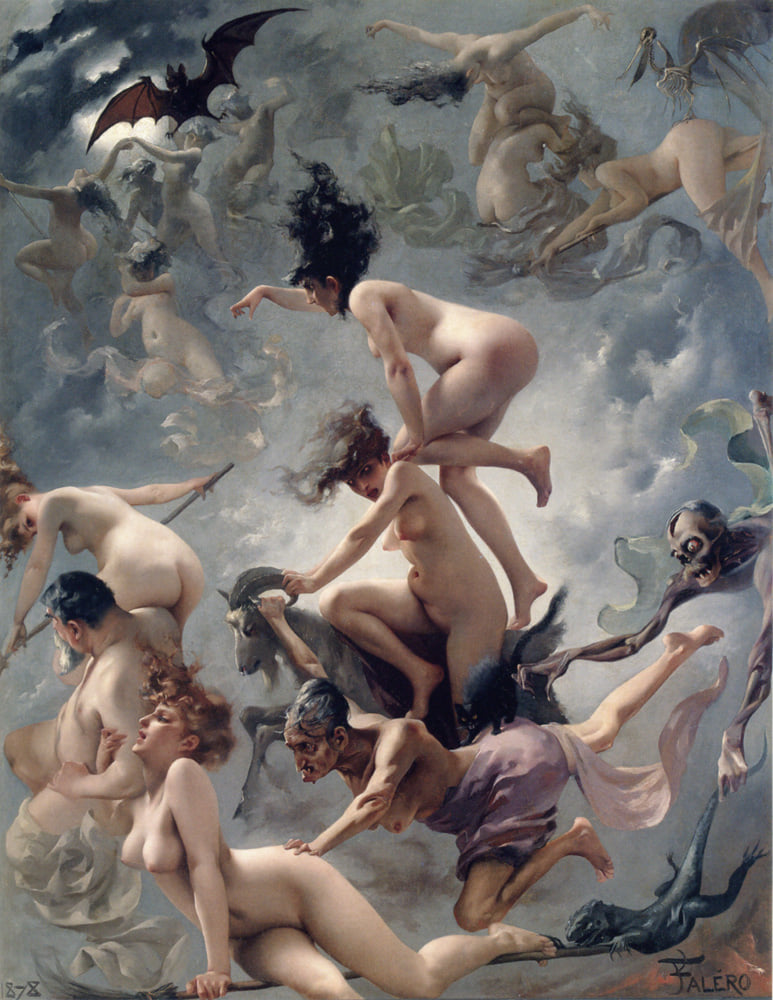
Luis Ricardo Falero, “Departure of the Witches” (a.k.a. “Witches Going to their Sabbath,”1878)
Ellen Taaffe Zwilich was born on this date in 1939. Zwilich made history when she became the first female recipient of the Pulitzer Prize for Music, in 1983, for her Symphony No. 1.
Seven years later, she made history for a second time for being perhaps the only living classical music composer – and to my knowledge the only woman – to be referenced in Charles Schulz’s beloved comic strip “Peanuts.”
In the first of three panels, Peppermint Patty and Marcie are shown attending a concert. Marcie, holding a program, says to Patty, half-asleep, that the next piece will be a Concerto for Flute and Orchestra. In the second panel, she notes, “It was composed by Ellen Zwilich who, incidentally, just happens to be a woman!” Patty springs awake, and in the last panel, she’s standing on her chair. As Marcie slumps into her seat in evident embarrassment, Patty cries, “GOOD GOING, ELLEN!” (The original strip is posted in the comments section below.)
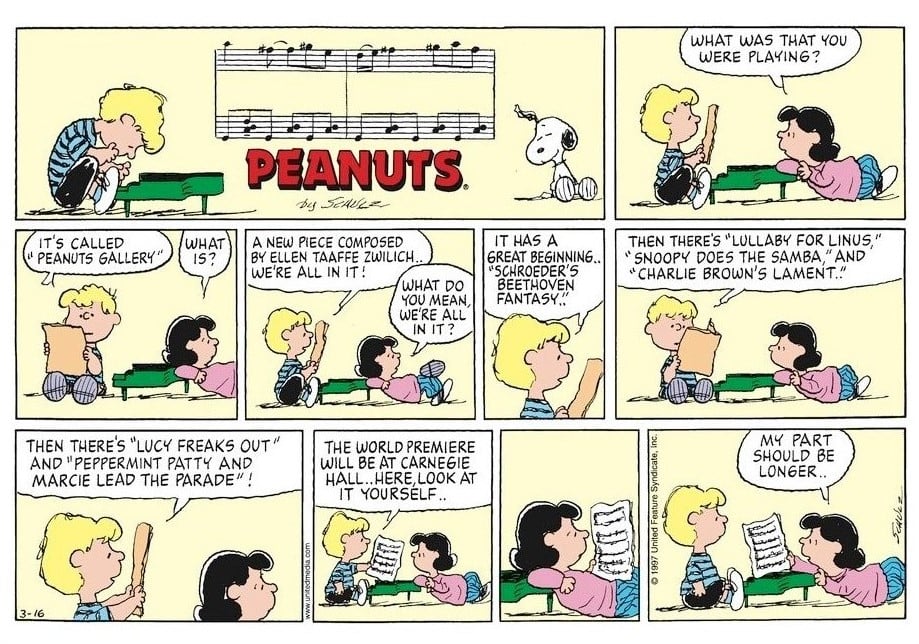
Turnabout is fair play, and in 1996, Zwilich composed a concertino of sorts, for piano and orchestra, titled “Peanuts Gallery.” The work includes movements inspired by Schroeder, Linus, Snoopy, Charlie Brown, Lucy, and Peppermint Patty and Marcie. It was given its premiere on a Carnegie Hall children’s concert, by the pianist Albert Kim and the Orpheus Chamber Orchestra.
The piece was recorded for the Naxos label, with pianist Jeffrey Biegel and the Florida State University Symphony Orchestra. The movements are posted individually on YouTube. I have it cued up so that you can let them all play through, continuously, here:
As an alternative, here’s the entire work, performed without break, with actors and dancers, in a reduction for two pianos:
“Peanuts Gallery” became the subject of a prize-winning PBS documentary. A second Zwilich documentary was produced to trace the development of her “Gardens” Symphony:
Coming at the end of a week in which way too many trees have been hacked down in my neighborhood by a bunch of butchers enlisted by the idiot property association, it’s perhaps ironic that our topic on the next “Roy’s Tie-Dye Sci-Fi Corner” – formulated by Roy and me on Earth Day – will be the environmental cult classic “Silent Running” (1972).
This was one of only two movies directed by special effects legend Douglas Trumbull (of “2001: A Space Odyssey” and “Close Encounters of the Third Kind” fame).
Space botanist Bruce Dern – a little borderline even under the best of circumstances – is driven to employ desperate measures to ensure that he and his robot sidekicks, Huey, Dewey, and Louie, can continue to carry-out their reforestation mission in a floating geodesic greenhouse near the rings of Saturn.
None other than Peter Schickele wrote the music. Folk icon Joan Baez generates a queasy air of counterculture flower-powerlessness.
“Fields of children running wild
In the sun
Like a forest is your child, growing wild
In the sun
Doomed in his innocence
In the sun
Gather your children to your side
In the sun
Tell them all they love will die
Tell them why
In the sun
Tell them it’s not too late
Cultivate, one by one
Tell them to harvest and rejoice
In the sun.”
In short, you’re doomed, everything you care about will die, but it’s not too late to cultivate… Sounds pretty hopeful to me.
It would be cathartic to hack off a few arms to avenge every tree limb right about now. Dern doesn’t quite deliver on that scale, but “Silent Running” can still put a lump in the throat of anyone who cares at all about wildlife and the environment. It conveys the essential truth that no matter what century you live in, the majority of humankind is at best clueless.
“Tears of sorrow running deep
running silent in my sleep
running silent in my sleep…”
Join us as I preach a gospel of despair on Roy’s Tie-Dye Sci-Fi Corner. The only plant will be my fist in the face of all butchers, as we livestream on Facebook. Fill the comments section with your lamentations, this Friday evening at a special time – one half-hour later than usual – 7:30 EDT.