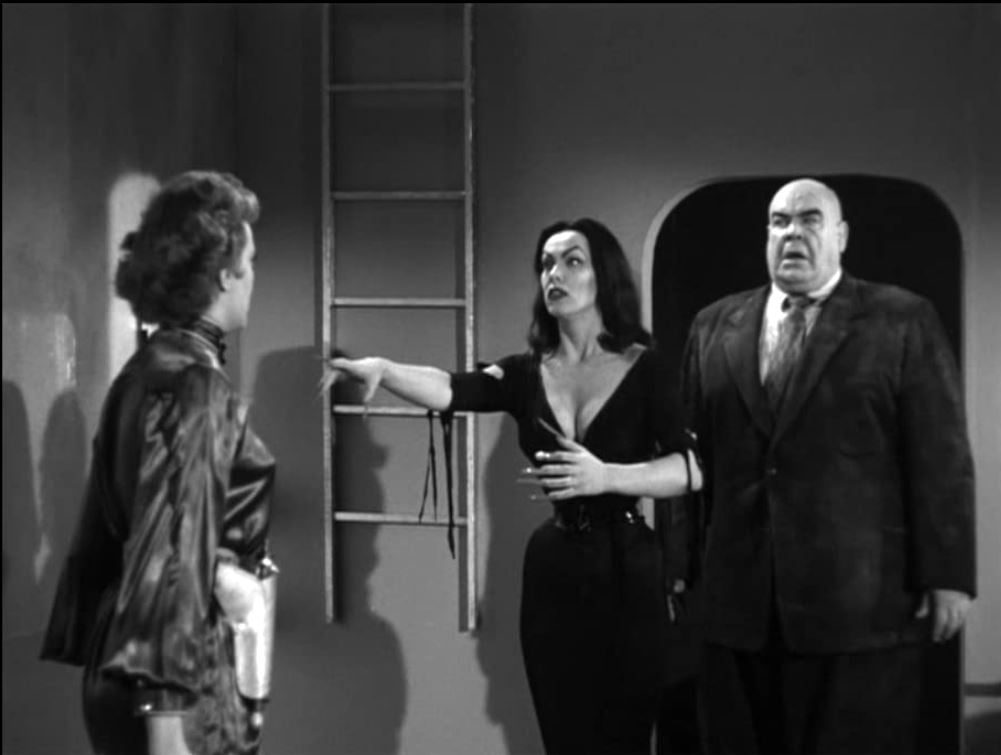
As a follow-up to last night’s all-too-brief discussion about “Ed Wood” (1994) on SciFi Distilled, Roy and I will welcome our erstwhile hosts, Mike and Marybeth, to “Roy’s Tie-Dye Sci-Fi Corner” for a follow-up chat about Wood’s pablum opus, “Plan 9 from Outer Space” (1959).
Widely embraced as the worst movie ever made, “Plan 9” is like “The Day the Earth Stood Still” gone horribly wrong. Commander Eros and his saucer people resurrect the earth’s dead in order to get the world’s governments to take them seriously on their intergalactic mission of peace. Or something like that.
Ludicrously scripted, cheaply shot, cringeworthily acted, and artlessly executed, the film stars Swedish wrestler Tor Johnson, pioneering TV host Vampira, and faded horror icon Bela Lugosi. This is one riveting, flabbergasting train wreck.
The “Plan” is for all of us to hang together, on the next Roy’s Tie-Dye Sci-Fi Corner. Join us as we livestream on Facebook! The comments section will yawn like the grave, this Friday evening at 7:00 EDT.
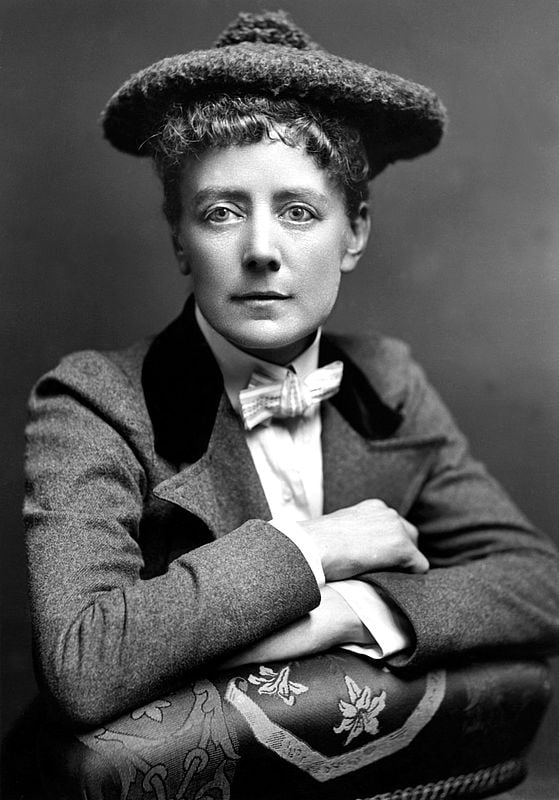
When I think of Dame Ethel Smyth (1858-1944), the first thing that springs to mind is Sir Thomas Beecham’s recollection of her leading an impromptu chorus of women, gathered in a prison courtyard for exercise, by conducting with her toothbrush between the bars of her cell.
Smyth was incarcerated for two months for smashing out the windows of politicians who opposed the female vote. Her “March of the Women” became the anthem of the women’s suffrage movement in England.
The other thing I think about is how Smyth’s opera, “Der Wald” (“The Forest”), was the only work by a female composer produced at New York’s Metropolitan Opera for over a century. That was in 1903.
Anticipating the assertion that well-behaved women seldom make history, Smyth was driven to act up from the start. And who could blame her?
She managed to outmaneuver her father, a major general in the Royal Artillery. When he objected to her pursuit of a career in music, she studied privately. This culminated in an all-out battle, in the course of which Ethel’s will proved steelier than her dad’s. The result was that she was that she was able to attend the Leipzig Conservatory.
When the conservatory didn’t measure up to her expectations, she sought out Heinrich von Herzogenberg for further polish. Her travels also brought her into contact with Dvořák, Grieg, Tchaikovsky, Clara Schumann, and Herzogenberg’s friend, Johannes Brahms.
It was at a private performance of Brahms’ Piano Quintet, with the composer in attendance, that Smyth’s St. Bernard mix, Marco, burst through a door, toppling the cellist’s music stand, which, much to everyone’s relief, the notoriously prickly Brahms found hilarious. Later, when Tchaikovsky wrote to Smyth, he never failed to ask after Marco.
Her first piece to be played in public was her String Quintet in E major (1884).
Her first orchestral work, the Serenade in D (1889) – written with the encouragement of Tchaikovsky – is better than just about anything composed by Sir Hubert Parry (whose music I happen to enjoy) and much more compelling than the symphonies of Sir Charles Villiers Stanford. Smyth’s serenade is a symphony in all but name, with some pretty good tunes.
Even so, it was only in 1893, after her Mass in D was favorably received by George Bernard Shaw that her father’s objection to her chosen career began to thaw. (Shaw had declared the Mass “magnificent.”)
While she met with considerable success in her lifetime, as a woman, she was still often marginalized and had to push for almost everything. In her mid-50s, she began to lose her hearing. Undeterred, she commenced a second career as a writer, producing ten books. She was made a Dame Commander of the Order of the British Empire in 1922 .
The next time a music director is looking for an alternative to Elgar (himself not exactly overplayed in this U.S.), he or she could do worse than to consider Ethel Smyth. The overture to her opera “The Wreckers” (1906) would make for a dynamic curtain-raiser.
“The Wreckers” was presented at Bard College, in a series of performances, under the direction of Leon Botstein, in 2015. Botstein led a concert performance of the piece at Carnegie Hall in 2007. Happily, the Bard production was filmed.
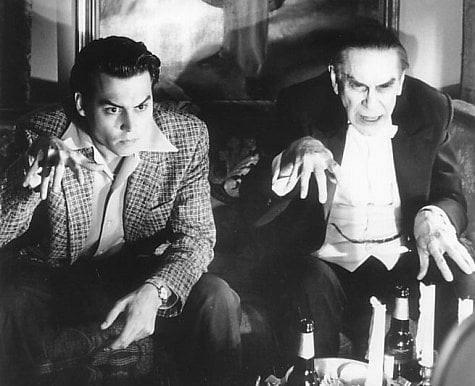
I hope you’ll join Roy and me in celebration of “Anniversary Month,” first with Michael Rizzo and Marybeth Ritkouski on “Sci-Fi Distilled,” and a conversation about Tim Burton’s love letter to the quixotic, no-budget film director, “Ed Wood” (1994).
Then Mike and Marybeth will join us for a spot of tea inside the saucer, on “Roy’s Tie-Dye Sci-Fi Corner,” and a chat about Wood’s most notorious creation, “Plan 9 from Outer Space” (1959). “Plan 9” inevitably floats to the top of any list devoted to the worst movies ever made.
By comparison, Wood makes Burton seem like Orson Welles. Interestingly, Burton’s most successful movies have been those with “Ed” in the title (or perhaps “Pee-Wee”). In his best film since “Edward Scissorhands,” Burton reunites with Johnny Depp as the fatally optimistic, ever-resourceful, angora-wearing Wood, who flourishes blissfully on another plane. Martin Landau earned an Academy Award for Best Supporting Actor for his poignant and profane turn as faded horror icon Bela Lugosi. Howard Shore’s theremin-laden, lounge-infused score lends to the kooky fun.
Both discussions will be livestreamed on Facebook (“Ed Wood” on “Sci Fi Distilled,” Wednesday at 7 pm EDT, and “Plan 9” on “Roy’s Tie-Dye Sci-Fi Corner,” Friday at 7 pm EDT).
It’s been a full year of cocktails and tie-dye! Celebrate with your firecrackers in the comments sections. Join us for a chat about Ed and the dead. It’s a crossdresser crossover with extraterrestrial intervention, this Wednesday and Friday evenings at 7:00 EDT!
I find it fascinating that Germaine Tailleferre waited out World War II in Philadelphia. And yet I can never seem to find out very much about what she did while in exile.
Tailleferre was the only female member of Les Six, that loose collective of composers that rose to prominence in Paris in the late ‘teens and 1920s, under the guidance of Jean Cocteau. Her famous colleagues included Francis Poulenc, Darius Milhaud, Arthur Honegger, and Georges Auric. Louis Durey, a hard-line communist who went on to set poems by Ho-Chi Minh and Mao Zedong, is the one nobody remembers. (I wonder why.)
Tailleferre was strong-willed from the beginning. Her birth name was Taillefesse, but she changed it to spite her father, since the old man opposed her musical studies. However, she took piano lessons with her mother and was admitted into the Paris Conservatory. It was there that she met the rest of The Six and that the prizes began to pile up. She also earned the friendship and received the support of Maurice Ravel.
In 1925, she married Ralph Barton, the American caricaturist, and moved to New York. Two years later, the couple returned to France, then divorced. Her career thrived in the 1920s and ‘30s. With the outbreak of World War II, however, she beat it back to the United States, leaving most of her scores at her home in Grasse, and, as I said, passed the war years in Philadelphia.
After the war, she again returned to France, where she resumed her career. As she got older, her pieces tended to be shorter, as she suffered from arthritis. She also wrote a lot for children and young pianists. She composed virtually right up until the time of her death in 1983, when she was 91 years-old. She wrote so much, in fact, that a lot of the music of her later years has never been published, and fresh discoveries from her output are being recorded all the time.
Happy birthday, Germaine Tailleferre! If anyone has any information about her activities in Philadelphia, I would be very curious to know.
The Concertino for Harp and Orchestra (1927):
The lovely and wistful “Arabesque” for clarinet and piano (1972):
The Concerto for Piano and Orchestra (1924). The piece was given its U.S. premiere – in the presence of the composer – by Alfred Cortot and the Philadelphia Orchestra, conducted Leopold Stokowski.
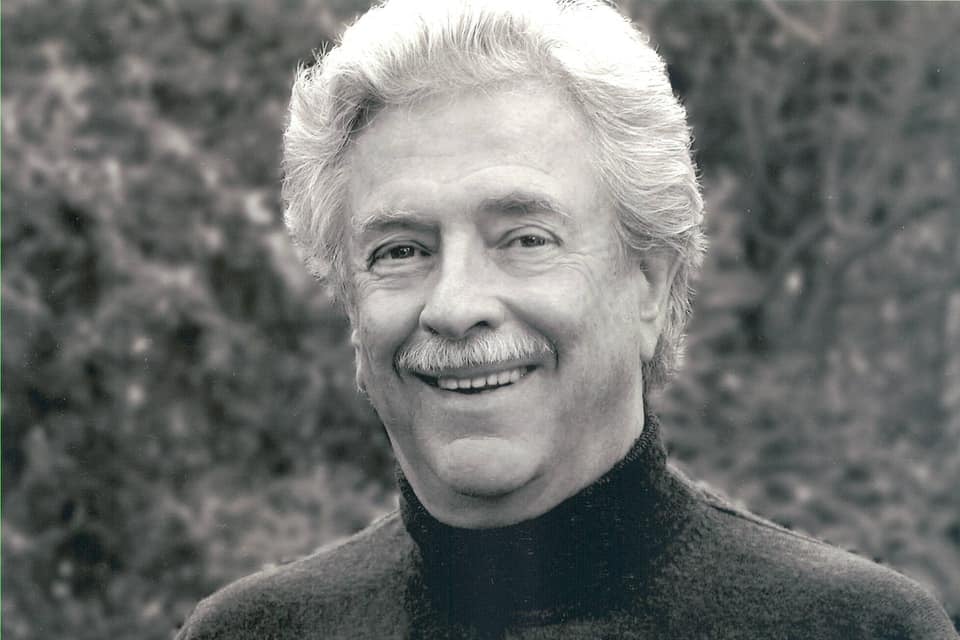
On Friday, news began circulating that American composer Wayne Peterson died at the age of 93. He was a recipient of the Pulitzer Prize for Music, for his orchestral work “The Face of the Night, the Heart of the Dark,” in 1992.
The award was not without controversy. Through no fault of Peterson’s own, the prize caused a bit of a scandal after the judges on the music committee went public with news that their own selection – Ralph Shapey’s “Concerto Fantastique” – had been vetoed by the Pulitzer board, and the award bestowed for Peterson’s piece instead.
While the board’s intervention was not unprecedented (Edward Albee’s play “Who’s Afraid of Virginia Woof?” and Thomas Pynchon’s novel “Gravity’s Rainbow” were similarly dismissed), it was the first time it had imposed its will in the music category.
What exactly spurred the action is anyone’s guess. Certainly Peterson’s work is no more commercially viable than Shapey’s. So it could not have been a sop to the public. Though the board justified its decision by stating the “Pulitzers are enhanced by having, in addition to the professional’s point of view, the layman’s or consumer’s point of view.”
On the other hand, Shapey did have something of a reputation for being a prickly S.O.B., so maybe he just rubbed the wrong people the wrong way. Unquestionably, he had the respect of his peers. He had previously been a finalist for the Pulitzer in 1990.
“I’ve been up for a Pulitzer year after year,” he remarked, “and I can’t get a Pulitzer.” Shapey was born in Philadelphia 100 years ago last month. He died in 2002.
With few notable exceptions – among them Aaron Copland’s “Appalachian Spring” and Charles Ives’ Symphony No. 3, “The Camp Meeting” – Pulitzer Prize winners tend to fade from memory rather quickly.
When Ives was awarded the Pulitzer in 1947, he muttered, “Prizes are for boys. I’m a grown-up.”
Forever cranky, he characterized the very notion of prizes as “badges of mediocrity.”
Peterson himself remarked, “Winning the Pulitzer has meant nothing for the piece that won. Back when Blomstedt was at the San Francisco Symphony, David Zinman conducted it and did a beautiful job. But they never did it again and nobody else has ever played it.”
It did, however, generate new commissions and guaranteed publication of his music. In 2017, “The Face of the Night, the Heart of the Dark” was finally recorded, by Boston Modern Orchestra Project, or BMOP.
This year’s Pulitzer Prize winners will be announced on June 11.
Peterson’s obituary in yesterday’s WaPo. He died on April 7.
Peterson’s “The Face of the Night, the Heart of the Dark,” in two movements (so just let it run):
To my knowledge, Ralph Shapey’s “Concerto Fantastique” has yet to be recorded. Here’s “Ontogeny,” from 1958, a considerably earlier work, but I’m posting it here because, like the Pulitzer reject, it’s orchestral.