With the possible exception of his own transcriptions of the music of Johann Sebastian Bach, Leopold Stokowski recorded more Wagner with the Philadelphia Orchestra than any other composer.
This Sunday night on “The Lost Chord,” on Stoky’s birthday, we’ll revisit some of his early recordings, originally issued on 78s, including the controversial “Liebesnacht,” the original version of his symphonic synthesis after “Tristan und Isolde” – an arrangement that infuriated listeners, with its inconclusive ending – and the “Liebestod,” which he subsequently undertook, by popular demand, in order to provide a more satisfactory conclusion.
We’ll also hear a superb performance of “Wotan’s Farewell and Magic Fire Music,” from “Die Walküre,” with baritone Lawrence Tibbett, in a role he never sang on stage. And, as an added bonus, Stokowski himself will supply a spoken summary of the “Ring Cycle,” done for CBS radio in 1932, complete with faux middle-European accent. (Stoky was a second-generation Londoner, his father of Polish extraction and his mother Irish.)
I hope you’ll join me for “Magic Fire” – Leopold Stokowski’s early Wagner recordings with the Philadelphia Orchestra – this Sunday night at 10:00 EDT, on WWFM – The Classical Network and wwfm.org.
And since the comments section is bound to be filled with gasps of “LEOPOLD,” we may as well get this out of the way right now. (Then read on!)
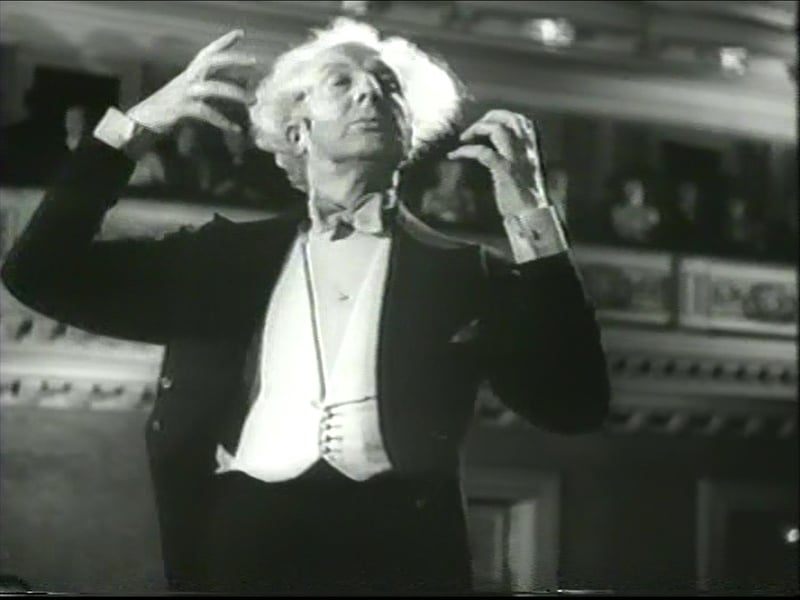
The snapping of the baton is a little bit of an in-joke, since Stokowski made it a point to lead not with a stick, but rather using his expressive, mesmerizing hands.
Here he is in “Carnegie Hall” (1947), real junk food for the classical music lover. Forget about the plot, which is total hokum – a brash young American pianist turns the classical music world on its ear with the debut of his corny “jazz” concerto (with Harry James, no less, playing trumpet obbligato) – the main draw is a parade of real-life classical music superstars.
The director Edgar G. Ulmer, emerged from German Expressionist cinema (he claimed to have worked on “Metropolis” and “M”), to direct atmospheric Hollywood films like “The Black Cat” and “Detour.”
The experience obviously prepared him for this showcase of Stokowski, who in the film’s best sequence conducts a movement from Tchaikovsky’s Symphony No. 5. The camera angles are striking, the lighting dramatic, and Stoky’s hair just keeps getting bigger… and bigger… and bigger.
Stokowski also shared screen time with Deanna Durbin in “One Hundred Men and a Girl” (1937). In case you’re curious, Charles Previn, credited as associate musical director, was the second-cousin of Andre Previn. Stokowski conducts the finale of the same Tchaikovsky symphony. Also, Deanna Durbin sings from “La Traviata.”
Naturally, there’s the obligatory shot of a bored husband (character actor Eugene Pallette) dozing in the audience, and a boy-next-store shouting from a balcony, just to keep it all comfortably “regular guy.”
But it goes without saying that the most enduring artifact of Hollywood’s romance with Stoky was the conductor’s work on Walt Disney’s “Fantasia” (1940), including this iconic handshake with Mickey Mouse:
Stokowski recorded the soundtrack in experimental stereo, captured by 33 microphones and three million feet of sound film, at Philadelphia’s Academy of Music in 1939. Stokowski served as the Philadelphia Orchestra’s music director from 1912 to 1938. Here he directs Bach’s “Toccata and Fugue in D minor,” from a Spanish print of the film:
Finally, Stokowski talks about his experiences in Hollywood, most specifically his work on “Fantasia,” in an interview given in the 1960s:
Notoriously, the accent is totally phony baloney. Stokowski’s grandfather was Polish, but he himself was a second-generation Londoner. But Stoky always did have a whiff of P.T. Barnum about him. He may have been a visionary, but, first and foremost, he knew how to captivate an audience.
I hope you’ll join me tonight for “The Lost Chord,” as I’ll be highlighting some of Stokowski’s early Wagner recordings with the Philadelphia Orchestra. The program, “Magic Fire,” will air at 10:00 EDT on WWFM – The Classical Network and wwfm.org.
On last night’s show about “The Ghost Busters” (1975 – not 1984), we ruminate on Saturday morning cartoons, the Bowery Boys, Vaudeville, and Charles Nelson Reilly. Our special guest, Roy’s son, Ryan Bjellquist-Ledger, lends his own perspective as our millennial correspondent.
I hope you’ll join us next time for Ed Wood Week. First, Michael Rizzo and Marybeth Ritkouski will host Roy and me on their show, “Sci-Fi Distilled,” for a discussion about Tim Burton’s “Ed Wood” (1994), Wednesday at 7 pm EDT.
Then it will be our turn to host Mike and Marybeth, when we talk about Wood’s most notorious creation, “Plan 9 from Outer Space” (1959) – invariably categorized as one of the worst movies ever made – on “Roy’s Tie Dye Sci Fi Corner,” Friday at 7 pm EDT.
What kind of Wood doesn’t float? Tune in for our protracted responses. Our respective shows livestream on Facebook next Wednesday and Friday at 7 pm!
For “Ed Wood”: SciFi Distilled
For “Plan 9”: Roy’s Tie-Dye Sci-Fi Corner
Remember: future events such as these will affect you in the future!
In the film “Conan the Destroyer” (1984), one of Conan’s companions speculates, “I suppose nothing hurts you.”
To which Conan responds, philosophically, “Only pain.”
Discriminating viewers may feel a little pain themselves, watching these silly, cheesy, violent films, all of which were inspired by the writings of pulp master Robert E. Howard. Howard created the warrior Conan in 1932. The character became the center of a series of lucrative stories first published in “Weird Tales” magazine.
It would be a half century before Conan made the leap to the big screen, under the direction of John Milius. “Conan the Barbarian” (1982) propelled Arnold Schwarzenegger, already a legend in the field of bodybuilding, to international superstardom. While “Conan” isn’t exactly “Citizen Kane,” it does have its pleasures. The intensity of the violence can be a little disturbing, but the ponderous tone is a blast. “Conan” is a film that takes itself just seriously enough to make it occasionally hilarious.
Another thing “Conan” has going for it is the fact that it was made on a blockbuster budget. The first-rate production values extend to the music by Basil Poledouris, who employs a full symphony orchestra to impressive ends. In fact, the “Conan” score was one of the strongest of the decade. It’s amazing that anyone would find so much inspiration in such a mediocre film, but Poledouris’ music intersperses Borodin-style Central Asia lyricism with brawny, thrilling action music.
Sadly, the sequel, “Conan the Destroyer,” betrays signs of penny-pinching, so that it often winds up feeling like a direct-to-video effort. Poledouris was forced to make do with a smaller orchestra, which sounds a bit too much like a television ensemble. Still, he gave it his all, and there’s something to be said for the fact that it is an original score, rather than a mere retread of the original.
Another one of Howard’s creations, Kull of Atlantis, was given the big screen treatment as “Kull the Conqueror” (1997). Kevin Sorbo, TV’s Hercules, plays the title role. The composer, Joel Goldsmith (son of Jerry Goldsmith), was asked to incorporate heavy metal riffs into his orchestral underscore. I haven’t actually seen this one, but for some reason I don’t feel like I’m missing anything.
The astoundingly prolific Ennio Morricone – with more than 500 motion picture and television scores to his name – had an uncanny knack for spinning garbage into gold. His music for “Red Sonja” (1985) lends the film an aura of ‘80s cheese ball fun, perhaps more so than it deserves. This is the film that introduced Brigitte Nielsen as the chain-mailed barbarian beauty. Schwarzenegger appears in the supporting role of Lord Kalidor.
In the ‘80s, even bad films had great scores. I hope you’ll give “Conan the Barbarian” a shot this week, on “Picture Perfect,” music for movies, this Saturday evening at 6:00 EDT, on WWFM – The Classical Network and wwfm.org!