Category: Daily Dispatch

  • Waldteufel Christmas Roses and Skaters Waltz

    Waldteufel Christmas Roses and Skaters Waltz

    Only days after the arrival of Krampus, the Christmas devil, comes the birthday of Emil Waldteufel. Waldteufel is German for “forest devil.” He was born on this date in 1837.

    Though Waldteufel had long been a mainstay of Paris society balls of the Second Empire, he was nearly 40 by the time he achieved international fame. It was the Prince of Wales – the future King Edward VII – who introduced him to London, and his music came to dominate Queen Victoria’s state balls at Buckingham Palace. One of his best-known works, “Les Patineurs” (“The Skaters’ Waltz”) was introduced there in 1882. Another of his most successful waltzes, from the other end of the decade, was “Roses de Noël” (“Christmas Roses”).

    The holidays are in bloom! Take some time to smell the roses with Emil Waldteufel.

    “The Skaters’ Waltz”

    “Roses de Noël”

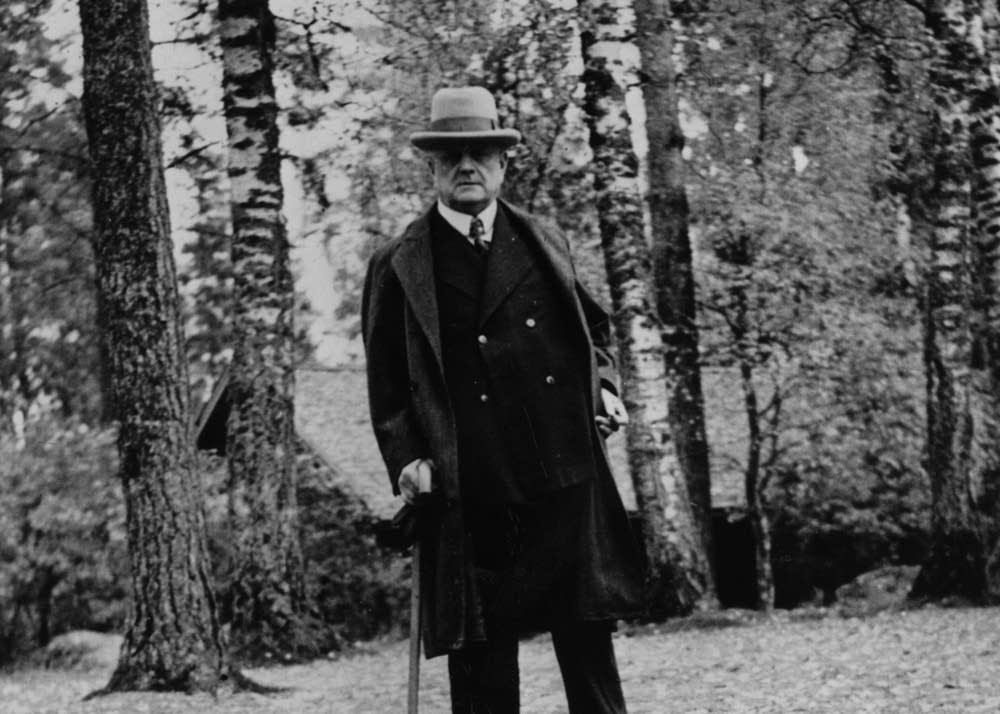
  • Sibelius at 155 A Finnish Hero’s Legacy

    Sibelius at 155 A Finnish Hero’s Legacy

    EIGHT DAYS OF SIBELIUS – DAY 8

    Well, today is the day. The 155th anniversary of the birth of Jean Sibelius.

    The Sibelius legacy is an interesting one. In Finland, he is regarded as a national hero – so much more than a composer – since essentially, he provided the soundtrack for Finnish independence. His image has adorned statues, stamps, and currency. Finnish Flag Day is even celebrated on his birthday (December 8).

    Outside of Finland, Sibelius’ reputation has been a little spottier, his path to the pantheon a bit more circuitous. Broadly speaking, he has fared better in England and the Commonwealth, the United States and, naturally, Scandinavia. In Germany and France, much less so. In the modernist era, his music became regarded in some circles as a hopeless throwback. Here was a tonal composer who, in his naiveté, still wrote tunes! René Leibowitz went so far as to call him “the worst composer in the world.”

    There are still some who remain deaf to Sibelius’ charms, and blind to his significance. But in his way, he was every bit as innovative – and every bit as subversive – as Stravinsky or Schoenberg. Like Franz Liszt before him, the great Finn blazed his own trail, rejecting forms that had been developed over generations, particularly those of German origin, to reinvent the symphony, in a manner that would become recognized as wholly characteristic of the North.

    Few composers’ music has been so tied-up with the spirit of their homeland. Sibelius came of age at a time when artists of the “provincial” countries of Europe began to chafe against imperial domination, and to assert their own national identities. Sibelius loved Finland. He loved its history. He certainly loved its natural beauty.

    All this is reflected in his most famous piece, the tone poem “Finlandia,” his most flagrant expression of Finnish patriotism, performed under many names in its early days, in order to circumvent the Russian censors. The work was first heard in Helsinki on July 2, 1900. The conductor on that occasion was Sibelius’ good friend Robert Kajanus.

    YOU OWE IT TO YOURSELF TO WATCH THIS EXCEPTIONAL VIDEO! “Finlandia” is given a stirring presentation, complemented by Northern Lights, imposing forests, and stunning wildlife footage. I guarantee it will be nine minutes of your day well-spent. An inspiring visual interpretation that breathes new life into an overplayed favorite.

    The serene melody at the heart of “Finlandia” is often heard separately as the “Finlandia Hymn.” Though not the Finnish national anthem, it is basically the Finnish national song. Listen to this lovely performance, recorded in November, by the Sibelius High School Chamber Choir. In this case, social distancing need not mean isolation.

    HAPPY BIRTHDAY JEAN SIBELIUS!


    PHOTO: “Passio Musicae” (1967) by Eila Hiltunen, the Sibelius Monument in Helsinki

  • Sibelius’s Andante Festivo a world greeting

    Sibelius’s Andante Festivo a world greeting

    EIGHT DAYS OF SIBELIUS – DAY 7

    Sibelius hadn’t been in front of an orchestra for over a decade, when the music critic Olin Downes – Sibelius’ great champion at the New York Times – sent out a request for the composer to conduct one of his own works, as a kind of “greeting to the world,” in honor of the New York World Exhibition in 1939. Remarkably, Sibelius obliged, essentially coming out of retirement at the age of 73 to lead the performance on New Year’s Day.

    The work, “Andante Festivo,” originally conceived for string quartet, was commissioned to mark the 25th anniversary of a sawmill, of all things, in 1922. Sibelius transcended the, um, run-of-the-mill occasion by crafting a genuinely inspired, soulful composition that is none the worse for its touching simplicity. For the World’s Fair radio transmission, allowing for the technological limitations of the day, he rescored the piece for string orchestra and timpani. In retrospect, the full-throated, free-flowing hymn could be seen almost as a religious statement, with the world teetering on the brink of war.

    This is the only recording that exists of Sibelius conducting. The tempo he chooses is slower and more solemn than usual, but hardly surprising, considering the circumstances. For years, another recording, set down on the same day, at an even slower tempo, was thought to be the one conducted by the composer, but the confusion has since been sorted out.

    The work would later be played at Sibelius’ funeral. It’s so like Sibelius to find wistfulness in “festivity.”

    Here’s a modern recording, at a more customary tempo, with Neeme Järvi conducting the Gothenburg Symphony Orchestra:

  • Remembering Pearl Harbor & Seeking Unity

    Remembering Pearl Harbor & Seeking Unity

    Perhaps if we reflected more on all we’ve been through as a country, and the trials of our forebears, we would be more inclined to honor their sacrifices with less division, more public mindedness, and a little kindness.

    It was on this date in 1941 that the Imperial Japanese Navy launched a surprise military strike against the United States naval base at Pearl Harbor, awakening Yamamoto’s “sleeping giant” and precipitating the U.S.’s entry into World War II. Ultimately, that probably turned out to be a good thing, but tell that to the 2,403 Americans killed and the 1,178 wounded. Sailors, soldiers, airmen, marines, and civilians were caught in the attack.

    In 1991, American composer John Duffy was commissioned by the U.S. government to mark the 50th anniversary of the strike. The result was “A Time for Remembrance: A Peace Cantata.” Duffy dedicated the work to the memory of the victims of Pearl Harbor. Among them were the composer’s sister, brother, and cousin. The texts are taken from a poem by Rupert Brooke, a speech by Franklin Delano Roosevelt, an African American spiritual, and actual letters written by sailors aboard the USS Arizona.

    James Earl Jones is the narrator on the only recording of the piece, with the Milwaukee Symphony Orchestra conducted by Zdenek Macal, which I am very sorry to see has not been posted online, though you’ll find a few audio clips when you click on the link. The relevant files are titled “The Dead,” “Letters Home,” “I Want to Die Easy,” “An End to War,” and “Blow out you bugles, over the rich Dead.”

    http://www.johnduffy.com/freedomworks.html

    Grant us peace – internationally and at home.

  • Saint Nicholas: From Saint to Santa in Music

    Saint Nicholas: From Saint to Santa in Music

    Over the centuries, the character of Saint Nicholas has undergone a remarkable transformation from austere-but-generous religious figure, to gift-giving, jolly old elf. This Sunday night on “The Lost Chord,” we’ll have music reflective of both.

    The historical and legendary Nicholas, fourth century Bishop of Myra, is the patron saint of sailors, merchants, travelers, brewers, prisoners, prostitutes, Russia, and of course children. THAT Nicholas is celebrated for his secret acts of charity, even if he could be rather short-tempered and a bit severe. Nicholas is said to have punched a few heretics, on occasion.

    One famous episode tells of Nicholas saving three daughters of a poor man from a life of prostitution by tossing bags of gold down their chimney, thereby providing them with proper dowries. The episode is reflected in the familiar pawnbrokers’ symbol of three gold spheres suspended from a bar (and also the practice of hanging stockings by the chimney with care).

    Composer Joseph-Guy Ropartz, a native of Brittany, and a pupil of Jules Massenet and César Franck, focuses on another famous, albeit grisly Nicholas legend. “Le Miracle de Saint Nicolas,” composed in 1905 on a text by René Avril, relates the slaughter of three boys by an unscrupulous butcher, who chops them up and pickles them in brine, with the goal of passing them off as ham. Nicholas restores the youths, and the butcher repents. The same story would be set some 40 years later by Benjamin Britten, as part of his cantata, “Saint Nicholas.”

    Clement Moore’s poem, “A Visit from Saint Nicholas,” exemplified, and in many ways codified, the modern perception of St. Nicholas as Santa Claus. The work inspired, among other things, a symphony by William Henry Fry.

    Fry was born in Philadelphia in 1813. A pioneering figure in American music, he was the first native-born composer to write on a large scale. He composed orchestral works and the first opera by an American to be performed publicly in his lifetime (“Leonora,” in 1845). He was an outspoken advocate of American music – that is, music composed by Americans – at a time when German imports ruled the roost. It would be decades before American music would gain a toehold in the concert halls, which makes Fry an even more remarkable figure.

    Fry studied music with a former bandleader in Napoleon Bonaparte’s army, who went on to become the head of Philadelphia’s Musical Fund Society. Fry himself would become the society’s secretary.

    He was also a journalist, a writer on music, and the first music critic to write for a major American newspaper. He was a foreign correspondent for the Philadelphia Public Ledger and acted as music critic for the New York Herald Tribune.

    Fry composed seven symphonies, all of them of a descriptive nature. His “Santa Claus Symphony,” of 1853, is more of a precursor to the Straussian tone poem, a detailed blow-by-blow of incidents conveyed in Moore’s verse.

    I hope you’ll join me, on this St. Nicholas Day, for two faces of St. Nick. That’s “Dr. Nicholas and Mr. Claus,” this Sunday night at 10:00 EST, on WWFM – The Classical Network and wwfm.org.


    PHOTOS: After resurrecting dismembered children from the dead, Saint Nicholas kicks back with a Coke and a smile

Tag Cloud

Aaron Copland (93) Beethoven (95) Composer (114) Film Music (136) Film Score (143) Film Scores (255) Halloween (94) John Williams (195) KWAX (229) Leonard Bernstein (103) Marlboro Music Festival (125) Movie Music (151) Mozart (88) Opera (208) Philadelphia Orchestra (89) Picture Perfect (174) Princeton Symphony Orchestra (108) Radio (88) Ross Amico (244) Roy's Tie-Dye Sci-Fi Corner (290) The Classical Network (101) The Lost Chord (268) Vaughan Williams (103) WPRB (396) WWFM (881)

DON’T MISS A BEAT

Receive a weekly digest every Sunday at noon by signing up here


RECENT POSTS