At a time when mobility has been limited for a great many of us, music is still common ground. It unites us, it comforts us, and it creates a sense of home. We at The Classical Network have persevered during these challenging times in doing our part to maintain an environment of stability and cheer.
WWFM is home to some of your favorite specialty shows: “The Dress Circle,” “The Piano Matters,” “Sounds Choral,” “Between the Keys,” “The Sunday Opera,” “Bach at One,” “The Lyric Stage,” “Half Past,” “Curtis Calls,” “Inside Music,” “Cadenza,” “A Tempo,” and of course “Picture Perfect” and “The Lost Chord.” These are all still produced, more or less, in-house.
For some of us, this home has been a virtual one since the arrival of COVID, but we’ve all worked hard to see to it that classical music programing remains available to you in a 24/7 format. Please help support it. Call us today at 1-888-232-1212, or make a donation online at wwfm.org.
There’s no place like music. From our home to yours, thank you for your support of WWFM – The Classical Network!
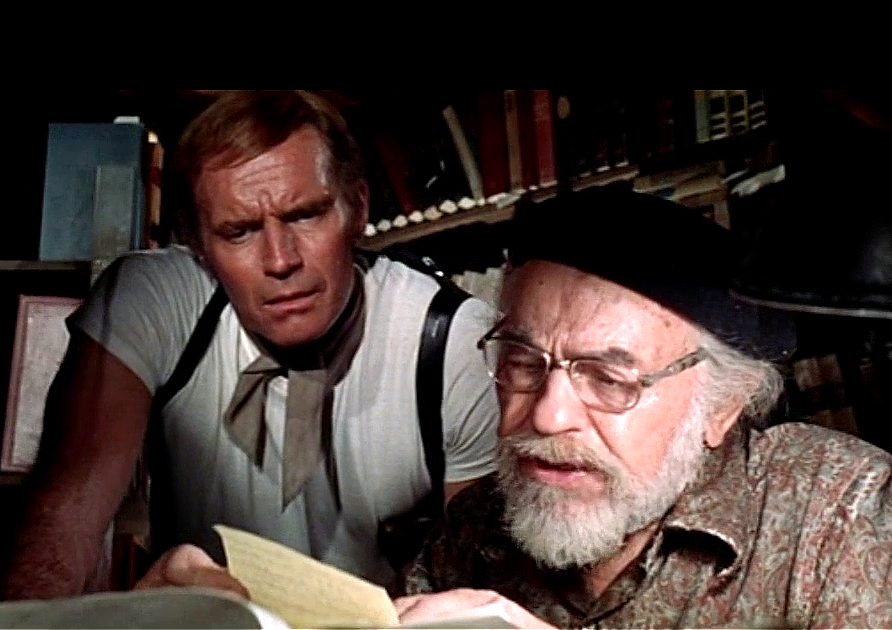
Edward G. Robinson, who was propelled to stardom as Caesar Enrico Bandello in 1931’s “Little Caesar,” made his final screen appearance 42 years later, in “Soylent Green.”
Richard Fleischer’s adaptation of Harry Harryson’s dystopian novel “Make Room! Make Room!” is that rare film that can be spoiled by revealing but a single line. So we’ll save it for tomorrow, when Roy Bjellquist and I will be joined by special guest – and Roy’s wife – Shari Bethman-Bjellquist, for a discussion of this ‘70s sci-fi classic, a horror story set in the year 2022, now getting just a little too close for comfort.
Robinson’s scenes are lent an added poignance, when you realize he was already aware that he was terminally ill. In fact, he died only twelve days after shooting his final scene. His character, Sol, is a cultivated dinosaur, much like the real-life Robinson, an art connoisseur who spoke seven languages. Sol the librarian puts on a recording of Mozart’s “Kegelstatt” Trio as he introduces Charlton Heston’s Frank Thorn to honest-to-goodness vegetables and beef stew. Then, when it’s time to “go home,” he departs to a medley of Tchaikovsky, Beethoven, and Grieg.
Interestingly, a few years earlier, Robinson was cast to play Dr. Zaius, opposite Heston, in “Planet of the Apes,” but already, health concerns caused him to drop out.
Climate change. Greenhouse gases. Dying oceans. Pollution. Poverty. Overpopulation. Depleted resources. Corporatocracy. And gruesome solutions. If anything, this film has become more chilling – and more likely – with the passing of the years, than it ever was in 1973.
All hail plankton! Green is the new black, on Roy’s Tie-Dye Sci-Fi Corner. Join us for this special three-way conversation. We’ll be looking for your comments, when we live-stream on Facebook, this Friday evening at 7:00 EDT.
In his years before the public, he was recognized as a pianist of diabolical stamina. Franz Liszt was the inventor of the modern piano recital. While most of his rivals cultivated their reputations on the more intimate salon circuit, Liszt graduated to the larger halls. He was the first to turn the piano sideways, the better to show off his long hair and noble profile, like that of a Hungarian falcon.
He made mincemeat of the delicate instruments of his day, which were unable to withstand his musical onslaughts. In a masterstroke of showmanship, he always kept a spare on stage. On at least one occasion, he went to head-to-head with an orchestra. He mesmerized his audiences with his superhuman transcriptions and paraphrases, whipping them into frenzies. The ladies of Europe forgot their manners and rushed the stage. Skirmishes broke out, as they wrestled for his gloves and cigar butts, carelessly, calculatedly, left behind.
Liszt enjoyed enormous fame. He accumulated staggering wealth. And he enjoyed prodigious love affairs. Then all at once, at the age of 35, he simply walked away. He knew he was more than a vulgar showman, and he was eager to explore other avenues. He may have been a man who savored the privileges of celebrity, but he was also an intellectual and an artist of the spirit. In fact, he was one of the most innovative musical thinkers who ever lived.
Among his innumerable achievements, he pioneered a technique known as thematic transformation, which he employed in his own compositions, as a radical alternative to traditional classical form. He is also credited with the creation of the symphonic poem. Without Liszt, there would have been no Wagner as we know him. In fact, Romantic music would have had to find its own way.
He also happened to be extraordinarily generous. He never took payment from any of his pupils. He programmed the operas of Wagner and Berlioz, when nobody else would touch them. He selflessly promoted the works of Grieg, Smetana, Debussy, Saint-Saëns, Fauré, Borodin, and many others. He was lured back to the concert stage only for charitable purposes – for the relief of victims of fire and flood, in support of political refugees, and to raise money for a Beethoven monument in Bonn.
When Wagner was on the run as a fugitive for his role in the 1849 Dresden uprising, Liszt, then a prominent conductor at the Weimar court, not only gave him the money to flee to Switzerland, he endorsed Wagner’s courtship of his (already married) daughter. Wagner’s “Tristan chord” would send shockwaves throughout Europe, changing music forever, but in actuality it was only one of the many innovations he borrowed from his future father-in-law.
Liszt’s later music at times anticipates the experiments of the 20th century, by composers as diverse as Debussy, Scriabin, and Schoenberg. “My sole ambition as composer,” he once pronounced, “is to hurl my lance into the infinite space of the future.”
For his pains, he was unrelentingly lambasted by his critics and intrigued against by jealous rivals. At various points throughout his career, he was dismissed for pandering to the mob, ridiculed as a charlatan and a hypocrite, and shunned for his long-term relationships with two women who fled troubled marriages.
Yet there is a depth and spirituality in his greatest music that defies all charges. Liszt may have been something of a glamor puss, but he was not a shallow man. He was an intellectual, and he was also devoutly religious, even to the point of taking minor orders and living in a cell in Rome. In all, he was a fascinating amalgam of charlatan and visionary, sinner and saint, peacock and messiah.
Happy birthday, Franz Liszt (1811-1886). One thing you were not was listless!
“Totentanz” (“Dance of Death”), 1849, rev. 1859
“Nuages gris” (“Grey Clouds”), gnomic and existential,1881
“La lugubre gondola,” Liszt’s premonition of Wagner’s funeral procession through the canals of Venice, 1882
Transcription of Saint-Saëns’ “Danse Macabre,” 1874
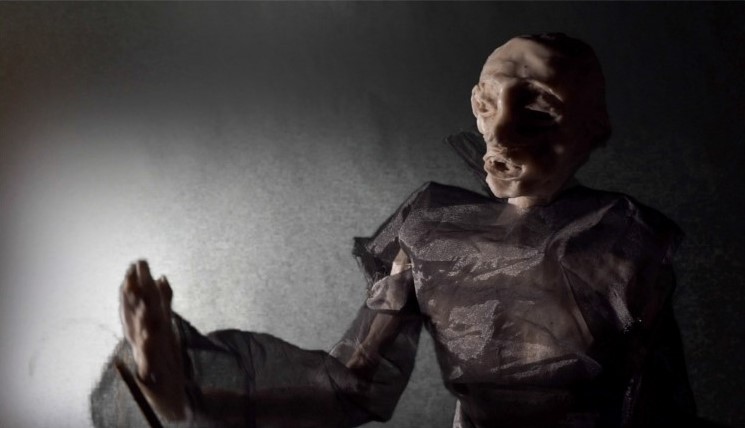
If, like me, you think Dvořák’s “The Spectre’s Bride” is too long – with not enough puppets! – then this should be the very thing for you.
At 43, Dvořák was at the peak of his creative powers (he had only just completed the Symphony No. 7) when he composed his dramatic cantata, and its premiere, in London, in 1885, was an astonishing success. In fact, Dvořák claimed it was the greatest success he had enjoyed up to that time. The Victorians always were rather mad for their oratorios.
I have listened to “The Spectre’s Bride” a number of times on recordings and have found it to be only fitfully interesting. This is especially surprising to me, since the story is so lurid it should grip my inner eight year-old and not let go. The tale may be a familiar one from many European folk tales: a maiden is abducted by the ghost of her fiancé, who gallops off with her, through the air and across a forbidding landscape, with the aim of reaching the phantom’s “castle” – in reality, a graveyard. At the work’s macabre climax, the maiden wrests free and bolts herself inside a cottage, spirits howling at the door. Inside, a corpse, prepared for burial, stirs to do their bidding.
Admittedly, this is an effective setpiece, but until then, I must say, it’s not just the graves that are yawning. And I offer this as someone who generally admires Dvořák. No doubt there are those who have sung the work who could be of a different opinion, and perhaps hearing it in concert is a more compelling experience than listening to it at home.
Dvořák’s setting is based on a poem by Karel Jaromir Erben. Erben, who lived from 1811 to 1870, was an important figure in the development of a Czech national identity. He served as a kind of Brothers Grimm to the Czech people, synthesizing works based on traditional and folkloric themes, into gruesome ballads full of witches, goblins and ghosts. So far, so good.
In my opinion, however, Dvořák was much more inspired when writing his other, more colorful, Erben-influenced pieces, including the comparatively compact symphonic poems “The Water Goblin,” “The Noon Witch,” “The Golden Spinning Wheel,” and “The Wild Dove,” and the enchantingly melancholy, ceaselessly melodic opera “Rusalka.”
Therefore it is with great relief that I stumble across this lean, 29-minute distillation. From its fragmentary nature, I assume that it was designed to be projected at certain key moments during live performance. Maybe that’s what a guy like me needs. Visual aids. But I don’t think so. I just think it’s not that interesting a piece, to demand an investment of 80 minutes. It seems like a miscalculation by a less experienced composer. And I offer this as someone who is generally captivated by Dvořák’s operas, or at least the ones I have seen and own. Of those, “Rusalka” must be near the top of my list of favorites, by any composer.
The puppets are designed by Francesca Borgatta, and they’re all crafted from “recycled objects and materials taken from nature.” Good. If you’re going have them dragged into the gaping maw of Hell, it’s best that they’re biodegradable.
You can learn more about Borgatta at her website, puppetfigures.com.
“…[T]hou was a skellum,
A blethering, blustering, drunken blellum;
That frae November till October,
Ae market-dae thou was na sober.”
Rabbie Burns wrote those lines of Tam O’Shanter. But they could just as well have applied to Sir Malcolm Arnold. Both men were, more or less, fond of the bottle and also driven by demons.
Arnold was born on this date in 1921. He started out as a trumpeter with the London Philharmonic Orchestra. He became its principal in 1943.
During World War II, Arnold registered as a conscientious objector. However, following the death of his brother, a pilot in the RAF, he decided to enlist. At least for a time. Though he never saw action beyond a military band, he quite literally shot himself in the foot in order to get back to civilian life.
In 1948, he retired from orchestral playing to devote himself exclusively to composition. He had an attractive melodic gift, which served him well in the writing of light music and film scores. He won an Academy Award in 1957 for his work on “The Bridge on the River Kwai.”
However, Arnold also had his dark side, as can be detected in passages of his symphonies. He was frequently cantankerous, often inebriated, and also highly promiscuous. He tried to kill himself at least twice. He was treated for depression and alcoholism, overcoming both, but then in the early 1980s he was given only a year to live. In the event, he actually lasted another 22, during which he completed his Symphony No. 9, among other works.
Arnold died in 2006, one month shy of his 85th birthday. He was a brilliant composer, of great facility. After Malcolm Williamson was named Master of the Queen’s Music in 1975, Sir William Walton remarked that they had given the job to the “wrong Malcolm.” For a man with so many personal demons, he wrote reams of perfectly delightful music.
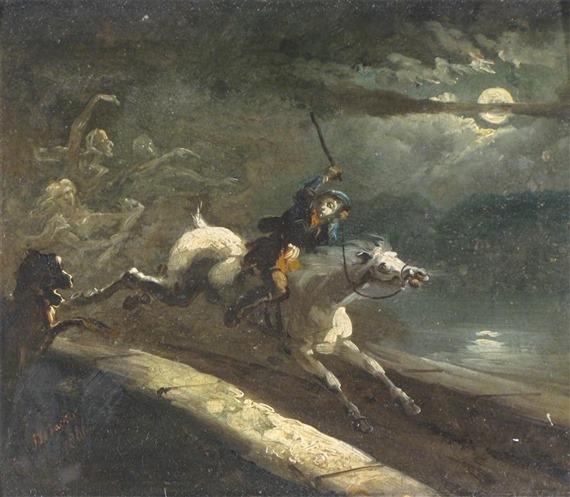
A good example, and one of my favorite Halloween pieces, is the descriptive overture “Tam O’Shanter” (1955), in which Burns’ antihero tarries at a pub, in defiance of his wife, then staggers out into the night. Under ominous skies, he detects the sound of bagpipes emanating from the ruins of an old church. Pressing his face to chink he espies “Auld Nick,” the Devil himself, “in shape o’ beast,” presiding over a coven of high-stepping witches and warlocks. When a particularly comely witch catches Tam’s eye, he, in his drunkenness, roars, “Weel done, Cutty-sark!” (in reference to her short skirt). This brings the forces of darkness down up him, and there is a hell-for-leather sprint by horseback for a nearby river, since spirits are said not be able to cross running water.