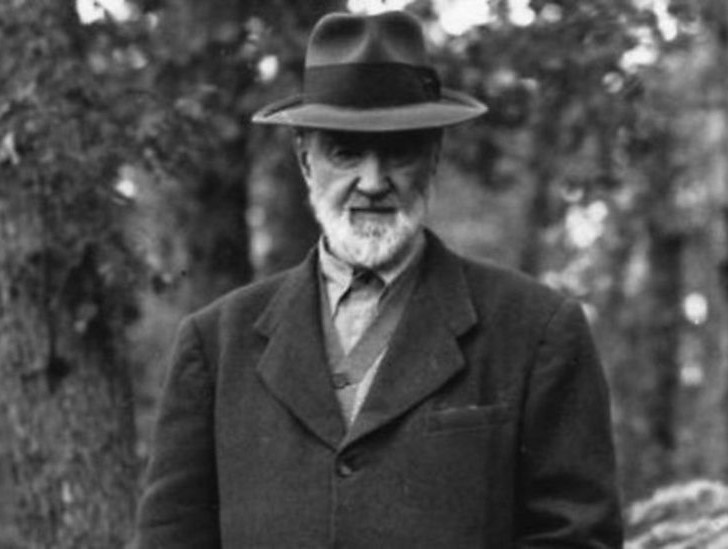
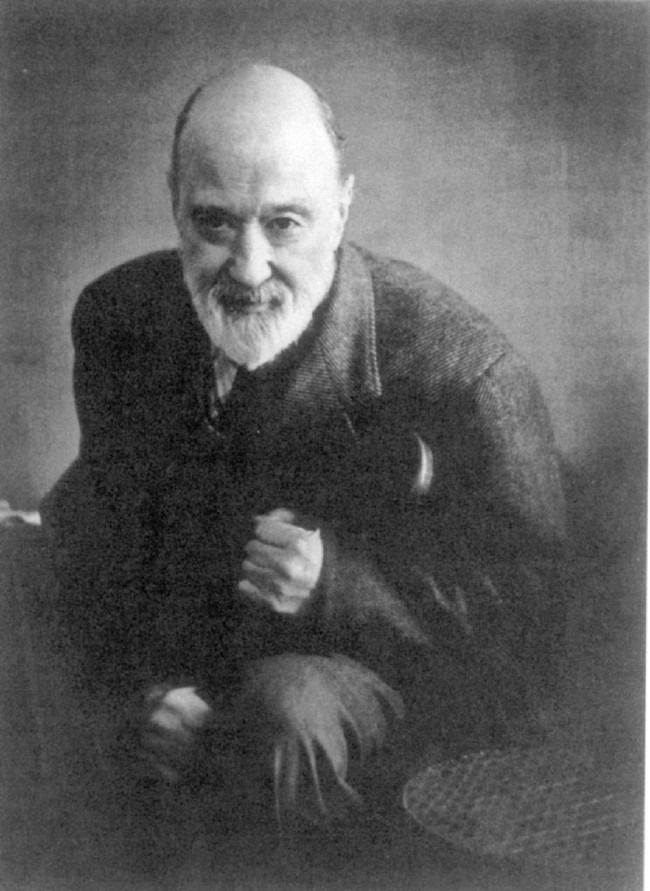
For Charles Ives’ birthday, here are two Halloween-specific pieces. You can listen to them both in just over three minutes.
First, my favorite recording of “Hallowe’en” (1907), in its original version for string quartet and piano, since it actually includes the bass drum. Ives later orchestrated the work, but it just ain’t the same. The composer wrote, “It’s a take-off of a Halloween party and bonfire – the elfishness of the little boys throwing wood on the fire, etc., etc… it is a joke even Herbert Hoover could get.”
And then this wisp of a song, “Slugging a Vampire” (1902). Like somebody slipped acid in your Smartees.
A lovely memory, on Charles Ives’ birthday: The program to a recital given last year at Princeton University’s Richardson Auditorium of all four Ives Violin Sonatas, played by Stefan Jackiw and Jeremy Denk. I don’t have a recording of the concert, but the performers toured with the program, and the Sonata No. 1 – the most “Romantic” of the four, and the one Ives published last – has been posted to YouTube, with Denk’s spoken introduction. It’s not quite the same as being there, of course, but I hope you will enjoy it even a fraction as much as I did. Thanks, Alex Rainer, for the photo!
Coinciding with the composer’s birthday, the Charles Ives Society is planning to live-stream a performance of Ives’ “Concord Sonata,” to mark the centenary of the work’s publication. This free recital will be presented by Charles Ives Society president Donald Berman, tonight at 7:30 pm EDT.
“Are my ears on wrong?” once remarked Charles Ives, marveling at how out of step with musical convention his own compositions could be. Yet he soldiered on, writing works of all stripes, tonalities, and quasi-tonalities, even atonality, navigating with remarkable certainty for some 30 years, with very few performances to affirm his chosen course.
I’m not saying anything new in stating that Ives was an American original. He wrote the kind of music he wanted to write, stitching together hymns and fiddle tunes of his youth into a brilliant crazy quilt of the American experience.
His father had been something of an original himself, a bandmaster during the Civil War. He taught Ives to sing in one key while he played in another. This likely contributed to his son’s unique appreciation of a formative experience: while standing on a street corner during a parade, the boy Ives giddily perceived the natural dissonances and rhythmic complexities resulting from a clash of marching bands as they wrapped around the block.
Thankfully, his quirky musical predilections were tempered by a practical streak. Ives pursued a career in the insurance business, and he became very successful at it. (His work in the field helped lay the groundwork for modern practices in estate planning.) While this would occupy much of his time, it also allowed him the financial security to follow his idiosyncratic muse. Ives composed in the evenings, on weekends, and during holidays. For a few years, in the 1890s, he was also organist and choirmaster at a couple of New York churches.
Ives retired in 1930, which permitted him to devote himself wholeheartedly to music. Ironically, by then, he found he was no longer able to compose. His wife recalled a day in 1927 when he came downstairs with tears in his eyes and confessed that everything sounded wrong to him. After that, he labored mostly at revision and publication.
By the time his works finally began to gain recognition, it had already been 20 years since he stopped writing. At the time of his death, in 1954, he was still widely misunderstood and much of his music remained unperformed. Nevertheless, he had some important champions. He was a recipient of the Pulitzer Prize for Music in 1947, for his Symphony No. 3, subtitled “The Camp Meeting,” a work he composed in 1904. The symphony was given its belated premiere, under Lou Harrison’s direction, in 1946.
Arnold Schoenberg regarded Ives as a paragon of artistic integrity. After Schoenberg’s death, his widow found the following note, scrawled, among his papers: “There is a great Man living in this Country – a composer. He has solved the problem of how to preserve one’s self-esteem and to learn. He responds to negligence by contempt. He is not forced to accept praise or blame. His name is Ives.”
Here is Ives, in all his patriotic, profane glory, singing “They Are There,” from 1943. Originally written in 1917, for the Great War, the song employs an updated text.
Ives draws on his memory of the wrap-around marching bands of his youth, in Danbury, Connecticut, for “The Fourth of July.” Note the climactic rocket explosion, fading away into sparks!
Finally, the work that won him the Pulitzer, the Symphony No. 3, “The Camp Meeting”:
Ives’ characteristically gruff reaction: “Prizes are for boys. I’m grown up.” In private, though, he proudly hung the certificate on his wall.
Last night, we celebrated Roy’s 50th episode with a discussion of the classic “Star Trek” Halloween episode “Catspaw,” and some Johnnie Walker Red.
On Friday, we’ll be joined by special guest (and Roy’s wife) Shari Bethman-Bjellquist, as we make a meal of “Soylent Green” (1972); and then on Sunday, Roy and I will be back in the saddle for one of my personal Halloween favorites, “The Devil Rides Out” (1968), starring the great Christopher Lee.
Get ready for some serious hooves-on-hooves action. Roy’s Tie-Dye Sci-Fi Corner live-streams on Facebook every Friday and Sunday at 7 pm EDT!