Consider that night stalked! Simon Oakland, who played Tony Vincenzo, Kolchak’s long-suffering editor, was also a concert violinist, and composer Jerry Fielding, while blacklisted, filled his time, pleasantly enough, jamming with a young Johnny Williams. Even in the realm of the unexplained and the supernatural, music makes the world go ‘round.
Here’s Roy Bjellquist and my leisurely ramble through sinister after-dark Chicago, a nostalgic exploration of “Kolchak: The Night Stalker” (1974-75).
Roy’s Tie-Dye Sci-Fi Corner is live-streamed on Facebook every Friday and Sunday at 7 pm EDT. Tomorrow night, we’ll revisit the classic “Star Trek” Halloween episode “Catspaw.” Energize!
Over the course of 20 weekly installments, intrepid reporter Carl Kolchak pounded the sewers and back-alleys of after-dark Chicago, in search of the unutterable truths that would keep his stories off the wire. The supernatural. The extraterrestrial. The experimental. The redacted.
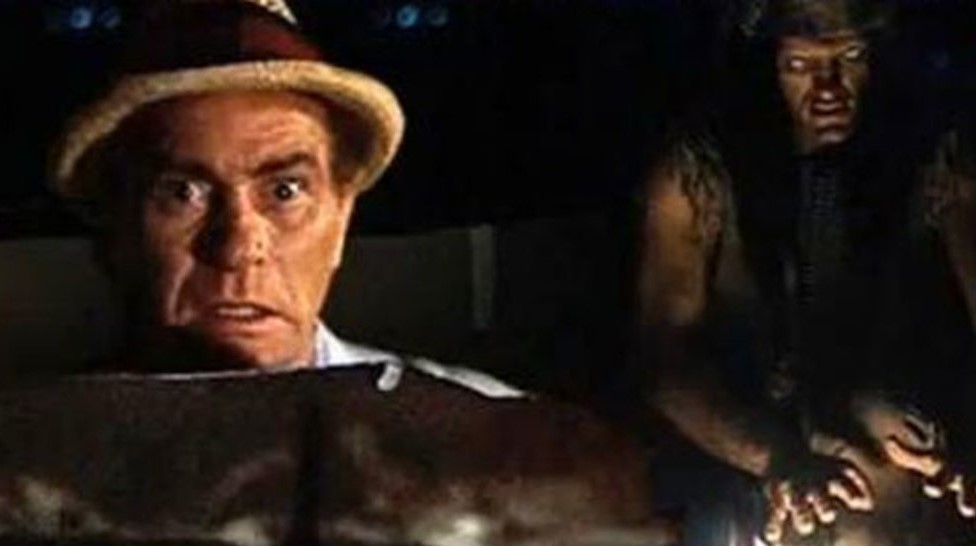
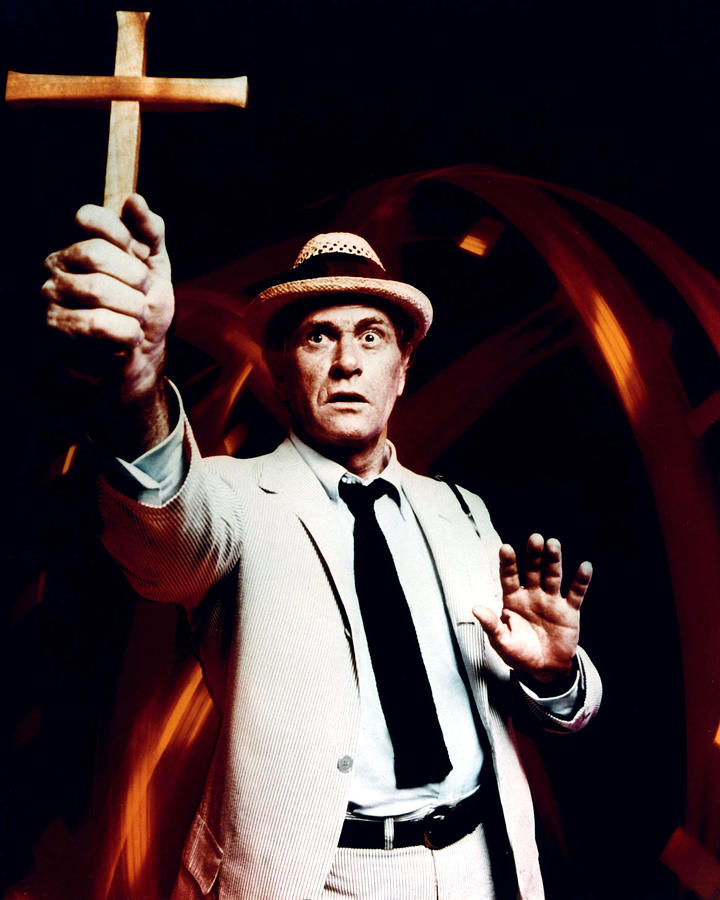
Darren McGavin donned the trademark raffia hat, rumpled linen suit, and white sneakers, in “Kolchak: The Night Stalker” (1974-75). Armed only with a Rollei 16 millimeter camera, a Sony recorder, and a rudimentary knowledge of the monster-of-the-week, Kolchak always did what he had to do, though how he managed to hang on to his job and stay out of jail is anyone’s guess.
Roy Bjellquist and I will reminisce about this short-lived, much-loved television series on the next Roy’s Tie-Dye Sci-Fi Corner. We’ll be melting buttons into silver bullets, sewing salt into zombies’ mouths, and watching for your comments, as we live-stream on Facebook, this Friday evening at 7:00 EDT!
This week on “Picture Perfect,” prepare to get “lost!” It’s an hour of music from fantasy films set in lost worlds.
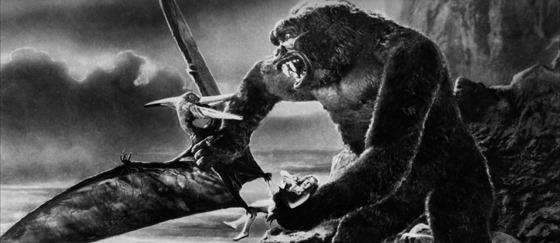
In “King Kong” (1933), filmmaker and entrepreneur Carl Denham hires a ship to an uncharted island, known only from a secret map in his possession. There the crew discovers the titular gorilla and other outsized, should-be-extinct creatures. Kong is abducted from his natural habitat – and you know the rest. The composer, Max Steiner, pulls out all the stops. “Kong” was one of the first films to demonstrate how truly powerful an orchestral soundtrack could be.
Then we travel to the earth’s core, courtesy of Jules Verne and “Journey to the Center of the Earth” (1959). James Mason is the professor who leads the expedition. The film sports one of Bernard Herrmann’s most outlandish soundscapes, the orchestra consisting of winds, brass and percussion, but also cathedral organ, four electric organs, and an obsolete Renaissance instrument called the serpent. Watch out for that giant chameleon!
“One Million Years B.C.” (1966) is a guilty pleasure if ever there was one. Produced by Hammer, the studio that gave us all those repugnant yet somehow delicious Peter Cushing-Christopher Lee horror team-ups, the film features special effects by the legendary Ray Harryhausen and an equally legendary fur bikini, sported by Raquel Welch. The music is by Mario Nascimbene, who wrote one of my favorite scores for Kirk Douglas, for “The Vikings.” We’ll be listening to the film’s climactic volcano sequence.
As he did with the Indiana Jones films, director Steven Spielberg turned to B-movie source material as his visual inspiration for “Jurassic Park” (1993), based on the novel by Michael Crichton. The herky-jerky dinosaur effects of yore are replaced by state-of-the-art computer-generated imagery, in this story of a remote island safari park gone wrong.
Sure, we’ve come a long way from Raquel Welch being carried off by a Pteranodon, but admit it, we all still want to see people fight dinosaurs. Instead of fudging history, now we can feel superior by fudging science. “Jurassic Park” plays on modern scientific thinking, with DNA extracted from mosquitoes trapped in amber, cloning, and the theory that dinosaurs were not lizards, after all, but rather birds. The music is by long-time Spielberg collaborator, John Williams.
If you happen to forget a compass, don’t panic! In the words of Ian Malcolm, life finds a way. Join me for “Lands That Time Forgot,” on “Picture Perfect,” now at its new time, this SATURDAY EVENING AT 6:00 EDT, on WWFM – The Classical Network and wwm.org.
Did you know, you could watch all 20 episodes AND both TV movies in 24 hours? That still gives you time to binge-watch “Kolchak: The Night Stalker” (1974-75).
Roy Bjellquist and I will be talking about the short-lived, but fondly remembered cult TV series, in which intrepid reporter Carl Kolchak (in-on-the-joke Darren McGavin) ferrets out the mysterious and supernatural in after-dark Chicago. McGavin is a hoot and unquestionably the main reason to watch the show, though Simon Oakland, as his editor, long-suffering Tony Vincenzo, plays exasperation well.
The series ably walks the line between chills and camp. It is very 1970s – everyone looks horrible, the women are all stereotypes, and the monster make-up is cheesy to the extreme. Still, it has always appealed to the eight-year-old in me. And there’s something in it that still resonates in a world obsessed with conspiracies and cover-ups.
Chris Carter claims that “Kolchak” was a principal influence when he came to create “The X-Files.” He even attempted to resurrect “The Night Stalker” itself, but it’s just not possible without an actor as quirky and knowing as McGavin, probably best recognized these days, thanks to annual TBS marathons, as Ralphie’s “Old Man” in Jean Shepherd’s “A Christmas Story.”
Every episode of “The Night Stalker” sports multiple guest stars, some veterans, some on their way up. So along the way to the final showdown with the vampire, werewolf, or extraterrestrial of the week, we encounter Cathy Lee Crosby, Erik Estrada, Tom Skerritt, Dick Van Patten, Larry Storch, Scatman Crothers, Carolyn Jones, Jamie Farr, Mary Wickes, Keenan Wynn, James Gregory, Jim Backus, Phil Silvers, Jackie Mason, and Richard Kiel, to name a few.
The series is also notable for breaking in Robert Zemeckis and Bob Gale, who put their own memorable spin on the Headless Horseman, making him a motorcyclist! Zemeckis and Gale later hit it big with “Back to the Future,” and Zemeckis would win the Academy Award for Best Director for “Forrest Gump.”
The shows usually conclude with a lonely epilogue, with Kolchak typing away in a deserted newspaper office, or dictating into his recorder, after hours. Do the stories ever make it to print? Not if Tony Vincenzo has anything to say about it. But the truth is out there!
Pour yourself some day-old coffee, and start your “Kolchak” marathon now. Roy and I speak truth to power on the next Roy’s Tie-Dye Sci-Fi Corner, live-streamed on Facebook, this Friday at 7 pm EDT!
Oscar Wilde lavishly praised it. H.P. Lovecraft and Guillermo del Toro claimed it as a seminal influence. Stephen King called it “one of the best horror stories ever written. Maybe the best in the English language.”
Is Arthur Machen’s “The Great God Pan” (1894) really all that? I don’t know if I’d take it that far, but it certainly was influential.
Parallels have been drawn with Bram Stoker’s “Dracula” (1897) – likely because of its patchwork narrative and atmospheric distancing from an impalpable terror. In common with Stoker’s magnum opus, it teases the imagination into grasping for that which is always just beyond comprehension.
So unspeakable are the horrors that lurk within, Machen’s characters literally cannot bring themselves to speak them. Rather, there are abundant warnings about soul-shattering terrors, implied but never outright stated. The reader is given just enough to titillate that part of the brain that craves sensation, the desire to look upon that which makes us look away. There is a lot of very depraved action, evidently, transpiring right around the corner, or beyond the bluff, or in the woods, or behind the doors of a certain London townhouse.
From its reception, you’d think that Machen’s novella was a threat to the very underpinnings of Victorian society. “Too morbid to be the production of a healthy mind,” wrote one critic. Another assessed it as “A perfectly abominable story, in which the author has spared no endeavor to suggest loathsomeness and horror, which he describes as beyond the reach of words.” He continues with a warning that Machen’s books are a dangerous threat to the entire British public, and that they will destroy a reader’s sanity and grasp of morality.
Needless to say, with that kind of publicity, “The Great God Pan” sold like bangers and mash.
The story is certainly handled with far more subtlety and art than those churned out for the penny dreadfuls, popular serials by hack writers who trafficked in lurid melodrama. What made Machen seem so dangerous in the eyes of the establishment was likely a perceived affinity with the Decadent movement in art and literature, as embodied by Wilde and his associates. He may have shared Wilde’s publisher, The Bodley Head, and “Pan” itself prefaced with an illustration by Aubrey Beardsley, but Machen, the family man, was more than likely to be caught sipping black tea than absinthe.
He has been called the greatest of Welsh writers, yet he remains a cult figure, despite the widening availability of his work. It used to be that one had to sift for his stories, like shards of pottery, in anthologies of the supernatural; now editions of his works are available from more respectable outlets, like Oxford World’s Classics and Penguin Classics.
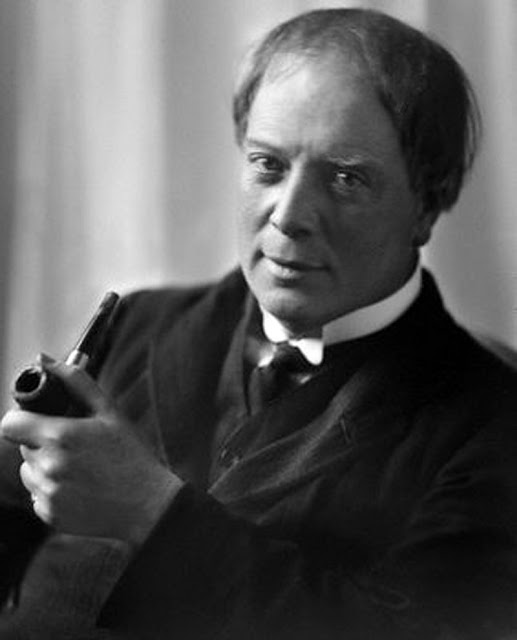
He was born in Caerleon, Monmouthshire, in 1863. Descended from a long line of clergyman, he himself was attracted to ancient and medieval history, a passion fueled by the Celtic and Roman ruins that studded the Welsh landscape. He was also fascinated by the occult, an interest sparked by an article on alchemy he had stumbled across in a volume of Dickens’ “Household Words,” discovered on the shelves of his father’s rectory library. “Pan” was inspired by the author’s personal interaction with the ruins of a Roman temple near his childhood home. The temple is believed to have been dedicated to Nodens, God of the Depths.
The composer John Ireland considered Machen’s fiction to be life-changing and claimed that it influenced much of his own work. Ireland’s “The Forgotten Rite” was directly inspired by readings of Machen’s books. These awakened in him an affinity for long-lost customs and rituals, often of a pagan hue. Ireland’s “Legend,” dedicated to Machen, and “Mai-Dun” both ruminate on ancient sites, imbued with a sense of the supernatural.
Machen’s writings were also beloved, on the one hand, by Jorge Luis Borges, acknowledged father of Latin American Magical Realism, and on the other, the occultist Aleister Crowley, whom Machen loathed.
Is Machen for everyone? Probably not. His prose is certainly much denser than that commonly encountered in fiction today. But the fact that it makes one strain to see beneath the surface makes it all the more effective. “Pan” is set in a world of scientists, occultists, and pompous gentlemen, all of whom speak in their own abstruse fashion. The truth, kept always ill-defined and just out of reach, lends the story the quality of a dream, or more precisely a nightmare.
I imagine some might find this kind of writing frustrating or even dull. There are no jump-scares or fountains of gore. There is, however, abundant atmosphere and a profound undercurrent of unseen horror unfolding beneath our very noses. “Pan” emerged from the same world as “The Strange Case of Dr. Jekyll and Mr. Hyde” (1886) and “The Picture of Dorian Gray” (1890). Also Jack the Ripper and the Whitechapel murders (1888-91). It was no great stretch for Machen to be able to instill in his readers a sense that there is much to be feared in ordinary life, and it all exists behind the thinnest of veils.
That said, if I’m to be honest, “Dracula” holds up much better as a popular story. A few eyerolling Victorian floridities aside, Stoker’s book, which owes much to “Pan,” is unremittingly compelling in a way that Machen’s story no longer is. I think any literate person can pick up “Dracula” and still thrill to its elemental power.
Machen is for the weird tales crowd. His underlying ideas are chilling. His technique is scattershot, but when everything comes together, his method is cumulatively brilliant. However, in a world accustomed to being bludgeoned with blunt sentences and vulgar bloodletting, “Pan” may seem, if not exactly tame, then frustratingly obscure. Needless to say, I like his writing very much.
The title, “The Great God Pan,” was taken from this poem by Elizabeth Barrett Browning. Below, you’ll also find a link to some of John Ireland’s music.
A MUSICAL INSTRUMENT (1862)
I.
WHAT was he doing, the great god Pan,
Down in the reeds by the river?
Spreading ruin and scattering ban,
Splashing and paddling with hoofs of a goat,
And breaking the golden lilies afloat
With the dragon-fly on the river.
II.
He tore out a reed, the great god Pan,
From the deep cool bed of the river:
The limpid water turbidly ran,
And the broken lilies a-dying lay,
And the dragon-fly had fled away,
Ere he brought it out of the river.
III.
High on the shore sate the great god Pan,
While turbidly flowed the river;
And hacked and hewed as a great god can,
With his hard bleak steel at the patient reed,
Till there was not a sign of a leaf indeed
To prove it fresh from the river.
IV.
He cut it short, did the great god Pan,
(How tall it stood in the river!)
Then drew the pith, like the heart of a man,
Steadily from the outside ring,
And notched the poor dry empty thing
In holes, as he sate by the river.
V.
This is the way,’ laughed the great god Pan,
Laughed while he sate by the river,)
The only way, since gods began
To make sweet music, they could succeed.’
Then, dropping his mouth to a hole in the reed,
He blew in power by the river.
VI.
Sweet, sweet, sweet, O Pan!
Piercing sweet by the river!
Blinding sweet, O great god Pan!
The sun on the hill forgot to die,
And the lilies revived, and the dragon-fly
Came back to dream on the river.
VII.
Yet half a beast is the great god Pan,
To laugh as he sits by the river,
Making a poet out of a man:
The true gods sigh for the cost and pain, —
For the reed which grows nevermore again
As a reed with the reeds in the river.