
A reminder that The Metropolitan Opera will stream the complete Ring Cycle, from its “Live in HD” series, beginning with “Das Rheingold” tonight at 7:30 p.m. The opera (or music drama) will be made available through 6:30 tomorrow evening. Then it’s “Die Walküre” for 23 hours, and so on and so forth. The Met is offering free streaming of its repertoire of encore broadcasts, for as long as the house remains closed. You’ll find more information at metopera.org.
Category: Daily Dispatch
-
Lehigh Valley Celebrates John Antes
Here’s a shout-out to all my peeps in the Lehigh Valley.
Today is the 280th birthday of Moravian composer John Antes.
Antes, born in Frederick, Montgomery County, PA, in 1740, is credited with being one the first American composers to write chamber music. He was also the creator of the earliest surviving bowed string instrument made in America by someone actually born in the colonies. Antes’ violin, made in 1759, is housed in the Museum of the Moravian Historical Society in Nazareth, PA. A viola, made by Antes in 1764 (again believed to be the earliest surviving of American origin), is housed in the Lititz Moravian Congregation Collection in Lancaster County. Antes created at least seven such instruments.
In 1752, Antes attended school in Bethlehem, PA. In 1760, he was admitted into the Single Brethren’s choir there. From Bethlehem, he travelled to Herrnhut, Germany, the international center of the Moravians, to prepare for a career as a missionary. In the meantime, he also took up watchmaking. He was ordained a minister in 1769, and then set out for Egypt. There, he served as a missionary to the Coptic Church in Grand Cairo. After a largely uneventful decade, he was captured and bastinadoed by followers of Osman Bey.
During his convalescence, he occupied himself with the composition of three string trios. He also sent a copy of six quartets to Benjamin Franklin, who he had known in America. The quartets are now lost (nice job, Ben), but the trios survive.
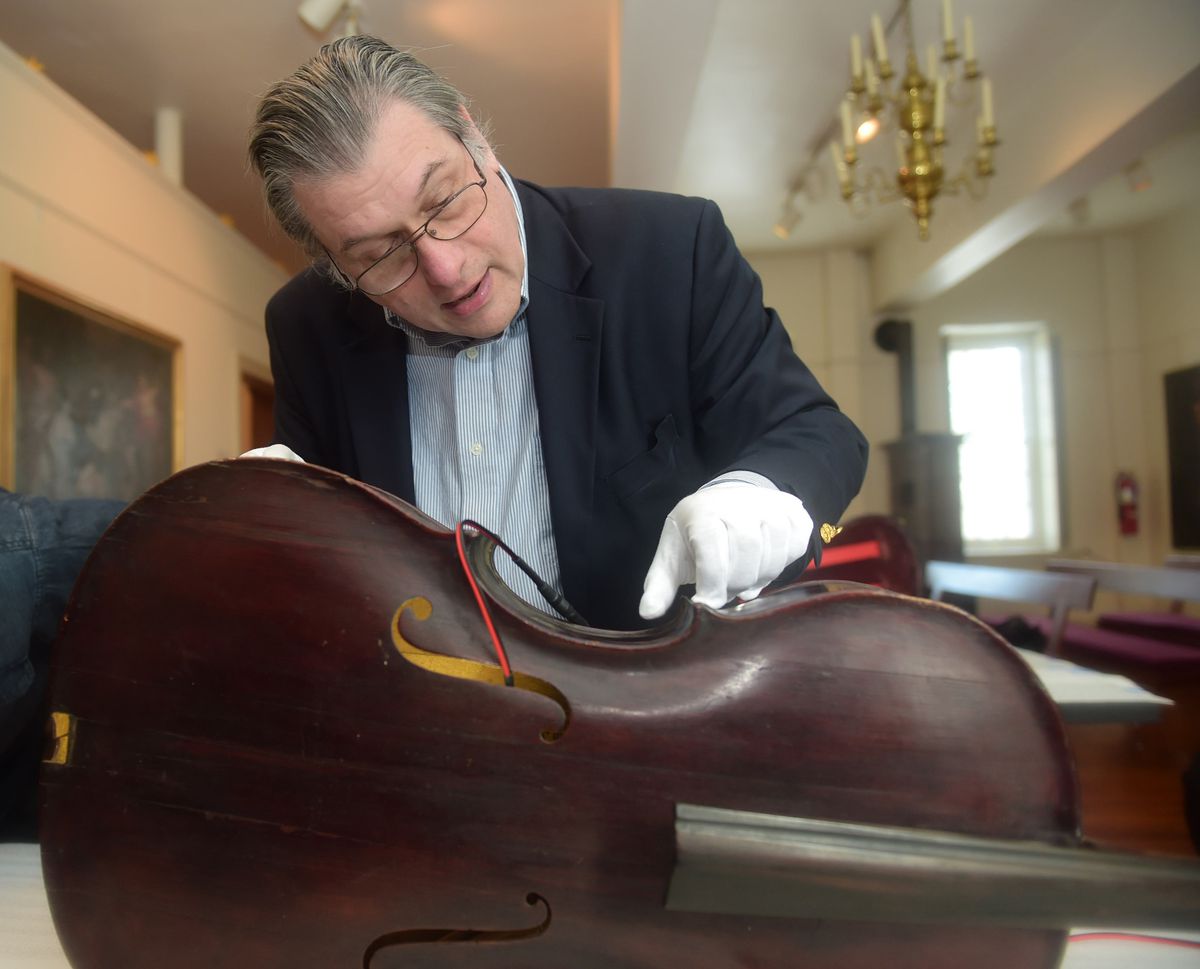
Apparently, Antes also delved into making keyboard instruments (he completed a few for friends), but then the church elders reined him in. An Antes cello was discovered in somebody’s attic in 2018.
https://apnews.com/e88096710de44cde9c4db7fae41b1760/Abandoned-cello-hits-a-high-note-in-Bethlehem
Video comparison of the three surviving Antes instruments:
https://www.youtube.com/watch?v=-WhWs-3u-EI
Selections from the String Trio No. 2 in D minor:
PHOTO: Philip J. Kass and the rediscovered Antes cello
-

Geoffrey Bush’s Hamlet Overture A Centenary Celebration
What kind of composer writes a comedy overture on the subject of “Hamlet?”
Today is the 100th birthday of Geoffrey Bush (1920-1998).
“Alas, poor Yorick! I knew him Horatio, a fellow of infinite jest, of most excellent fancy.”
An interview with Bruce Duffie:
-
Rainy Day Music Vaughan Williams Symphonies
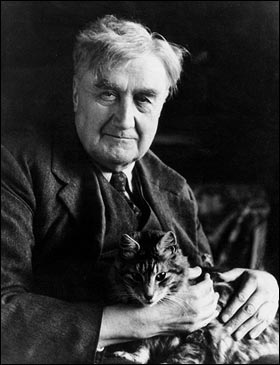
A good rainy day. The perfect time to hunker down with Ralph Vaughan Williams.
Here are links to two of his symphonies – the first, his most desolate, the Symphony No. 6, and the second, his most unambiguously hopeful, the Symphony No. 5. In common with the greatest classics, both exist outside of time – they are timeless – yet both speak perfectly to the present. Life in the time of Coronavirus
Vaughan Williams’ Sixth Symphony (1944-47) is full of tension, turbulent, bleak, with a few wistful passages that seem to reflect on a lost world. Though the composer denied any extramusical program, the last movement has been interpreted by many as an aural portrait of the world laid waste. Some have attributed the barren atmosphere as a response to the atomic bomb.
https://www.youtube.com/watch?v=I1suBbnp5Go
The Symphony No. 5 (1938-43), by contrast, is a balm for the soul. Though completed at the height of World War II, the symphony is a musical celebration of the endurance of humanity and tradition against an implacable enemy. The work shares much in common with Vaughan Williams’ passion project, the opera “The Pilgrim’s Progress,” which he had already been writing for 30 years. Not only does it quote some of the opera’s themes, it also reflects its spirit. The piece is brimming with solace, hope, and indescribable beauty.
Vaughan Williams dedicated the work to Jean Sibelius, “without permission and with the sincerest flattery.” When Sibelius heard the piece, he confided to the conductor Sir Adrian Boult, “This Symphony is a marvelous work… the dedication made me feel proud and grateful… I wonder if Dr. Williams has any idea of the pleasure he has given me?”
Keep calm and carry on. Pour youself a cuppa. Listen to Ralph Vaughan Williams, and find your strength.
-

Free Wagner Ring Cycle Met Opera HD Streams
Ho jo to ho!
Last week, I posted about The Metropolitan Opera’s free “Live in HD” broadcasts, which the Met has pledged to offer for the duration of the house’s closure due to the Coronavirus pandemic. True to its word, the Met is ladeling out a full week of Wagner, starting tonight, including a complete Ring cycle. Of course, it’s the current, ridiculous seesaw production, and not the classic Otto Schenck. But hey, Wagner is Wagner.
Here are this week’s offerings:
Monday: Tristan und Isolde
Conducted by Simon Rattle, starring Nina Stemme, Ekaterina Gubanova, Stuart Skelton, Evgeny Nikitin, and René Pape. Transmitted live on October 8, 2016.Tuesday: Das Rheingold
Conducted by James Levine, starring Wendy Bryn Harmer, Stephanie Blythe, Richard Croft, Gerhard Siegel, Dwayne Croft, Bryn Terfel, Eric Owens, and Hans-Peter König. Transmitted live on October 9, 2010.Wednesday: Die Walküre
Conducted by James Levine, starring Deborah Voigt, Eva-Maria Westbroek, Stephanie Blythe, Jonas Kaufmann, Bryn Terfel, and Hans-Peter König. Transmitted live on May 14, 2011.Thursday: Siegfried
Conducted by Fabio Luisi, starring Deborah Voigt, Hunter Morris, Gerhard Siegel, Bryn Terfel, and Eric Owens. Transmitted live on November 5, 2011.Friday: Götterdämmerung
Conducted by Fabio Luisi, starring Deborah Voigt, Wendy Bryn Harmer, Waltraud Meier, Jay Hunter Morris, Iain Paterson, Eric Owens, and Hans-Peter König. Transmitted live on February 11, 2012.Saturday: Die Meistersinger von Nürnberg
Conducted by James Levine, starring Annette Dasch, Johan Botha, Paul Appleby, and Michael Volle. Transmitted live on December 13, 2014.Sunday: Tannhäuser
Conducted by James Levine, starring Eva-Marie Westbroek, Michelle DeYoung, Johan Botha, Peter Mattei, and Gunther Groissböck. Transmitted live on October 31, 2015.The operas will stream free from 7:30 in the evening to 6:30 the following afternoon. (Tchaikovsky’s “Eugene Onegin,” with Dmitri Hvorostovsky and Renée Fleming, is still available through 6:30 today.)
You’ll find more information and a complete schedule at metopera.org.
Tag Cloud
Aaron Copland (93) Beethoven (95) Composer (114) Film Music (137) Film Score (143) Film Scores (255) Halloween (94) John Williams (195) KWAX (229) Leonard Bernstein (103) Marlboro Music Festival (125) Movie Music (152) Mozart (88) Opera (208) Philadelphia Orchestra (89) Picture Perfect (174) Princeton Symphony Orchestra (108) Radio (88) Ross Amico (244) Roy's Tie-Dye Sci-Fi Corner (290) The Classical Network (101) The Lost Chord (268) Vaughan Williams (103) WPRB (396) WWFM (881)