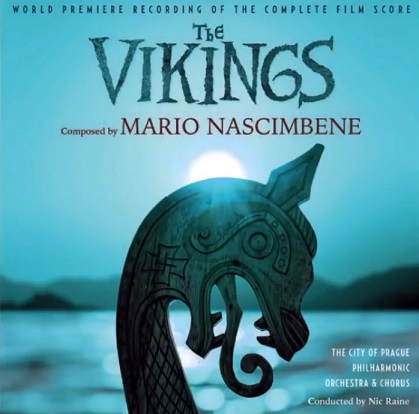
Dragon boat sighting! This week on “Picture Perfect,” we’ll quaff deep from our drinking horns to music from “The Long Ships” (Dusan Radic), “Prince Valiant” (Franz Waxman), “The 13th Warrior” (Jerry Goldsmith), and “The Vikings” (Mario Nascimbene). Lock up your daughters, and let the looting begin, this Friday evening at 6:00 EST, on WWFM – The Classical Network and wwfm.org!
Category: Daily Dispatch
-

Viking Movie Music Hour of Runes and Tunes
We’ve got the need for mead!
It’s an hour of swords and fjords this week, on “Picture Perfect,” as we travel north for music from movies about the Norsemen.
In “The Long Ships” (1963), two Viking brothers, played by the unlikely pair of Richard Widmark and Russ Tamblyn, make off with a king’s funeral ship – and the king’s daughter – as they set sail on a quest for the fabled “Mother of Voices,” an enormous solid gold bell – also coveted by a Moorish prince, played by Sidney Poitier. Needless to say, camp value is high. The music for this British-Yugoslavian production is by the Serbian composer Dusan Radic.
“Prince Valiant” (1954), based on the enduring comic strip by Hal Foster, is set in the days of King Arthur, though Val himself is a Viking prince of the kingdom of Scandia. And indeed Vikings play an important role in the film. Victor McLaglen is Val’s Viking pal Boltar, Janet Leigh is Princess Aleta, James Mason the villainous Sir Brack, and Sterling Hayden a ridiculous Gawain. Robert Wagner dons the signature page-boy haircut.
The score is every bit as vivid as the film’s Technicolor. We’ll hear selections from a very special recording, with the composer himself, Franz Waxman, conducting.
Michael Crichton’s 1976 novel, “Eaters of the Dead,” presents an unlikely, fish-out-of-water alliance, between historic Persian ambassador of the 10th century, Ahmad ibn Fadlan, and a band of Vikings. They overcome their cultural differences to face off against the Wendol, humanoid creatures who periodically emerge from the mist to feed on human flesh.
Crichton’s story was filmed in 1997 and ultimately released as “The 13th Warrior” (1999), with Antonio Banderas as Ibn Fadlan. The production was plagued by misfortune. The original director, John McTiernan, who found success with “Die Hard,” was fired for running over-budget, and Crichton himself was brought in to re-shoot a number of the scenes. Nevertheless, the film proved to be a box office failure. But any movie to feature a Jerry Goldsmith score – and Vikings! – can’t be all bad.
The legendary Jack Cardiff, who actually directed “The Long Ships,” provided the stunning cinematography for “The Vikings” (1958). The film stars Kirk Douglas, Tony Curtis, Janet Leigh, and Ernest Borgnine. Although unintentionally amusing on several levels, “The Vikings” is highly regarded for its attention to detail and stabs at historical accuracy – particularly in regard to its Viking dragon boats.
Also impressive is the haunting score by Mario Nascimbene, which we’ll hear in a digital re-recording, issued on the Prometheus Records label, featuring the City of Prague Philharmonic Orchestra and Chorus, conducted by Nic Raine. The recording is like mead from Valhalla.
I hope you’ll join me for an hour of runes and tunes. It’s the perfect mix-tape for your dragon boat. Set sail with the Vikings, this Friday evening at 6:00 EST, on WWFM – The Classical Network and wwfm.org.
-
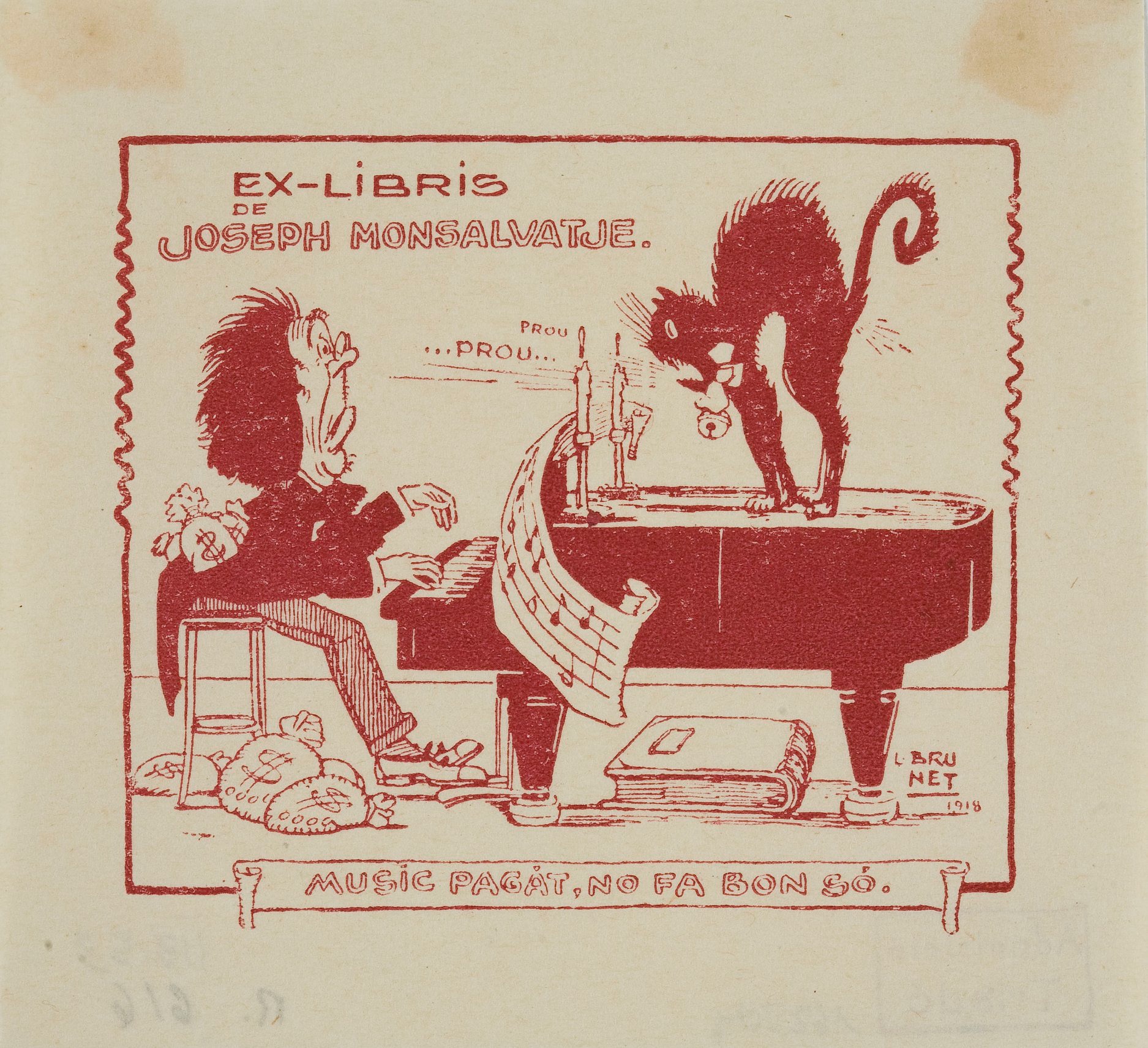
Montsalvatge Bookplate Mystery Solved
Here’s a follow-up to my post on Sunday, about the J. Montsalvatje bookplate. You may recall, I was wondering if it had once been the property of Catalan composer Xavier Montsalvatge.
I heard back from my contact, which in fact is the composer’s nephew. The composer’s father was the brother of my acquaintance’s grandfather. I had forgotten their exact relationship in my alcoholic haze. (We met at a party.) In any case, it’s not the easiest thing to remember!
According to the nephew, the composer changed the spelling “because in the grammatical catalonia is correct way [sic], but Monsalvatje is the ancient form for writing my last name.
“This last name was born in Girona (Catalonia, Spain) long time ago and only my family has this name in all Spain, it’s true that in States there are person with that name too, because one of my old family went to States in XIX century.”
He goes on to relate that his great grandfather was a collector of books, by the name of Joseph Montsalvatje. Apparently, many of those books are now in museums and private collections. Books are very big in the Montsalvatje family. Also the arts. The family tree is full of artists and musicians.
Since I originally posted, I managed to trace the bookplate, by googling the designer (L. Brunet), to the Rare Book and Manuscript Library at the University of Illinois. The plate is identified as having belonged to one Jordi Montsalvatje i Fossa – probably from the branch of the family Montsalvatge’s nephew says settled in the U.S.
In the meantime, I also managed to uncover a second bookplate (pictured), likely the former property of the same Joseph Montsalvatje cited by my acquaintance. Here I learn that the artist/designer’s full name is Llorenç Brunet Torroll:
The caption reads: “Music pagat, no fa mal sò,” apparently a common expression in that part of the world, since a Google search turns up many results. The translation is roughly, “Music paid for makes bad sound,” meaning, as far as I can make out, that when one is paid for one’s work, one doesn’t do it well, or doesn’t do it at all. Feel free to correct me on that, Catalan speakers.
If you didn’t catch my earlier post on the matter, you can always just scroll down my Facebook page until you find it, if it means that much to you.
For the time being, I’m using the earlier bookplate as my profile pic.
As a reward for reading, enjoy some more music by Xavier Montsalvatge!
-
Anton Reicha Beethoven’s Forgotten Friend
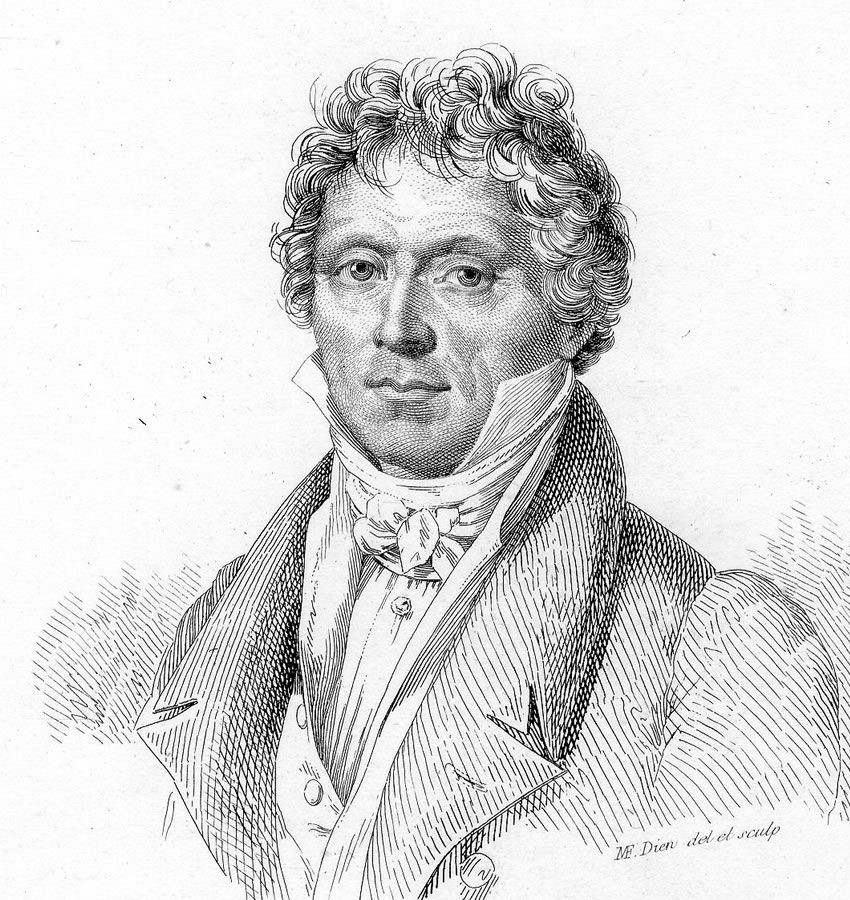
He was a lifelong friend of Beethoven. They shared the same teachers and exchanged musical ideas. He taught Liszt, Berlioz, Franck, and Gounod. But, unless you happen to be a wind player, how many people really know the music of Anton Reicha? Perhaps a shade more than realize that today is his 250th birthday.
Though he composed music in all genres – symphonies, concertos, operas, string quartets, choral music, vocal and instrumental works – Reicha is principally remembered, if at all, for his 25 wind quintets. Written in Paris between 1811 and 1820, the quintets came at a time when there was a dearth of good material for this particular configuration, so they were very successful. They also happen to comprise some of Reicha’s most traditional music.
Earlier, during his years in Vienna – a time when he was closest to Beethoven – he espoused some pretty radical ideas, including polyrthyms, polytonality, and even microtones. These were innovations that would not make serious inroads in the world of classical music for over a hundred years.
As the composer noted in his memoirs, “The number of works I finished in Vienna is astonishing. Once started, my verve and imagination were indefatigable. Ideas came to me so rapidly it was often difficult to set them down without losing some of them. I always had a great penchant for doing the unusual in composition. When writing in an original vein, my creative faculties and spirit seemed keener than when following the precepts of my predecessors.”
Reicha was a prolific composer, whose music is full of novel ideas. His forward-looking string quartets influenced Beethoven – with whom, naturally, he shared many musical discussions – and Franz Schubert.
Yet for some reason, he was often reluctant to publish. This led to the slapdash organization of his output, following his death, and lots of confusion, as pieces were lost, opus numbers were assigned willy-nilly, and some works were even counted more than once.
So here we are, today, on Reicha’s 250th birthday, and the world is Beethoven-mad. I think his music deserves at least an occasional hearing. But you know how it is. Beethoven sells more tickets.
It reminds me of the famous anecdote, related by Franz Liszt, in which he puckishly swapped trios by Beethoven and Johann Peter Pixis, presenting them opposite to the order in which they were advertised in the concert program. The audience reaction to the Pixis was stormy and enthusiastic, but when he came to perform the Beethoven, the response was tepid at best. It annoyed many in the hall when Liszt revealed the ruse.
Reicha’s music is closer to Beethoven’s than is Pixis’. Get people in the chairs, and they will enjoy it.
In the meantime, I’ll be sharing something by Reicha this afternoon, as I’ll also be observing the birthdays today of composers Richard Wetz and Frank Bridge, conductor Witold Rowicki, pianist Lazar Berman, and soprano Emma Kirkby.
It will be music by Mozart and Schubert on tonight’s “Music from Marlboro,” at 6. That ought to sell some tickets. I hope you’ll join me from 4 to 7 p.m. EST, on WWFM – The Classical Network and wwfm.org.
-

Mozart & Schubert at Marlboro This Week
It all goes back to Mozart, on this week’s “Music from Marlboro.”
As a boy, Franz Schubert so impressed his teacher, Antonio Salieri – Mozart’s friend and rival – that Salieri recommended him for a scholarship to the Imperial Seminary. There, he was introduced to the symphonies of Mozart and Haydn. By the time he attained leadership of the seminary’s orchestra, he had developed a clear affinity for Mozart’s Symphony No. 40 in G minor.
Mozart’s 40th was obviously in the back of Schubert’s mind when, in 1815, at the age of 18, he came to compose his own String Quartet in G minor, D. 173. The opening theme of Schubert’s first movement emulates that of the last movement of Mozart’s 40th.
You can hear for yourself, as we enjoy a performance from the 1981 Marlboro Music Festival, with violinists Yuzuko Horigome and Margaret Batjer, violist Philipp Naegele, and cellist Gary Hoffman.
First, Mozart’s Sonata for Two Pianos in D major, K. 448, was written in 1781, when the composer was 25 years-old. He first performed it in tandem with his pupil, Josepha Auernhammer.
Auernhammer was sweet on Mozart. Though the composer described her privately as “a monster,” he praised her playing, albeit with a few reservations. (His friend, the clarinetist Anton Stadler, was unqualified in his approval.) The duo performed publicly on several occasions, and Mozart dedicated six of his violin sonatas to her.
Parenthetically, the Sonata for Two Pianos was the piece that was selected in 1993 for use in a scientific study to test the so-called “Mozart effect,” which posited that listening to Mozart’s music could improve short-term mental acuity. I don’t know about you, but I’m feeling smarter already.
Tune in for a performance given at Marlboro in 1975 by the husband and wife team of Claude Frank and Lilian Kallir.
The music is Frankly wonderful. Mozart and Schubert will improve your mood, if not your I.Q., on the next “Music from Marlboro,” this Wednesday evening at 6:00 EST, on WWFM – The Classical Network and wwfm.org.
Marlboro School of Music and Festival: Official Page
Tag Cloud
Aaron Copland (93) Beethoven (95) Composer (114) Film Music (137) Film Score (143) Film Scores (255) Halloween (94) John Williams (195) KWAX (229) Leonard Bernstein (103) Marlboro Music Festival (125) Movie Music (152) Mozart (88) Opera (208) Philadelphia Orchestra (89) Picture Perfect (174) Princeton Symphony Orchestra (108) Radio (88) Ross Amico (244) Roy's Tie-Dye Sci-Fi Corner (290) The Classical Network (101) The Lost Chord (268) Vaughan Williams (103) WPRB (396) WWFM (881)