Category: Daily Dispatch

  • Ernest Fanelli Mummy Rediscovered

    Ernest Fanelli Mummy Rediscovered

    By the time his music was performed publicly, it had been 18 years since the composer had stopped writing.

    Ernest Fanelli is one of those poor, unsung prophets of music history who wrote works brimming with colorful ideas, expressed well ahead of their time. He was underappreciated, unnoticed, or fell short of his overall potential, yet later masters capitalized, either wittingly or unwittingly, on his remarkable innovations. Others undoubtedly lifted his discoveries to greater heights, but that doesn’t change the fact that Fanelli got there first.

    This Sunday night on “The Lost Chord,” just in time for Halloween, we rediscover this forgotten composer and exhume his seminal masterpiece, “The Romance of the Mummy.”

    It’s fairly obvious that Fanelli’s unpublished manuscript fueled the imagination of Claude Debussy, who in turn not only influenced the course of French music, but also changed the way artists and audiences thought about music heading into 20th century. That’s not to say that Fanelli was of the same caliber as Debussy. But like Hans Rott, whose lone symphony clearly influenced Mahler, he is an essential footnote in the history of a new kind of music.

    Episodes from “The Romance of the Mummy” anticipate not only Debussy and Ravel, but also Paul Dukas and Florent Schmitt, Holst, Sibelius, Respighi, Richard Strauss and even Stravinsky, a figure Fanelli would not have known. Not all of these composers were familiar with Fanelli’s work – in many cases, it’s simply a matter of music history finally catching – but Debussy most probably was. When Fanell’s “Mummy” was finally given its first public hearing, Debussy did his best to distance himself from the composer. He was even known to have done an about-face if he happened to walk into a café and saw Fanelli sitting at the piano.

    Fanelli lived from 1860 to 1917. A French composer of Italian descent, he studied at the Paris Conservatory for a stint – allegedly under Charles-Valentin Alkan (although it’s unlikely, since Alkan had already quit the Conservatory by the time he entered). Later, he returned to study under Léo Delibes. Fanelli was unable to complete either course, due to lack of funds. In the meantime, he eked out a career as a percussionist.

    He was seeking employment as a copyist in 1912, when he showed Gabriel Pierné an example of his handwriting from one of his unpublished manuscripts, written some 30 years earlier. Pierné was so taken by the actual music that he arranged for the “Mummy’s” belated premiere.

    “The Romance of the Mummy,” based on a novel by Théophile Gautier, tells the tale of an English archaeologist, who exhumes and falls in love with – well, a mummy. Papyrus rolls in her mausoleum reveal her back-story and fate. She is Tahoser, who falls in love of Poeri, a handsome Hebrew. The Pharaoh (unnamed, though it would have been Ramses II) desires Tahoser for himself. However, the lovely young woman falls ill when she finds Poeri is in love with Rachel. She is healed by the prophet Moses, who initiates her into the cult of Jehovah. Pharaoh becomes an enemy of the Jewish people and abducts Tahoser. When he dies in the Red Sea, in circumstances described in the Book of Exodus, Tahoser is crowned Queen of Egypt. Hence, her presence in the pharaoh’s tomb.

    The first set of tableaux is titled “Thebes,” and is made up of the subsections “Before Tehoser’s Palace,” “On the Nile,” and “Triumphal Return of the Pharaoh.”

    It was the conductor Adriano who discovered a second set of tableaux in the music library of Radio France, titled “Festivities in the Pharaoh’s Palace.” The three subsections of the second set are called “In a Room in the Palace – The Naked Jugglers,” “Grotesque Dance of the Egyptian Jesters,” and “Triumphant Hymns – Orgy.” The music received its first performance only in 2002 for this release, issued on the Marco Polo label.

    Is it love or infatuation? Peer behind the bandages of music history on “Mummy Dearest,” this Sunday night at 10:00 EDT, on WWFM – The Classical Network and wwfm.org.

  • Scarlatti’s Cat Fugue Halloween Music

    Scarlatti’s Cat Fugue Halloween Music

    31 DAYS OF HALLOWEEN (DAY 26)

    On the birthday of Domenico Scarlatti, beware his “Cat’s Fugue.” Scarlatti’s feline companion, Pulcinella, used to walk across the keys of his harpsichord. The story goes that on one of those occasions, the composer jotted down the notes and used it as the lead subject for his famous sonata. Spooky.

  • Remembering William Hootkins Star Wars to Batman

    Remembering William Hootkins Star Wars to Batman

    Does anyone else remember William Hootkins?

    Somehow I wound up on his Wikipedia page, while scrambling down the rabbit hole in search of more information on a Lalo Schifrin piano concerto. Schifrin is the composer of over 100 film and television scores, including those for “Cool Hand Luke,” “Bullitt,” “Dirty Harry,” “Enter the Dragon,” “Rush Hour,” and of course “Mission: Impossible.”

    You know how it is. You look up a recording, then the artist, you click on a link to the composer, glance over his film credits, click on a film, and then take a look at the cast. In this case, while running my eyes down a page devoted to a totally forgotten 1998 film called “Something to Believe In,” I recognized a familiar name in the role of “Car Dealer.”

    Although his parts were generally quite small, William Hootkins was a highly visible character actor to those of us of the “Star Wars” generation. He would have first been imprinted on our consciousness as Rebel pilot Jek Porkins (a.k.a. Red Six) during the climactic dogfight over the first Death Star.

    He was also Major Eaton, who sent Indiana Jones on his quest for the Ark of the Covenant in “Raiders of the Lost Ark.” He played a corrupt cop in Tim Burton’s “Batman,” opposite Jack Nicholson. He was Dr. Zarkov’s turncoat assistant in 1980’s “Flash Gordon.” He also appeared in a couple of “Pink Panther” films, “A River Runs Through It,” and the 1996 version of “The Island of Dr. Moreau.”

    The same year as “Star Wars,” 1977, he played Fatty Arbuckle in Ken Russell’s “Valentino.” At the time of his death, he was at work on a screenplay for a projected biopic in which he planned to reprise his role as the disgraced silent comic.

    On stage, Hootkins scored his biggest success as Alfred Hitchcock, in a London production of “Hitchcock Blonde.” With talk of a Broadway opening, it seemed as if he was poised for wider recognition at last. Sadly, he was diagnosed with pancreatic cancer. The illness would claim his life in 2005, at the age of 57. “Hitchcock Blonde” was not performed in the United States until a year after his death.

    “Hoot” was born in Dallas, Texas, in 1948. A high school classmate of Tommy Lee Jones, he attended Princeton University, where he pursued astrophysics and oriental studies. It was John Lithgow who recommended he study acting at the London Academy of Music and Arts.

    Hoot’s residence in the UK made him easily accessible to American productions that set up shop at Elstree and Pinewood Studios.

    Although he was rarely onscreen for more than a few minutes, he was always a memorable presence. His prolific film work ensured a kind of cumulative recognition.

    I am posting about him here because of his unexpected Princeton connection, and as one of millions of adolescents who actually gave a hoot about Hootkins.

  • Superman vs Frankenstein Halloween Tunes

    Superman vs Frankenstein Halloween Tunes

    31 DAYS OF HALLOWEEN (DAY 25)

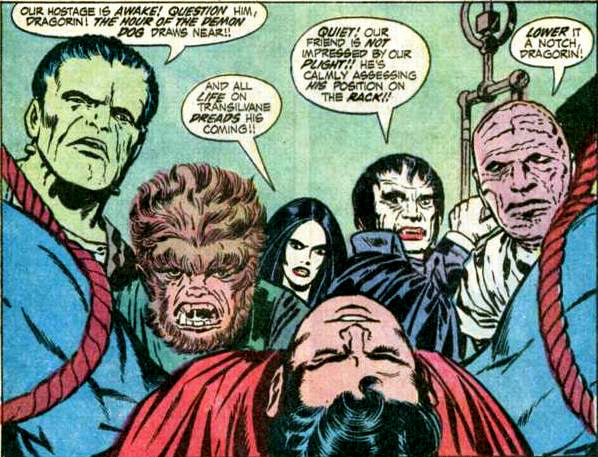
    Poor Kal-El. Lone survivor of the planet Krypton, and here he is, once again besieged by monsters. Thank you, Jack Kirby!

    “Herr Supermann” from HK Gruber’s “Frankenstein!!”

    And Moritz Eggert’s “The Son of the Daughter of Dracula Versus the Incredible Frankenstein Monster (from Space),” with two theremins.

    Enjoy all your pleasures at once.


    ARTWORK: Superman’s Pal, Jimmy Olsen #143 (1971)

  • Vampire Movie Soundtracks from Page to Screen

    Vampire Movie Soundtracks from Page to Screen

    This week on “Picture Perfect,” it’s all widow’s peaks and plastic fangs, as we listen to music from film adaptations of novels about vampires.

    “Interview with the Vampire” (1994), based on the novel by Anne Rice, featured some pretty counterintuitive casting, including Tom Cruise as Lestat (Rice would have preferred Rutger Hauer), but thanks largely to director Neil Jordan the film still managed to deliver the goods. Elliot Goldenthal’s music was nominated for an Academy Award. Interestingly, the American Boychoir sings the opening “Libera me.”

    Frank Langella’s characterization of Bram Stoker’s Dracula drove the critics wild when the play by Hamilton Deane and John L. Balderston was revived on Broadway in 1977. (It was the same adaptation that launched Bela Lugosi on his big screen career.) But when the film “Dracula” (1979) was released a couple of years later, reviews were mixed. Langella retained his dreamy magnetism, and the producers managed to secure Sir Laurence Olivier and Kate Nelligan for the parts of Van Helsing and Mina, respectively, but I wonder if John Badham was the best choice for director. Badham had just come off the enormous box office success of “Saturday Night Fever,” and it looks as if his Dracula retains John Travolta’s hair. You know, just for luck.

    I remember being so excited, as a 13 year-old, watching the trailer at the movies. When Langella leaped through a window and transformed into a wolf in mid-flight to John Williams’ dramatic music, it was almost more than I could bear. Watch the trailer here:

    https://www.youtube.com/watch?v=ydj01YcD83A

    How could a film called “Abraham Lincoln: Vampire Hunter” (2012) ever live up to its title? The answer is, it can’t, but the adaptation of Seth Grahame-Smith’s supernatural-historical mash-up wasn’t as terrible as everyone says it was. Sure, I would have preferred it had Daniel Day-Lewis played Lincoln, but put anybody in a stove-pipe to fight vampires with an axe, and I’m happy. I probably wouldn’t have been so permissive had I seen it in the theater, where the noise and effects would have pushed me over the edge, but it was a diverting rental, with a gothic score by Henry Jackman that ping-ponged between Americana lyricism and an orchestra bolstered by electronics and heavy metal guitars. But what are you going to listen to when you’re fighting vampires, a string quartet?

    James Bernard’s music for Hammer Studios’ “Dracula,” released in the United States as “Horror of Dracula” (1958), is one of his best-known efforts. His Dracula theme, with its clashing harmonies, laid the groundwork for the sound of the film’s numerous sequels, most of which featured Christopher Lee in his most iconic role. Bernard became so closely associated with Hammer and vampires that he was approached late in life to provide a new score for the silent classic “Nosferatu.”

    Finally, “Bram Stoker’s Dracula” (1992), despite the claims of utmost fidelity in its very title, was not a faithful adaptation of Stoker’s book. Why? WHY??? The film was lovely to look at, with eye-popping costumes and production design that combined Universal Studios in-the-camera trickery and honest-to-goodness miniatures with a few more Jean Cocteau references than perhaps was for its own good. This could have been THE Dracula film. Alas, it wasn’t. However, for me, it had THE Dracula score. It was a stroke of genius to hire Polish composer Wojciech Kilar to give the film just the right Eastern European sound.

    Get your blood up, with page-to-screen vampires this week, on “Picture Perfect.” Watch out for those paper cuts, this Friday evening at 6:00 EDT, on WWFM – The Classical Network and wwfm.org.
Tag Cloud

Aaron Copland (93) Beethoven (95) Composer (114) Film Music (137) Film Score (143) Film Scores (255) Halloween (94) John Williams (195) KWAX (229) Leonard Bernstein (103) Marlboro Music Festival (125) Movie Music (152) Mozart (88) Opera (208) Philadelphia Orchestra (89) Picture Perfect (174) Princeton Symphony Orchestra (108) Radio (88) Ross Amico (244) Roy's Tie-Dye Sci-Fi Corner (290) The Classical Network (101) The Lost Chord (268) Vaughan Williams (103) WPRB (396) WWFM (881)

DON’T MISS A BEAT

Receive a weekly digest every Sunday at noon by signing up here


RECENT POSTS