Category: Daily Dispatch

  • Foulds’ World Requiem Armistice Remembrance

    Foulds’ World Requiem Armistice Remembrance

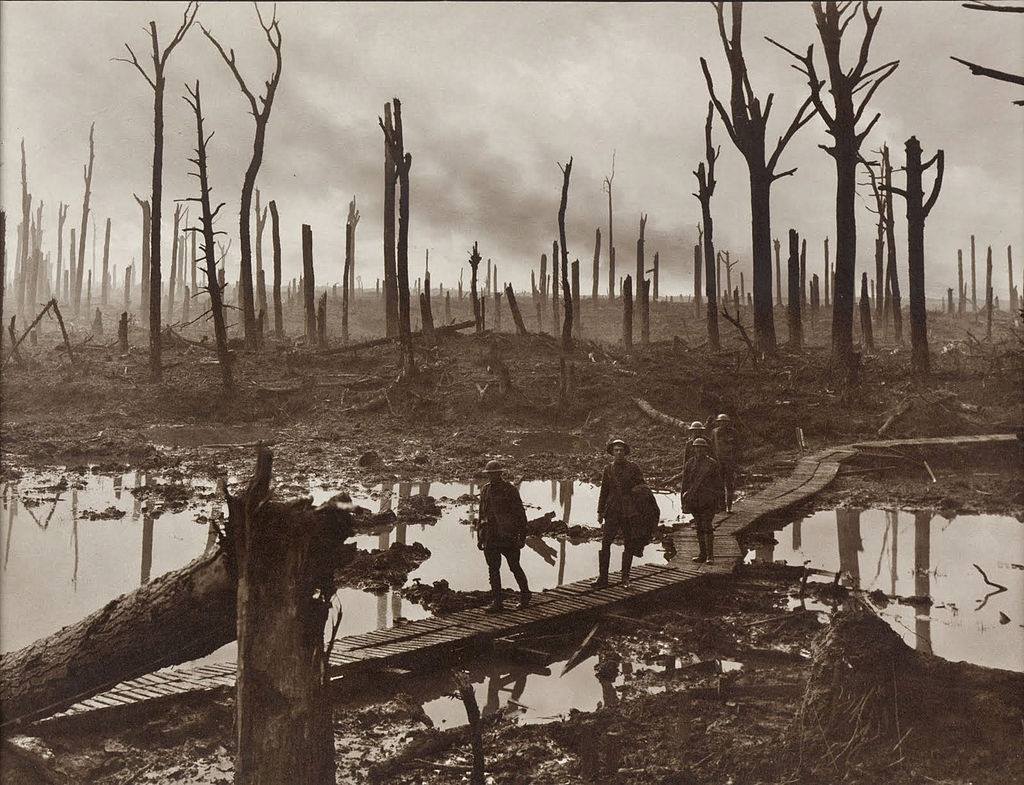
    John Foulds conceived “A World Requiem” in the wake of World War I as a memorial to the dead of all nations. This Sunday night on “The Lost Chord,” we’ll conclude our two-part commemoration of the signing of the 1918 Armistice by highlighting the second half of this epic, 90-minute work for vocal soloists, massed choirs – including children’s choirs – large symphony orchestra, off-stage instrumentalists, and organ.

    The Requiem’s texts were derived from various spiritual sources by the composer’s wife, Maud MacCarthy, built on fragments from the Requiem Mass, as well as writings of John Bunyan and the Hindu poet Kabir. Its overall tone is more Brahms than Britten. The second part conveys radiant visions of paradise.

    “A World Requiem” was given its first performance on Armistice Day, November 11th, 1923, then performed annually for the next four years. After that, it lay unheard for some eight decades, until revived by conductor Leon Botstein. Botstein has dusted off more than his share of worthy curiosities, though few are more ambitious than “A World Requiem.” This world premiere recording, on Chandos Records, was taken from a live concert presented on Armistice Day, 2007, at the venue in which the work was first heard, Royal Albert Hall London.

    We’ll round out the hour with music by Cecil Coles, one of the many (too many) artists who lost their lives in combat. Coles was born in Scotland in 1888. He studied at Edinburgh University, the London College of Music, and Morley College; then in Stuttgart, where he remained as assistant conductor at the Stuttgart Royal Opera House. Forced to return to England before the outbreak of war, he enlisted for overseas service and was sent to the trenches in 1915. Coles was killed near the Somme on April 26, 1918, during a heroic attempt to rescue some wounded comrades.

    Coles had continued to compose even on the front lines. His manuscripts of the period, some still embedded with shrapnel, have been painstakingly reconstructed for a recording on Hyperion Records. We’ll hear one of the surviving movements from “Behind the Lines,” titled “Cortège” – a military funeral procession – especially poignant, given the composer’s fate. Coles was just 29 at the time of his death.

    “The War to End All Wars” was a lesson that won’t be learned, apparently, but it’s healthy to reflect on the horror, the heroism, the waste, and the sacrifice. Join me in marking the centenary of the Armistice, on “A Farewell to Arms, Part II,” this Sunday night at 10:00 EST, on WWFM – The Classical Network and wwfm.org.
  • William Goldman Screenwriter Dies

    William Goldman Screenwriter Dies

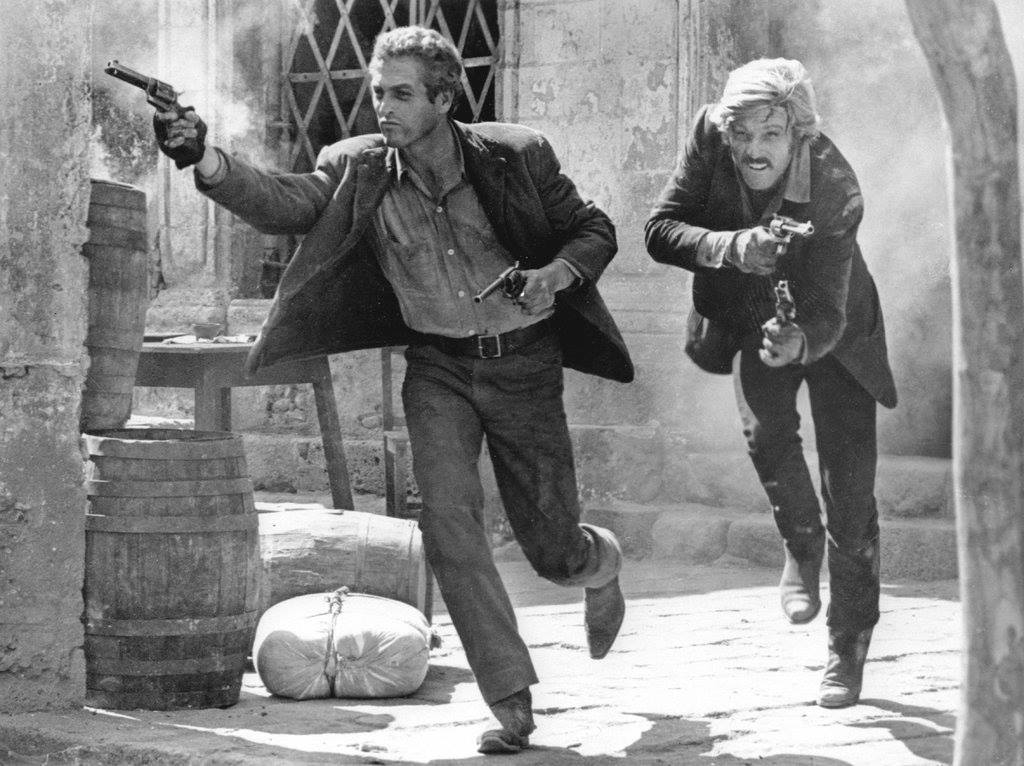
    Butch Cassidy. All the President’s Men. Marathon Man. The Princess Bride.

    I’m a day late on this, but legendary screenwriter William Goldman has died.

    Goldman wrote “Butch Cassidy and the Sundance Kid” while teaching creative writing at Princeton University in 1965.

    https://www.nytimes.com/2018/11/16/obituaries/william-goldman-dead.html

  • Copland Bernstein Foss Fine Discuss American Music

    Copland Bernstein Foss Fine Discuss American Music

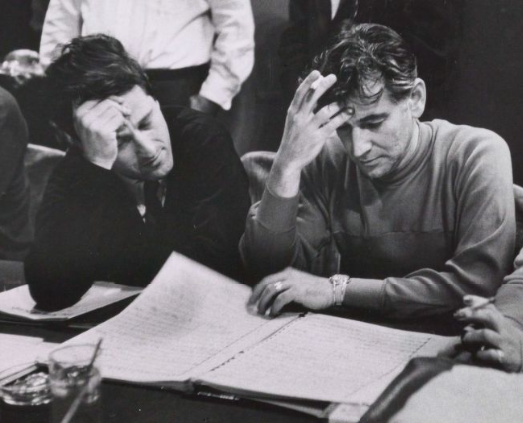
    I found this the other day, on Aaron Copland’s birthday, but I thought I would save it for the weekend, when you might have time to actually listen to it. It’s a fascinating document of four insanely talented composers – Copland, Leonard Bernstein, Lukas Foss, and Irving Fine – gathered around a piano and engaged in a bull session about the state of American music.

    https://www.wnyc.org/story/217199-what-american-music/


    PHOTOS: (top) Foss and Bernstein; (bottom) Copland and Fine

  • Thanksgiving Movies Celebrating American Ideals

    Thanksgiving Movies Celebrating American Ideals

    There’s more to Thanksgiving than just turkey and football. This week on “Picture Perfect,” we count our blessings and aspire to do better, with music from movies reflective of what’s best in human nature and most admirable in the American character.

    Aaron Copland’s work on “The Cummington Story” (1945), a semi-documentary produced by the Office of War Information, underscores the gradual acceptance of European war refugees into a cautious but fundamentally decent New England community. The music is pure Americana, with some of the material later finding its way into Copland’s Clarinet Concerto and “Down a Country Lane.”

    “Field of Dreams” (1989) is one of those rare films that has the ability to reduce manly men – even those without father issues – to a pool of tears. Phil Alden Robinson’s superior adaptation of W.P. Kinsella’s novel, “Shoeless Joe,” is a male wish-fulfillment fantasy, in which a man finds redemption, and a new understanding of his father, in the enchanted cornfields of America’s heartland. And it’s all brought about courtesy of America’s pastime, baseball. The evocative score, much indebted to Copland, is by James Horner.

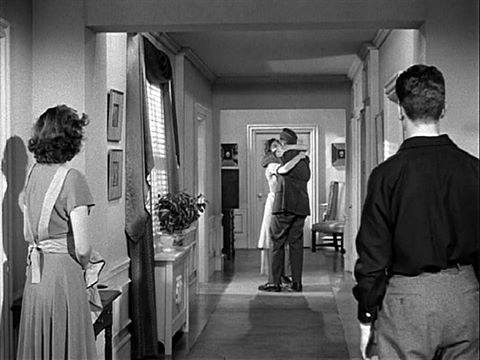
    “The Best Years of Our Lives” (1946) is one of the great American classics. This touching film tells the tale of the three WWII veterans struggling to readjust to civilian life. It isn’t easy, but with the support of family and friends, there’s plenty of hope for the future. Hugo Friedhofer wrote the Academy Award-winning score, earning the film one of its seven Oscars. The orchestrations were by Copland protégé (and composer of “The Big Country”) Jerome Moross.

    Finally, Daniel Day-Lewis elevated Steven Spielberg’s “Lincoln” (2012) to greatness with one of the most uncanny performances ever captured on film. Day-Lewis’ gentle but shrewd Man of Destiny would go to any lengths to hold the country together. John Williams tapped into America’s proud musical heritage, clearly influenced by Copland and Ives, to create a score of stirring nobility.

    I hope you’ll join me as we give thanks for family, community and country on “Picture Perfect,” music for the movies, this Friday evening at 6:00 EST, on WWFM – The Classical Network and at wwfm.org.


    And thank you, YouTube, for making “The Cummington Stoy” available online!

    Watching it again, it’s interesting to reflect on what an influence, for good or ill, media and government have had in shaping the popular consciousness.

  • Rachel Barton Pine on The Classical Network

    Rachel Barton Pine on The Classical Network

    When you tune in to The Classical Network this afternoon at 4:00 EST, you’ll be able to enjoy a conversation with Rachel Barton Pine, Violinist. Pine will be a guest of the Princeton Symphony Orchestra this Sunday, when she appears as the soloist in Niccolò Paganini’s Violin Concerto No. 1. The concert will take place at Princeton University’s Richardson Auditorium in Alexander Hall. Also on the program will be works of Leoš Janáček and Igor Stravinsky. Pine will tell us a little more about the concert, her insights, and her work promoting music by Black composers, both through her foundation and a new recording on the Cedille Records label.

    We’ll round out the hour with a recording on Boston Records of Princeton Symphony music director Rossen Milanov conducting a performance of Reinhold Glière’s Harp Concerto, with Gretchen Van Hoesen, principal harpist of the Pittsburgh Symphony Orchestra.

    At 8:00 tonight, Carl Hemmingsen will host a broadcast concert with Milanov conducting the Princeton Symphony. Guest soloist Simone Dinnerstein will perform the Keyboard Concerto No. 7 by Johann Sebastian Bach and the Piano Concerto No. 3, a PSO co-commission, by Philip Glass. The program will also include works by Mason Bates and Maurice Ravel.

    In matters unrelated to the PSO, it’s also the birthdays today of Paul Hindemith, Antipodean colossus Alfred Hill, and neglected Baroque master Guillaume Dumanoir. We’ll celebrate with some of their music, and more, in the 5:00 hour.

    At 6:00, we’ll turn our attention to music for the silver screen, as we do every Friday, on “Picture Perfect.” This week, we’ll anticipate Thanksgiving with film scores by Aaron Copland, James Horner, Hugo Friedhofer, and John Williams.

    It’s a veritable cornucopia! Give thanks for variety in music. Make us your horn of plenty, at WWFM – The Classical Network and wwfm.org.
Tag Cloud

Aaron Copland (93) Beethoven (95) Composer (114) Film Music (137) Film Score (143) Film Scores (255) Halloween (94) John Williams (195) KWAX (229) Leonard Bernstein (103) Marlboro Music Festival (125) Movie Music (152) Mozart (88) Opera (208) Philadelphia Orchestra (89) Picture Perfect (174) Princeton Symphony Orchestra (108) Radio (88) Ross Amico (244) Roy's Tie-Dye Sci-Fi Corner (290) The Classical Network (101) The Lost Chord (268) Vaughan Williams (103) WPRB (396) WWFM (881)

DON’T MISS A BEAT

Receive a weekly digest every Sunday at noon by signing up here


RECENT POSTS