Category: Daily Dispatch

  • Richard Harris Sings MacArthur Park Today

    Richard Harris Sings MacArthur Park Today

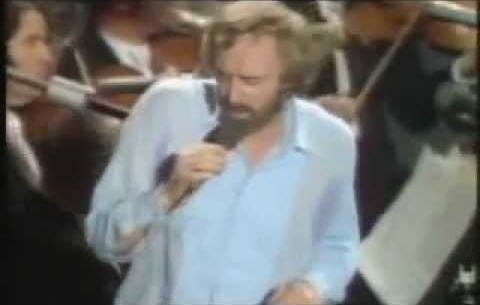
    Today is the anniversary of the births of Paul Dukas and Vladimir Horowitz. But forget those hacks! Enjoy the vocal stylings of birthday boy Richard Harris, who sings “MacArthur Park.”

    Then join me this afternoon from 4 to 7 p.m. EDT, for Dukas and Horowitz, on WWFM – The Classical Network and wwfm.org.


    The genius of “MacArthur Park:”

    SCTV’s Dave Thomas on “Mel’s Rock Pile:”

    https://www.youtube.com/watch?v=I8JlQNIvIfI

  • Romania Mania Unearthing Musical Gems

    Romania Mania Unearthing Musical Gems

    For a country so steeped in music, George Enescu has done an awful lot of the heavy lifting. Regarded as Romania’s most gifted musical polymath, Enescu exploded onto the international scene at the age of 19 with his world famous “Romanian Rhapsody No. 1.” Perhaps even more impressive, his “Romanian Poem,” a half-hour expanse for chorus and orchestra, was composed four years earlier.

    But Enescu was also a gifted violin prodigy, a pianist, a conductor, and a notable teacher. Although we are exposed to a shamefully small proportion of his compositional output, at least much of it has been recorded, and his name is secure in the classical music pantheon. This Sunday night on “The Lost Chord,” we’ll look beyond Enescu to hear music by three of his compatriots, only one of whom managed to achieve a reputation beyond the borders of his homeland.

    George Stephănescu (1843-1925) was an important figure in the development of Romanian opera. He founded the nation’s first opera company in 1885. He is also credited with having composed the first Romanian symphony. Stephănescu conducted at the National Theater and taught at the Bucharest Academy of Music. His “National Overture” of 1876 reflects his patriotic concerns.

    By contrast, György Ligeti (1923-2006) was destined generally to be a bit of an outlier. Born into a Jewish family in an ethnically Hungarian region of Transylvania, Ligeti went on to become one of the most important composers of his generation, but much of his music is in a style which would be deemed “avant-garde.” But he also had his playful side. In 1951, he wrote his “Concert românesc” (“Romanian Concerto”), a wholly accessible and little-known work based on actual Romanian folk tunes that he had studied at the Folklore Institute in Bucharest. Despite this being one of his most overtly delightful works, the piece was banned after a single rehearsal in Bucharest and was not heard publicly until 1971. “Totalitarian regimes do not like dissonances,” he observed ruefully.

    Finally, Paul Constantinescu (1909-1963) was part of a generation of Romanian composers who came of age in the shadow of Enescu. He composed in most musical forms: opera, ballet, oratorio, incidental music, symphonic, chamber and choral music, and music for film, yet he remains little-known in the West. His concertante output includes works for violin, cello, piano and harp, in addition to a concerto for string orchestra. We’ll hear Constantinescu’s Piano Concerto, from 1952.

    I hope you’ll join me for this neglected music from Southeast Europe. That’s “Romania Mania,” this Sunday night at 10:00 EDT, on WWFM – The Classical Network and wwfm.org.

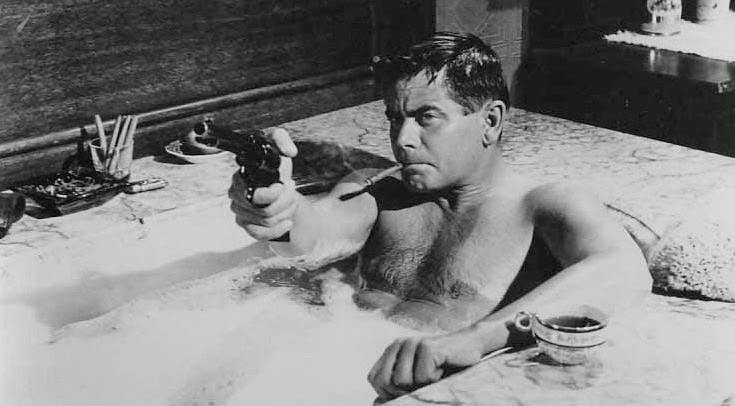
  • Bath Time Glenn Ford or Alban Berg

    Bath Time Glenn Ford or Alban Berg

    In the bath, are you more Glenn Ford or Alban Berg?

  • Sherlock Holmes Movie Music Picture Perfect

    Sherlock Holmes Movie Music Picture Perfect

    The game is afoot! This week on “Picture Perfect,” it’s an hour of music from movies inspired by the world’s greatest detective.

    “Sherlock Holmes” (2009) features Robert Downey Jr. and Jude Law, in Michael Ritchie’s post-“Matrix” take on the master detective. While some of the film adaptations over the years may have glossed over the character’s physicality, Ritchie’s revisionist Holmes perhaps errs a mite too far in the other direction. Hans Zimmer wrote the music, he too going against received wisdom, and in the process coming up with one of his more interesting scores, if only for the quirky instrumentation, which includes a Hungarian cimbalom, accordion, fiddles and a broken pub piano.

    Perhaps it’s unfair to put Zimmer up against an old pro like Miklós Rózsa. Rózsa wrote the music for Billy Wilder’s melancholy portrait of the great detective, “The Private Life of Sherlock Holmes” (1970). Wilder requested that the composer adapt his lovely Violin Concerto for the project, a recording of which the director had listened to repeatedly during the writing of the screenplay. Rózsa and Wilder had previously collaborated on “Double Indemnity” and “The Lost Weekend.”

    The Sherlock Holmes comedy, “Without a Clue” (1988), represents a missed opportunity of sorts. The hope had been for Sean Connery to play Watson opposite Michael Caine’s Holmes, a longed-for reunion between the two who had worked so well together in “The Man Who Would Be King.” In the end, it was Ben Kingsley who assumed the role.

    The fun conceit that sets “Without a Clue” apart is that Holmes is the fictional creation of mastermind Watson, who in reality is the gifted crime-solver. Through necessity, Watson hires a second-rate actor to play the role of Holmes. Of course, the actor turns out to be a bumbling idiot. Henry Mancini provides the British Light Music style score, with a nod to Edmund White’s “Puffin’ Billy” (familiar stateside as the theme to “Captain Kangaroo”).

    Finally the Steven Spielberg-produced “Young Sherlock Holmes” (1985) offers a conjectural origins story, including Holmes and Watson’s first meeting as teenagers (ignoring the particulars laid out by Arthur Conan Doyle in his stories, with Watson already a war veteran who had served in Afghanistan). It’s all for fun, though it’s unfortunate the filmmakers felt the need to interject ‘80s-style special effects, rather than simply trust in the inherent magic of the subject matter. “Young Sherlock Holmes” features the first photorealistic, fully computer-generated character (a stained glass knight). Also, some Indiana Jones B-movie antics involving an Egyptian cult seem especially out of place.

    Interestingly, the film’s screenwriter, Chris Columbus, went on to direct the first two Harry Potter films. By my recollection, “Young Sherlock Holmes,” with its boarding school setting, has some of that same feel.

    The music, by Bruce Broughton, is certainly buoyant and beautiful, in the best John Williams tradition. Broughton scored a handful of big screen hits, notably “Silverado” and “Tombstone,” though arguably it is in the medium of television that he’s made his greatest impact. Thus far, his work has been recognized with a record 10 Grammy Awards.

    It’s elementary, my dear Watson. Join me for “Picture Perfect,” this Friday evening at 6:00 EDT, on WWFM – The Classical Network and wwfm.org.

  • 23 Years on WWFM Classical Radio Memories

    23 Years on WWFM Classical Radio Memories

    23 years ago tomorrow, I made my first appearance on WWFM – The Classical Network. Somehow, despite all the challenges – and there have been many: societal, interpersonal, economic, technological, and office-political – I’m still standing.

    My first time on microphone was in the 9:00 hour of Bliss Michelson’s morning air shift, on Thursday, September 28, 1995. I took over Saturday and Sunday mornings immediately following and continued to cover weekends for the next 18 ½ years.

    Since then, of course, I’ve been on weekday afternoons. Oh yeah. There was that hiatus of a year or so when I had no live air shifts but was kept on invoice as an independent contractor. But we won’t talk about that, other than to say if it hadn’t happened, I probably wouldn’t be here on Facebook. So lucky you!

    Here’s the music I selected for my first ever hour on WWFM:

    HOWARD HANSON – Merry Mount: Suite

    SIR PETER MAXWELL DAVIES – Farewell to Stromness

    MUZIO CLEMENTI – Symphony No. 1

    ARNOLD SCHOENBERG – Aria from “The Mirror of Arcadia”

    Though I had already had nine years’ experience in community radio, cutting my teeth on a couple of college stations in and around Allentown, PA, I remember I was shaking like a leaf. Sensing my apprehension about going before such an imposing listenership – WWFM covered much of central and southern New Jersey and portions of eastern Pennsylvania – Bliss’ words of advice were sage: “Remember, it’s just you and the microphone.”

    It’s been a crazy ride. Looking back, there are times I think maybe I should have worked in rodeo instead of radio.


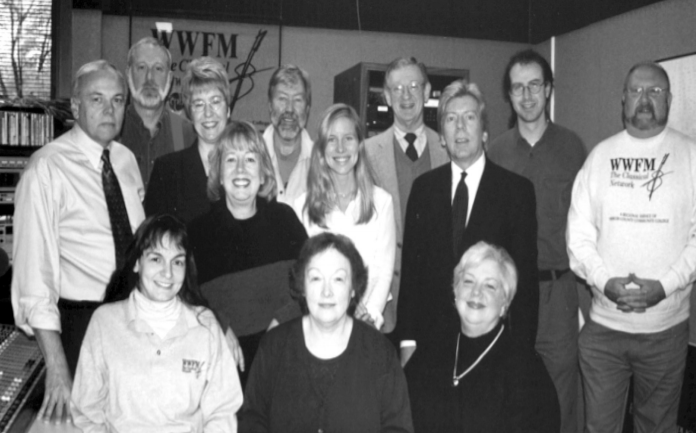
    Check out this old WWFM staff photo!

    Pictured in 2003, in the old broadcast booth (we have since moved next door to a room with a better window, and this was turned into a production studio), from left to right:

    (front) Darlene Berson, Sandy Steiglitz, and Nancy Fish;

    (middle) Walt Gradzki, Marjorie Herman, Diane D’Ascoli, Jeffery Sekerka, and Phil Joiner

    (back) Bliss Michelson, Alice Weiss, Andrew Rudin, Glenn Smith, and Yours Truly.

    Of those pictured, only Alice and I remain, with Walt and Glenn returning on a contractor basis. Radio is not for the financially needy or the weak of heart!

Tag Cloud

Aaron Copland (93) Beethoven (95) Composer (114) Film Music (137) Film Score (143) Film Scores (255) Halloween (94) John Williams (195) KWAX (229) Leonard Bernstein (103) Marlboro Music Festival (125) Movie Music (152) Mozart (88) Opera (208) Philadelphia Orchestra (89) Picture Perfect (174) Princeton Symphony Orchestra (108) Radio (88) Ross Amico (244) Roy's Tie-Dye Sci-Fi Corner (290) The Classical Network (101) The Lost Chord (268) Vaughan Williams (103) WPRB (396) WWFM (881)

DON’T MISS A BEAT

Receive a weekly digest every Sunday at noon by signing up here


RECENT POSTS